“Right To Offend: The Black Comedy Revolution” and the Duty to Remember

So much of the nation’s cultural health and societal values rely on our fulfillment of the duty to remember. Thanks to our incompetent and unethical education system and the increasing estrangement of American history from our popular culture, recent generations share so little important historical and cultural touchpoints as Americans that effective cross-generational communication is becoming impossible. Television could be a nostrum for this dangerous phenomenon, if only finding the constructive and informative programming were not a task akin to finding, as the saying goes, a needle in needle stack.

I was thinking about this after I stumbled upon the 2022 Starz documentary, “Right to Offend: The Black Comedy Revolution,” a two-part series that I only saw because I am briefly getting Starz free on DirecTV. I missed it entirely when it was new, and have never read or heard anything about it. I haven’t seen the whole series yet either, and only watched an incomplete stretch of Episode One. But that was enough to trigger several thoughts, and to make me schedule a serious viewing of the whole thing from beginning to end.

Among those revelations,

Continue reading

The Unethical Obscurity of Larry Doby

Yesterday was “Jackie Robinson Day” in baseball, with every player wearing the civil rights and baseball icon’s retired uniform number 42. April 15, 1947 is the day Robinson, following the bold plan of Brooklyn Dodgers General Manager Branch Rickey to desegregate baseball, officially broke the game’s color barrier in an event with national, cultural and societal significance. (I’ve written a lot about Jackie, a great man as well as a great baseball player.) Baseball is justly proud of its role in advancing civil rights (and justly ashamed of its long exclusion of black players before and after Robinson’s trailblazing), but commenter “Old Bill” reminded me this morning of the undeserved and unfair relative obscurity of Cleveland Indians great Larry Doby, the second black man to play Major League Baseball.

“It was 11 weeks between the time Jackie Robinson and I came into the majors. I can’t see how things were any different for me than they were for him,” Doby once said. Well, they weren’t. Doby’s courage and fortitude while battling bigotry and hostility to integrate what had been a white man’s game were no less than what Robinson displayed.

Lawrence Eugene Doby was born on December 13, 1923, in Camden, South Carolina. Larry’s father, David, was a stable hand, grooming the horses of many wealthy New Jersey families. When Larry was eight years old, his father died in a tragic accident. After that the boy was cared for by his aunt and uncle as well as his mother and moved from locale to locale, finally settling in Patterson, N.J. Even before graduating from high school, Doby was playing second base in the Negro Leagues under the assumed name of Larry Walker for the Newark Eagles. Despite is tender years, he was considered a rising star. He entered college, where he was a basketball stand-out, and was drafted and joined the Navy during W.W. II. Doby was honorably discharged from the military in January 1946, and inspired by the news that the Dodgers had signed a black player, Robinson of course, he changed his career plans from teaching to baseball. Doby sensed that the times they were a-changing. He rejoined the Negro League Eagles, believing that might be a path to the Major Leagues.

When his team went on to win the Negro Leagues World Series in 1946, Doby attracted the attention of maverick Cleveland Indians owner Bill Veeck, now best known as the man who sent a midget up to bat. Veeck, like Rickey, had long sought to integrate baseball, which for Veeck was the American League. He became convinced that Doby was the right player to do it. Veeck decided that he would purchase Doby’s contract and bring him up to join Cleveland right after the 1947 All-Star break. Doby’s white team mates on the Indians refused to look at or speak to him. Doby told an interviewer in 2002, “I knew it was segregated times, but I had never seen anything like that in athletics. I was embarrassed. It was tough.” 

He didn’t win a place in the Indians regular line-up until the next season, when the Indians won the AL pennant with him playing the outfield every day. That fall Doby became the first black player to hit a home run in the World Series, winning Game Four 2-1 and sending the Indians to a World Series victory the next day. A remarkable photo taken after Game Four showed Doby embracing white Cleveland pitcher Steve Gromek. (I was told that this photo is famous: I’ve followed baseball and baseball history most of my life, and I had never seen it. But there is a statue of Pee Wee Reese with his hand on Jackie Robinson’s shoulder! ) in what was supposedly a watershed for race relations.

Continue reading

Ethics Hero Emeritus: Shelia Washington, 1960-2021

Shelia Washington

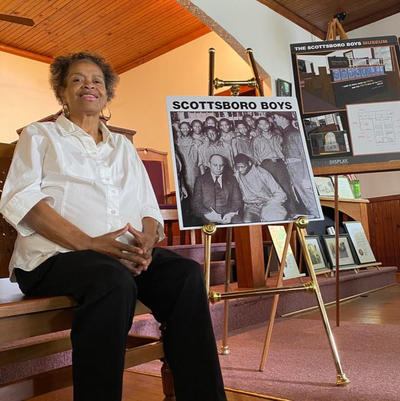
Shelia Washington is a sterling example of how a dedicated, passionate citizen can repair gaping wounds in history and law.

Washington died last month, but not before fulfilling a self-assigned mission. She accepted that mission at the age of 17, when, as a native of Scottsboro, Alabama, she found a book hidden under a mattress at her home while she was doing some cleaning. Her stepfather told her to hand it over. “You don’t need to know about that,” he said. “Just keep quiet about this now.” The book was “Scottsboro Boy,” a 1950 memoir by Haywood Patterson, an innocent young man who was convicted four times by all-white juries and sentenced to death three times.

Washington did not obey her stepfather. To the contrary, Washington set out to obtain posthumous justice for the nine young black men known as The Scottsboro Boys, who were falsely accused of raping two white women in 1931. They were subjected to many trials at the height of the Jim Crow era, two reaching the U.S. Supreme Court. The ugly story of the Scottsboro Boys became the country’s most sensational civil rights case up to that point. Their tragic story later inspired feature films, documentaries, a Broadway musical, and was a factor in shaping the plot of Harper Lee’s 1960 novel, “To Kill a Mockingbird.”

Yet how many Americans today can tell you anything about The Scottsboro Boys?

Continue reading

Comment Of The Day: “Oppressing The Twitter Troll”

censorship cartoon

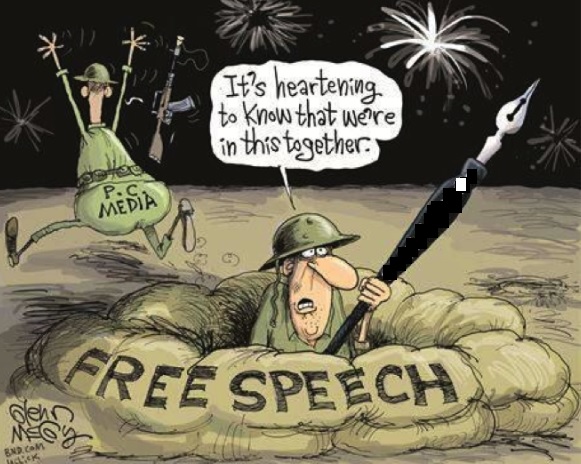
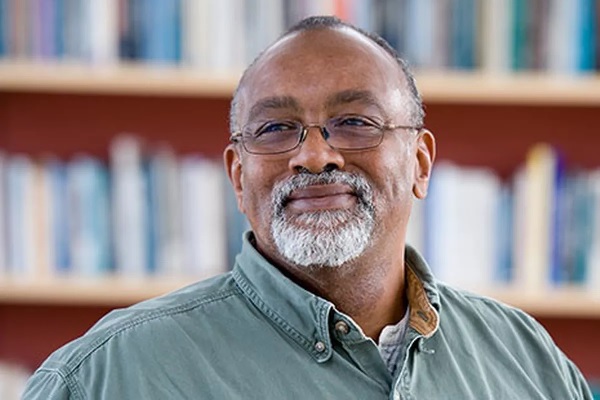
This is Glenn Logan’s Comment of the Day on the post, “Oppressing The Twitter Troll”:

I always like to look at the law, and at the charges, to see if they are particularized and actually allege a violation.It seems to me the particular law at issue is 18 U.S. Code § 241 – Conspiracy against rights. The relevant text would seem to be paragraph 1:

If two or more persons conspire to injure, oppress, threaten, or intimidate any person in any State, Territory, Commonwealth, Possession, or District in the free exercise or enjoyment of any right or privilege secured to him by the Constitution or laws of the United States, or because of his having so exercised the same; orIf two or more persons go in disguise on the highway, or on the premises of another, with intent to prevent or hinder his free exercise or enjoyment of any right or privilege so secured—

What the government is alleging here, apparently, is essentially a conspiracy to cyber-bully. Attempting to convince others to vote a certain way or not to vote at all is called “electioneering” and is not only legal in the United States, but protected speech under the First Amendment, as well as widely practiced by all political parties 24-7-365, legally and peacefully. The law criminalizing conspiracies to deprive persons of rights was passed during the civil rights era and was plainly directed at the Klu Klux Klan and similar organizations.

As we all know, those groups would intimidate voters of all races, but primarily black people and their sympathizers, by burning crosses, lynchings, threats, and other violent actions to suppress or affect voting against the groups’ interests. Most of their methods were illegal under state and federal law to begin with, but the law in this case provided an additional tool to attack those who plannedlawless actions against the rights of others as well as those who carried them out. It is a bit like the Civil RICO laws, which were primarily aimed at those who directed corrupt mob actions but almost never participated in overt criminal activity.

Continue reading

Oppressing The Twitter Troll

Twitter troll meme

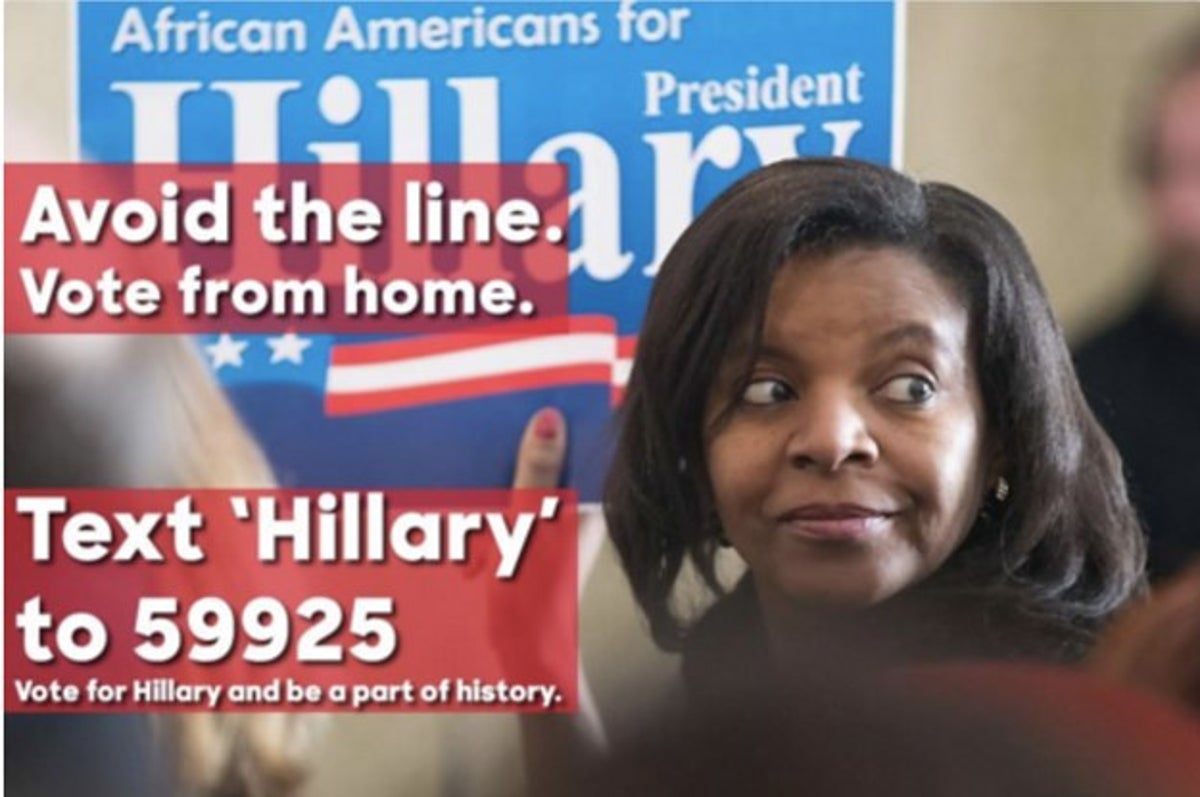
Federal prosecutors accused Douglass Mackey, 31, described in news reports as a “Twitter Troll,”of coordinating with co-conspirators to spread misinformation on Twitter in 2016 that Hillary Clinton’s supporters could vote by sending a text message to a specific phone number.

Mackey was arrested a week ago in the first criminal case in the country alleging voter suppression through the use of false tweets.

Seth DuCharme, the acting United States attorney in Brooklyn, whose office is prosecuting the case, said, “With Mackey’s arrest, we serve notice that those who would subvert the democratic process in this manner cannot rely on the cloak of internet anonymity to evade responsibility for their crimes.” The alleged crime is a conspiracy to “oppress” or “intimidate” anyone from exercising a constitutional right, such as voting. The charge carries a maximum sentence of 10 years in prison. Prosecutors allege that 4,900 really gullible and lazy Hillary Clinton supporters were fooled by Mackey’s scheme into trying to vote for her using a phone number publicized on social media. Mackey and his co-conspirators joked online about about tricking “dopey” liberals.

There is no question that what Mackey et al. did was unethical, dishonest, unfair and sinister. However, I find it hard to understand how he can be prosecuted while the deceptions of others whose efforts to mislead voters and either dissuade them from voting or get them to vote for a candidate they otherwise would not have were far more widespread and had far more impact on election results. My guess is that this charge is harassment, and harassment based on partisan intimidation.

Continue reading

The Biden Nomination of Kristen Clarke To Be Assistant Attorney General For Civil Rights

Biden Promise

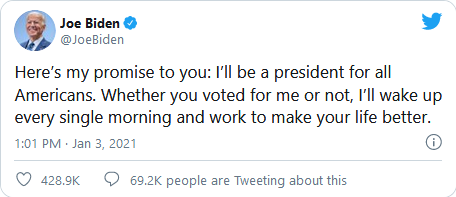
Kristen Clarke is the African American attorney who Joe Biden announced will run the Civil Rights Division at the Department of Justice, pending Senate confirmation.

From FOX News:

In 1994, Clarke wrote a letter to The Harvard Crimson in her capacity as the president of the Black Students Association to explain her views on race science.

“Please use the following theories and observations to assist you in your search for truth regarding the genetic differences between Blacks and whites [sic],” Clarke wrote.

“One: Dr Richard King reveals that the core of the human brain is the ‘locus coeruleus,’ which is a structure that is Black, because it contains large amounts of neuro-melanin, which is essential for its operation.

“Two: Black infants sit, crawl and walk sooner than whites [sic].

Three: Carol Barnes notes that human mental processes are controlled by melanin — that same chemical which gives Blacks their superior physical and mental abilities.

“Four: Some scientists have revealed that most whites [sic] are unable to produce melanin because their pineal glands are often calcified or non-functioning. Pineal calcification rates with Africans are five to 15 percent [sic], Asians 15 to 25 percent [sic] and Europeans 60 to 80 percent [sic]. This is the chemical basis for the cultural differences between blacks and whites [sic].

“Five: Melanin endows Blacks with greater mental, physical and spiritual abilities — something which cannot be measured based on Eurocentric standards.”

The technical term for such a screed is “Yikes!”

Continue reading

From The Ethics Alarms Archives, August 21, 2014: “Wishing Ethics: What Should We WANT The Outcome To Be In Ferguson?”

finger-crossed

[This seems to be a propitious time to re-post this essay, from the peak of the Micahel Brown shooting upheaval. I’m going to wrestle my fingers to the ground and avoid making any comments on it now, and leave such reflections to the comments.]

The simple answer to the question in the headline is: we should all want the truth to come out, whatever it is, and be dealt with honestly and justly. I don’t think that result is possible, unfortunately, just as it proved impossible in the Martin-Zimmerman tragedy.If the truth could be determined, however…if an experimental, advanced video recorder just happened to capture everything that occurred between Officer Wilson and Mike Brown, including in the squad car; if it captured the incident from all angles, and we could hear and see everything that transpired between them, what would we want that to be, recognizing that the tragedy cannot be undone?

Would we want it to show that Mike Brown was murdered, that he was fleeing for his life when he escaped the car, then turned, fell to his knees ( as at least one witness claims) and was gunned down with his hands in the air? Obviously many Americans, including Brown’s family, the Ferguson protestors, many African-Americans, civil rights activists, police critics, politicians and pundits, have an interest in seeing this be the final verdict of investigators, for a multitude of reasons. The grieving family wants their son to be proven innocent of any fault in his own death. Others, especially those who prematurely declared Officer Wilson  guilty of “executing” Brown, have a strong interest in being proven right, for even though it would not excuse their unfair and irresponsible rush to judgment, such a determination would greatly reduce the intensity of criticism leveled at them.

[Side Note on Ethics Dunce Jay Nixon: That won’t stop the criticism here, however: Whatever the facts prove to be,  Gov. Jay Nixon’s comments are indefensible, and inexcusable. Now the Democrat is denying that they meant what he clearly meant to convey: calling for “justice for Brown’s family” and a “vigorous prosecution” can only mean charging Wilson, and that is what those calling for Wilson to be arrested took his comments to mean. If the Governor didn’t mean that, as he now claims, then he is 1) an ignoramus and 2) beyond incompetent to recklessly comment on an emotion-charged crisis in his state without choosing his words carefully.]

Or should we hope that the facts exonerate Wilson? After all, shouldn’t we want the one living participant in this tragedy to be able to have some semblance of a life without being forever associated with villainy? Certainly his family and friends, as well as member of the Ferguson police force who want their own ranks to be vindicated, and police all over the nation who have had their profession attacked and denigrated in the wake of the shooting, fervently hope that the narrative pushed by the demonstrators is proven wrong.

Others want to see Wilson proven innocent for less admirable reasons. They want to use the incident to condemn police critics, and undermine and discredit civil rights advocates, especially long-time ideological foes like Al Sharpton. They want Eric Holder to look biased, (he looks biased anyway, because he appears to be taking sides) and to make the case—one that a single episode neither supports nor can possible rebut—that police do not have itchy trigger fingers when their weapons are pointed at young black men.

From the standpoint of ethics, which means that the best outcome will be the one that does the most good for society, the choice is complex.  Continue reading

Let’s See If Professor Loury Gets Cancelled For This…

We noted Brown Prof. Glenn Loury last week when he protested Brown’s pandering message of support for the protests/riots for containing no actual content, just unsupported generalities, much like the annoying virtue-signaling PR posts you are seeing from the marketing departments of BestBuy, PetSmart, and the NFL. (Aside: EA has received enough submissions of such grovels to do its promised awards, once I have the time to sift through them.) Now he is interviewed in the City-Journal, and stating what I think is the most inconvenient truth of them all regarding the George Floyd Freakout. Fortunately he’s an African American, so nobody will try to call him a racist. (There is a lively debate about whether Brown will be pressured to fire him, however, since we are in a “no dissenting from the mob” free speech lockdown.)

It is fair to assume that his well-reasoned position won’t get any publicity outside of conservative news sources, and that he won’t be given a chance to be on a CNN panel where he would be likely to demonstrate that his debating Don Lemon or Chris Cuomo is like me debating an avocado.

Read the whole interview, please, but Loury says in part, Continue reading

From The Archives: “Ethics Quote of the Week: Moses (Charlton Heston) in ‘The Ten Commandments'”

Seven years ago, while  watching the annual showing of “The Ten Commandments ” on ABC, I realized how advanced its civil rights message was for its time, and what an interesting and instructive ethics movie the epic was. This post was the result. I’ve edited it a bit.

The movie hasn’t been shown yet in 2020 ; it’s scheduled for the weekend before Easter, which is late this year.  I never miss it, and if you watch the film with your ethics alarms primed, you might see it in a whole new dimension.

_______________________________

“That evil that men should turn their brothers into beasts of burden, to be stripped of spirit, and hope, and strength – only because they are of another race, another creed. If there is a god, he did not mean this to be so!”

—-Moses, as played by Charlton Heston and scripted by seven writers, in Cecil B. DeMille’s “The Ten Commandments,” answering the Pharoah Seti’s question, “Then why are you forcing me to destroy you? What evil has done this to you?”

“The Ten Commandments” is so extravagantly fun and entertaining that, I must confess, I never watched it as an ethics film until tonight, as ABC once again broadcast the Biblical epic on an Easter weekend. This quote especially struck me as remarkable for a film made by an infamously rigid conservative, DeMille, in 1956.

Less that a year earlier, on Dec. 1, 1955, Rosa Parks was arrested for refusing to give up her seat on a Montgomery, Alabama city bus. The next twelve months were tense, difficult days in which the entire U.S. population was undergoing a wrenching cultural debate regarding human rights.  On Dec. 6, 1955, the civil rights boycott of Montgomery city buses, led by Rev. Martin Luther King , began. January 1956 saw Autherine Lucy, a black woman, accepted for classes at the University of Alabama in Tuscaloosa, the first African-American ever allowed to enroll.  On Jan. 30, the Montgomery home of Martin Luther King, Jr. was bombed. February 4 saw rioting and violence on the campus of the University of Alabama and in the streets of Tuscaloosa. Lucy had to flee the campus, and the university’s Board of Trustees barred her from returning. On the 22nd of that month, warrants were  issued for the arrest of the 115 leaders of the Montgomery bus boycott. A week later, courts ordered Lucy readmitted, but the school expelled her. Continue reading

Prosecutorial Ethics: Not Charging The Police In The Eric Garner Case Is The Right Ethical Decision…

…and trying any of the officers involved would be unethical.

Naturally, Eric Garner’s family immediately is attacking  the decision of the Justice Department today not to bring federal charges against  the New York police officers whose ugly and violent arrest of Eric Garner in 2014 led to his death. This incident came in the midst of several high-profile police shootings following the triggering Trayvon Martin killing, and led directly to the emergence of Black Lives Matters as well as launching one of several catch phrases connected with the movement, “I can’t breath.”

The Department of Justice took a long time reviewing the incident and the evidence, and could not determine that Officer Daniel Pantaleo willfully committed misconduct, an “essential element necessary to bring federal charges,” a senior department official told reporters at a briefing today. Considering all the elements of the  crime required to be proven under the law, the DOJ official said, the conclusion was that  the police conduct did not “fit within the statute.”

In deciding not to bring charges, U.S. Attorney General Bill Barr sided with federal prosecutors in Brooklyn. The  Justice’s Civil Rights Division had favored bringing charges.

The main problem facing the Justice Department and the New York prosecutors was that a conviction would be unlikely, making a prosecution more of a show trial than a real one, much like the George Zimmerman trial for allegedly murdering Martin. That trial was brought unethically to slake activist thirst for vengeance against Martin’s shooter, despite the glaring  evidence indicating self-defense. Prosecutors may not use the process itself to punish citizens. If a trial can’t be won, or if the justification for charges are dubious, then it is professional misconduct to bring them.

Were police negligent and reckless in using such aggressive measures to bring down a suspect who was resisting arrest? Absolutely, and this was addressed, as it should have been, in a civil trial. (Garner’s family was awarded 4 million dollars from the city.) Did the cops intend to kill Garner? It takes real anti-police bias to conclude that. The video shows a huge, morbidly obese man resisting arrest by a group of much smaller officers, who pretty evidently over-reacted. Although the ME attributed Garner’s death to “compression of neck (choke hold), compression of chest and prone positioning during physical restraint by police,” the defense in a criminal trial will have no trouble finding persuasive expert testimony to the effect that what ultimately killed Eric Garner was his weight and poor health. Continue reading