Comment Of The Day: “Don’t Cheer Mississippi’s Westboro Baptist Tactics Too Loudly: You Never Know Who Might Hear You”

An Ethics Alarms commenter with the evocative screen name of Fuck you, who is a bit behind on his surfing, or perhaps a really, really slow reader, was moved to author today’s Comment of the Day on a post from seven years ago regarding the tactics used by Mississippi law enforcement to foil a legal demonstration by Fred Phelps’ merry band of homophobes.

Why is this a Comment of the Day? It perfectly embodies the rudimentary, lizard-brain level of ethical analysis that predominates in the public, in much of the media, and among our elected officials. It is helpful, to me at least, to read such comments, for this is exactly the find of gut-level, emotion-based, legally and ethically ignorant reaction that my work exists to overcome. I’ll have more to say after the Fuck You has his say.

As an aside, it was nostalgic reading the names of the commenters on the original post. There, for example, fighting as usual, were liberal logic-cop tgt and uber-conservative Stephen Mark Pilling. Ah, those were the days…

Here is Fuck You’s Comment of the Day on the post, Don’t Cheer Mississippi’s Westboro Baptist Tactics Too Loudly: You Never Know Who Might Hear You—I’ll be back at the end:

Fuck you for this comparison. I know I’m coming in years later with this and I hope that others have already expressed a similar sentiment. I also understand the point you are trying to make. But still FUCK YOU. I sincerely hope that if you ever lose someone dear to you, these fucking hatemongers show up and protest that person’s funeral. FUCK YOU. Yes they have a right to protest but this type of shit should definitely qualify as a reasonable restriction, like yelling fire in a crowed theater.

FUCK YOU. This comparison is not only an insult to the Marine in question but also to the civil rights activists from decades ago that you just compared to the fucking WBC. FUCK YOU.

Once again Fuck you, you goddamn scum ass mother fucker. Oh, and FUCK YOU.
Continue reading

The NFL Anthem Protest Ethics Train Wreck, Part Two

The overview of our latest Ethics Train Wreck continues from Part One

  • Slate published an essay by African-American musician John Legend that itself makes an excellent case against the protests while supposedly glorifying them. Never mind the standard anti-Trump spin at the beginning about “Islamophobia” and the rest, though it is nice for any author to state up front that he’s completely biased and his opinion should be discarded as such. Legend and Slate have the audacity to evoke actual protests that were clear and targeted in comparison the all-purpose “knee”:

“Protest is patriotic. Protest has played a critically important role in elevating the voices of the most vulnerable in our nation. Protest in America has been essential to ending war, to demanding equal rights, to ending unfair practices that keep citizens marginalized. If we quell protest in the name of patriotism, we are not patriots. We are tyrants.

Would there have been a Civil Rights Act without the Birmingham protests? When Bull Connor unleashed his fire hoses and dogs on the schoolchildren taking to the streets, racial disparities and the violence facing people because of the color of their skin became the issues of the times. With savage images of the brutal attack in the news every day, President John Kennedy had little choice but to push for a Civil Rights Act that demanded equal services and equal rights.

Protests in Selma, Alabama, changed the trajectory of this nation and catapulted the Voting Rights Act into being.”

A recipe for tapioca would be as germane to the NFL protests as the Selma march. There is no definable law, principle or position these protests bring into focus. Let’s check the Ethics Alarms Protest Ethics Checklist against the NFL grandstanding:

1. Is this protest just and necessary?

No. How is it just? How is it necessary?

2. Is the primary motive for the protest unclear, personal, selfish, too broad or narrow?

Unclear and too broad by definition, since no two protesters make the same argument.

3. Is the means of protest appropriate to the objective?

Obviously not. What does football have to do with “racial justice”?

4. Is there a significant chance that it will achieve an ethical objective or contribute to doing so?

None whatsoever.

5. What will this protest cost, and who will have to pay the bill?

It’s already cost the NFL millions. But nobody is protesting the NFL…

6. Will the individuals or organizations that are the targets of the protest also be the ones who will most powerfully feel its effects?

No.

7. Will innocent people be adversely affected by this action? (If so, how many?)

Sure: every single fan who wants to just watch football.

8. Is there a significant possibility that anyone will be hurt or harmed? (if so, how seriously? How many people?)

The relentless politicizing of sports and entertainment harms U.S. society and frays the fabric of democracy. That means everyone.

9. Are you and your group prepared to take full responsibility for the consequences of the protest?

Clearly not: witness the constant complaining that NFL teams won’t hire Kaepernick so their season is dominated by racial politics rather than, you know, football..

10. Would an objective person feel that the protest is fair, reasonable, and proportional to its goal?

No.

11. What is the likelihood that the protest will be remembered as important, coherent, useful, effective and influential?

My guess: no chance whatsoever, unless unintended consequences count, like getting more votes for President Trump and crippling the NFL count.

12. Could the same resources, energy and time be more productively used toward achieving the same goals, or better ones?

It’s hard to imaging what wouldn’t be a better use of resources, energy and time.

Verdict: It’s an unethical protest. There is nothing patriotic about unethical protests. We have a right to protest; as with free speech, that doesn’t make all examples of exercising that right good, and certainly not “patriotic.”

  • However, let me argue in the alternative, as lawyers often do. Let’s say that, as Legend claims, all protests are patriotic. Fine. Then then Charlottesville protest against tearing down a statue of Robert E. Lee was also patriotic. Why, the, was the President attacked—by Legend and Slate, among others, for not condemning it?

The Left believes that protests are sacrosanct only when they are doing the protesting. There is nothing wrong or unpatriotic about accurately labeling a dumb, badly-conceived or destructive protest, and this one is all three.

“Football was down. The end. We, the good people who read the NYT, must say no to football. What is known cannot become unknown except by willful, immoral forgetting. No decent person can take pleasure in football. No fit parent can allow a child to take up the game. The era of American football is over. Bury it. We can end the misery through the simple and necessary refusal to watch anymore. Say no, America… or hey, wait a minute. Here’s that nasty President of the United States and he’s calling for a boycott of football…

So, watch the liberal media endeavor to save football from bad old President Trump. He’s a racist. This is his racism once again, stirring up the stupid people who voted for him. Here‘s the NYT today:

“The tweet suggested that the president, who used an expletive on Friday night to refer to players who kneel or sit in protest during the anthem — a practice that took hold last season among some African-American players after Colin Kaepernick, the now-former San Francisco 49ers quarterback, did so to protest racial and social injustice — is bent on deepening a bitter culture-war fight with the N.F.L.

It is a highly charged debate, with unmistakable racial undertones, pitting advocates of free speech who argue that professional athletes should have a right to use their positions to call attention to social issues against those who contend that refusing to honor the anthem disrespects the military and the nation, and that sports is no place for such displays.”

 Ann’s line:

“Let the brain damage continue. We’ve got a culture war to fight.”

Continue reading

Thanking Dick Williams…Finally

The late Dick Williams, doing what great leaders do

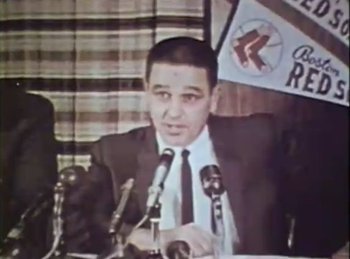
If you are not a baseball fan, or under the age of thirty, you probably never heard of Hall of Fame manager Dick Williams, who died yesterday at the age of 84. I never met Williams myself, but I have been indebted to him for four decades. I never told him the immense difference he made in my life, just by doing his job.

In the winter of 1967, I was a devoted fan of my home town team, the Boston Red Sox, and had been since 1962.  Over that period I had listened to every single baseball game on my transistor radio when a game wasn’t on TV, which was most of the time, or when I wasn’t at the game, which was almost always the case. I was the only person I knew who followed the team, and for good reason: it was torture. The Red Sox were hopelessly mediocre on the way to awful, and hadn’t had a winning season in more than ten years.

It is a great character builder to follow the fortunes of a terrible baseball team. Almost every day, for six months, you are let down, and yet return to the scene of your despair the next, attempting to muster hope while steeling yourself against likely disappointment. You find yourself finding things to appreciate other than winning: the gallant veteran player who “plays the right way” (Eddie Bressoud, shortstop, 1962-1965); the exciting rookie who gives promise of a better future (Tony Conigliaro, right fielder—rest in peace, Tony); the unique talent who is worth watching for his own sake (Dick Radatz, relief pitcher, 1962-1966). These things help, but following a perennial losing team and caring about them is like being punched in the gut four or five days a week without knowing which day you’re getting it.

Since 1965, I had always reserved seats for the first day of the season and one of the last two home games, just in case those last games would be crucial to a (hahahaha!) Red Sox pennant drive. This was especially pathetic, since the team was getting worse. They had finished in a tie for 9th place in 1966, and as the 1967 season loomed, Vegas had them installed as 100-1 underdogs to win the American League pennant. In truth, the odds should have been longer. Nonetheless, I wrote the Red Sox and got my tickets, this time for the next to last day of the season.

The team was full of rookies and near rookies, and appropriately had hired a minor league manager, Dick Williams, to be the new skipper. Williams was something else, however: he was a gifted leader. One day, in the middle of Spring Training, a Boston scribe asked the new manager what the prospects were for the upcoming season. Would the team escape the cellar? Would there be forward progress? Williams’ answer was instant front page news:

“We’ll win more than we lose.” Continue reading

Ethics Quote of the Week: The Washington Post Editors

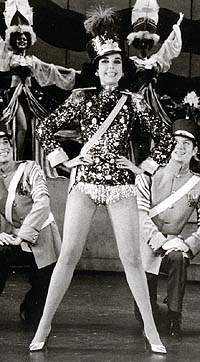
Clear out, everybody! Ann Miller wants to honor Thomas Jefferson!

“Aggrandizing what amounts to a stunt based on misinformed views of the First Amendment cheapens the real and courageous achievements of those who advance the causes of civil rights by refusing to comply with immoral laws”

—–The Washington Post, in an editorial entitled “Dancing at a National Memorial Isn’t Civil Disobedience”

The Post is talking about the escalating and pointless battle by self-indulgent, publicity-seeking, First Amendment grand-standers —a description that I shortened to the crude but sufficiently explanatory “assholes” in my post on the same topic-–to demonstrate for the endangered ‘right” to dance inside government memorial structures(Next up: frog races, strip shows, and Mummer parades). The editorial makes the true content of this noble exercise plain: it is 100% nonsense: Continue reading

Dancing With Thomas Jefferson: How Assholes Make the Law Spoil Life For Everyone

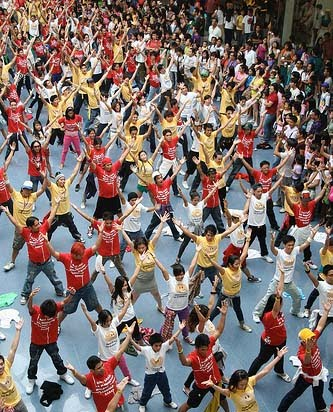
Coming to a place of honor and reflection near you.

On Saturday, the U.S. Park Police forcefully arrested five “Code Pink” protesters under the dome of the Jefferson Memorial for defying a recent Federal Appeals Court ruling that dancing at federal monuments was not constitutionally protected expression.

Perhaps you missed that ruling earlier this month, which was, I presume, made necessary by the realization that a flash mob could break out at any moment at the Lincoln Memorial or the Alamo. That was not the threat in 2008, however, when Mary Oberwetter was arrested, also at the Thomas Jefferson Memorial, for hoofing to celebrate Thomas Jefferson’s birthday.

She sued the National Park Service for violating her First Amendment rights, and on May 17 the U.S. Court of Appeals for the D.C. Circuit held that the Jefferson Memorial should have a “solemn atmosphere” and that dancing, silent or otherwise, was an inappropriate form of expression there. The appellate judges concurred with the lower court that the memorial is “not a public forum,” and thus demonstrators must first obtain a  permit. Demonstrations that require permits in the Park Service’s National Capital region are defined as

“…picketing, speechmaking, marching, holding vigils or religious services and all other like forms of conduct which involve the communication or expression of views or grievances, engaged in by one or more persons, the conduct of which has the effect, intent or propensity to draw a crowd or onlookers. [The] term does not include casual park use by visitors or tourists which does not have an intent or propensity to attract a crowd or onlookers.”

The Appellate Court wrote: Continue reading

From First Amendment Outrage to Ethics Hypothetical: The Westboro Baptist Church vs. Brandon, Miss. Hoax

"Never mind!"

Bulletin: The story about how citizens and law enforcement personnel in Brandon, Miss. foiled the efforts of Fred Phelps’ homophobic Westboro Baptist Church to disrupt the funeral of a serviceman killed in Afghanistan never happened. The source of the hoax is unclear, but an enterprising Stars and Stripes blogger investigated and has determined that it never happened. The Church was never even in Brandon.

I detest fake web stories and the people who create them, as you probably know. The public is  confused enough by reality without having falsehoods, fabrications and hoaxes added to its database. Luckily, this is not a news site, but an ethics site, and my commentary about those who applauded this tale of a community conspiring to rob a group of their U.S. Supreme Court confirmed constitutional rights is as valid as when it was widely assumed that the story was real.

The foiling of Fred Phelps’ gang by “Mississippi Burning” tactics is not only an ethics hypothetical that most people flunked, but also an effective trap to lure the self-righteous into agreeing  that ends justify unethical means as long as the victims of those ends are sufficiently despicable.   This group includes one of the most quoted commentators on the story, who approved of the fictional response by the town and wrote,

“This is a template for how to handle the Westboro people. If lawsuits don’t work, other means will. Whatever it takes to keep them from harassing bereaved military families on the day their fallen loved ones are laid to rest.”

He was wrong then, and he’s wrong now.

Don’t Cheer Mississippi’s Westboro Baptist Tactics Too Loudly: You Never Know Who Might Hear You

"Demonstrators? Just leave them to us."

Sgt. Jason Rogers, who was killed in action in Afghanistan, was buried two weeks ago in Brandon, Mississippi. As is its custom, the Westboro Baptist Church, fresh from U.S. Supreme Court-confirmed constitutional protection, was prepared to sully Sgt. Rogers’ funeral with its usual hateful chants about how God kills our soldiers to punish our sinful, homosexual-loving ways. Its plans were foiled, however, by a little bit of traditional Mississippi social control ingenuity.

A couple of days before the funeral, one of Fred Phelps’ vile cultists boasted about the upcoming protest while visiting a Brandon gas station, and the good citizenry on the scene gave him the sound beating they felt his sentiments warranted. Continue reading