Ethics Observations On Georgetown Law Center’s Scalia Foofarah

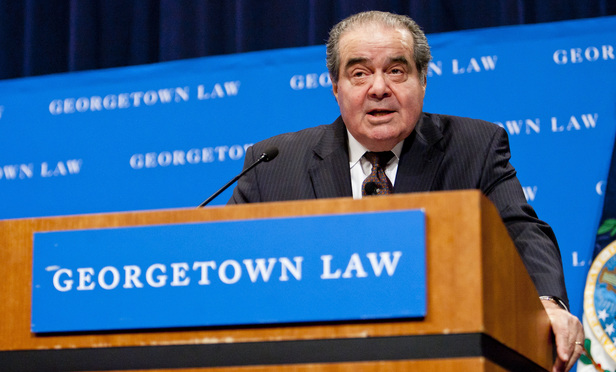
Scalia-Georgetown

I am a Georgetown University Law Center grad, as well as a former administrator there. I also know and have personal relationships with several members of the faculty. None of this especially informs my ethical analysis of the community argument there that arose from a rather innocuous official expression of respect and mourning in the wake of Justice Scalia’s death, but if anyone wonders why I’m posting about this rather than many other ethics issues nipping at my heels, that’s part of the reason. The other reason is that this academic dust-up raises interesting ethics issues, and has received national publicity.

Observations on the tale as it has unfolded:

1.  Georgetown Law Center issued a press release mourning the death of Antonin Scalia, including a statement from Dean William M. Treanor that read:

Scalia was a giant in the history of the law, a brilliant jurist whose opinions and scholarship profoundly transformed the law. Like countless academics, I learned a great deal from his opinions and his scholarship. In the history of the Court, few Justices have had such influence on the way in which the law is understood. On a personal level, I am deeply grateful for his remarkably generous involvement with our community, including his frequent appearances in classes and his memorable lecture to our first year students this past November. The justice offered first-year students his insights and guidance, and he stayed with the students long after the lecture was over. He cared passionately about the profession, about the law and about the future, and the students who were fortunate enough to hear him will never forget the experience. We will all miss him.”

[Note: In the original post, I missed the first line, and kept missing it. Don’t ask me why. The text has been finally, after a couple botched attempts, been revised to include it.]

Is there anything inappropriate about the dean’s statement? Not in my view. This is nothing but a traditional expression of professional respect on behalf a prominent institutional member of the legal community. There is nothing in the statement, save for the last sentence, that anyone could argue is untrue. Countless academics, as well as Scalia’s more liberal colleagues, did learn “a great deal from his opinions and his scholarship.” He was an influential and significant figure on the Court. Scalia was generous with his time and passion as a teacher, and by all accounts he was a good one.

The opening statement,  “Scalia was a giant in the history of the law, a brilliant jurist whose opinions and scholarship profoundly transformed the law,”  seems to be what rankled Scalia critics. It shouldn’t have. At worst it is standard memorial puffery. But calling Scalia a giant “ in the history of the law” seems fair whether you agree with his jurisprudence or not: he is certainly among the 20 or so most quoted, most debated, and most provocative justices. The rest shouldn’t be troubling to anyone who isn’t suffering from Scalia-phobia. A Justice can be brilliant and transformational while being wrong.

None of the reports of the controversy ignited by this standard issue sentiment mention it, but Georgetown Law Center isn’t on the Georgetown campus. It has its own campus that is a 15 minute walk from the Supreme Court. Law students regularly attend oral arguments; I did: it was one of the great advantages of studying law there. More than any law school, the Law Center has good reason to feel a special affinity to the Court and all its justices.

2.  What about the last sentence? Is it appropriate for Treaner to speak for the law school community and say that “We will all miss him”? He was reasonable and fair to assume that.  Unfortunately, in today’s vicious partisan divide where opinions and sincere positions reached after thought and research are too often treated as proof of consort with Satan, and ion which even lawyers, who are trained not to take legal arguments personally, are frequently unable to respect a colleague for a well-reasoned argument that they may still think is completely wrong, it was not a safe assumption. Pillory the dean, then, for giving all members of his community the benefit of the doubt, and assuming they are capable of grace, compassion, fairness, professional respect and civility.

It’s still not unethical to assume one’s colleagues have some class.

3. They all don’t, unfortunately. Law Center professors Gary Peller and Mike Seidman (I know Mike, never met Gary) then used the Campus Broadcast system, usually used for event announcements, invitations and policy changes, to send a message  to all members of the student body titled, “Responses to Dean Treanor’s Press Release Regarding Justice Scalia.”  Peller’s statement reads,

Like Mike Seidman, I also was put-off by the invocation of the “Georgetown Community” in the press release that Dean Treanor issued Saturday. I imagine many other faculty, students and staff, particularly people of color, women and sexual minorities, cringed at headline and at the unmitigated praise with which the press release described a jurist that many of us believe was a defender of privilege, oppression and bigotry, one whose intellectual positions were not brilliant but simplistic and formalistic….That ‘community’ would never have claimed that our entire community mourns the loss of J. Scalia, nor contributed to his mystification without regard for the harm and hurt he inflicted.”

This was partisan grandstanding of the worst kind. The professors, of course, have a right to proclaim their opinions to the student body any time they want to, but their complaint here was petty and mean-spirited. It also models behavior that is poisonous both to the legal profession and the culture as a whole. The are saying, in essence,We don’t mourn him, we won’t miss him, and we’re glad to be rid of him, because his legal theories aren’t our legal theories, and we are on the side of the angels while he was an uncaring villain.” Such a message accomplishes nothing positive, and much that is destructive. The professors engaged in demonizing, when their profession and their duty is not to denigrate but reason. If they really think they can prove that Scalia was a defender of privilege, oppression and bigotry, they can make that case in a scholarly paper: I doubt that they can. Scalia often defended the rights to engage in conduct that he did not personally support, as well as some he did: the sloppy rhetoric of Seidman and Peller echoes the legally ignorant who accuse criminal defense attorneys of defending robbery and murder. Continue reading
Encore! Presidents Day Ethics: The Presidents of the United States on Ethics and Leadership

It’s President’s Day, and I see that it has been five years since the most popular Ethics Alarms President’s Day post was published. That one, from 2011, reminds us of the ethics wisdom and leadership acumen of the remarkable men who have served their country in the most challenging, difficult, and ethically complicated of all jobs, the U.S. Presidency.

In the middle of a campaign season littered with some disturbingly unethical candidates, it seems especially appropriate to re-post that entry now….with some updates. In 2011, I left out three Presidents, including the current one. Now all are represented, most of them well.

So…

Ladies and Gentlemen, the Presidents of the United States of America:


George Washington: “I hope I shall possess firmness and virtue enough to maintain what I consider the most enviable of all titles, the character of an honest man.”

John Adams: “Because power corrupts, society’s demands for moral authority and character increase as the importance of the position increases.” 

Thomas Jefferson: “On great occasions every good officer must be ready to risk himself in going beyond the strict line of law, when the public preservation requires it; his motives will be a justification…”

James Madison: “No government any more than any individual will long be respected without being truly respectable.”

James Monroe: “The best form of government is that which is most likely to prevent the greatest sum of evil.”

John Quincy Adams: “Always vote for principle, though you may vote alone, and you may cherish the sweetest reflection that your vote is never lost.”

Andrew Jackson: “One man with courage makes a majority.”   (Attributed)

Martin Van Buren: “No evil can result from its inhibition more pernicious than its toleration.”

William Henry Harrison: “There is nothing more corrupting, nothing more destructive of the noblest and finest feelings of our nature, than the exercise of unlimited power.” Continue reading

Ethics Observations On An Ugly–But Entertaining!—GOP Debate

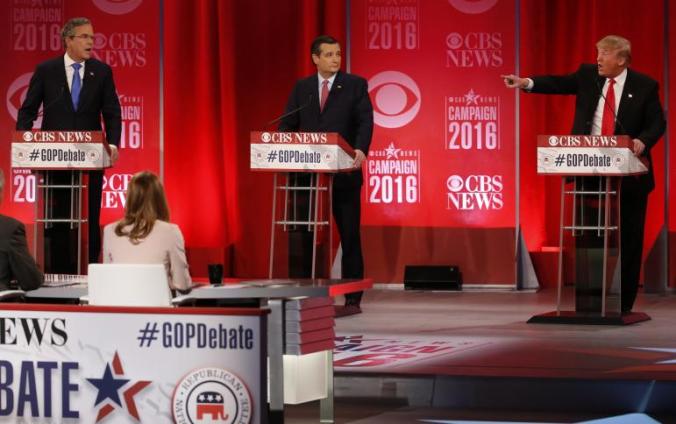
CBS debate

I knew this time would come, and it came the same week for both parties: I’m getting sick of the debates, and it’s harder and harder to find new illumination and conclusions with each one. For some reason, however—the effect of the unsettling news of Justice Scalia’s sudden death. perhaps?—last night’s Republican debate (transcript here) was nastier and more personal than any of the debates this cycle, and Charles Krauthammer may be correct that that it was the most ugly Presidential candidates debate ever.

Observations:

1. This was 100% the fault of Donald Trump. I keep reading that the Republicans should be embarrassed—-what control does the party have over Trump? He’s in the race, and that means that he will drag down the conduct in the race. Arguing with him is like arguing with a 12-year-old—I was reminded of Erma Bombeck’s line that it is impossible to argue with a six-year-old without sounding like a six-year-old. Sometimes I think all the debaters should agree to turn their backs on Trump when he’s ranting, like all the jurors do in “Twelve Angry Men” when the racist finally lets it all out.

I wrote months ago that Republicans should have told Trump he wasn’t a Republican and thus wasn’t welcome in the debates, the nomination race or the party. They had neither the foresight, principles nor guts to do that, and now they are stuck with him polluting the debates and the race, engaging in the equivalent of belching and farting, as the juveniles supporting him cheer and snicker. Good job, everybody.

2. That was excellent, fair, competent moderation by John Dickerson. You know the debate has been a mess when the moderator is the star.

3. I have really come to resent Ben Carson’s sleepy, arrogant, useless statements and observations, wasting precious time, blathering platitudes, appealing only to those ignorant souls, like him, who really think the most challenging and consequential job on Earth should be handed to a proud amateur. In that respect, he is the most unethical individual on the stage. Continue reading

Ethics Dunce: Jeb Bush

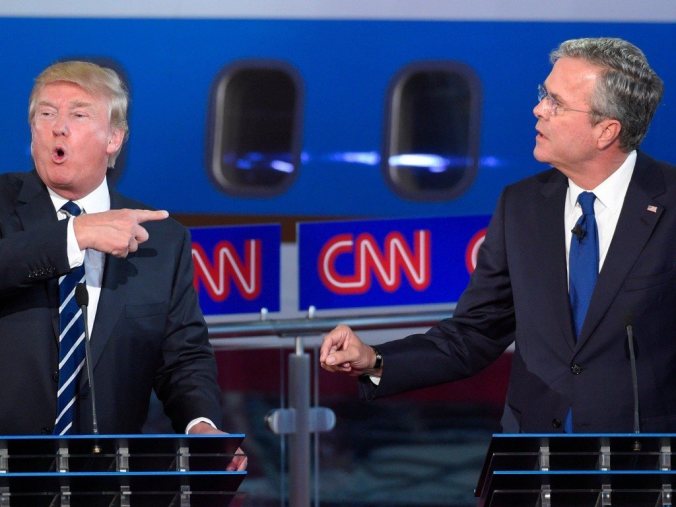
Donald-Trump-Jeb-Bush

Poor Jeb.

I do sympathize. It must be so humiliating to enter a race for President as a presumed frontrunner, after both your father and brother have won the office, only to fail spectacularly. These people thrive on admiration; rejection is death to them. “Please applaud,” Jeb had to plead with a recent sluggish crowd. To make it worse, there is Donald Trump, someone Jeb has no respect for at all (nor should he), insulting him, mocking him, denigrating him like a schoolyard bully. It has to hurt. It has to make him furious.

Sinking to Trump’s level, however, is not the answer. Trump may get away with it because his supporters are cretins, but name-calling and twitter pissing-matches are not suddenly civil, ethical, responsible or right. It degrades the process and coursens the culture. “He started it” and “He deserves it”  are rationalizations for emotional retaliation that shows weakness, not strength. I assumed that Jeb Bush understood this, and if he was going to lose, and he is, then at least he could hold his head up high at the end knowing that he didn’t violate his principles just because a boor like Donald Trump goaded him into it.

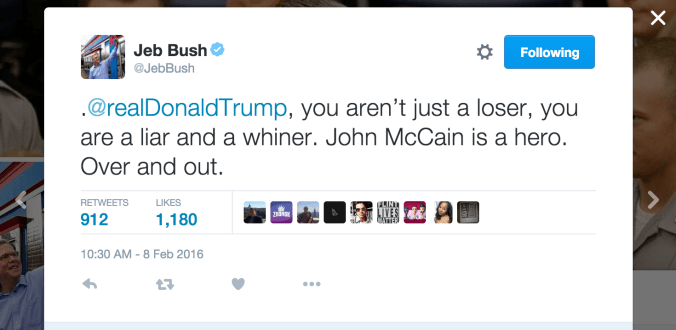
Then today, Jeb tweeted this:

Jeb Tweet

Guess not.

Keep It Up, Vulgarians

This morning I was listening to a CNN reporter in New Hampshire interviewing an ordinary, middle aged woman who is a Trump supporter, and she dropped a word inappropriate for TV live. The interviewer said, “You just said a cuss word!” and she just ignored him. In Phoenix, Don Harris, the head of Arizona’s largest NAACP chapter, was discussing the somehow national scandal over six white teenage Desert Vista High School students posting a photo of themselves aligned so the letters on their T-shirts spelled N-I-*-* E-R when he just couldn’t resist saying that a TV reporter who had just interviewed him had “nice tits”as he was speaking to another TV interviewer.

The recording was posted, and Harris had to resign as Chapter president. Called about the incident by another reporter, Harris said, among other things, “I’m really fucking sorry. I’m going to slash my wrists . . . Better yet, I’m going to throw myself out of a fucking window, except I’m on the first floor . . . I’m one of the best goddamned people in the state. They’ve seen me now, they’ve seen what I’ve done. I’ve given up my law practice. I’m down here six, seven days a week. That’s what my commitment is. I support NOW, the women’s organization — goddamn! — are you shitting me? Are you going to write this up?”

Why yes, Don, you vulgar fool, they are.

Harris and the dumb New Hampshire woman (I did say she was a Donald Trump supporter, right?) are victims of the crude and ugly culture of rudeness and incivility being imposed on the culture. If you don’t fight back, you will be sucked in: your civility and decency ethics alarms will become rusted and useless. At the 2016 Golden Globes awards, knowing they were on live TV and in front of an audience of adults, various presenters and award winners used the words cunt, sugar tits, fuck and fucking (twice). Speaking like this in private or controlled workplace surroundings is as old as the hills, but somewhere the principle has been lost in which such gutter discourse was understood to be ugly, lazy and the mark of an unmannerly lout when it leaks into more formal, or public settings. Who thinks this is a positive development? Continue reading

How To Get Banned From Ethics Alarms: A Case Study

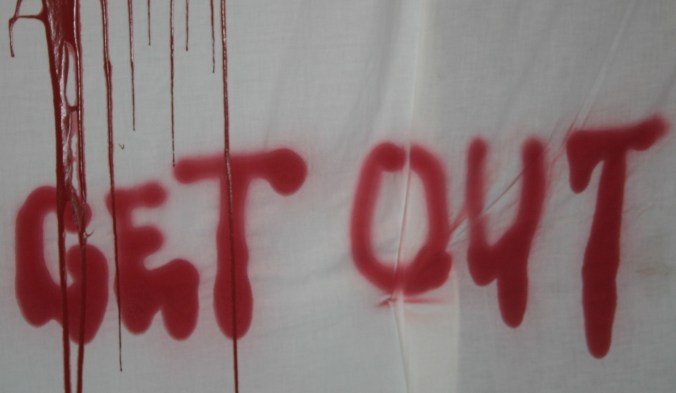
get-out

I just spammed nine attempted comments from a would-be participant here calling himself by the confidence-inspiring name of “Muh.” As sometimes happens, he discovered us and began posting comments everywhere. Here is a representative sample:

1. On the “Frontrunners” post: “The funniest part about Ted Cruz is that he pretends he’s an outsider and the rubes fall for it. But one look at his resume and you can see this guy is as well connected as anyone. If only everyone who ever met him didn’t hate him, he’d probably already be President!”

Why it was rejected: This is a pure political comment, with no ethics content whatsoever. That’s not what this blog is here for. Go to Mediaite, the Daily Kos, or Politico for gratuitous, cynical, fact-free candidate-bashing.

2. Comment on the same post: “This article, well you can see where the author seems to be. You want to talk about these three, and you leave off Ted Cruz who’s basically talked about nuking the Middle East? Give me a break.”

Why it was rejected: Accusing me of pro-Cruz bias, or pro-anyone bias, based on this or any post is unjustified. I chose those three because they are far and away the front-runners, and for no other reason. I have not shied away from ctiticizing Ted Cruz. If a commenter is going to accuse me of bias, he or she had better check the blog archive first. And Cruz said no such thing.

“Give me a break” is in the class of other disapproved rhetoric such as “LOL!” and arguments beginning with “Uh…” Continue reading

Ethics Quiz: The Martin O’Malley Dilemma

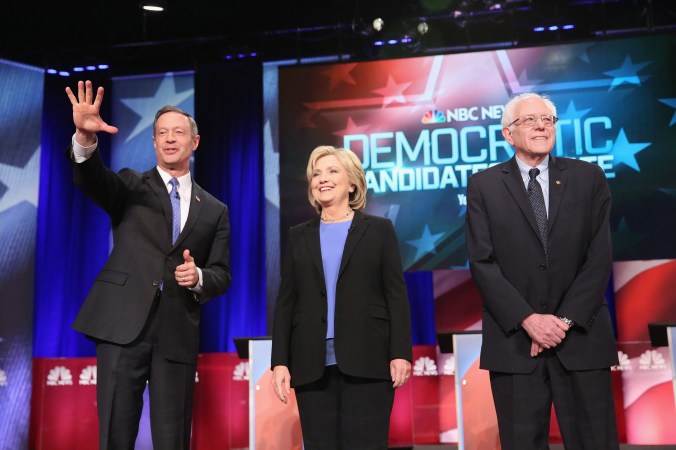
hooked-off-stageI didn’t mention it in the post on the last Democratic presidential candidates debate (I should have), but the NBC moderators went out of their way to give as little attention and camera time to former Maryland governor Martin O’Malley as possible. The frustrated third wheel found himself begging for time like Jim Webb in the first debate, and several commentators have noted that Andrea Mitchell and Lester Holt were openly disrespectful to him, making it clear to all that he was irrelevant.

Disrespect is usually unethical, and the conduct of the moderators was indeed disrespectful, essentially marginalizing O’Malley and muzzling him as well. The context, however, is that they may have a point. O’Malley has been running from the start. He has said nothing to distinguish himself from Hillary Clinton or Bernie Sanders, other than remind everyone that he’s the only ex-governor in the race. He is polling in Lincoln Chafee territory, even though his opposition is a superannuated socialist whose positions make no sense, and a previously rejected serial liar who is facing a possible indictment. Is he the equivalent of the guest who won’t leave the party?

Your Ethics Alarms Ethics Quiz question today:

Is the news media treating Martin O’Malley unfairly?

Continue reading

Ethics Observations On The South Carolina Democratic Candidates Debate

Debate transcript here.

1. The cynical effort to protect Hillary Clinton by scheduling debates at times when as few people as possible will watch them has officially become ludicrous, and also beyond denial. CNN’s alleged media watchdog Brian Stelter, in one of his occasional non-partisan episodes, grilled Debbie Wasserman Schultz on the strategy Sunday, and got a typical Wasserman Schultz-ish non answer, as she compared the TV rations with past debates and then mocked the Republican debates, which have been more conveniently scheduled and have garnered far more viewers. This time the tactic worked on me: my wife wanted to watch “Downton Abbey” (during the debate, one website wag on a post about the Democrats wrote, “Lady Crawley is losing the debate with Mrs Hughes and with The Hospital Board merger. Sad.”) Showtime was also running “The Godfather Epic,” which I had never seen, re-editing I and II together (but somehow differently from “The Godfather Saga.” I didn’t last to the end, so I assumed it also included III, and so wrote until a commenter put me straight), and then there was the football game. I had to watch the MSNBC re-run late into the night.

2. Several commenters claimed that Bernie was rude to Hillary, making funny faces, shouting. That’s Bernie, though, and here we go again: Hillary’s a feminist, but her supporters want to impose a double standard of how she is treated in the rough-and-tumble world of politics. This has, after all, been very effective from the race perspective insulating Barack Obama. If the Democrats dare to run such a corrupt candidate as Hillary, they will deserve Trump as the opposition, the one candidate who won’t pay any attention to media claims that he should pull his punches.

Nothing Bernie did during last night’s debate was nearly as outrageous as Joe Biden’s snorting, snickering, eye-rolling and constantly interrupting performance in the 2012 Vice-Presidential debate with Paul Ryan, as Martha Raddatz played “boxing referee who has taken a bribe” by ignoring it all. Well, but Ryan’s a guy, and a Republican , so he didn’t deserve common civility.

3. The central dishonesty in this debate and all of the Democratic debates is the inherent hypocrisy of simultaneously saying the economy is a mess and Wall Street is pulling the strings, while extolling the record of Barack Obama. Sanders is the most hypocritical, at one point proclaiming his pro-Obama bona fides as he runs a campaign calling for a revolution.  Here’s Sanders in his opening:

“As we look out at our country today, what the American people understand is we have an economy that’s rigged, that ordinary Americans are working longer hours for lower wages, 47 million people living in poverty, and almost all of the new income and wealth going to the top one percent….This campaign is about a political revolution to not only elect the president, but to transform this country….”

4.  Once again, all three candidates used cover words and vagueries to advocate “comprehensive immigration reform” without saying what that is. Nor did  NBC’s softball-tossing moderators, nor the candidates to each other, demand details and meanings. What “reforms”? Opening the borders? Making all illegal immigrants citizens? How long will illegal immigrant-pandering Democrats be allowed to get away with this? If they really are willing to sacrifice U.S. sovereignty, they have an obligation to say so, and clearly. Continue reading

Eleven Ethics Observations On The Fox GOP Presidential Debate In South Carolina

The moderators...

The moderators…

1. Last night’s Fox News debate was the most ethical,  and generally the best of them all so far, in either party.

2. Rand Paul’s boycott of the so-called “undercard” debate reveals his arrogant nature. Chris Christie was demoted for one round, didn’t complain, participated, did well, and came back to the main event. Rand thinks he’s more qualified to be President  than Carly Fiorina, Mike Huckabee and Rick Santorum. Well, then, show us. Paul, in one complaint, proudly pointed to the fact that he’s the only GOP candidate who wants to legalize drugs and return the U.S. to isolationism as the world burns.  Yes, and this is why you’re not on the main stage, Senator. This is called “answering your own question.”

3. A group of Paul supporters started chanting his name at one point, causing Neil Cavuto to pause and look bemused. Oddly, Donald Trump did not command that their coats be confiscated.

4. Early on, both Bush and Marco Rubio pointed out—since the news media is still trying to soft-peddle it—that Hillary Clinton’s legal problems are serious, and that her lies about her e-mail and Benghazi should disqualify her for national leadership. Good. Continue reading

Comment of the Day: “In Which We Visit The Daily Caller To See….”

Businessmen fighting

Inspired by one of my periodic visits to the ethical, verbal and analytical wasteland of the comment section of major web news aggregators and political commentary sites, longtime Ethics Alarms participant and curmudgeonly philospher luckyesteeyoreman was moved to write a digression on what he calls the 5-la culture, a topic my dad was referring to when he said, “My mind’s made up, don’t confuse me with facts.”

Confirmation bias is human problem, not a partisan one, but it is disturbing to see that partisan warfare has produced a dominent mindset where confirmation bias is regarded as an asset rather than a weakness. It is a weakness, you know.

Here is luckyesteeyoreman‘s Comment of the Day on the post, In Which We Visit The Daily Caller To See How Civil Discourse Is Proceeding On The Conservative Website…

It seems clear that large parts of public discourse in American society have been largely hijacked by diverse cults of non-thinking – but committed – self-righteously indulgent exhibitionists of what I call a culture of la-la-la-la-la, or “5-la culture.”

All of us reading here are probably very familiar with this – but where it started and how it became so popular, I don’t know. Picture: a person with their mind closed on a matter (usually, presumably), intent on blocking-out the entire world, firmly pressing the palms of his hands against his ears, elbows jutting out to their respective sides, rejecting any and all external input while making “counter-noise,” namely: “LA-LA-LA-LA-LA!!”

That little “5-la” gesture says so much with so little. It is such a convenient crutch for worshiping irrationality and anarchy, and so lazily. Ethically, it perpetrates, proliferates, and perpetuates much harm most insidiously.

Continue reading