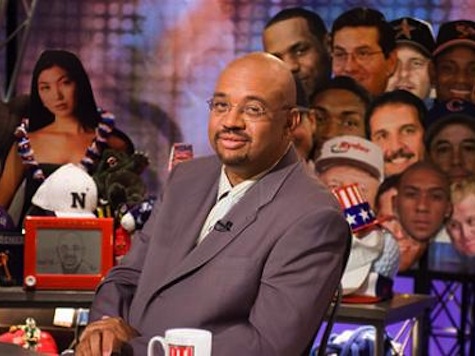
Sportswriter Michael Wilbon, Tony Kornheiser’s African-American foil on the fluffy ESPN show “Pardon the Interruption” and hardly a rabble-rouser, shocked his audience this week when he announced that he is an aficionado of the word “nigger” (but not in public), and objects to being told that there is something wrong with that, especially by white folks. The issue came up regarding an uproar over a tweet, since deleted, from an NBA player using the word to criticize his team mates. [ Aside: It is funny how frequently a single post on Ethics Alarms about a topic—say political correctness, word censorship, civility and the morass of related ethical issues—seems to trigger an explosion of news stories in the same area. Undoubtedly it is because the proximity of the post itself influences my judgment regarding which events deserve comment, but it sure doesn’t feel that way. This is similar to the phenomenon where you think you have heard a word or phrase for the first time, and suddenly you’re aware of it everywhere.] Wilbon said, unapologetically,
“People can be upset with me if they want, I, like a whole lot of people, use the N-word all day, every day, my whole life … I have a problem with white people framing the discussion for the use of the N-word.”
Your Ethics Alarms Ethics Quiz this weekend is this:
Is Wilbon’s defense of using the word “nigger”ethical? Continue reading →
There is more to discuss, a lot more, regarding what I will now call “The Klosterman Apology,” because it sounds like a Robert Ludlum novel. For now, however, since it is fresh in my jet-lagged mind, I’d like to focus on the inevitable result of declaring certain words and phrases so objectionable, hurtful, uncivil or politically incorrect that extraordinary means are employed to eliminate them. In the case of The Klosterman Apology, the words were “retard” and “retard,” and a Mom with a blog threatened “The Ethicist” from the New York Times magazine with an onslaught of political correctness bullies if he didn’t immediately express his abject contrition for having used these words in a harsh way a decade ago, in another job that didn’t directly involve ethics. Chuck capitulated, gracefully and well. As I will discuss in another post, I don’t think he had much choice. Still, word-banning is an ugly, and ultimately unethical business. Continue reading →
Democratic Party candidate Ralph Northam cannot possibly lose the Virginia Lieutenant Governor race today; in fact, he should win by a landslide. His Republican opponent, African-American minister E. W. Jackson, is so conservative he makes his running mate, gubernatorial candidate Ken Cuccinelli, look like Saul Alinsky, and I’m only exaggerating a little bit. From the pulpit, he has made statements that sound like they were ghosted by Pat Robertson in one of his crazy moods, like when he seemed to be suggesting that children with birth defects were being punished for their parents sins. Jackson doesn’t believe in evolution, thinks that government programs have done more harm to blacks than slavery, and could fairly be described as homophobic.
Still, he is a citizen, a candidate and a human being, so when he offered his hand to his soon-to-be victorious opponent Northam following a TV debate, there was only one decent, civil, ethical, statesmanlike response for Northam: take it, and shake it. That is traditional, civilized, and polite, and for Northam to do what he chose to do instead—ignore Jackson and his hand and snub the Republican, refusing even to look him in the eye—on live TV, no less!— shows him to be an arrogant, unmannered, uncivil jerk of the breed that has brought American politics, government and discourse to a new low. Continue reading →
“Oh, sure, he’s hell to work for, but he never breaks any laws, so you’ll be fine.”
I have been remiss in not adding the terrific blog Evil HR Lady to the Ethics Alarms links, and will finally do so as soon as I post this entry. No profession deal s with ethical nuances and dilemmas more frequently than human resources professionals, and they can be very difficult, even gut-wrenching. In a recent post, EHRL searched through the archives of questions she has answered over the past years, and compiled an eye-opening list, especially for non-lawyers, of the conduct employers could engage in legally, which is to say, get away with and not be successfully sued, to employees, together with some questionable kinds of conduct that are legal for employees to do to each other.
She listed 62 of them, many of which are reasonable ( it’s okay to fire an employee for “being a jerk”) and some are obvious, or should be; it is legal to quote the Bible in the office, for example. What is legal is not always good, fair, or right, however, and I perused the list with an eye out for legal workplace conduct that was legal but still unethical. About a third of the types of conduct on the Evil HR Lady’s list made mine. What follows is the sub-list of the 62 things it is legal to do at work, the 22 things it may be legal to do at work, but which are still unethical. The reasons for my unethical verdict follow Evil HR Lady’s items.
Here’s the list of the unethical 22 workplace practices: Continue reading →
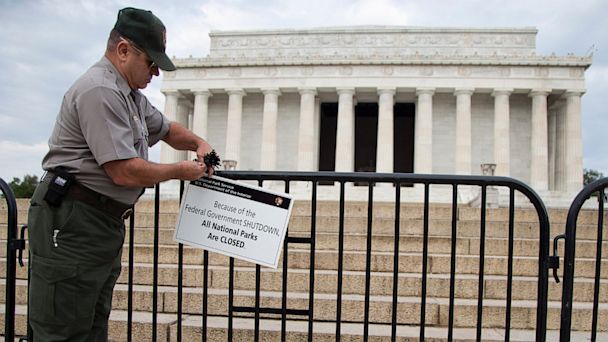
Stipulated: I am not in generally favor of government shutdowns, just as I do not favor strikes, boycotts, Massada-style mass suicides, wars, or any other destructive tactics, strategies and actions in response to impasses over important matters. Sometimes, however, they are necessary and responsible. Sometimes, they are not.
1. It is fascinating reading the comments on the shutdown from my friends on Facebook. It is startling how many of them simply parrot back partisan talking points they have heard on CNN and MSNBC, but especially striking are the angry rants of the government employees who appear to take the shutdown as a personal affront. How dare the evil Republicans disrupt their lives, their paychecks, their work schedule, their vacations! I wonder if my friends have the same reactions to labor strikes, wars and national disasters. Do they really believe that those elected officials struggling to decide on crucial matters of policy, firmly believing in a course that is right for the nation and reaching an impasse, should just shrug off the serious implications of the issue at hand and say, “But, hey, Joe Finsterwald will have a tough time if his agency has to shut down, and the Bradys’ DC vacation will be ruined, so the heck with it: go ahead with that law we think will be a disaster for the country. We’ll back off.” Do those Facebook complainers really think that would be responsible governance? You know, guys, this isn’t personal: it’s called politics and two party government. It’s part of the deal. Disagree with the policy arguments if you have the knowledge and perspective to do so, but taking the position that the entire business of running the country revolves around your convenience over the next few days or weeks is as juvenile as it is irresponsible. If you work for a private company, you risk disruptions because of business failures, competition and re-organizations. If you work for the government, you risk things like this. It’s not only about you.
2. What various polls show about what the American public believes or doesn’t believe is irrelevant, and anyone on either side of the dispute who cites them as support for the Affordable Care Act or gutting the Affordable Care Act is either naive or trying to deceive. Continue reading →
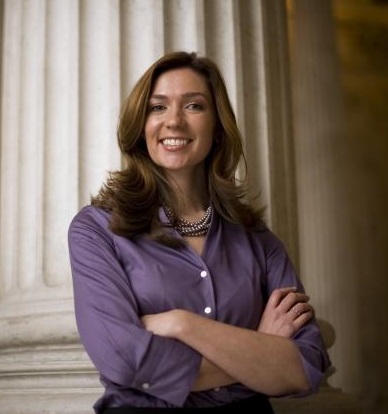
Hellspawn and Public Louse, Amanda Carpenter. Nice disguise!
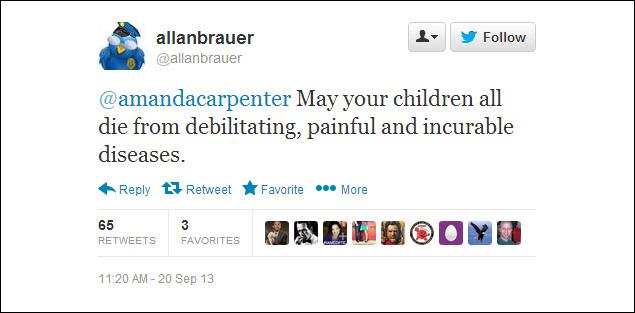
The Communications Chair for the Sacramento Democratic Party, Allan Brauer, sent a series of cruel and uncivil tweets assailing Sen. Ted Cruz aide Amanda Carpenter for her own Twitter missive cheering on GOP opposition to gun control, the President’s Syrian policy—whatever it is—and the Affordable Care Act. After some online drama, he apparently regretted his rash and hurtful words, and sent Carpenter this apparently heartfelt apology:
“Hi- am truly sorry for my tweet. I was very upset and lashed out. Your kids are not fair game either. My apologies.”
She graciously accepted. How could anyone quarrel with this resolution of the incident?
Here is how: Brauer, who has a record of social media viciousness, made it very clear in the course of the controversy launched by his commentary that he didn’t regret what he had said at all. Here was his first tweet:
After being swarmed by various Twitter users who protested his language and sentiments, Brauer followed up with these well-chosen and unrestrained statements to them and his Twitter followers: Continue reading →
Prof. Reynolds, the iconic conservative bloggers who wields considerable influence in the right-leaning blogospehere and beyond, has frequently displayed a dismaying affection for the unethical response of “tit-for-tat.” Has seldom done so as blatantly, however, as in a post yesterday, linking to a National Review article about CUNY students shouting down General David Petraeus, who is now a lecturer there.
“I think right-leaning groups should similarly hound Hillary and other Obama Administration apparatchiks — including Obama himself, when he ventures onto campuses, both now and post-Presidency. The standard of behavior has been established. Let them live with it.”
Even giving Reynolds the benefit of the doubt and assuming that he is speaking tongue-in-cheek or hyperbolically, as he often does, this is an irresponsible statement if he doesn’t mean it, and an unethical one if he does. He is considered a sage and an opinion leader among many conservatives, and for such a prominent figure to expressly approve of the downward behavioral tail-spin that inevitably results when each competitor or adversary re-aligns ethical standards according to the unethical acts of the other is embracing all-out culture war and chaos, with no standards at all.
“They started it, so let’s give them a taste of their own medicine and see how they like it!” is street gang thinking, (Jets:“Well they began it!”Sharks:“Well they began it!”Both: “And w’ere the ones to stop it once and for all…tonight!”— “Quintet” from West Side Story) as far from ethics as one can get, and this is exactly what Professor Reynolds is endorsing. That ethically bankrupt approach, and the fact that our political system has been operating by it at least since 2000, accounts for today’s poisonous culture in Washington D.C. It has crippled both the Bush and Obama administrations, paralyzed the government and divided the public. If political and intellectual leaders embrace this reaction to misconduct in one setting, they are implicitly accepting it as a justifiable strategy, and it is not. It is a brutal, unethical strategy.
Students who interfere with invited speakers’ efforts to challenge or enlighten university audiences should be disciplined; it doesn’t matter whether the speaker is an ex U.S.general or Ilsa, Wolf of Dachau. Interfering with speech isn’t protected speech, nor is it ethical protest. That behavior isn’t a “standard of behavior,” it is a defiance of civilized standards. The President, Hillary Clinton and other targets of the right should be allowed to speak, listened to politely, and then confronted, if they are confronted, with civil and articulate rebuttals on the basis of their words and ideas. For a university professor to advise otherwise is unconscionable. For one who is respected and followed as extensively as Reynolds to write this defies reason.
Heck, it seems like everything is an Ethics Train Wreck or getting close to one these days…the NSA, Egypt, San Diego, the New York Yankees, life…
I need a vacation.
Now Texas Republican rep Steve Stockman has come aboard by making the obnoxious, simple-minded and inherently offensive gesture of inviting the unfairly banned clown to perform his classy act at a Texas rodeo. Undignified, unprofessional, cheap, nasty, and stupid…I’m sure I left out some equally accurate descriptors. This is like George Zimmerman in miniature. Is it really so hard to understand that protesting unfair treatment of someone need not, and in some cases should not, be accompanied by affirmative endorsement…and that’s what the invitation by Stockman is. Is he really so dense that he doesn’t realize that? Or is he really such a hyper-partisan, unstatesmanlike boor that he thinks it’s responsible and appropriate for a member of Congress to express his approval of an entertainer who called the President of the U.S. a clown and invited a crowd to cheer at his metaphorical abuse by a bull, some of whom were undoubtedly motivated by bigotry?
I really don’t care. Stockman’s stunt is ethically objectionable on a grand scale, and either he, the House, Republicans, or preferably all three owe President Obama an apology. One would think a Congressman would understand that there are different standards for the high elected officials responsible for our laws and rodeo clowns. But toward the bottom of the ethical and intellectual barrel we call the Republican Party (God, I certainly hope it’s toward the bottom!), this is apparently untrue.
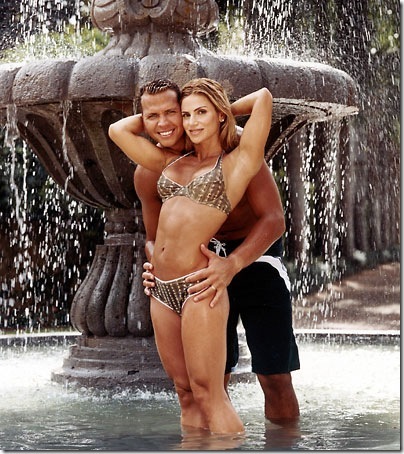
Baseball’s most embarrassing super-star, the steroid cheat Alex Rodriguez, in playing for the New York Yankees while appealing his long suspension by Major League baseball. As he is unquestionably a repeat liar and a serial violator of the game’s rules against PED’s (performance enhancing drugs), as he signed a contract, in part generated by the results of his cheating, that will both enrich him by millions and handicap his team competitively while conferring few, if any benefits, as he would qualify, by most objective standards, as the antithesis of a sports hero, the fact that Arod, as he is called, still was cheered by a vocal minority in Yankee Stadium when he made his season debut this week is intriguing. What does this mean? Can it be ethical to cheer Rodriquez now?
These are deceptively complex and difficult questions. The threshold issue is whether cheering or jeering any sports figure, or any public figure at all, is an act with ethical content rather than just a communication of an opinion. Is it conduct, or just “words”? I think, in the context of the Rodriquez situation, a sound argument can be made that it is conduct. Registering group approval or disapproval of prominent conduct by someone of status and influence is a crucial societal function in setting standards, registering disapproval, and prompting shame, regret, apology and reform—none of which, so far at least, seem to register with Arod.
That is pretty clearly what the boos convey, but what about the cheers? If the boos are ethical—they are if the disapproval is proportionate, rational, fair, and just—then are the cheers automatically unethical? Not necessarily. Here are some of the things those cheers could be expressing: Continue reading →
Conservatives will grandstand about declining standards of dignity and decorum in the U.S., happily blaming the decline of gentility and civil public expression on rappers, Hollywood liberals and Joe “This is a big fuckin’ deal” Biden, until a Democrat with a name ready-made for bad sex puns and double-entendres shows up, and then its a mad stampede to bad taste.
Wow. Clever.
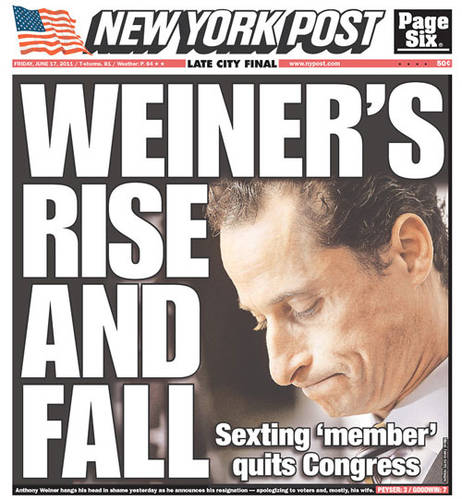
What is it with the Right: is everybody 12? From Rush Limbaugh (“Weiner is hard to swallow…”) to The Daily Caller (“Weiner blows his lead”) to the New York Daily News (“Cuomo Spanks Weiner!”) to dozens of websites that can’t resist versions of “Will Weiner pull out?” and “Weiner Exposed,” to Drudge (“Weiner Goes Soft”) to CNS (“Boehner Won’t Bite On Weiner”) to, naturally, the reliably crude New York Post ( “Too Hard To Stop!’…”Tip of the Weiner”…”Obama Beats Weiner”…”Weiner: I’ll Stick It Out”…and on, and on–okay, it’s abrand, I get it ), apparently conservative pundits and headline writers can’t resist seeking naughty snickers from obvious gags. Continue reading →


 Ethics Alarms