Now THIS Is An Abuse Of Police Power

The trooper is on to something...it is amazing how persuasive a sermon can be when it's backed up by a gun...

The trooper is on to something…it is amazing how persuasive a sermon can be when it’s backed up by a gun…

According to the complaint filed in a U.S. District Court, Indiana State Trooper Brian Hamilton stopped Ellen Bogan to give her a ticket,proceeded to grill her on whether she had yet accepted Jesus Christ as her savior, and then gave her a pamphlet to help her see the light.

Quite reasonably, Ms Bogan felt coerced and was ready to swear that she had the Bible tattooed on her back if hse had to get away from the Preacher Policeman After the prolonged stop, Trooper Hamilton said “God bless you,” which was nice, and then went on to find other motorists to proselytize at gunpoint.

This is what the First Amendment to the Constitution is concerned about when it prohibits the state from interfering with citizens’ free exercise of religion. It’s wonderful that Trooper Hamilton is a good Baptist and all, but he is in the wrong line of work, and needs to have a forced occupation change immediately. A badge doesn’t give him the right to use his authority as a police officer to bully motorists into endorsing his favorite brand of Christianity. In fact, the badge, the gun and the nature of his employer take that right away from him while he’s working.

__________________________

Pointer: Fred.


The Ethics Scrooge On The Starbucks Pay-It-Forward Ponzi Scheme

KONICA MINOLTA DIGITAL CAMERA

The Ethics Scrooge here.

If you think I’m going to get all misty eyed about the “random acts of kindness” fun and games Florida Starbucks customers have been amusing themselves with lately,  you are sadly mistaken.

The happy-talk story of the week—and I admit, the nation needed one—concerned a St. Petersburg, Florida Starbucks where an early morning customer at the drive-through window decided to “pay it forward” and buy coffee for the next person in line.That customer emulated the spirit of the Kevin Spacey weepie,  and bought a drink for the next person in line at the drive-through, and so it continued throughout the day, with 378 customers purchasing drinks for the strangers in line behind them, a so-called altruism chain that lasted 11 hours.

Awww. Continue reading

Ethics Dunces: Arthur Allen, CEO of ASG Software Solutions and David Siegel, CEO of Westgate Resorts (UPDATED)

MSNBC has discovered two CEO’s who have told their employees that if they don’t vote for Mitt Romney—if the Republican isn’t elected—their jobs are at risk. I’m sure there are others like them; probably many others. They are all unethical, and seriously so.

In some jurisdictions what they are doing is illegal, but illegal or not, it is wrong. Nobody with power over others, be they bosses, parents, ministers, teachers, military officers or police officers, should attempt to use that power to influence individual political choices. To do so is coercive, unfair, an offense to personal autonomy and the rights of citizenship, an abuse of power and an abuse of position.

Chris Hayes, who has publicized the efforts of Arthur Allen, CEO of ASG Software Solutions, and David Siegel, CEO of Westgate Resorts to influence the votes of his employees, opined that their efforts were inappropriate and felt “fundamentally coercive.” Exactly. The CEOs have power over their employees’ welfare, and such appeals come with an implied threat.

Telling someone how to vote is presumptuous. Telling someone how to vote when you have authority over him is unethical.

UPDATE: Think Progress has found yet another leaked audio of Mitt Romney talking to supporters, this time to what the progressive website calls the “very conservative” National Federation of Independent Business. I guess when your that far left, almost anything looks “very conservative,” but the NFIB is just a business association, and not especially conservative. Romney, in addressing the excutives, urged them to do essentially what Allen and Siegel did:

“I hope you make it very clear to your employees what you believe is in the best interest of your enterprise and therefore their job and their future in the upcoming elections. And whether you agree with me or you agree with President Obama, or whatever your political view, I hope — I hope you pass those along to your employees. Nothing illegal about you talking to your employees about what you believe is best for the business, because I think that will figure into their election decision, their voting decision and of course doing that with your family and your kids as well.”

Mitt’s exhorting them to abuse their power. His advice is unethical.

___________________________________

Graphic: Ars Technica

Policies Don’t Fix Unethical Professors

“Here is your assignment, class: Vote for who I tell you to.”

I saw this story and decided it was too obvious to write about. A community college math professor distributes to her class a pledge to vote for Obama and the Democratic slate, and demands that the students sign it—come on! Is anyone going to defend that as ethical? Then a reader sent me several links to the item (thanks, Michael), and after reading them, I was moved to reconsider.

The professor, Sharon Sweet, was put on unpaid leave pending an investigation; I can’t fault Brevard Community College (in Florida) for not firing her yet. What troubles me is the college’s statements that her conduct is just a breach of policy. BCC Spokesman John Glisch told the press that “The college takes this policy [prohibiting employees from soliciting support for a political candidate during working hours or on college property] extremely seriously. It is very important that all of our faculty and staff act in that manner at work and while they’re on campus.” So college provosts are reminding employees about the policy.

Let’s be clear. Associate Professor Sweet’s conduct was an abuse of power and position, an insult to the autonomy of the students and an attempt to take away their rights as citizens, disrespectful to them and the values of the nation, and an attempt to circumvent election laws and to subvert democracy. It was also, quite possibly, illegal. If a college needs to have a policy to stop teachers from behaving like that, it is hiring the wrong kinds of teachers—individuals whose ethics are those of totalitarian states, and whose respect for individual rights are nil. This was an ethical breach of major proportions, not a policy misunderstanding. No teacher should require a policy to tell her that this conduct is indefensible and wrong. Continue reading

Ethics Quote of the Day: Calvin Coolidge

“There is no right to strike against the public safety by anybody, anywhere, any time.”

—-Calvin Coolidge, then Governor of Massachusetts, soon to be Vice-President and later President upon the death of Warren G. Harding, in a September 14, 1919 telegram to labor leader Samuel Gompers on the occasion of the Boston police department strike.

Cal made his words count.

The Boston police were fired for extorting the city, and Coolidge’s words were in the air when President Ronald Reagan responded to an illegal strike by air traffic controllers by firing the strikers and banning the union.

Now Chicago’s teachers are striking, not against the city management that is denying their demands, but against the children of the city and their families.

What would silent Cal say? I think I can guess. Harming children and families for higher wages is as much extortion as leaving a city unprotected against crime, and cannot be defended ethically. The defense will be, inevitably, “Well, management is unfair, and their offer is unjust. What are we supposed to do?”

The answer is: something else.

__________________________________

Facts: Chicago Tribune

Source: Wikipedia

Graphic: Washington, Jefferson and Madison Institute

Ethics Alarms attempts to give proper attribution and credit to all sources of facts, analysis and other assistance that go into its blog posts. If you are aware of one I missed, or believe your own work was used in any way without proper attribution, please contact me, Jack Marshall, at  jamproethics@verizon.net.

Sympathy Abuse: The Unethical Death Announcement Request


Take ’em or leave ’em.

The Miami Herald reports that Robert Maurius Reno, a younger brother of former U.S Attorney General Janet Reno has died. In lieu of flowers, the family is asking  friends to give to the Obama campaign –“even if they are Republicans.”

Wrong. Ethics foul.

I know that the Obama campaign has been promoting its tasteless brainstorm of encouraging wedding invitees and birthday celebrants to give money to the campaign rather than a gift, but this is emotional extortion. A citizen has a right to his or her own political activity, and short of using logic, facts and the power of persuasion to prompt a shift in loyalties, it is an abuse of the power of friendship and a misuse of sympathy to exploit a death to make someone give support to a cause, a party or a candidate that he or she would normally oppose.

If a family can compel Republicans to give to the campaign of a Democratic candidate, then it can use a family death to make an anti-abortion advocate give to Planned Parenthood, an Orthodox Jew contribute to Hamas, and a Red Sox fan buy a season ticket to watch the Yankees. This turns a generous and normal desire to show respect for the deceased and support for the grieving family into a trap to make mourners choose between violating their core beliefs and rejecting the wishes of the family.

The device is unfair, unmannerly, offensive and crude, and places politics over friendship and good taste. So is Obama’s birthday and wedding registry scheme, but that only  crossed an ethical line, while this obliterates it. Republican or Democrat, if you’re going to try this strong-arm tactic on me, don’t expect to see me at the funeral.

Or anywhere, for that matter. And I might just give double to the other side.

___________________________________________

Pointer: James Taranto

Facts: Miami Herald

Ethics Alarms attempts to give proper attribution and credit to all sources of facts, analysis and other assistance that go into its blog posts. If you are aware of one I missed, or believe your own work was used in any way without proper attribution, please contact me, Jack Marshall, at  jamproethics@verizon.net.


Ethics Chess Lesson: The Tale of the Kidney and the Ungrateful Boss

Ethics chess is complicated, but ignore it at your peril!

Ethics chess is the process by which one considers the likely chain of events that follow from an act, and tries to predict the ethical dilemmas that may result before they occur. Debbie Stevens and Jackie Brucia didn’t play ethics chess. This is what happened to them.

When  Stevens was exploring the possibility of returning to the Atlantic Automotive Group, where she had worked previously, she met with Brucia, her former and potential boss, and somehow got on the topic of Brucia’s health problems. She needed a kidney transplant, and had found a donor, though it was not yet certain that the kidney would be hers. Stevens said that she might be willing to contribute her own kidney if that donor didn’t work out.

Later, Stevens was hired by Brucia,and two months later, in January of 2011,  Brucia called Stevens into her office and told her that she had lost her organ donor. “Were you serious when you said you would be willing to give me one of yours?’ Brucia asked.  “Sure, yeah,” Stevens says now. “She was my boss, I respected her. It’s just who I am. I didn’t want her to die.’’ It wasn’t exactly a direct donation, but Stevens donated her kidney to a stranger who matched up well with it so Brucia could be advanced on the list and get a better matched kidney from another source. Nonetheless, Brucia got a healthy kidney because Steven’s gave up one of her own. Continue reading

Easy Call: Employers Asking For Facebook Passwords? It’s Unethical. So Let’s Stop It.

Ethics Alarms’ predecessor, The Ethics Scoreboard, had a feature known as “Easy Calls,” where I would render periodic ethics verdicts I thought should be obvious. Today’s talk radio and blogosphere sensation, the report that asking for a job applicant’s Facebook password is becoming a common practice of employers, is a classic easy call. And like a lot of those on the Scoreboard, an amazing number of people are getting this easy call wrong anyway.

For example, I heard lawyer-radio talk-show host Laura Ingraham today mock complaints about the practice, saying it was a legal request. Sure, it’s legal. It is still wrong, an indefensible incursion of personal privacy. “You are always free to look for a job somewhere else,” Ingraham says, as if that makes everything fine. Being free to reject an unfair and coercive job requirement doesn’t make it any less unethical. Law professor Orrin Kerr says that the Facebook demand is in the same league as demanding a job applicant’s house keys. Let’s see, what else could a prospective employer ask? Continue reading

The Ethics Verdict on the Homeless Hotspot Project

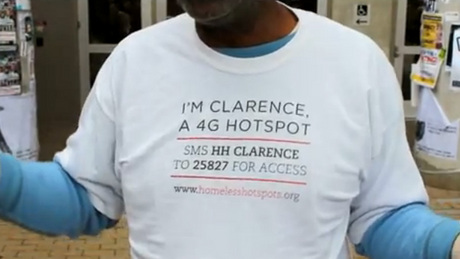
BBH Labs, the innovation unit of the international marketing agency BBH, hired members of the Austin, Texas homeless population to walk around carrying mobile Wi-Fi devices, offering high-speed Internet access in exchange for donations. Thirteen volunteers from a homeless shelter were hooked up to the devices, given business cards and put in shirts with messages that designated them as human connections. “I’m Rudolph, a 4G Hotspot” read the label on the homeless man on the New York Post’s front page with the lead, “HOT BUMS!

The Walking Hotspots—now there’s a new horror series for AMC when they run out of zombies— were told to go to the most densely packed areas of the South by Southwest high-tech festival in Austin, Texas, where the technology trend-devouring conventioners often overwhelm the cellular networks with their smart phones. Attendees were told they could go up to a Homeless Hotspot and log on to his 4G network using the number on his T-shirt. A two-dollar contribution to the homeless man was the suggested payment for 15 minutes of service. BBH Labs paid  the wired-up homeless $20 a day, and they were also able to keep whatever customers donated.

What BBH called its “charitable  experiment” ended yesterday with the conference, and with all participants seemingly thrilled. The “Homeless Hotspot” gimmick got nationwide publicity, thirteen homeless men made some money, and conference participants got great connectivity…so why were so many people upset? Continue reading

Taking A Stand On Privacy, As Ethics Alarms Go Silent

"Oh, all right---as long as I get that job."

The cultural consensus on the boundaries of personal privacy are eroding more quickly than I imagined. There are a lot of reasons for this: the intrusions of technology, increased government intrusiveness as part of anti-terror measures, utilitarian calculations that conclude that privacy should be sacrificed for supposedly more worthy objectives, like preventing bullying, or discouraging sexism and anti-gay attitudes. Whatever the reasons, it is crucial that society puts the brakes on, hard, or George Orwell’s nightmare will arrive remarkably intact, just a few decades late.

A stunning report on the MSNBC blog Red Tape reveals that some state agencies are routinely requiring job applicants, as a condition of employment, to provide full access to their social networking accounts so their otherwise private communications can be monitored. Equally disturbing, college athletes at many colleges are being required to “friend” a coach or other university personnel, who can keep tabs on what the student is posting. From the University of North Carolina handbook: Continue reading