Pundit Malpractice: NBC Sports Defends Colin Kaepernick By Misrepresenting Jackie Robinson

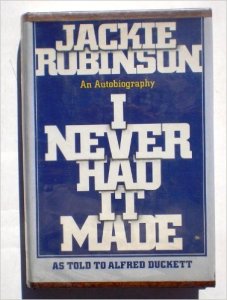
What does Jackie Robinson's autobiography have to do with Colin Kaepernick, you ask? Well...nothing at all, really.

What does Jackie Robinson’s autobiography have to do with Colin Kaepernick, you ask? Well…nothing at all, really.

It also represents a rationalization for unethical conduct that is not currently represented on the Ethics Alarms Rationalization List.

Someone sent Craig this quote, from Jackie Robinson’s  autobiography,  as baseball’s color-line breaker thought back to the first game of the 1947 World Series:

“There I was, the black grandson of a slave, the son of a black sharecropper, part of a historic occasion, a symbolic hero to my people. The air was sparkling. The sunlight was warm. The band struck up the national anthem. The flag billowed in the wind. It should have been a glorious moment for me as the stirring words of the national anthem poured from the stands. Perhaps, it was, but then again, perhaps, the anthem could be called the theme song for a drama called The Noble Experiment. Today, as I look back on that opening game of my first world series, I must tell you that it was Mr. Rickey’s drama and that I was only a principal actor. As I write this twenty years later, I cannot stand and sing the anthem. I cannot salute the flag; I know that I am a black man in a white world. In 1972, in 1947, at my birth in 1919, I know that I never had it made.”

This naturally made Craig, whose mind sometimes cannot help itself from shifting into progressive cant autopilot, think about Colin Kaepernick’s incoherent grandsitting as he refuses to stand on the field with his team for the National Anthem. He wrote,

“Colin Kaepernick is not Jackie Robinson and America in 2016 is not the same as America in 1919, 1947 or 1972. But it does not take one of Jackie Robinson’s stature or experience to see and take issue with injustice and inequality which manifestly still exists…the First Amendment gives us just as much right to criticize Kaepernick as it gives him a right to protest in the manner in which he chooses. But if and when we do, we should not consider his case in a vacuum or criticize him as some singular or radical actor. Because some other people — people who have been elevated to a level which has largely immunized them from criticism — felt and feel the same way he does. It’s worth asking yourself, if you take issue, whether you take issue with the message or the messenger and why. Such inquiries might complicate one’s feelings on the matter, but they’re quite illuminative as well.”

Let’s begin with the fact that there is nothing similar about Jackie Robinson and the 49ers quarterback, except their race and the broad occupation of “sports” that they shared. Continue reading
Observations On S.F. 49ers Quarterback Colin Kaepernick’s Anti-America Protest

Colin-Kaepernick-24

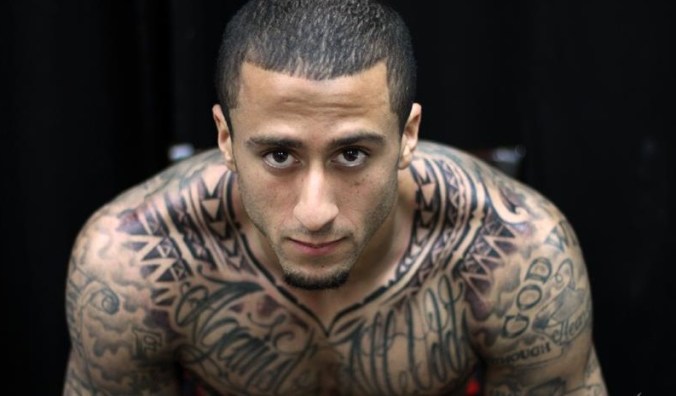
San Francisco 49ers quarterback Colin Kaepernick refused to stand for the playing of the national anthem before Friday night’s 49ers-Green Packers exhibition game as a protest against the United States. He has apparently been doing all NFL preseason, but it wasn’t noticed until the most recent game.

Questioned about his certain to be controversial gesture, the mixed race athlete—he had one white parent, and was raised by a white adoptive parent—explained thusly:

“I am not going to stand up to show pride in a flag for a country that oppresses black people and people of color.To me, this is bigger than football and it would be selfish on my part to look the other way. There are bodies in the street and people getting paid leave and getting away with murder.”

Observations:

1. Give him credit for one thing: he isn’t trying to take advantage of the King’s Pass. His star immunity is at low ebb, since Kaepernick’s status with his team is shaky and his job as a first string quarterback is in doubt, not because of his political views, but because he has been injured too much and not all that great when healthy. What he did was not in his own best interests. It took guts.

So does leaping naked into a zoo’s tiger exhibit.

2. His action wasn’t a protest. It was grandstanding. It generated publicity for a message that was incoherent. All his gesture said was “Colin Kaepernick is upset and has an irrationally inflated concept of how much anyone cares, or should care.”

3. Kaepernick could have salvaged his act by being ready with a well-reasoned, well-stated, articulate and persuasive explanation. Based on what he said, which was ignorant, counter-factual and foolish, we must assume that he actually gave thought to his response, and that this pathetic statement was the best he could come up with. That shows him to be incompetent, ill-informed, and not very bright. Continue reading

The Colin Kaepernick Tattoo Controversy: “Ick,” Not Ethics

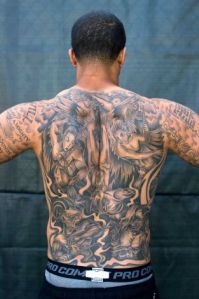
How can he pass with a back that looks like that?

How can he pass with a back that looks like that?

The new star San Francisco 49ers quarterback Colin Kaepernick is tattooed all over. Does this mean that he is unqualified to be a leader, a role model, an ethical exemplar, as NFL quarterbacks are supposed to be? The Sporting News’ columnist David Whitley argued in a column that indeed Kaepernick’s tattoos do mean that, and as you would expect, the number of coherent points he could mount in support of that position equaled exactly zero. He did, however, give everyone a terrific example of how people who don’t comprehend ethics make what they think are ethical arguments.

His column is about ethics, because ethics is central to leadership. Whitley believes that Kaepernick’s tattoos undermine his ability to lead by compromising the values he represents to those who must follow him. And those values that tattoos undermine are??? Well, Whitely doesn’t really explain that. He says that tattoos on a quarterback send the wrong message because prisoners get tattoos in the Big House. This is a man who is hostage to cognitive dissonance. Presumably if Stephen Hawking or Barack Obama showed a tat, he’d be fine with Kaepernick’s decorations. When I was kid, it wasn’t prisoners but sailors who we identified with tattoos. I knew a Pearl Harbor survivor with a big one—this neither convinced me that he was a rotter instead of a hero or made me want to get a giant anchor needled into my arm. Popeye had a tattoo, and we all loved Popeye. He also ate spinach. We didn’t. Continue reading