Dead President Ethics: The Post Mortem Odyssey Of James K. Polk

James K. Polk is one of my favorite Presidents, in part because he has never received his due for being spectacularly effective, if unwavering ruthless in achieving his goals. By the standards of fulfilling his own stated objectives, a President can’t be more successful than Polk. He pledged to expand U.S. territory to the West, Southwest and North, and did so, then served only one term, as he had promised. Polk also wrote a fascinating diary, essentially an autobiography.

His relative obscurity arises in part because he was a one term President, but primarily because he existed in the shadow of his fellow Tennessean, Andrew Jackson, who was more flamboyant, more influential on more political fronts, and had far more than four years in the spotlight. He was also much taller. Poor Polk lived just three months after leaving office, dying of cholera in 1849, in Nashville. Tennessee. The laws of the time held that those who died of that dread disease be buried within 24 hours to prevent epidemics, so the former President of the United States was  laid to rest in a mass grave less than a year after leaving the White House.

A year later, Polk was removed from the mass grave and buried on the grounds of his Nashville home, Polk Place, in accordance with the will he drew up five months before his death. Polk, a lawyer, stipulated that his body and that of his wife be buried there, and that after his death and his wife’s, the property should be held in trust by the state, which would be bound allow a blood relative to live there. Unfortunately for the dead Polks, the ex-President made a tyro’s drafting gaffe. After Polk’s widow Sarah died in 1891, a court voided the terms of the will because it violated the common-law Rule Against Perpetuities: a property owner can’t bequeath property to unborn future generations. So Polk Place was sold to private interests, eventually razed, and today there is a boutique hotel on the property. On Sept. 19, 1893, Polk’s body and Sarah’s were moved again, to the Nashville grounds of the Capitol.

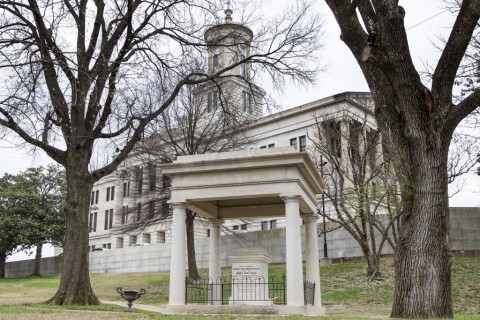
On a small patch of grass within a stone’s thrwo of the Capitol, the Polks’ grave is lies in a modest but attractive classical monument framed by Greek columns, with an inscription declaring  that Polk “planted the laws of the American union on the shores of the Pacific.” It was designed by William Strickland, the architect who also designed the Capitol itself and George Washington’s sarcophagus at Mount Vernon in Virginia. But Polk’s Jackson problem continues: his gravesite is dwarfed by a nearby equestrian statue of Old Hickory, and tourists virtually ignore it. And while Jackson’s grave at the Hermitage, his family plantation, is a major tourist draw in Nashville, Polk remains—that is Polk’s remains remain—an afterthought. When President Trump visited Nashville last month, he laid a wreath on Jackson’s tomb, and saluted him in a speech. As for the perpetually dissed 11th President, the campaign jeer of the Whig Party running against the first Dark Horse candidate in 1844 apparently remains appropriate: “Who is Polk?”
Continue reading →

Sen. Gillibrand’s State of the Union Guest

Emma and her mattress: actually, many of the other attendees at the State of the Union would have loved to have had a mattress...

Emma and her mattress: actually, many of the other attendees at the State of the Union would have loved to have had a mattress…

I was considering framing this as an either/or ethics quiz, with Sen. Gillibrand (D-NY) inviting Emma Sulkowicz, a Columbia student who continues to harass the student she accused of rape despite her allegations being judged, by the school and police, as unprovable to the State of the Union, being compared to Speaker John Boehner’s in-your-face invitation of Israel Prime Minister Benjamin Netanyahu to address a joint session of Congress about Iran. I don’t like either of the moves: both are unethical in different ways. I can at least devise an argument for Boehner, however. I don’t see how anyone can excuse Gillibrand, who is essentially accusing a young man of rape when she has no direct knowledge of what happened.

Columbia student Paul Nungesser was found “not responsible” for sexually assaulting Sulkowicz, Since that official determination, Sulkowicz has been carrying a mattress around the university as “an art project” to protest Nungesser’s success at defending himself. When he learned that the Senator had injected herself into the controversy, he told reporters,

“I am shocked to learn that Senator Gillibrand is actively supporting Ms. Sulkowicz’s defamation campaign against me by providing her with a public forum in which to broadcast her grave allegation. By doing so, Senator Gillibrand is participating in a harassment campaign against someone who, for good reason, has been found innocent by all investigating bodies.”

Yup, I’d say that’s a fair interpretation. He continued,

“Sulkowicz’s accusation is untrue and unfounded: I have never sexually assaulted anyone. This is why Columbia University after seven months of detailed investigation in November 2013 found me to be not responsible…I voluntarily let myself be interviewed by DA chief of Sex Crimes at SVU in New York City, in August 2014. Shortly after this interview, the DA’s office informed me that they decided not to pursue the case further.”

Sulkowicz  decided not to pursue the criminal case any further. She just took the alternative action of setting out to hound, harass, accuse, stigmatize and embarrass Nungesser as “art.” Continue reading →

Comment of the Day: “Ethics Dunce: Columbia, South Carolina Police Chief Ruben Santiago”

A few quick points, before I present Chris Marschner’s excellent Comment of the Day:

  • You know you’re posting too much when a you’ve completely forgotten an essay less than a month old, like this one.
  • Why didn’t someone tell me that I left the “l” out of “Columbia”?
  • I’m going to have to start working on my proof-reading again, clearly. There were a couple more typos in this post.
  • Chris just started commenting, and this is the third carefully written, well-reasoned substantive piece he has produced. I am grateful; such debuts raise everyone’s game.
  • I liked this post, and not many people read it or commented on it. I am increasingly worried about the trend in law enforcement and in government generally, especially the schools, to brush off free speech as an inconvenience. I’m grateful to Chris for raising the issue again.

Here is his Comment of the Day on the post, “Ethics Dunce: Columbia, South Carolina Police Chief Ruben Santiago”: Continue reading →

Ethics Dunce: Columbia, South Carolina Police Chief Ruben Santiago

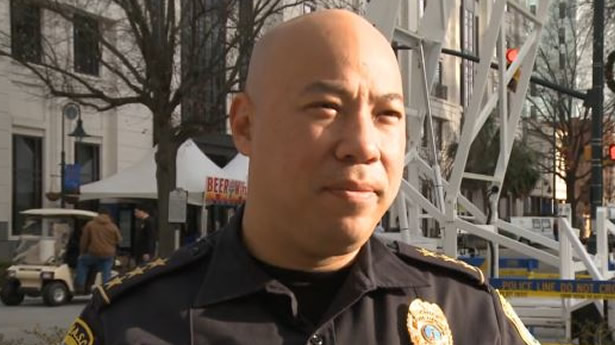
The face of police power abuse in Columbia, S.C.

The face of police power abuse in Columbia, S.C.

If our culture did a minimally competent job communicating the essential right of free speech in the United States, people like Ruben Santiago wouldn’t think as the do—as they do being best described as ignorantly, censoriously, arrogantly and stupidly. Both the Left and the Right are to blame for the message not getting out to the public, and, consequently, members of the public who acquire governmental authority: the government can’t threaten you or harm you for mere speech…the Left through its attempts at political correctness, mind control and indoctrination in the schools, the Right in its efforts to use laws to curb expression involving sex and violence in the arts and entertainment.

In Columbia,Police Chief Ruben Santiago took to the Columbia Police Department Facebook page to announce that his officers had seized  $40,000 in marijuana from an apartment after a successful drug investigation. Citizen Brandon Whitmer, on his own page, took note of the arrest and opined, “maybe (police) should arrest the people shooting people in 5 points instead of worrying about a stoner that’s not bothering anyone. It’ll be legal here one day anyway.” Santiago replied ominously to Whitmer, saying, “(W)e have arrested all of the violent offenders in Five points. Thank you for sharing your views and giving us reasonable suspicion to believe you might be a criminal, we will work on finding you.”

Somebody  in the department with a working knowledge of the Constitution quickly got that post deleted, but Santiago defended it in a double-down post, writing, Continue reading →