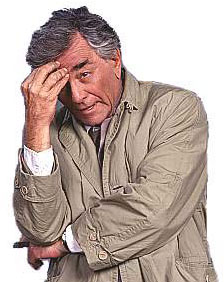
If a real Columbo was on his case, Tony Stewart might be in trouble.
The word “ethics” and NASCAR should never be uttered in the same sentence without irony. After all, the sport arose out of the exploits of outlaw bootleggers. The current billion dollar sport’s culture regards cheating as “breaking rules and getting caught doing it.” The fact that the team manager of one of the sport’s biggest stars would see no reason for his meal-ticket not to compete today just because he was being investigated for what might have been a mid-race homicide yesterday shouldn’t shock anyone.
In case you missed it Saturday (I did, having a visceral aversion to NASCAR stronger than my dislike of nightcrawlers), NASCAR superstar Tony Stewart drove his car into twenty-year-old driver Kevin Ward Jr., killing him, during a dirt-track race at Canandaigua Motorsports Park in upstate New York. Ward’s car and Stewart’s car had swiped each other during the race, disabling Ward’s vehicle. Ward left his car and was walking on a track with the caution flag out, waving his arms and pointing at Stewart. One car swerved to avoid Ward, but Stewart’s hit him, injuring him fatally. Until the media and public began to register its objections, Stewart was preparing to race today as if nothing had happened. As recently as this morning, Stewart team manager Greg Zipadelli called it “business as usual.”
It’s business as usual in a culture where a participant who just killed someone in public under suspicious circumstances sees no reason to show, or even fake, any remorse or contrition whatsoever. Here’s the latest entry on Tony Stewart’s website, at least as I write this:
“Thanks to everyone who participated in this week’s edition of “Tony Trivia.” This week’s answer: There’s no track on the circuit where Tony Stewart is more dominant than at Watkins Glen International.”
[UPDATE: At 1:pm Sunday, Stewart finally posted the statement about the accident that is now up on the site. Note that he says nothing about his part in the accident at all. It could be about any NASCAR accident, anywhere.]
Call me a silly sentimentalist, but if I ran down another racer and killed him, I would make certain that a public statement expressing sorrow and regret at the incident would be up on my “official website” before the first ESPN headline was written about the incident. Meanwhile, why would NASCAR allow a racer to compete after an incident like this? Oh, that’s right: because the only ethics in NASCAR involve making money, protecting its stars, winning races, and keeping the fans entertained. After all, having Stewart race today would be a great story. Will he kill again? Will any driver have the guts to point at him this time?
Yes, it’s Bizarro World ethics again, another culture with inverted values like the fictional cube planet in Superman comics, where idiotic clones of Superman and Lois Lane think, live and speak illogically. Continue reading →
 Ethics Alarms