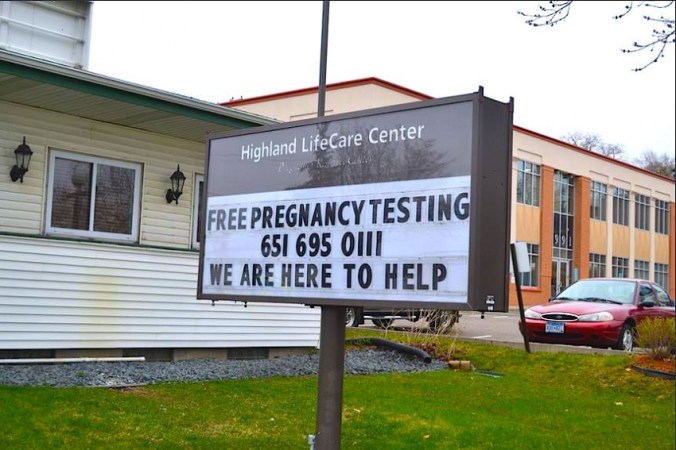
The Supreme Court ruled today that California could not require that pregnancy resource centers (PRCs) promote abortion services on their premises. The law doing so, the 5-4 majority held, is forced speech. (A law couldn’t make the PRC’s bake cakes saying “YAY ABORTION!” either, presumably.)
The ruling in National Institute for Life Advocates (NIFLA) v. Becerra holds that by imposing the law, California created “an unduly burdensome disclosure requirement that will chill [PRCs’] protected speech.”
California’s 2015 Reproductive FACT (Freedom, Accountability, Comprehensive Care, and Transparency) Act mandated that any facility that provides care to pregnant women must post this notice:
California has public programs that provide immediate free or low-cost access to comprehensive family planning services (including all FDA-approved methods of contraception), prenatal care, and abortion for eligible women. To determine whether you qualify, contact the county social services office at [insert the telephone number].
Fines for violating the law were $500 for the first offense after 30 days, and $1,000 for each subsequent offense.
Justice Clarence Thomas, writing for majority, concluded that the requirement “alters the content” of the licensed centers’ speech by requiring them to notify pregnant women about the availability of low- or no-cost abortions even though the centers’ goal is to persuade women not to have abortions at all. This could be justified by a “compelling interest,” Thomas wrote, but he noted that there are other ways —an advertising campaign or posting notices on public property near the licensed centers—that would not force the centers to promote the very activity that they exist to stop.
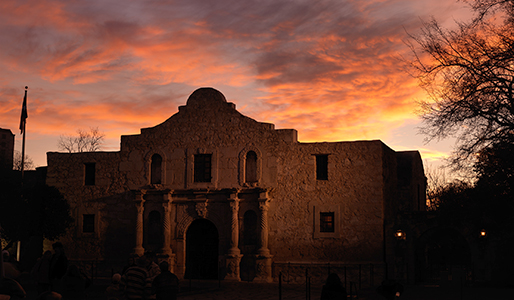
While the Alamo was under siege, the provisional Texas government organized at Washington-on-the-Brazos. On March 2, the convention declared independence and the Republic of Texas was born, at least on paper. The Alamo’s garrison showed its support for independence from Mexico by sending its own delegates to the convention.While they were unaware that Texas had declared independence, the roughly 200 Alamo defenders stayed at their post waiting on help from the settlements. Among them were lawyers, doctors, farmers and a former congressman and famous frontiersman from Tennessee named David Crockett. While the youngest was 16 and the oldest defender was Gordon C. Jennings, age 56, most defenders were in their twenties. Most were Anglo, but there were a handful of native Tejano defenders as well. Legendary knife fighter and land speculator James Bowie was in command before falling ill and sharing duties with Travis. Several women and children were inside the Alamo, including 15-month-old Angelina Dickinson. Just before the final battle, Travis placed his ring around her neck, knowing she would likely be spared. One of the last messages from the Alamo was a note from Travis asking friends to take care of his young son Charles.
The final attack came before dawn on March 6, 1836. As Mexican troops charged toward the Alamo in the pre-dawn darkness, defenders rushed to the walls and fired into the darkness. Travis raced to the north wall but was soon killed. Bowie was most likely killed in his bed, while reports differ as to Crockett’s death. Many believe Crockett survived the initial attack but was put to death by Mexican soldiers soon afterward.
Mexican soldiers breached the north wall and flooded into the compound. The fierce battle centered on the old church, where defenders made a last stand.
BEXAR, Texas, March 6, 1836 — Alas, alas! Forever more, the name of the Alamo shall stand alongside that of Thermopylae in the annals of history as a tale of unmatched bravery to be handed down from generation to generation.
The bastion of Texas Liberty has fallen, and to a man, Lt. Col. William Travis and his fellow defenders — like the immortal 300 Spartans — have been martyred.
After withstanding an unrelenting siege of twelve days’ duration by one of the mightiest armies ever assembled on this continent, the walls of the old mission that had housed Travis (a man as brave as the fabled King Leonidas), Col. James Bowie, the Hon. David Crockett and some 200 other defenders were breached before the sun rose to-day.
Savagery was unleashed therein as a juggernaut orchestrated by the modern-day Xerxes, Mexican Gen. Antonio López de Santa Anna, swept over the Alamo….
Since I was a small boy, this episode in American history moved me more than any other. It still does. I first learned about the Alamo when I watched Fess Parker as Davy Crocket, swinging his rifle like a baseball bat at Mexiacn skulls, the last man standing as behind him we could see more of Santa Anna’s soldiers pouring over the wall. We never saw Davy fall—my dad explained that this was appropriate, since nobody is sure how or when he died, unlike Travis and Bowie, and the last verse of the Ballad of Davy Crocket played…
His land is biggest an’ his land is best from grassy plains to the mountain crest He’s ahead of us all meetin’ the test followin’ his legend into the West Davy, Davy Crockett, king of the wild frontier!
The politics and complexities of the Texas war of independence don’t alter the essential facts: a group of men of different backgrounds, under the command of three prototypical American figures—the pioneer (Crocket), the settler (Bowie), and the law-maker (Travis), all of whom were trying to recover from dark periods in their lives—chose to make the ultimate sacrifice for a cause they believed in fervently enough to die for, in the company of others who felt the same. It was, after all, the perfect ethical dilemma, the choice between an ethical act for the benefit of society and a non-ethical consideration, the most basic one of all: staying alive. They all had the same choice, and rejected life for a principle.
That’s what I remember about the Alamo.
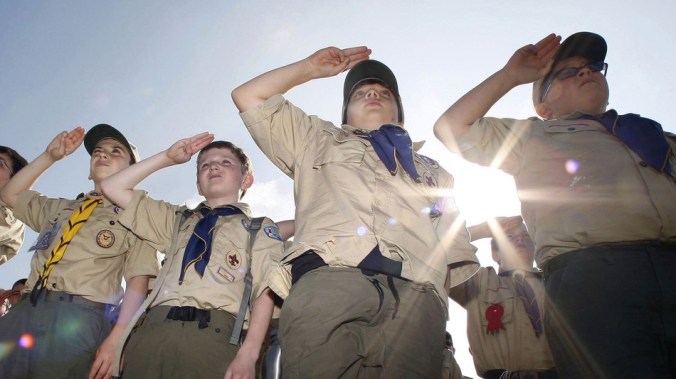
2. There is hope. Once again, I gave a 90 minute presentation to a Boy Scout troop and parents last night, and challenged them this time with several hypotheticals that Ethics Alarms readers would recognize, such as this one, the plight of Ryan Seacrest and those who snubbed him on the red carpet, the “Mrs. Miniver” flower show, and this one, from personal experience, which set off the most lively debate of all:
The Option
Your professional theater company has limited funds, so it offers its actors an option. They may choose a flat fee for their roles, or get a percentage of the show’s profits, if there are any, on top of a much smaller base fee.
The company just completed an extremely profitable production, the biggest hit your theater has ever had. Nine of the show’s ten cast members chose the percentage of profits option, a gamble, because most of the shows lose money. One, the star, who you know could not afford to gamble, took the flat fee for the role. After the accounting for the production is complete, you realize that every member of the cast will make $1000 more than the star, because of the show’s profits.
Question 1: What do you do?
Give him the extra $1000. It’s only fair.
Pay him the flat fee. A deal’s a deal.
You can weigh in:
Question 2: You remount the production, and the exact same thing happens. The actor chooses the flat fee, the show is again a huge money-maker,,and the rest of the cast will make much more than him because they chose the percentage. Do you give him the extra amount again?
No. Now he’s taking advantage of me.
Yes. Nothing has changed.
As before, the approximately 50 11- and 12-year old boys were astute, serious, thoughtful, and gutsy, and their ethical instincts were superb. Continue reading →
1 Last week, Andrew Sullivan delivered a couple of excellent pieces of commentary with ethical clarity. My definition of an ethical analyst is one who can steer away from the magnetic pull of cognitive dissonance, and realize that, for example, just because Democrats and progressives deplore President Trump as much as you do doesn’t mean you have to regard their battiest and most unethical positions as better than they are. Sullivan qualifies. Here he is making what I once thought was an obvious point: that Democrats and progressives embracing open borders (and condemning as racist anyone who doesn’t) was irresponsible:
I don’t believe it’s disputable at this point that the most potent issue behind the rise of the far right in America and Europe is mass immigration. It’s a core reason that Trump is now president…[and the] reason why I have dwindling hopes that the Democratic Party will be able to defeat Trump in 2020. Instead of adjusting to this new reality, and listening to the electorate, the Dems have moved ever farther to the left, and are controlled by ever-radicalizing activists. There’s a nuanced, smart — and shockingly honest — piece in Vox by Dara Lind about this. Money quote:
For Democrats, it’s been a simple calculus. Democrats’ attempts at “tough love” centrism didn’t win them any credit across the aisle, while an increasingly empowered immigrant-rights movement started calling them to task for the adverse consequences of enforcement policies. Democrats learned to ignore the critics on the right they couldn’t please, and embrace the critics on the left who they could… Democrats in 2017, in general, tend to criticize the use of immigration enforcement, and tend to side with those accused of violating immigration law, as a broad matter of principle beyond opposing the particular actions of the administration … Democrats are no longer as willing to attack “illegal immigration” as a fundamental problem anymore.
This is, to be blunt, political suicide. The Democrats’ current position seems to be that the Dreamer parents who broke the law are near heroes, indistinguishable from the children they brought with them; and their rhetoric is very hard to distinguish, certainly for most swing voters, from a belief in open borders. In fact, the Democrats increasingly seem to suggest that any kind of distinction between citizens and noncitizens is somehow racist. You could see this at the last convention, when an entire evening was dedicated to Latinos, illegal and legal, as if the rule of law were largely irrelevant. Hence the euphemism “undocumented” rather than “illegal.” So the stage was built, lit, and set for Trump.
1 I’m giving an ethics talk to a Boy Scout troop this afternoon. Figuring out how to use example that are appropriate to ages 11-14 while avoiding hot-button issues like race, sexual orientation, police, guns and politics in general is a lot more difficult than I thought it would be. What pop culture reference points will work is also a conundrum. What movies are they likely to have seen? In the Sixties, I could have referred to Westerns, many of which routinely embodied ethics lessons. But they also often involved shooting people, and kids don’t see Westerns now. In the Eighties, I might have sent Boy Scouts to episodes of “Star Trek: The Next Generation,” which was virtually all about ethics. But Patrick Stewart is just an old guy doing commercials now, and there have been four TV incarnations of the franchise since Data packed it in, not counting the movies. Pixar movies are usually ethics-rich, but a lot of kids will bristle at being presumed to be cartoon fans. Superhero movies? The ones that raise ethics issues usually do so badly, or the issues are too complex—or too dark– for a Boy Scout Troop. Here we see the serious cultural problem of declining cultural literacy and deteriorating cross-generational communications as a result of the loss of common experience. and interests.
Well, it’s early. I’ll figure out something.
One approach I considered was to suggest they practice ethical analysis by reading the newspaper, picking out the ethics dilemmas and controversies that appear, thinking about them and arguing about them. Of course, that was foolish: they would probably ask, “What’s a newspaper?” However this morning’s Sunday Times is a perfect example. I could teach a four hour ethics seminar based on the stories in this edition alone. Look…
2. The baker who refused to sell a cake to a gay couple is back on the front page, thanks to the case winding its way to the Supreme Court. This time, the focus isn’t on Freedom of Religion (in this case, freedom to act like a jackass using your religion as an excuse), but Freedom of Speech. The government cannot compel speech, nor will the law compel specific performance of an artistic nature. The baker claims that his cakes are artistic creations, and he doesn’t have to make them for anyone or anything if he doesn’t want to. The gay couple says that they weren’t asking for him to create an artwork, just to sell them a wedding cake. If the cake is a commodity, then the bake shop should be a public accommodation, and subject to applicable laws. Then the baker has to sell his cakes to anyone. If the cake is an “artistic creation” made specifically for the couple, then the law cannot force the baker to make it, or punish him if he refuses. Art is speech.
I hate these kinds of cases, and I’m sure the SCOTUS justices do too. A cake is sometimes just a cake, and sometimes a work of art. The confrontation should have been handled with ethics rather than law. The baker is a bigoted jerk, that’s all. I think he has a right not to make a cake for a gay couple, but exercising that right is cruel and insulting. Continue reading →
For a judge, you just can’t get any more incompetent than this.
In Florida, Circuit Judge Jack Schramm Cox ordered the Palm Beach Post to scrub a previously published story from its website. This is prior restraint, or the government preventing publication based on content. The order violates the First Amendment; it isn’t merely unconstitutional, it is incredibly unconstitutional. Concluded Constitutional Law professor and blogger Jonathan Turley in his usual restrained manner, “The utter lack of legal judgment (and knowledge) shown by Cox in this order is deeply troubling.”


 Ethics Alarms