The “Transitioning” Female Wrestler: A Failure Of Ethics And Common Sense

The girls wrestling champion, Matt Beggs.

The girls wrestling champion, Mack Beggs.

Mack Beggs is a competitive wrestler at Euless Trinity High School, and also is a biological female more than a year into the process of “transitioning” to male.  Beggs just won his third consecutive girls’ wrestling tournament victory in the 110-pound weight class. I’ll call him “he” because that is what the student wants to be called, and he, in great part due to the male steroid treatment he has been undergoing,  is now 55-0 on the season. All of his opponents have been high school girls who are not taking steroids, and unlike Mack, do not intend to become, for all intents and purposes, male.

While Beggs says he wants to wrestle in the boy’s competitions,  the University Interscholastic League rules use an athlete’s birth certificate to determine gender, a measure that makes sense in most cases, just not this one. (See: The Ethics Incompleteness Principle) The rules prohibit girls from wrestling in the boys division and vice versa, and rules are rules. If you are a rigid, non-ethically astute bureaucrat, you follow rules even when you know that they will lead to unjust, absurd results, like Mack’s 55-0 record in matches.

The  rules also say that taking performance enhancing drugs like the testosterone that has given Beggs greater muscle mass and strength than his female competitors is forbidden, but  UIL provides an exception for drugs prescribed by a doctor for a valid medical purpose. After a review of Beggs’ medical records, the body granted him permission to compete while  taking male steroids—compete as a girl, that is.  Rules are rules!

One athletic director, after watching Beggs crush a weaker female competitor who left the ring in tears,  asked for his name not to be used as he commented to reporters, and opined that “there is cause for concern because of the testosterone,” and added, “I think there is a benefit.”

Really going out on a limb there, sport, aren’t you?

Here, let me help.

This is an unfair, foolish, completely avoidable fiasco brought about by every party involved not merely failing to follow ethical principles and common sense, but refusing to. Continue reading

Unethical Quote Of The Week, Olympics Division: Hope Solo

"Jim Kaat, meet Hope Solo. Hope...Jim."

“Jim Kaat, meet Hope Solo. Hope…Jim.”

“I thought that we played a courageous game. I thought that we had many opportunities on goal. I think we showed a lot of heart. We came back from a goal down; I’m very proud of this team. I also think we played a bunch of cowards. But, you know, the best team did not win today; I strongly, firmly believe that. I think you saw America’s heart. You saw us give everything that we had today. Unfortunately the better team didn’t win.”

—-U.S. women’s soccer team goalie Hope Solo,after the Swedish team eliminated the United States from the Olympic women’s soccer tournament in a penalty shootout Friday.

Diagnosis: Jerk.

I remember the first time I ever heard a representative of a losing team use the old “the best team didn’t win today” line.

It was 1967, the best summer of my life, when I spent my last carefree teenage school break following the greatest pennant race in baseball history. My team, the Boston Red Sox, were the surprise underdog in an amazing, see-saw four team race that had its outcome in doubt until the bitter end. The Sox, led by MVP and Triple Crown winner Carl Yasrtzemski, entered the final series at home against the first place Minnesota trailing by a single game. It was a two game series. If the Red Sox won both, they would be American League Champions after nearly 20 years of losing.

They did win both. I was at one of the games, among the most hopeful, raucous, joyous baseball crowd I have ever had the honor to be part of. Both games were hard fought, with surprising twists and turns like the whole season. Still, the Sox won. I was so proud of that gutsy young team, which I had rooted for through every nail-biting inning—the team was nicknamed “The Cardiac Kids”—of their 162 games, and never more happy going to bed after enduring a crucial, nerve-wracking contest.

The next day, I read in the sports pages a post-game statement by Twins pitcher Jim Kaat, who had started the game I attended. He said, “We’ve got to give Boston credit,but I think the best team and the best fans will be watching the Series on television.”

I thought it was an astonishingly  graceless and obnoxious quote by a losing athlete, the epitome of bad sportsmanship, and stupid to boot. If the Twins were so damn great, why were they ending the season tied (with the Tigers) for second place? By definition, the team that ends a season with the best record is the best team, and the team that loses the decisive game has proven that it is not the better team.

Solo’s statement was worse. Continue reading

Ethically, Caster Semenya Points Us Directly To Gender-Free Sports Competition, And There Is No Ethical Way To Avoid It

Caster

Ethics Alarms first mentioned female runner Caster Semenya in this essay , when the international sports community was debating the South African track champion’s fitness for competition. Caster, depending on who you believe, is either a woman, intersex, a woman with freakishly high levels of testosterone in her body, or a man who identifies as a woman. What is undeniable is that she is faster than most women, and maybe all of them, and her unique physical make-up, whatever you want to call it, gives her an advantage. Since the last Olympics, Caster has been forced to take drugs that inhibited her body’s production of testosterone.Then, in July 2015 , the Switzerland-based Court of Arbitration for Sport overturned the 2011 IAAF regulations that restricted testosterone levels in female athletes. They also suspended hyperandrogenism regulations for two years. Now Semenya will be able to compete as she is naturally, and because she will, she is widely expected to smoke the competition.

Is it fair to let her run? Is it fair not to let her run? After this year of controversy and confusion over gender, with boys and men “identifying as women” and transgender discrimination laws roiling the culture wars, this is a perfect time for an intersex champion. Then, presumably, all hell will break loose. A sports scientist tells The Guardian,

“I’m actually dreading the Olympics. People only want to hear a good story so when Semenya wins gold the South African media will go crazy. If she breaks the world record, which I think she will, it’ll be even crazier. You can lie and say: ‘Happy days. Let’s celebrate our golden girl’ – which the politicians and media want. Or you can be honest and principled and say: ‘Actually, there are many things we need to address.’ That’s very unpopular”

Society and sports have reached the point  the ethical solution is obvious and unavoidable, and, unfortunately, brutal. If society is accepting the fact that a binary gender distribution is a myth, and there may be seven, ten, or dozens of gender variations along a spectrum, then integrity and consistency—and fairness—demands that gender distinctions in sport be eliminated as arbitrary. Continue reading

Ethics Quiz: The Lettering Of Michael Kelley

Michael-Kelley-Down-Syndrome

Controversy in Kansas:

Michael Kelley is a high school student who has Down Syndrome and autism. He plays extra-curricular special needs basketball, so his family bought him a varsity letter and had it sewed to a school jacket to resemble the jacket the school’s athletes wear. The school’s special needs teams are not regarded as  varsity sports.

The school asked Michael to remove the jacket or the letter, since East High’s policies dictate that only varsity teams can wear the letter.

Now Michael’s mother is petitioning the school board to ensure that special needs team members get letters. Public reaction in Wichita is running against the school, which is being painted as cruel and lacking compassion by not letting Michael wear his letter jacket.

Your Ethics Alarm Ethics Quiz this almost spring weekend (March is back to being a lion here in the D.C. area) is this:

Should the school have let the special needs athlete wear his counterfeit letter jacket?

Continue reading

The Tangled Ethics of the Down Syndrome Cheerleader

There’s a lot going on here, and I may lack the ethics dexterity, or perhaps the courage, to figure it out.

I learned about the story on CNN this morning, as the newscasters were getting misty-eyed and “Awwing” all over the place. With a lot of fairly disturbing ethics issues rotting on my plate, I was looking for something uplifting to write about. I’m not sure whether this is it or not.

Here is the most recent on-line story about Kory Mitchell, a sophomore on the varsity cheerleading squad for Manitou Springs (Colorado) High School, who was born with Down Syndrome:

DENVER, Colo. – A Colorado teen with Down syndrome has made her dream of competing in a cheerleading competition come true.

Colorado’s 3-A cheerleading champions hail from Manitou Springs. At the top of their pyramid is a teenager who has overcome serious challenges in her life. The countdown is on as thirteen girls get one last practice in at the Colorado School of Mines. In minutes, the Manitou Springs Mustangs huddle will compete against other top teams.

Cheerleaders take center stage showcasing their spirit and synchronicity. The Manitou Springs Mustangs huddle one last time. And for the first time, joining them in competition is 16-year-old Kory Mitchell.

“She is full of life and full of energy and always wants to be a part of everything,” says her mom, Bonnie King, as she watches with pride.

Her daughter has dreamt about being a cheerleader since elementary school. Her mom is emotional.

But learning these already complicated routines is harder for Kory. “It`s just a tough road when you have a differently-abled child. And to see them have a sense of belonging and acceptance is what she wants, of course, is just so beautiful to see it,” mom says.

Kory’s teammates see what’s under the surface. Things like courage, patience and unconditional acceptance.

“She`s pretty spunky. And she`s got some sass. She loves being out there. It`s nice to see her smile and part of the team,” says one of her teammates. Sometimes competitions aren’t about who wins, but a little hardware doesn’t hurt.

Kory accepted the trophy and a hand from her teammates.

“It`s my dream come true. I love my girls a lot. I`m a big fan of cheerleaders,” Kory said.And Kory’s teammates are big fans of her. This was Kory`s first competition, but she has cheered with the team since last year at football and basketball games.

Observations (some of them reluctant): Continue reading

Election Ethics Catch 22: The Necessary And Destructive Lie

Unrecorded Custer quote that he probably said: "Don't worry, men! I believe we will win!"

Unrecorded Custer quote that he probably said: “Don’t worry, men! I believe we will win!”

In the last 48 hours, both Joe Biden and Democratic Committee Chair Debbie Wasserman Schultz told interviewer on national television, and thus the American public, that the Democrats would hold the Senate in tomorrow’s elections. Literally nobody believes this. News reports abound that Democratic pollsters and consultants don’t believe this. Polls show that Democrats are in for an epic clobbering that will give Republicans control of both Houses of Congress. Is there a chance this won’t come to pass? Sure there is: that why we cast real votes. But there is a big difference between “I hope our party holds the Senate” or “I think if everyone gets out and votes, we can hold the Senate,” and “We will hold the Senate.” The latter means “I honestly believe we will hold the Senate.” In context, it is either a statement of ignorance and delusion, or a lie.

Now with the track record of Biden and Schultz, one can never be certain that they aren’t delusional, but I’m going to give them the benefit of the doubt and assume they are lying. (They have track records in that area as well.) They are lying because they don’t really believe what they are saying, but feel they have no choice. This is the Underdog’s Dilemma. If anyone is going to care about a contest, neither competitor can concede or admit that it’s a hopeless mismatch. This is especially true for the leaders of  a team facing near certain defeat, and perhaps more true even in politics than in sports. Even when defeat seems inevitable, a candidate or his or her party’s leaders can’t admit it. Why would anyone bother to come out and vote when the object of the vote admits it’s a waste of time? The integrity of the system demands that the myth that anything can happen is kept alive until the final vote is counted. Sometimes, as we all know, the impossible upset happens. Truman defeats Dewey. Eric Cantor, a Republican heavyweight whose polls show him waltzing to re-election, gets beaten in the primary by some guy nobody ever heard of. Continue reading

Ethics Dunce: The Gwinneth Football League (Lawrenceville, Georgia)

"Us punish little boys playing football for scoring touchdowns!"

“Us punish little boys playing football for scoring touchdowns!”

Combine political correctness, the thoughts of Chairman Mao, incompetent administrators, kids and football, and this is the disgusting mess you get.

The Gwinnett Football League, a children’s sports program, allegedly fined one of its teams $500 and suspended its coach after an 8-year-old playing for the Lawrenceville Black Knights intercepted a pass and ran it back for a touchdown. In a normal sports league, run by sane people, where victory and achievement are appreciated, encouraged and celebrated rather than being stifled to allow losers to preserve their self-esteem when what they need is to be motivated to play better,  the child would have had a joyful, memorable childhood experience. Not in the Gwinnett Football League, however. The young player was to learn that his failure to realize that taking advantage of his opponent’s poor play was considered bad sportsmanship in this Bizarro World* league —cruel, unkind, psychically scarring—and would result in his team being fined and his coach being suspended. You see, the touchdown constituted an infraction of league rules, because the GFL has a so-called “mercy rule” that prohibits a team from throttling a weaker squad by more than 33 points.

The parents of the child protested that their son had no idea he should do. Miss the throw intentionally? Run it back the wrong way for an opposition touchdown? Beg the other team to forgive him? The parents of the rest of the team’s players insisted that the fine and suspension were far too severe….for, you know, playing football in a football game. Being fined and penalized for breaching an appallingly misconceived rule that nobody with the brains of an egret thought through? Yes, I think that’s a reasonable cause for complaint.

Hilariously, the president of the league, who must have risen to his place in life after his planned career as  pin setter didn’t pan out, told the media that news reports about the reason the team was fined were false.  Erik Richards said the team was fined because it made a “mockery of the game” in other respects besides running up the score: laying on the ground, running off the field and mocking the other players. He explained that the penalty for violating the mercy rule is “only” $100.

What the league needs is a fine for incompetent and irresponsible oversight of a kids football league: Continue reading

Ethics Quiz: Silent Soccer

Zip_it_ball

The American culture’s grim determination to raise a race of wimps, weenies, hysterics and delicate snowflakes continues apace. Or is this a necessary adjustment to our growing incivility?

In Ohio, the Thunder United Metro Futbol Club, a kids’ soccer league, held an experimental “silent soccer weekend.” Parents and fans were told that there would be no shouting or cheering at the games. Clapping was permitted, but not whistling or using  noise makers. Team coaches were instructed to keep shouted instructions to a minimum. Printed signs and rally towels got a green light, since they are quiet.

The objective, of course, was to combat negative shouts and other demonstrations by parents and fans that might bruise youthful egos and squash self esteem.

Your Ethics Alarms Ethics Quiz for today:

Is banning crowd commentary at youth athletic events responsible, or irresponsible?

Continue reading

Reading Club Ethics: Punishing The Motivated And Successful In Hudson Falls

There goes Tyler, doing more than he has to and spoiling things for everyone else...

There goes that show-off Tyler, doing more than he has to and spoiling things for everyone else…

Some day in the less-distant-than-we-might-think future, when the United States is a gray, socialist country populated by millions of Winston Smiths and Julias, historians and sociologists, if there are any left, may well look back on the species of American represented by Hudson Falls (New York) Public Library Director Marie Gandron, and reflect upon how it proliferated, eventually taking control of the culture and permanently stigmatizing initiative and talent to achieve the current ideological Holy Grail of guaranteed equal outcomes.

Ms. Grandon thinks its unfair that the student who reads the most books in the library’s student reading club summer competition keeps winning the annual distinction of being honored as the student who read the most books in the library’s student reading club summer competition.

Following the immortal logic of those who regard rewards for superior performance one more injustice spawned by the oppressive values of the United States of America, she reacted to the annual triumph by 9-year-old Tyler Weaver, who just loves to read and who again lapped his fellow club members in the Summer Reading Challenge for the fourth straight year, by suggesting that the rules should be changed. In an interview, the library director said Tyler “hogs” the contest and should “step aside,” because the other kids “quit because they can’t keep up.”  She told the reporter she planned on changing the rules of the contest so that instead of giving prizes to the children who read the most books, she would draw names out of a hat and declare winners that way. Continue reading

Unfairness in the Name of Fairness: Virginia’s Unethical Golf Rules

Liberty Anderson. Too bad they wouldn’t let her try to win fairly.

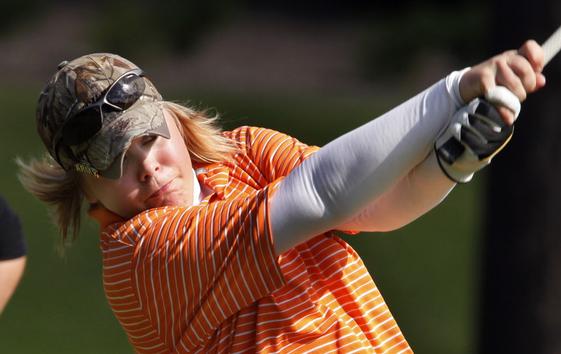
Lyberty Anderson, a junior at Manchester High School in Midlothian, Virginia, and undeniably female,  won the Virginia state boys Division AAA golf championship with an eagle on the final hole to capture the 36-hole tournament by one stroke. Lyberty is a terrific golfer, having demonstrated her precocious golf talents by winning women’s tournaments before she was in high school. Nonetheless, the boy’s tournament was outrageously slanted in her favor, and against her male competitors, tainting her victory.

Lyberty won, but she didn’t play the same course as her male opponents. She was allowed to tee her drives up on the shorter women’s tee, meaning that while the boys had to play a 6,653-yard course, hers was more than 1,000 yards shorter, almost 20%.  As Washington Post sportswriter Fred Bowen pointed out, Lyberty can’t be blamed for this: she played by the rules, and played as well as anyone could ask. She now says if she competes in the boys tournament again next year, she’ll tee of from the same spot as her competitors. That shows she understands fairness. Continue reading