A Shocking Ice Dancing Judging Scandal at the Winter Olympics

You can read the details of this completely predictable and in general ridiculous ice-dancing judging scandal here, here, and here. I’m not going recount the details because the details are misleading.

The ethics story is that the American ice dancing team of Madison Chock and Evan Bates lost the gold to the French team of Laurence Fournier Beaudry and Guillaume Cizeron because a French judge, Jezabel Dabouis, favored Beaudry and Cizeron by nearly eight points (make that “points”) over the three-time world champions in the free dance, a margin inexplicable when compared to the scores of the other judges, and so large that if her score were removed entirely, Chock and Bates would have won the top prize easily.

Catching Up With “The Lincoln Lawyer” Part 4

I like the show in general, but its writers need to catch up with the Rules of Professional Conduct and their interpretation.

Twenty years ago, in “The Sopranos,” Tony and his wife Carmella were having marital problems—gee , I wonder why?—and Tony was tipped off that she was looking for a divorce lawyer. So Tony contacted every major divorce lawyer he could find to tell them all about his marriage on the pretext that he was considering retaining one of them.. The idea was to conflict them all out of representing her, because they had received confidential communications from Tony.

Rule 1.18, relatively new at the time, held that lawyers had to keep the confidences of even potential clients, making such a dastardly tactic possible. But not long after that episode of “The Sopranos” revealed the loophole in the rules, courts and legal ethics opinions closed it with the sensible holding that someone only consulting a lawyer to create a conflict and not as a good faith effort to seek legal representation was not a genuine potential client.

Nevertheless, in the current season of “The Lincoln Lawyer,” Mickey’s newly minted lawyer associate (and ex-wife) says she got her first family law client because the woman had been frozen out of hiring the established divorce lawyers after her louse of a spouse had pulled Tony’s old trick.

True, it’s not always easy to prove that an estranged spouse is seeking conflicts rather than a lawyer. Nonetheless, lawyer TV shows are ethically obligated not to deceive the public. Tony Soprano’s method is unlikely to work now, and hasn’t been viable for at least a decade.

In one area, “The Lincoln Lawyer” deserves praise for properly representing a lawyer’s duty that Hollywood almost always ignores. Whenever Mickey Haller, “The Lincoln Lawyer,” is presented with a plea deal or another offer from the opposing attorney, even if Mickey makes it clear that he thinks the offer is ridiculous, he always says, “I’ll run it by my client,” which he has to do. But even in some of the most celebrated legal films, like Paul Newman’s “The Verdict,” the lawyers don’t do that. As a result, many clients don’t know their attorney can’t reject or accept a settlement offer without consulting them. That misconception can cause real harm.

The previous installments of these legal ethics commentaries on the streaming series can be found here, here, and here.

Catching Up With “The Lincoln Lawyer” Part 2

In this limited series of as yet undetermined length, I’ll be examining the legal ethics issues raised by the Netflix limited series of as yet undetermined length based on the Michael Connelly character, fed through the filter of the ubiquitous David Kelley.

I’m not going in strict order chronological order because why should I? This issue is a rich one, and arrived in Season 3 of the show. A prostitute whom Mickey had advised and had testified to help a client in Season 2 turned up dead, and he agreed to represent the man, her cyber pimp, accused of killing her before he realized she was the victim. Mickey liked and sympathized with the victim; whether he was officially her lawyer is a bit vague, but she seemed to think of him that way.

Can a lawyer represent a defendant accused of killing a lawyer’s client? Sure enough, this has happened; there’s even a Supreme Court case about it.

Tough Call: Who Is the Greater Ethics Dunce, David Hogg or the Democrats Who Elected Him Vice-Chair of the DNC? [Corrected]

David Hogg, had he not been a student at Marjory Stoneman Douglas High School when a mass shooting occurred, might have grown up to be a useful, ethical, productive and emotionally healthy human being. Unfortunately, he is likely to be a lifetime victim of the shooting, for it propelled him into the career path of being a professional single-issue fanatic, America’s Greta Thunberg but on the issue of gun control rather than climate change. In an example of the chaos PTSD can wreak on the vulnerable, Hogg has been transformed into a cynical grifter by a mass-murderer’s bullets. It’s tragic, but that doesn’t mean his unethical conduct should be tolerated, much less rewarded.

Barely two weeks after his election as a Democratic National Committee official, Hogg began using DNC contact lists to solicit donations to his own political action committee, “Leaders We Deserve.” That PAC pays his salary of more than $100,000 a year, according to Federal Election Commission records. “David Hogg here: I was just elected DNC Vice Chair! This is a huge win for our movement to make the Democratic Party more reflective of our base: youthful, energetic, and ready to win,” reads one the texts he sent out to the DNC’s vast database. The texts include a link to his PAC.

Continue reading

Tales of the King’s Pass

During the baseball off-season the MLB channel on DirecTV has a lot of dead time to fill between the periodic announcements of trades, free agent signings and post-season awards and honors. Lately it has been re-running an old Bob Castas show called “Studio 42” (that’s Jackie Robinson’s number) where the perpetually boyish-looking baseball commentator, who now really is Old Bob, interviews retired players and managers about significant games and moments in their careers.

In an episode I happened across this morning after my dog woke me up and then stole the bed as soon as I got out of it, Costas’s guest was the late, great manager Whitey Herzog, like so many successful baseball managers, a mediocre-to-poor player in his Major League career. Whitey told a story that is as good an example of the King’s Pass, #11 on the Rationalization List, as there is.

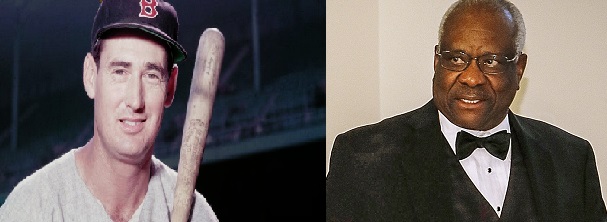
He said that in one game between the old Washington Senators (the first Senators, the team that moved to Minnesota and became the Twins) and the Red Sox in Boston, Ted Williams had drawn a walk on a 3-2 pitch right down the middle of the plate that the umpire had called a ball. Williams was famous for his plate discipline and above-average eyesight, and umpires frequently let him, opposing players complained, call his own balls and strikes because unpires acknowledged that he was better at it than they were. Herzog came to bat late in the same contest having walked four times and with a chance to set a record by getting five bases-on-balls in a single game. He told Costas that the umpire called him out on strikes on a 3-2 pitch in the dirt.

“I turned around and said to the ump, ‘You give Williams five strikes and give me only two. It should be the other way around!'”

This struck me particularly squarely because I had been thinking about the Judicial Conference declining to take any action against Supreme Court Justice Clarence Thomas, who has been the subject of a Senate Judiciary inquiry ever since ProPublica revealed that the Justice had neglected to report around half a million in luxury travel and gifts as legally required by the Ethics in Government Act of 1978.

Continue reading

Oh Look! Now the LEFT Is Complaining About Lawyers Being Reluctant To Represent Unpopular Clients!

In 2020, as discussed here, The NeverTrump Lincoln Project joined the anti-Trump Democrats in targeting law firms hired by the Trump campaign to challenge alleged irregularities in the election. Election law specialists Porter, Wright, Morris & Arthur and its lawyers were threatened with professional ruin and financial disaster, as they were told that daring to support the President of the United States constitutes a “dangerous attack on our democracy.” The firm, showing a dearth of legal ethics and integrity, withdrew, whining that the assault on its reputation created a conflict of interest, was disrupting the firm, and had prompted at least one lawyer’s resignation. Other firms dropped the campaign as a client, and the reason was fear—of losing clients, of being shunned in the legal community, of losing money. Mostly the latter.

How times had changed. When Bush Department of Defense Deputy Secretary Cully Stimson, a lawyer, gave a radio interview in which he condemned attorneys from large law firms who were representing Guantanamo Bay detainees pro bono and suggested that corporations avoid employing those firms because they were aiding the nation’s enemies, the legal profession reacted with indignation and horror. Karen J. Mathis, then the president of the American Bar Association, said, “Lawyers represent people in criminal cases to fulfill a core American value: the treatment of all people equally before the law. To impugn those who are doing this critical work — and doing it on a volunteer basis — is deeply offensive to members of the legal profession, and we hope to all Americans.” Prof. Stephen Gillers, the media’s favorite legal ethicist thanks to his penchant for being hard on conservatives and lenient on liberals, wrote, “This is prejudicial to the administration of justice. It’s possible that lawyers willing to undertake what has been long viewed as an admirable chore will decline to do so for fear of antagonizing important clients.” Christopher Moore, a lawyer at the New York firm Cleary, Gottlieb, Steen & Hamilton continued the profession’s defense of core lawyer ethics, telling the New York Times, “We believe in the concept of justice and that every person is entitled to counsel.”

Continue reading

Ethics Dunces: U.S. Judicial Conference Committee on Financial Disclosure

Problem: Judges getting adverse public scrutiny for not reporting potential conflicts of interest and avoiding the appearance of impropriety.

Solution: Lower the standards for conflicts of interest and the appearance of impropriety.

Problem solved!

Yecchh.

Continue reading

Lest We Forget…Ethics Dunce and Probable Ethics Villain: Dr. Rachel Gunn, a.k.a “RayGun”

For some reason, YouTube still has no clean, complete video of the infamous “breaking” performance that embarrassed the Paris Olympic games. (TikTok has one of the better ones, but I can’t embed TikTok.)

EA columnist Curmie flagged this ludicrousness for me [his analysis is here], knowing that my sock drawer problems precluded me from watching any of the goings on in Gay Paree. I didn’t know what to write about Gunn, having already expressed my belief that the dancing component of the Olympics was a breach of integrity and a betrayal of the mission of the Games. I didn’t specifically delve into the addition this time of “breaking,” aka breakdancing, which appears to me to be one more example of woke virtue-signaling in The Great Stupid, a kind of Olympics event reparations for blacks. (Why not clog dancing? Square-dancing? Russian squat-dancing? Tap-dancing? I hear that ballroom dancing may not be far off…)

Continue reading

Stephanopoulos? Chris Cuomo? If You Think U.S. Journalists Have Jettisoned Avoiding Conflicts of Interest As a Foundation of Journalism Ethics, “Good Morning Britain” Says “Hold My Beer!”

The background: There has been violent rioting in Great Britain’s Rotherham, Middlesbrough, Bristol, Bolton and other parts of the country following a stabbing attack in which three children attending a dance class were killed. Rioters have trashed and looted shops, set fire to vehicles and attacked police officers.

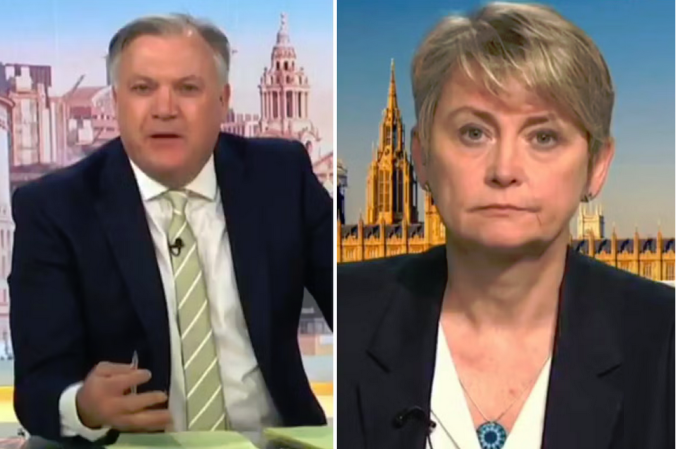
ITV, the alternative to the venerable BBC that dominates British television, had an interview with Home Secretary Yvette Cooper about the deepening domestic crisis on its popular morning show, a “Today Show” rip-off, “Good Morning Britain.” And who was the hard-hitting, independent, unbiased journalist given the assignment of handling the interview yesterday?

Why, it was none other than veteran broadcaster, GMB host and former Labour chancellor Ed Balls….Cooper’s husband.

Continue reading

Speaking of Conflicts of Interest and To Prove I’m Occasionally Right: Let’s Revisit “‘Baseball Super-Agent Scott Boras Has Another Super-Conflict And There Is No Excuse For It,’ the Sequel”

I have never recycled a post so soon (this one was was featured in January) but these are special circumstances:

  • After my analysis of the Fani Willis conflicts scandal did not jibe with the judge’s decision, my self-esteem is at a low ebb, and I feel the need to point out my prescience in this matter
  • This, like Willis’s self-made disgrace, is a conflict of interest, and one involving law as well…but also baseball.
  • The conflict of interest I flagged in January has now had some of the adverse results I predicted, and attention should be paid.
  • Baseball is one of the few things that has a chance of cheering me up right now, having gone through my first two weeks without Grace’s companionship and support. We followed the seasons (and the Red Sox) together since before we were married, as I taught her the game by taking her to watch the Orioles play Boston in old Memorial Stadium.

Two months after I wrote the post that follows, Spring Training is almost over and the season is less that two weeks away. Yet the two star pitchers I flagged as the victims of their agent’s greed and unethical conduct remain unsigned. I strongly believe that the reason they are unsigned is that the agent/lawyer they foolishly employ has been pitting teams against each other while using each pitcher as leverage to benefit the other, or so Scott Boras would argue. There is no question in my mind that if Blake Snell (above, right) and Jordan Montgomery (above, left), both talented left-handed starting pitchers that fill the same niche, were represented by different agents, both would have signed rich, long-term contracts by now. Because they have allowed themselves to be marketed by the same agent–an unconscionable conflict that baseball should prohibit and Boras’s bar association should sanction—they will not be ready to start the season even if both signed tomorrow. Pitchers who have had to miss large portions of Spring Training have frequently had off-years as a result: Boras’s greedy practice of representing competing talents may result in off seasons and even damage to their careers.

All of this could have and should have been avoided, and would have been, if baseball’s agents were subjected to any genuine ethical regulation.

Now here is the post… Continue reading