Should A Man Ever Hit a Woman? Well, It Depends.

The web is abuzz over this viral video, in which a young woman, aided by a videocam-wielding minion, goes to excessive lengths to provoke a young man of significant size:

The question being debated: Is it ever ethical for a man to strike a woman? Continue reading

Jonathan Capehart’s Confrontation Against Bigotry: Better Than Nothing, But Not Enough

confrontationWashington Post writer Jonathan Capehart shared a personal experience in a column today. Attending an aunt’s funeral in  church in the North Carolina community of her birth, he sat fuming as a guest minister used the occasion to condemn all gays as sinners, and urging them to use faith to give up their sinful ways.

Capehart, who is openly gay, decided that he was obligated not to accept this insult without a response. Here is what he did:

“After the visiting preacher was thanked for his rousing sermon by the congregation and the home pastor, the two made their way to us in the  front pew. During his oration, I vowed I would not shake his hand. But I did, given the immediate circumstances. So I used that as opportunity to make my displeasure known. As he shook my hand and leaned down for a sympathetic hug, I told the preacher, “Your sermon was offensive!” He leaned back, looked at me and replied, “What?” I repeated, “Your sermon was offensive to me. I need you to know that. That’s all I have to say.”

That seemed to satisfy Capehart. “As he moved his way down the pew, the anger I felt was replaced by relief and pride. Never before had I faced down religion-based bigotry. And it felt great.”

I feel terrible for Capehart having to endure such an indignity, and I’m glad what he did  made him feel better. But in no way did he “face down religious bigotry,” and I agree that facing down religious bigotry was called for. What did he do, really? He told the reverend that he was offended. He didn’t even say why he was offended. Continue reading

Web Ethics Complaint File: Rotten Etiquette in “Etiquette Hell”

The topic: rude behavior in public dining

There is nothing quite as exquisitely frustrating as having one’s commentary misrepresented elsewhere by a sloppy blogger, and then watching the nasty comments pile up by posters who never bother to read the original post. That is what is happening to Ethics Alarms, and thus me, over at an otherwise virtuous site called Etiquette Hell.

The site, or blog, or forum, or whatever the hell it is commented on the Starbucks post, with the inept headline: “Hogging all the tables in a crowded establishment.” That’s not what the post was about. That is a misrepresentation. The post was specifically about coffee shops that provide free wi-fi, and how customers abuse the privilege and benefit by camping out with their laptops for unreasonable amounts of time,  forcing patrons who need to use the tables for the primary purpose they exist to provide—allowing someone to eat and drink comfortably—to go elsewhere, or to stand. Continue reading

The Starbucks Principles

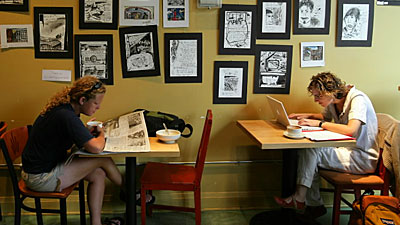
Hey you squatters! I'm coming over!

The First Starbucks Principle: If you create a free and open public benefit, the use of which is contingent on mutually understood conditions of fairness and reasonableness, eventually the utility of the benefit will be destroyed by individuals who refuse to be either fair or reasonable.

The Second Starbucks Principle: Once this occurs, there will necessarily  be rules and enforcement, conflict leading to consensus and a new social norm, or the elimination of the benefit.

Starbucks is in the midst of the First Starbucks Principle, but the Second is on the way. The nice, absurdly expensive coffee shops that created a culture where coffee-lovers could drink their lattes at leisure while working at their laptops or perusing  books and newspapers, are being choked to death by arrogant and cheapskate squatters who stake out the tables and remain for hours on end, often driving out customers who just want to sit down briefly and sip.

I had read about Starbucks’ New York City shops covering up outlets at the store, limiting the squatters to the battery storage limits of their laptops, a pretty mild reform. Then, last week, I saw the problem up close: a companion and I purchased coffee at a Starbucks clone, Caribou Coffee, and found that every table was occupied by one squatter with a laptop. Out of eight tables, only one had a cup or food of any kind. We had to go outside and find a bench; I guarantee that Caribou lost some business, because I would have purchased another drink. Continue reading

Ethics and the CALM Critics

The Commercial Advertisement Loudness Mitigation, or CALM Act, is now on the way to President Obama’s desk. The law addresses a long-time irritation to TV viewers, who have been complaining about television commercials booming out at ear-splitting volume as soon as a moderately-loud program takes a break. The advertising trick, which has been around for a while, has become even more blatant in recent years with availability of new sound technology. Some televisions have been equipped with devices that supposedly even out sound variations, but they do not completely solve the problem. The new legislation directs the Federal Communications Commission to require advertisers, within a year, to adopt industry technology aimed at lowering the volume on televised sales pitches.

This is a classic example of law doing what law is supposed to do: step in when individuals or organizations refuse to respect ethical values and cultural norms in the pursuit of their own self-interest, and set penalties to inspire them to engage in fair conduct, since “doing the right thing” isn’t motivation enough. Continue reading

Ethics Hero: George Clooney

An ethical challenge that all of us face now and then involves being present in a gathering when a host, a friend, a colleague or someone else makes an objectively bigoted or outrageously unfair and disrespectful  statement about a group that is not represented and thus unable to defend itself. At such times we all have a duty to confront and correct the speaker and condemn the sentiment, but the execution is difficult, and requires tact, knowledge, clarity and courage. Doing and saying nothing, however, gives the speaker and his slander support and tacit endorsement.

Fortunately, thanks to the magic of on-line video and George Clooney, we now have a lovely “How To” clip that demonstrates the right way to discharge one’s ethical duty in these awkward situations. Continue reading

The Evolving Ethics of Joke Theft

Kal Raustiala, a Professor at UCLA Law School and the UCLA International Institute, and Chris Sprigman, a Professor at the University of Virginia Law School, are counterfeiting and intellectual property experts who hang out at the Freakonomics blog, and their latest post discusses how the world of stand-up comedy deals with joke theft. Some of the commentary will remind you of the Monty Python sketch in which a professor dryly lectures (with demonstrations) on the art of slapstick, but their observation is important: professional comics have developed a series of standards, enforced informally by such methods as shunning, shaming, and confrontation (and the occasional punch in the face) to discourage theft of a form of intellectual property that cannot be efficiently protested by copyright or trademark law. Continue reading