Is It Unethical To Ban Stupid People From Congress?

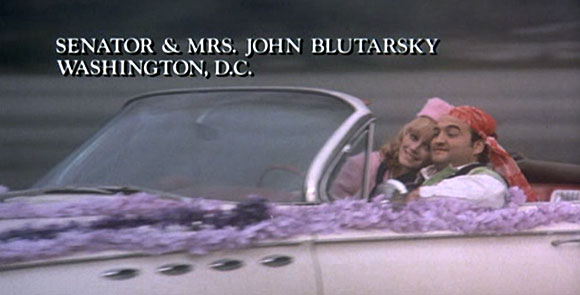
In 1978, this last image from “Animal House” was hilarious. In 2012, it’s tragic…because it came true.

The Todd Akin debacle has me wondering why we don’t take measures to block the ignorant and dim-witted from gaining high elected office. I know what you are going to say: that’s what elections are for. But we can’t bar ignorant and stupid people from voting: that’s been settled in court. It shouldn’t surprise us that they frequently tip elections toward candidates that the pollsters describe as “people like them”, and voilà! Todd Akin.

Akin is far (well, maybe not very far) from the  most intellectually suspect member of Congress. For example, Georgia Congressman Hank Johnson once expressed concern that the island of Guam might tip over, like a raft. There are too many other telling anecdotes relating to other members of Congress, in both parties. For those who shrug cynically and argue that it’s always been that way, there is solid evidence that indeed, Congress is getting dumber over time. A study of every word spoken in Congress concluded that the grade level at which members of the legislative branch speak has fallen a full grade since 2005, to just half-way through the junior year of high school. Democrats are slightly more articulate (.4 of a grade) than Republicans as a group, but that just could be because Joe Biden left to be Vice-President. Continue reading

Ethics Quote of the Month: Chief Justice John Roberts

“We do not consider whether the Act embodies sound policies. That judgment is entrusted to the Nation’s elected leaders. We ask only whether Congress has the power under the Constitution to enact the challenged provisions…Members of this Court are vested with the authority to interpret the law; we possess neither the expertise nor the prerogative to make policy judgments. Those decisions are entrusted to our Nation’s elected leaders, who can be thrown out of office if the people disagree with them. It is not our job to protect the people from the consequences of their political choices.”

—-Chief Justice John Roberts, in the introduction to his majority opinion in the case of National Federation of Independent Business et al. v. Sebelius, which upheld the Affordable Care Act on the grounds that the so-called “individual mandate” was a tax, not  government-mandated commercial conduct.
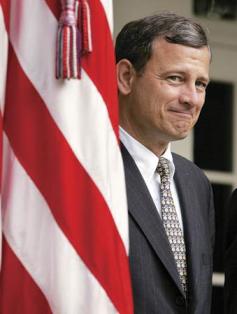
The Chief Justice’s statement is what is called dicta, commentary in a Supreme Court opinion that is neither binding on future courts nor a substantive part of the decision. Dicta, however, often has great influence in shaping future cultural consensus, and we can only hope that the Chief Justice’s wise and ethical words stick.

He is talking about process and accountability, and what is necessary for our democratic republic to work, and, frankly, survive. Reading letters to the editor and web site comments about yesterday’s decision, I find the overwhelming civic ignorance and “the ends justify the means” obsession of the vast majority of the writers more than depressing. The Supreme Court decision did not “vindicate” the Democrats and President Obama—only positive outcomes from the law they rammed through the system using every obfuscation and trick in the book could begin to do that, and even then it might be impossible, at least from an ethical standpoint. The Supreme Court’s decision raised the serious question of whether the law was passed under false pretenses, a tax disguised as something else so as not to call attention to its violation of the President’s promise not to raise taxes on the middle class. Once the Affordable Care Act began traveling through the courts, the Administration began suddenly calling the individual mandate a tax—a term that was not used in the 2500 page law itself—because it recognized that its Commerce Clause rationale for the individual mandate was shaky. Some courts found the bait-and-switch cynical and offensive, and refused to consider it. The bait-and-switch was offensive, or should be to citizens who believe that the public should know the truth about the laws Congress passes, but Roberts properly held that it isn’t up to the Supreme Court to protect the public from the curs, liars and knaves they regularly elect to high office because “character doesn’t matter.” In a democracy, this is the public’s job. We are accountable. The Supreme Court doesn’t exist to protect us from our own laziness, lack of principles and stupidity. It exists to make sure that if our elected officials pass lousy, ill-considered and un-read laws that roll the nation ever closer to a national diet of moussaka, at least they did it within the bounds of the Constitution. If We the People decide to tolerate cynical, dishonest, incompetent leaders and representatives and the nation ends up like Stockton, California, well, at least one branch of government did its job to make democracy work.

In the end, it will have been the people who failed to uphold their part of the experiment. That’s what the Chief Justice was saying.

I wonder if anyone is paying attention.

______________________________

Source: National Federation of Independent Business et al. v. Sebelius

Graphic: Linda Life

Ethics Alarms attempts to give proper attribution and credit to all sources of facts, analysis and other assistance that go into its blog posts. If you are aware of one I missed, or believe your own work was used in any way without proper attribution, please contact me, Jack Marshall, at  jamproethics@verizon.net.
The Congressional Black Caucus Walkout: Racial Bias, and Nothing But

Of course, they would also be staging a walk-out if a white AG was being held in contempt.

The Congressional Black Caucus  plotted to walk out of Thursday’s contempt of Congress vote regarding Attorney General Eric Holder’s stonewalling regarding legitimate oversight of the deadly Fast and Furious fiasco, and did, taking most of the other Democrats along. In so doing, the CBC, as if there was any doubt, unequivocally demonstrated its virulent racial bias, which interferes with its ability to discharge its duties in a fair, honest and legitimate matter.

The CBC had circulated a letter explaining its supposed rationale, which oddly manages never to mention that Eric Holder is African American. Yet it is unimaginable that the Congressional Black Caucus would stage a walk-out if Holder was the white Attorney General appointed by a white President. This is politics, but it is also dishonesty and naked tribalism. It should not be, pardon the expression, whitewashed, or allowed to proceed without calling it what it is—racial bias in the halls of Congress, where none belongs.

Here is the offensive and disingenuous letter being circulated by the CBC—with some commentary by me in brackets: Continue reading

Don’t Tell Us The Public “Doesn’t Care” About Incompetence and Corruption. It Has to Care.

The Washington Post broke the ethics story of the weekend, documenting a blatant conflict of interest on Capitol Hill that has many members of Congress making decisions on legislation directly affecting companies in their stock portfolios, and trading the stock contemporaneously with those decisions.

Based on the depressing dialogue on the Sunday public affairs shows regarding the Fast and Furious scandal—-especially the dialogue issuing from panelists who have obviously received and memorized received the Obama Administration and Democratic Party talking points—-I would assume that the American people can’t be bothered with this matter, and think it is a waste of time. After all, according to panelist after panelist who was either a mainstream media pundit or an Obama surrogate, all the American people care about is the economy and jobs. The fact that the U.S. Justice Department may be run by incompetents and law-breakers—who cares? The fact that nobody gets fired for approving a policy that breaks laws and gets innocent people killed—so what? The American people are, we are told, one-track mind morons, unable to focus on more than one problem at a time, and incapable of seeing the interrelations between problems. I wonder–might the fact that Congress may be corrupt and the Executive Branch, including Justice, may be irresponsible and inept have any bearing on the ability of the government to oversee the economy effectively? Don’t be silly, former New Mexico Governor and Clinton acolyte Bill Richardson told us yesterday. The public isn’t that sophisticated. The public doesn’t care about who’s cheating, who’s breaking the law and who’s incompetent! The people only want to talk about jobs! So, apparently, that is all the journalists and pundits should talk about, and all that policymakers should spend their time on.

No wonder none of those Sunday shows spent any time on this Post front page story: Continue reading

Fast and Furious: AG Holder’s Ethics Train Wreck

Let’s get a few things settled.

If you look closely, you can see Eric Holder in his engineer cap.

Fast and Furious is a true scandal, not a trumped-up distraction, just as Watergate wasn’t a “third-rate burglary.” When the U.S. government intentionally allows laws to be broken, secretly seeds violent crime in a neighboring country and gets both foreigners and Americans killed as a result, that’s a scandal any way you cut it. The U.S. Congress has an oversight role to play after such a fiasco, and getting to the bottom of what went sour is its duty, regardless of how much enjoyment partisan Congressmen appear to have making Administration officials sweat. Any politician or member of the media who suggests otherwise is trying to manufacture a cover-up and intentionally misleading the public. The mantra that “this is a waste of time when Congress should be doing the nation’s business” was used by Republicans during Watergate, Iran-Contra, and the Valerie Plame affair, and by Democrats during Whitewater, Lewinsky, and now, as Fast and Furious is finally bursting out of the hole of obscurity where the biased media tried to stuff it. A badly managed, law-breaking Justice Department isn’t trivial, and when utterly stupid, reckless operations like Fast and Furious come to light, it is essential that there be full disclosure and accountability. The voices trying to bury this scandal do not have the best interests of the United States or the public at heart. Let’s start with that.

Fast and Furious was so jaw-droppingly dumb that its very stupidity is almost a boon to defenders of Attorney General Holder’s department, since the normal reaction to such facts is that some crazy Republican must have made up the whole thing. Unfortunately, this really happened.  In 2009, the US government allowed Arizona gun sellers to illegally sell automatic weapons to suspected criminals. Then ATF agents (Bureau of Alcohol, Tobacco, Firearms and Explosives)  were directed to  allow the guns to “walk” across the border and be delivered to the Mexican drug cartels. The House Oversight Committee’s report explains, “The purpose was to wait and watch, in hope that law enforcement could identify other members of a trafficking network and build a large, complex conspiracy case…. [The ATF] initially began using the new gun-walking tactics in one of its investigations to further the Department’s strategy.”

Gee. What a great plan! What could possibly go wrong?

Oh, only everything.

1,608 weapons ended up in the bloody hands of Mexican criminals. The ATF lost track of them, until they turned up at shootings and crime scenes. Many Mexicans, though we don’t know how many, died from being shot by the planted guns, and when a US federal agent, Border Patrol Agent Brian Terry, was killed by one of them in battle with drug-runners, the fiasco became public. (ATF whistle-blower also helped.) In a sensible, fair, ethical system, the next steps would follow like Summer follows Spring:

  • The news media would give the story major coverage  and do its own, unbiased, competent investigation.
  • The Administration would express horror and regret, and set about its own internal investigation.
  • Both parties of Congress would aggressively seek answers, and make certain that systemic failures were exposed and responsible individuals were identified.
  • Those responsible would resign or would be fired.

But we do not have a sensible, fair, ethical system, at least as it is currently functioning. As a result, the Fact and Furious mess has become an ethics train wreck that appears to be gathering steam. The evidence so far: Continue reading

Don’t Blame Nixon

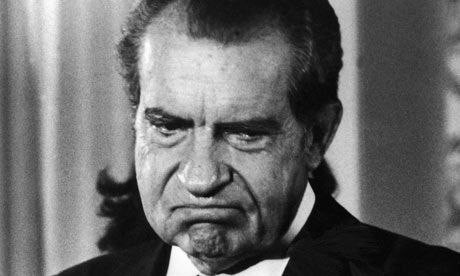
They can’t lay this one off on you, Dick.

I know it is much the vogue in Washington these days for leaders to blame previous leaders for persistent problems rather than to accept accountability and responsibility for not successfully solving them. Trendy though this attitude may be, however, Washington Post columnist Kathleen Parker’s column assigning fault for the U.S. public’s growing and frightening distrust of government institutions to Richard Nixon and the Watergate scandal shows its folly. It flies in the face of history and fairness, and lets literally thousands of subsequent leaders, elected officials, journalists, pundits and assorted knaves and hypocrites off scot-free.

Parker writes,

“Beyond the obvious, Nixon and the Watergate episode did great, perhaps irreparable, harm to the American spirit. A generation already traumatized by a war that ended up killing 58,000 of its brothers, boyfriends, husbands and fathers lost any remaining innocence, as well as trust in authority and faith in governmental institutions. The flag our forefathers raised on the moral high ground looked suddenly shabby and soiled. When even the president of the United States was willing to burglarize the American people, there was no one left to trust”

Oh, nonsense. The Watergate scandal, by the end, was one of the American system’s finest hours. The system worked, and worked on live television for all to see. A brave judge, John Sirica, showed integrity and grit in refusing to cave in to Presidential intimidation, ordering Nixon to turn over the tapes that ultimately proved his guilt. Senators and House members of both parties handled a complex inquiry diligently and well, with ethics heroes emerging on the Republican side, in individuals like Sen. Howard Baker, and the Democratic side, with the inspiring Senator Sam Irwin and others. When Nixon decided to fire the Special Prosecutor, Archibald Cox, who was getting too close to the truth, his own Cabinet member, Attorney General Eliot Richardson, resigned rather than do Nixon’s dirty work. Ultimately, Republicans and Democrats alike on the House Judiciary Committee voted for impeachment, forcing Nixon to resign. Yes, Tricky Dick was unethical and untrustworthy, but Americans had known that—and called him Tricky Dick— for decades. Then as now, too many Americans decided that “policies” trumped character, so they elected a man whose flawed values and integrity was a matter of public record—twice. Nonetheless, when he and his minions violated the law and threatened the principles of democracy, the vital institutions of the House, the Senate, the judiciary and the press showed their strength and virtue. Nixon was corrupt, not the Presidency, not the government. Continue reading

Incompetent Elected Officials Of the Month: Oh, Brother!

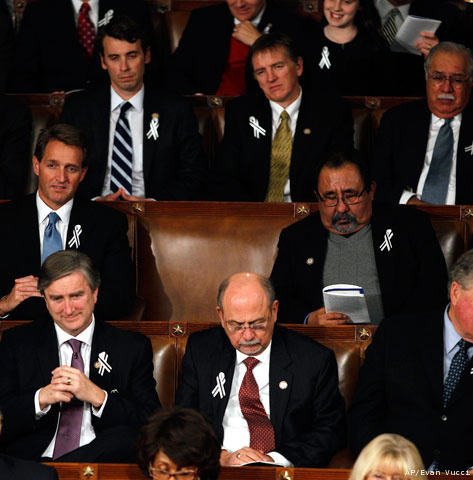
My mood after I wrote this...

As more and more observers predict that the individual mandate, a cornerstone of Obamacare, will be declared unconstitutional by the Supreme Court, I found my mind returning to the topics that have bothered me from the beginning. Why didn’t Congress make certain that it was on sound constitutional ground when it passed the law? Did they really understand what they were passing? Is it possible that our elected officials could spend so much time and occupy so much of the nation’s attention on an issue they didn’t understand? Surely our highest elected officials entrusted with devising the laws of this great nation must understand the powers and limits that relate to their duties in the Constitution. Don’t they? Isn’t that a minimum qualification for office?

George Mason Law Professor David Bernstein has provided clues to the answers to those question, and you’re not going to like them. He writes: Continue reading

Depressing Fun From CREW: “Are You More Ethical Than A Member of Congress?”

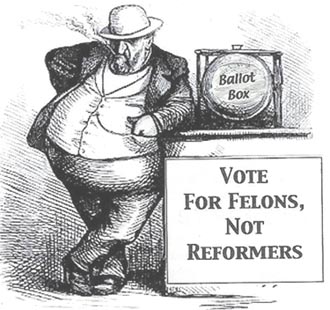
And yet, it once was even worse...

The Citizens for Responsibility and Ethics in Washington have a neat little feature on their website, an interactive survey entitled, “Are You More Ethical Than A Member of Congress?” It is well done, pointed, educational, and, if you hadn’t already figured out that the ethics on Capital Hill (and the character of the elected officials displaying them is beyond redemption, really depressing.

It is only a slight exaggeration to say that if you aren’t more ethical than a member of Congress, you are probably either in jail, or should be.

You can take the survey here.


Patch Motto Ethics, or WHO CARES???

Bear with me—this story has a point, and besides, it’s funny.

George S. Kaufman had the right idea.

Playwright George S. Kaufman  (“The Man Who Came To Dinner”, “You Can’t Take It With You”, and many more) was a panelist on  the long-forgotten early TV  program, “This is Show Business.” One of its features was to have a celebrity consult the panel members about a personal problem. On one show, singer Eddie Fisher ( father of Carrie) complained to the panel that some women refused to go out with him because of his youth. Kaufman replied with this immortal expression of complete disinterest:

“Mr. Fisher, on Mount Wilson there is a telescope that can magnify the most distant stars to twenty-four times the magnification of any previous telescope. This remarkable instrument was unsurpassed in the world of astronomy until the development and construction of the Mount Palomar telescope.  The Mount Palomar telescope is an even more remarkable instrument of magnification. Owing to advances and improvements in optical technology, it is capable of magnifying the stars to four times the magnification and resolution of the Mount Wilson telescope.

“Mr. Fisher, if you could somehow put the Mount Wilson telescope inside the Mount Palomar telescope, you still wouldn’t be able to see my interest in your problem.”

This is how I feel about the controversy over the removal of a reference to God on an Air Force unit’s patch, and it is how, I believe, everyone should feel, from the atheists who agitated for the patch to be changed, to the ridiculous Republican House members who are opposing the change. Continue reading

Better Late Than Never Dept.: Rep. Giffords Finally Does The Right Thing

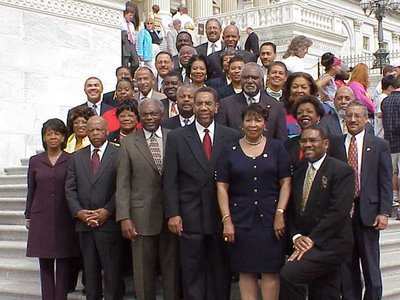
That's the Democratic Congresswoman from Arizona in the center.

Ethics Alarms first stated that Rep. Gabrielle Giffords was seriously disabled and needed to resign from the house on January 17, 2011. I wrote:

“Almost no medical experts foresee a woman with such massive head injuries being able to return to work within a year, if she can return at all. She only has a two-year term. Is it fair to the people of Arizona, not to mention the country, to have a member of Congress who is unable to work during the days ahead, which are critical to the nation on so many fronts?”

Although the answer to this question was obvious at the time, Rep. Giffords did not resign. I returned to the topic in March, June, September and November, but not only did the Giffords camp and Democrats continue to ignore the issue, the media largely did as well. Never mind that during a contentious and important year of critical legislative issues, one Congressional District in Arizona was essentially unrepresented.

Today, finally, Rep. Giffords announced that she had resigned, more than a year after being shot in the head. Her friend, Democratic National Committee Chair Debbie Wasserman Schultz, told the press that her friend’s recovery was likely to take years, not months. WOW! That’s a bulletin! Who had any idea that the Congresswoman was that seriously injured? Continue reading