Ethics Quote Of The Month: Secretary Of State John Kerry

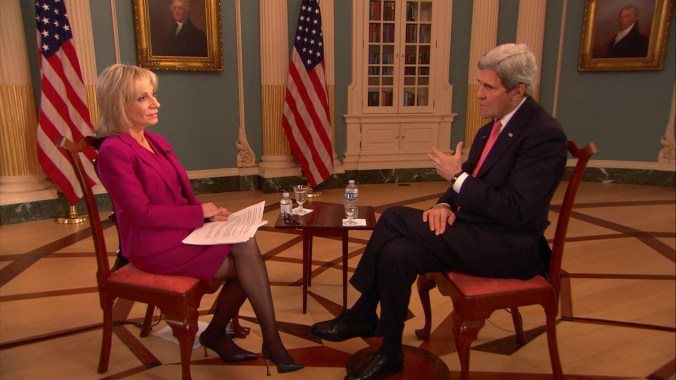
mitchell-kerry_140226

“…I’m proud of all the efforts we made to try to lead people to a peaceful resolution.”

John Kerry, in an interview on MSNBC, when asked if he had any regrets about the Administration’s handling of Syria;

The Sec. of State’s full answer:

Well again, Andrea, I’m going to have a lot of opportunities to be able to look back and digest what choices might have been made. I’m not going to do it now… Except to say to you, very clearly, that I’m proud of all the efforts we made to try to lead people to a peaceful resolution. And in fact, the only solution to Syria will be a peaceful agreement along the lines of what we laid out… and the several communiques that we issued, and the United Nations resolution that we passed. 2254. Those will be the basis for whatever happens, if they get there.

No, I’m not going to call Kerry’s statement an unethical quote, even as close as it came to making my head explode. Fortunately my expectations of John Kerry are basement-level low, from long experience. However, the latest fatuous sentiment from this veteran doofus is provocative and instructive.

In many pursuits, as we discuss here often, whether someone has done the right thing, made the ethical choice, should be evaluated on the basis of whether the conduct was competently considered and arrived at according to facts and ethical considerations before the conduct commenced. Judging its ethical nature  afterwards, when factors the decision-maker could not have foreseen or controlled have affected the result, is a fallacy: “It all worked out for the best” and thus the decision must have been ethical. This is consequentialism, and “the ends justifies the means” in its most seductive form.

A very recent example was the Republican leadership’s decision not to consider President Obama’s nomination of Merrick Garland to the Supreme Court. No, the tactic wasn’t unconstitutional or illegal. It was unethical, however: obstructive, partisan politics defying tradition and fairness. It was also, as I pointed out at the time, stupid. When Obama, knowing of the GOP’s intent, appointed not a flame-breathing left-wing zealot but a moderate-liberal judge of impressive credentials, the GOP majority in the Senate should have rushed to confirm him, knowing well that a nomination by Obama’s presumed successor, Hillary Clinton, would unbalance the Court to a far greater degree.

The GOP lucked out, as we now know. Now President Trump will fill that vacancy on the Court, with major impact on important legal disputes for decades to come. That’s all moral luck, however. The ethics verdict on the conduct still stands. It worked, but it was wrong.

Success is not irrelevant to ethics, of course. Many jobs are ethically complex because getting a desired result is part of the mission. The result and the manner of achieving it are important. If your job is to win the war, you can’t say you did an excellent job if the war was lost. Competence is still an ethical value. A successful CEO’s company does not go belly-up by definition. Government is often analogized to sailing a ship to a destination, or flying a plane, with good reason. Part of the responsibility a government leader has is to make choices that work to the benefit of  those governed, and others as well. A captain whose ship sinks cannot say afterwards, “I did one hell of a job.” Continue reading

Warning From Great Britain: The “Lawscam” Excuse Is Coming To Colleges

It was all the fault of imperial Indian history....

It was all the fault of imperial Indian history….

The controversy died down a bit in 2016, but it is still out there: unemployed young lawyers are still blaming their law schools for the fact that their degrees didn’t deliver riches and success in a competitive field. When a ballyhooed lawsuit by one such lawyer failed last April, it briefly muted the howling, but the central misconception is still virulent. From the Ethics Alarms post about that law suit:

The rejection of Alaburda’s law suit sends a message that young lawyers need to hear, and heed. If they thought a law degree was going to guarantee their success, they have been tragically confused by the culture’s hucksters and politicians, not the law schools.  For too long, education has been sold as the key to income and jobs, when it is nothing but a process designed to make more competent, able, creative and responsible human beings. By itself, a degree proves nothing. It only signifies that its owner has had access to useful knowledge and the chance to develop useful skills. It is up to graduates to use that knowledge and those skills to make a life for themselves. If they fail to achieve their goals, they cannot blame the law school because they perceived a promise that was never made.

One failed suit, however, couldn’t undo the destructive false message society and its leaders have been issuing for decades: “the purpose of earning a diploma is to get a good job.” As more and more young men and women are steered into college and a college degree becomes symbolic of nothing, there will be more law suits by college graduates like the one currently being fought in Great Britain, where Faiz Siddiqui, an Oxford graduate, is suing his alma mater for not giving him a first-class degree 16 years ago. (In British universities, graduating with a “first class degree” is roughly similar to graduating “with honors” in an American college. Based on a student’s grades, Oxford gives out three classes of degrees, first-class being the highest.)

Siddiqui is now 38 years old, angry and disillusioned. In his suit, he alleges that his life and career were stunted because he didn’t earn “a first,” as the degree is called, when he  studied modern history at Brasenose College and graduated from Oxford University in June 2000. “Negligent teaching” in a course on Indian imperial history, he says, pulled down his overall grade and ruined his life. Now he’s asking for a million British pounds in damages for his lack of lifetime earnings in a legal action against the Oxford chancellor, masters and scholars. His barrister, Roger Mallalieu, also claims that Oxford is responsible for Siddiqui’s insomnia and depression.

Apparently the history module was less than optimum while Siddiqui was a student, because half of the teaching staff responsible for Asian history were on sabbatical.  Mallalieu told the British high court that the inferior teaching resulted in his client’s lesser grade and thus “denied him the chance of becoming a high-flying commercial barrister.” Continue reading

Don’t Feel Too Bad, Americans: Ethics Alarms Aren’t Ringing In Canada, North Korea Or Japan, Either

It’s an International Ethics Dunce parade!

donald-trump-humane-society

1. Ontario, Canada

The Windsor-Essex County Humane Society in Ontario thought it would be really clever to use the Donald Trump phrase that many believe disqualify him to be President in an ad to adopt kitty-cats. It featured a photo of Trump and said, “You don’t have to be a star to grab a pussy … cat.”

Amazing. Not one person in the chain of custody of this—I would say obviously, but when so many people miss it, I guess it’s not—offensive ad had an ethics alarm sound.  Nobody had the sense, prudence or guts to say,

“Uh, guys? Hello? You do realize that this is using a phrase describing sexual assault while alluding to the one who used it to describe sexual assault? You do realize that “pussy” alluding to female genitalia is vulgar and uncivil, right? No? Here, let me explain it to you…or hwo about this: there is no way this won’t spark criticism. Is that what you want?”

Sure enough,  the ad promoting cat adoptions this week for $50, was taken down shortly after it appeared this week.

The society offered a pathetic apology. Melanie Coulter, executive director of the humane society, “explained” it was an attempt to make light of the U.S election campaign, though it also “made light” of sexual assault, contemptuous attitudes toward women,  and obscene rhetoric.

“We are obviously sorry if people are offended by the ad — that wasn’t our attempt in the least,” Coulter said. “Our attempt was to find homes for cats that need them.” She also added that the shelter took in more than a hundred cats in the last week.

For the record, the rationalizations here are…

3. Consequentialism, or  “It Worked Out for the Best”

13. The Saint’s Excuse: “It’s for a good cause”

19A The Insidious Confession, or “It wasn’t the best choice.”

It also suggests that I need to add “We meant well” to the list as a sub-rationalization to #13.

****

contest-winner

2. Kuroishi, Japan

Continue reading

Ethics And The New TV Season, Part 1: “The Good Place”

There are an unusual number of shows this season that should be full of fascinating ethical dilemmas. There is even sitcom, “The Good Place,” with a main character who is an ethicist. He’s a dead ethics, but that’s something. Let’s start with that show as I plan on reviewing the ethics-related TV shows in future posts.

The first episode of  the NBC comedy  began with selfish, habitually unethical  Eleanor Shellstrop (Kristen Bell) waking up in the afterlife called “the Good Place, I assume to avoid religious controversy. Michael (Ted Danson) welcomes her, and explains that he designed this particular Good Place neighborhood that she will reside in for eternity. As many of us were taught, our lives on Earth are being monitored by higher beings, literally and figuratively. In this show’s cosmology, they calculate our ethical worth using a point system.  Those with the highest positive point totals make it to the Good Place.

The problem is that there has been a glitch: Eleanor was erroneously awarded the point score of a capital punishment-fighting lawyer (naturally the Good Place regards all progressive and liberal positions as “good;” I assume that all conservatives and Republicans are in the Bad Place) when she really was a salesperson for an evil drug company. The situation in this sitcom is whether Eleanor can shape up and justify her points before she is found out and ends up playing strip poker in Hell with Ronald Reagan, William F. Buckley and Phyllis Schlafly.* Continue reading

A Moral Luck-Riddled Ethics Quiz: The Compassionate, Correct, Fired Police Officer

man-pointing-a-gunI have solicited opinions from some police authorities , and have yet to receive an answer. Maybe that’s cheating, though.

On May 6 of this year,  Weirton, West Virginia police officer Stephen Mader confronted a distraught and armed man after responding to a domestic violence call. “I saw then he had a gun, but it was not pointed at me,”  Mader told reporters. A silver pistol was in 23-year-old Ronald Williams’ right hand, hanging at his side and pointed at the ground.

Officer Mader calmly told Williams to put down the gun. “Just shoot me, ” Williams  responded, and jerked his wrists, suggesting that he was preparing to raise his weapon. “I’m not going to shoot you brother, ” replied Mader.

“I thought I was going to be able to talk to him and de-escalate it. I knew it was a suicide-by-cop,” he said.

Then two other Weirton officers arrived on the scene. Williams walked toward them waving his gun, and one of Mader’s colleagues shot Williams in the head, killing him instantly.

A West Virginia State Police investigation later concluded that the shooting was justified. Mader, in the meantime, faced an investigation of his own. In a meeting with his chief and the city manager,  Mader was told that he was being placed on administrative leave, and that an investigation would determine if he would still be employed.  “You put two other officers in danger,” the police chief told him.

Following the investigation, Mader received a notice of termination stating that by not shooting Williams, Mader“failed to eliminate a threat.”

Your Ethics Alarms Ethics Quiz of the Day:

Was it fair and responsible for the department to fire Officer Mader as a result of this incident?

Continue reading

The Amazing Saga Of Big Papi And Maverick Schutte: This One Has Everything, Folks: Baseball! The Bambino! Courage! Kindness! Compassion! Heroics! Moral Luck! Hubris! Consequentialism! And Dammit, I’m Crying Again

Let’s see if I can through this to the Ethics Quiz portion without shorting out my laptop.

Maverick Schutte, a 6-year-old from Cheyenne, Wyoming, has required over 30 surgeries, including five open chest procedures,  to treat a heart condition.He still must be hooked up to a ventilator most of each day to allow oxygen to reach his lungs, and more surgery will be needed, as he is in constant danger of heart failure.

The child’s greatest joy is baseball, and he has adopted his father’s team, the Boston Red Sox, as his passion. The Children’s Miracle Network put the family in touch with former Red Sox player Kevin Millar, now an MLB host and broadcaster, and Millar contacted Red Sox slugger David Ortiz, Maverick’s favorite, after the family explained that Maverick was in the hospital again and needed a morale boost. With Millar, Ortiz made a video for Maverick, ending with Ortiz promising to hit a home run that night, just for him. I didn’t believe it when I heard the story, but it was true. “Stay positive, keep the faith, and I’m going to hit a home run for you (Friday night),” Ortiz says in the video. “Remember that.”

Your Ethics Alarms Ethics Quiz for today before, as Paul Harvey would say, you learn “the rest of the story”…

Was it ethical for Ortiz to make such a promise to Maverick?

Continue reading

Talia Jane, Public Jerk, Grabs Credit For Yelp’s Pay Raise

She's baaaaaack!

She’s baaaaaack!

Remember the fifteen-minutes of infamy of Talia Jane, an entry-level Yelp employee who posted an article to the social media site Medium titled, An Open Letter To My CEO?    Cheekily addressed to “Jeremy” (Yelp Chief Executive Officer Jeremy Stoppleman), the letter/rant/ classic of arrogant entitlement was a long, snotty whine about her low compensation—you know, like all entry-level jobs—alleged abject poverty (which was quickly shown to be a lie), high Bay Area living expenses (because they were a secret until she moved there), company policies and the fact that Yelp creator Stoppleman was rich.

Jane was thoroughly shredded by every online commentator (including Ethics Alarms) over the age of 21 and not a Bernie Sanders supporter. The obnoxious screed showed a complete lack of personal responsibility for her own choices, and made her a strong candidate for Most Unattractive Job Candidate of 2016. My conclusion:

I wouldn’t trust Talia Jane to run my lemonade stand.

Hey, but she’s young, she made a mistake, and she’ll learn and grow through this misstep, understanding the error of her ways and going forward to become a fair, reasonable, ethical member of society, right?

Fat chance. I hesitated to pronounce her essay as signature significance, a misbegotten ethics botch of a magnitude that indicated the author was probably an incurable toxic jerk, because 25 is too early to write off even the most egregious offenders. She may learn yet, I suppose, but the most recent evidence is not encouraging. Continue reading

Three Strong Links: NCAA Cheating, Minimum Wage Delusions, Journalism Standards and Teammate Betrayal

three-links

Here are three essays on current ethics issues, all worth reading and pondering.

1. At Slate, the topic is what constitutes legitimate news, and consequentialism: if a news source publishing non-news creates a real news event because of that publication, does this justify the original publication?

No, of course not. The incident in question involves a gossip site that posted a video shoing Los Angeles Laker Nick Young admitting to cheating on his fiancée, pop star Iggy Azalea. The video was surreptitiously recorded by Young’s teammate, D’Angelo Russell, and now the Lakers are shunning Russell, causing a problem for the team on and off the court. Now is the video newsworthy. Yes, but yecchhh.

The story is here.

2. Commentary discusses the strange trend of liberal legislators pushing extreme minimum wage increases on their cities and states despite risks of serious job losses. California is the latest example. Here is the head exploding quote:

“Why shouldn’t we in fact accept job loss?” asks New School economics and urban policy professor David Howell, who’s about to publish a white paper on the subject. “What’s so bad about getting rid of crappy jobs, forcing employers to upgrade, and having a serious program to compensate anyone who is in the slightest way harmed by that?”

Kaboom. Continue reading

Fairness To Clinton: #WhichHillary Is Fair, Black Lives Matter Isn’t

Racial Justice Sign

Protesters who interrupt speeches are not engaging in free speech, they are defiling it. We can expect protesters of all sizes, shapes and colors to be interfering with campaign appearances this year, forcing candidates into a lose-lose-lose proposition of either giving the activists a platform they don’t deserve, rewarding rude and disrespectful behavior and looking weak (as Bernie Sanders did last year, allowing a Black Lives Matter group to hijack a campaign appearance), trying to ignore the disruption and thus being unfair to those who came to hear a speech without static, or being  confrontational with the protesters and alienating voters who may sympathize with their cause.

This is one area in which Donald Trump has a clear advantage: since neither he nor his addled supporters care about ethical values, he can safely be abusive to protesters, and he is. At the rate his abuse is escalating, I expect him to egg on one of his mobs to burning or eating one by the spring.

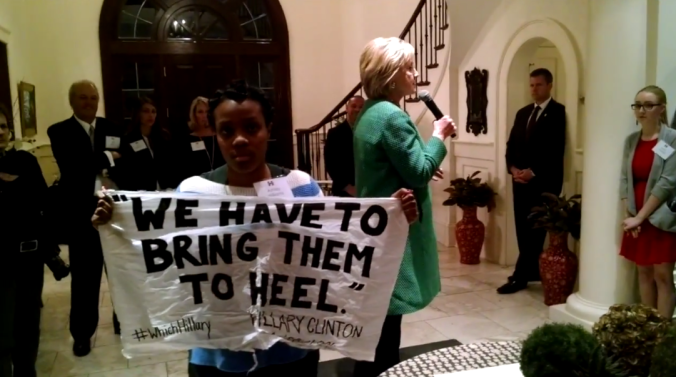
Thus I must sympathize with Hillary Clinton, who just had an ironic ethics encounter. Continue reading

Ethics Jump Ball: What Is An Ethical Reaction To This Story?

Pippa-Bacca

From the BBC (2008):

An Italian woman artist who was hitch-hiking to the Middle East dressed as a bride to promote world peace has been found murdered in Turkey.

The naked body of Giuseppina Pasqualino di Marineo, 33, known as Pippa Bacca, was found in bushes near the northern city of Gebze on Friday.

She had said she wanted to show that she could put her trust in the kindness of local people.

Turkish police say they have detained a man in connection with the killing.

Reports say the man led the police to the body.

I think I’ll add my reactions to the comments.

Fragments can be found in the tags.

You go first.

__________________

Pointer: Red Flag