Note To The News Media: Stop Encouraging Consequentialism!

Marco Rubio gallantly stood up to Fox’s Chris Wallace as the news anchor repeatedly asked him whether “knowing what we know now,” it was a mistake to invade Iraq in 2001. The previous version of the question that inexplicably tripped up Jeb Bush was self-answering: knowing how badly it would work out, no sane leader would make that decision, but since nobody can see into the future, it is like asking if we should have recruited Superman to help out U.S. troops if, you know, he was real. Wallace’s question, if possible, is worse. It validates the ethics rotting principle of consequentialism, in which we judge an action by its unpredictable results.

An decision is only a mistake if it was badly reasoned based on the information the decision-maker had at the time the decision was made. It does not become a mistake based on subsequent, unknowable events. Similarly, an action doesn’t become ethical just because it worked out well, or unethical because it didn’t. This misconception is rampant among the public, and leads to bad policy, bad decision-making, bad leadership, bad lots of things. It is bad.

Hectored by Wallace, Sen. Rubio, who does understand that “mistake” doesn’t mean what Wallace was implying it does, kept saying, “No, it was not a mistake, because it was the right decision based on what we knew at the time.” Now, you can argue that the decision was the wrong one based on that information, but that’s not what Wallace was asking…and asking, and asking. He obviously thinks “mistake” is defined as a decision that doesn’t work out the way the decision-maker hoped. Wrong.

Chris Wallace was making his audience dumber and less ethically astute. We judge actions and decisions based on the quality of the choice when it is made, which includes a rational, well-reasoned analysis of its likely results. By Wallace’s logic, driving home from the Christmas party smashed is only a mistake if you crash, kill someone, or get arrested.  The sober party goer who gets killed by a drunk driver as he drives home, in Wallace’s reasoning, made a mistake going to the party at all. The lesson, apparently, is that its a mistake to go to parties.

This is how incompetent and arrogant journalists made us dumber, and our leaders so risk averse that they are incompetent.

By the way, on CNN this morning, the gang is making fun of Rubio, like he’s the idiot. Of course. After all, he’s a Republican.

The Jeb Bush “Gotcha!”: Unfair Question, Dumb Answers

Enough about Iraq, Jeb: When did you stop beating your wife?

Enough about Iraq, Jeb: When did you stop beating your wife?

In the vast history of unfair questions, even including such immortals as “When did you stop beating your wife?,”none is more unanswerable in a substantive way than the question Jeb Bush was asked on Fox News—yes, that’s the same Fox News that supposedly lobs softballs for any Republican. The question: “Knowing what we know now” would he have authorized the Iraq war?

What possible use is that question, other than as an exercise in complete hindsight bias? If the answer is no, it appears to validate the dishonest criticism of the war decades ago, by those who attributed new knowledge about the infamous WMD’s to the original decision, which wasn’t about weapons of mass destruction in the first place. If it is yes, it is evidence of insanity.

Now we know that the invasion would be botched, the U.N. would cravenly and irresponsibly withhold support for enforcing its own resolutions, that our hillbilly soldiers would torture Iraqi prisoners and take photos of it, that the new Iraqi government would be incompetent and corrupt, that the news media would assist Democrats in re-writing the history of the decision, and most of all, that even after the situation in Iraq had finally been stabilized, an incompetent President would prematurely pull out our troops, causing the government to implode and ISIS to thrive.

George W. Bush had even said when he was President that if he had known that no WMD’s were there, he would not have invaded Iraq. That was also a dumb answer at the time, and I believe a dishonest one. But today, W. would give the same answer, and knowing what we know now, it would be both correct and honest. That’s if he were silly enough not to say, as his younger brother was too dim to say, this:

“I’m not answering that. It’s pointless. Would Lee have ordered Pickett’s Charge, knowing how it would turn out? Would I have left the dock as captain of the Titanic, knowing that it would hit an iceberg? Would I have approved the Space Shuttle program, knowing that two shuttles would meet with disaster? “Would you still go to see ‘Our American Cousin,’ Mrs Lincoln?” A decision can only be judged based on what the known situation is at the time. It cannot be fairly judged based on the results of the decision, immediately or years later. That’s consequentialism; it’s a logical fallacy.

and

“Nor can I answer the question of what I would have decided in my brother’s place, because I do know how things worked out, and he, of course, could not know. So asking that question is unfair to me, and answering it would be unfair to him. “

But Jeb was too dim to say that. So first he answered… Continue reading

“Piss Christ” and Garland

Piss-Christ

Ethics Alarms participant Other Bill raised “Piss Christ” on the comment thread to my post about the Garland, Texas attack, progressives’ and news media’s “hate speech isn’t free speech” confusion, and Geller’s supporters’ “gratuitously uncivil speech is laudable” delusion. He posted a column by George Parry, published under the heading “Think Tank” on a Philadelphia site. I’m grateful to Bill for raising the column, which he neither endorsed nor criticized. Titled Double Standard on Offending Christians and Muslims, Parry’s argument was…

  • “Christians objected to “Piss Christ” and the feces-covered Holy Virgin. And they rightfully wondered why their tax dollars had been used to promote these blasphemies. But their objections and questions were condescendingly dismissed by the secular left in the media and intelligentsia. …
  • “As if in one voice, the mainstream media and self-anointed intelligentsia argued that antiquated religious sensitivities must not be allowed to interfere with either an artist’s free expression or his right to government funding regardless of how offensive his work may be to Christians….”
  • “In Garland, Texas, on Sunday, two radical Muslims died trying to replicate the Charlie Hebdo massacre by mounting an armed attack on a “draw Mohammed” cartoon contest. We are not talking about drawings of Mohammed dunked in urine or smeared with animal dung. No, the gunmen apparently deemed the mere drawing of Mohammed to be an offense punishable by death…The overall media consensus has been to blame the intended murder victims for recklessly provoking the terrorists. Such provocation, we are told, is unacceptable and irresponsible behavior given the risk of retaliation by offended radical Muslims…”
  • “Better to question the wisdom of cartoonists exercising their rights than to acknowledge and vigorously confront and expose the elephant in the room, i.e., that there is a disturbingly large number of radical Muslims in this country who oppose our Constitution and who believe that murder is an appropriate sanction for those who offend Islam….”
  • “All of which leads to this question: Given their pusillanimous double standard, why should any reasonable or serious person believe, respect, or credit the self-serving mainstream media?”

That’s not the question. First of all, there is already no reason to believe, respect, or credit the mainstream media. Second, while Parry is correct that the analysis of the issues in the Garland attack have been largely incompetent and tainted by media dislike of Geller and journalism’s own cowardice (most news outlets were afraid to show the Charlie Hebdo cartoons, even though they were essential to reporting on the Paris massacre), his analogy with “Piss Christ” is no better.

The questions areContinue reading

Ten Ethics Musings On The “Unethical Photograph Of The Year” And The Daughters of Villi and Mary Kay

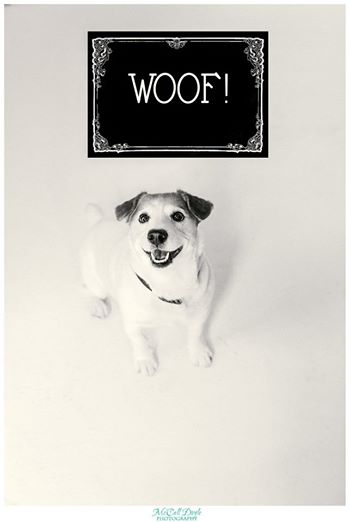
Here's my Jack Russell Rugby doing his imitation of the dog in "The Artist." It's a good antidote, at least for me, when I look at the Villi and Mary Kay family photo. Keeps the gorge down.

Here’s my Jack Russell Rugby doing his imitation of the dog in “The Artist.” It’s a good antidote, at least for me, when I look at the Villi and Mary Kay family photo. Keeps the gorge down.

I should have included these with original post, but the photo so nauseated me that I was barely capable of critical thought. I’m still nauseated, but better. So now I offer these ten question and thoughts:

1. Will this photo and its implication be used by cultural to excuse student-teacher sexual liaisons? They are grotesquely unethical when minors are involved, but professionally reprehensible even when the loving couple are college professor and student.

2. I presume it will. As I noted in the original post, this photo is a breeding ground for rationalizations, “No harm, no foul” among them, and of course, “It all worked out for the best.” This is like showing the modern China that arose out of Mao’s slaughter of millions with the face of the Great Leader superimposed over it all. It worked out so well! How can anyone argue with that?

3. Every time a grossly wrongful act creates some unanticipated good, consequentialism runs amuck. If Mary Kay  and Rape Victim Vili had produced children who had arms growing out of their mouths or who were drug-addicts and cat-burners, the same people who look at the photo now and say  “Awww!” would be pointing and crowing, “See?”

4. The proper comparison is a family created through incest. That taboo is so powerful still that a similar photo of Mom, Dad/Grandad and lovely Daughter–No, Sister! No, Daughter! No, Sister! (Sorry, I was having a “Chinatown” flashback) would not garner the kind of positive reaction too many are having to the Happy Fualaau. Continue reading

The Unethical French Animator, the Mammalian Duck, Dysfunctional Ethics Alarms

“Oggy and the Cockroaches” is a French animated comedy series produced by Xilam and Gaumont Film Company. Its future on the Nickelodeon children’s TV cartoon channel NickToons is in doubt, however, after the channel was thrust into an unwanted controversy by an unknown French cartoonist’s practical joke.

A recent episode that aired on NickToons featured a brief view of a framed wall hanging showing a cartoon female duck sporting a pair of bikini briefs, sunglasses and bouffant hair-do, and most significantly, naked torpedoesque breasts of a variety more familiar to afficionados of “Fritz the Cat” than the target audience of eight-year-olds. Naturally, the station was deluged with complaints from parents.

The NickToons  website now appears to have removed the show from both its schedule and its homepage. Good start. It should also end any relationship it may have with Xilam and Gaumont.

I know cartoonists are not known for an excess of maturity, but a network needs to be able to reside a modicum of trust in its contractors, suppliers and partners. If an animator would think it’s funny to slip a topless, sexy duck into a kid’s show, then who is to say the next “joke” won’t be a giant talking penis or Adolf Hitler having sex with a cow?

Far more disturbing than the prank itself are the rationalizations and justifications being offered for it in online comments to the story and in social media: Continue reading

Unethical Quote of the Week: Sen. John McCain, and also “WHAT????”

U.S. Senator John McCain gestures as he arrives to address the third session of the Republican National Convention in Tampa

“It was kind of a very rapid process. Everybody was looking forward to getting out of town because of the snowstorm. I think we probably should have had more discussion about it, given the blowback that there is.”

—- Sen. John McCain (R-Az) to Politico, explaining and making excuses for 47 Republican Senators injecting themselves into sensitive U.S. negotiations with Iran over nuclear weapon development..

1. I am speechless. Luckily, I can type.

Well, sort of.

2. The silver lining: at least the Senator just made those regretting President Obama’s election in 2008 feel better. We were spared embarrassing moments like that of President McCain, asked why he sent missiles to destroy Toronto, explaining, “Yeah, I was watching “Family Feud,” had to run to the can, and was distracted. Hey, it happens.” Continue reading

Downton Abbey Ethics: Evil Barrow’s Ethics Lesson

Downton-abbey-season-5

If some of your PBS watching friends are unclear on those essential ethics analysis tools, the concepts of moral luck and consequentialism, the season finale of “Downton Abbey”( which you can view here) provided a wonderful example of both in action.

Now, settle down, because this takes some table-setting: Continue reading

Comment of the Day: “Ethics Alarms Encore: ‘Aesop’s Unethical and Misleading Fable: The North Wind and the Sun”

AESOPSFABLNever let it be said that we aren’t eclectic on Ethics Alarms! Today’s Comment of the Day is a thoughtful response to my objections to Aesop’s “The North Wind and the Sun,” a 2011 post that I republished this week in fascination over how it continues to draw traffic. The thread here and on the original has touched on many diverse topics, including theology; commenter Rich (in CT), however, just submitted the most interesting analysis yet.

Here is his Comment of the Day on the post, Ethics Alarms Encore: “Aesop’s Unethical and Misleading Fable: The North Wind and the Sun:

”The comparison of God and Satan in Job to the Sun and Wind is an apt comparison, because the fable relies on “divine privilege”. An exercise of divine privilege should not be taken as an example of behavior that non-divine entities should emulate. Rather, they are external parameters that set up a hypothetical environment to illustrate the lesson of the story.

I specifically say “lesson”, because the objective of the story need not be a superficial “moral”. The “moral” that was selected here was a lazy plot device by an author who attempted to pigeon-hole the fable into his limited definition of a fable. While the particular moral in the version you share is useless, the fable perhaps might better illustrate both the use of strategic thinking and well as illustrate the role of moral luck in one’s success. A more apt “moral”, if any, might be to be clever, but acknowledge the limit of cleverness.

Ethical behavior never takes place in a vacuum, but must balance certain principles with the current circumstances. In the fable, an arbitrary task is selected, and the two actors use the tools at their disposal to attempt to achieve the task. The wind has two tools: blow hard or soft; the sun has analogous tools: beat hard or soft. Given the task, arbitrarily set up as a competition, only one had tools that could creatively solve the task.

The tale here thus illustrates a few important principles that are of value to a child; creative use of ones tools can lead to success, and that not everyone has a every tool available. A non-lazy author might use the fable to teach the value of cooperation, pooling a group’s tools to complete a task.

The particular task is irrelevant, and is set up as an exercise of divine privilege. Mere mortals have no right to manipulate the weather, but the fable’s embodiment of the solar rays and moving air manipulate these elements in an ethically neutral manner. The selection of a mere mortal as a target of task, might be to lead the reader indirectly, through empathy, to the conclusion that some circumstances are arbitrary and beyond one’s control. The objective might be to teach humility, that one is never entirely responsible for one’s success, no matter how clever one might be.

I thus agree that the particular version of the fable shared is unethical. This is, however, the result of a lazy author. The premise, if used wisely, is ethically neutral; Aesop, or some other interpreter, could use the premise of the story to teach a valuable lesson if so desired.


Ethics Alarms Encore: “Aesop’s Unethical and Misleading Fable: The North Wind and the Sun”

north-wind-and-the-sun-story-oil-painting

[ I vowed that the next time I got a comment on this post, I would publish it again. It hails from four years ago, when  Ethics Alarms got a quarter of the traffic it gets now. I confess that I wrote it on a whim, having been talking with my wife about how Aesop’s Fables were joining Mother Goose stories,  Edward Lear limericks and American folks song in the Discarded Bin of our culture and then stumbling upon a fable I had either never read before or forgotten about.  To my surprise the post attracted intense criticism from fans of the story—I even had to ban a commenter who got hysterical about it—and the post joined a very eclectic group of early essays here that get considerable and consistent readership every week. Apparently there are a lot of Sun-worshipers out there. Anyway, since you probably missed it the first time, here it is.]

Today, by happenstance, I heard an Aesop’s Fable that I had never encountered before recited on the radio. Like all Aesop’s Fables, at least in its modern re-telling, this one had a moral attached , and is also a statement of ethical values. Unlike most of the fables, however, it doesn’t make its case. It is, in fact, an intellectually dishonest, indeed an unethical, fable.

It is called “The North Wind and the Sun,” and in most sources reads like this:

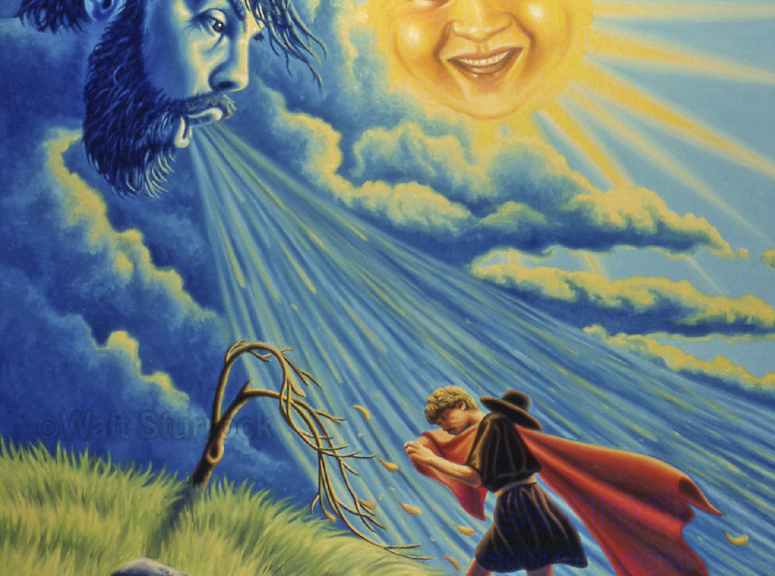
“The North Wind and the Sun disputed as to which was the most powerful, and agreed that he should be declared the victor who could first strip a wayfaring man of his clothes. The North Wind first tried his power and blew with all his might, but the keener his blasts, the closer the Traveler wrapped his cloak around him, until at last, resigning all hope of victory, the Wind called upon the Sun to see what he could do. The Sun suddenly shone out with all his warmth. The Traveler no sooner felt his genial rays than he took off one garment after another, and at last, fairly overcome with heat, undressed and bathed in a stream that lay in his path.”

The moral of the fable is variously stated as “Persuasion is better than Force” , or “Gentleness and kind persuasion win where force and bluster fail.”

The fable proves neither. In reality, it is a vivid example of dishonest argument, using euphemisms and false characterizations to “prove” a proposition that an advocate is biased toward from the outset. Continue reading

Is It Ethical For Professors To Date Students?

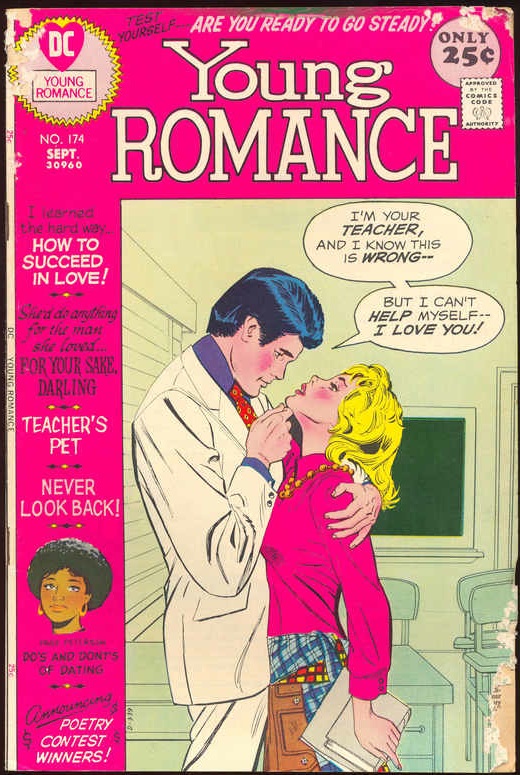
teacher-student datingProfsBlog asks the question regarding law professors and law students, but the question doesn’t change by narrowing the definition. The question is really, and only, “Is it ethical for teachers to have romantic relationships with students?” The answer is, has been, and forever shall be, “No.”

The answer to an ethics question sometimes becomes obvious when it is apparent that every argument on one side is either a logical fallacy, an unethical rationalization, or the application of an invalid ethics principle. Such is the case here, and thus I somewhat question the motives of the author of the post, Kelly Anders. Wishful thinking, perhaps? Asking the question creates the illusion that there is a real controversy. In this case, there isn’t.

I addressed this question a long time ago, in an early post here barely seen at the time but among the most frequently visited since. I wrote:

[P]rofessors [are] obligated to maintain a position of authority, objectivity and judgment as mentors and teachers of the whole student body, and [have] a duty to their schools not to allow their trustworthiness to be undermined by having intimate relationships among the same group that they [are] supposed to be supervising and advising. Dating a student is a professional breach of trust, and one that adversely effects the integrity of the entire educational institution…. The appearance created when a supervisor/manager/leader indulges in intimate relations with someone over whom they have authority, status and power—and every professor has authority over every student, in class or out— undermines the institution and the profession, by sending the false message that such relationships are standard, approved, and implicitly desirable in the culture where they occur…A professor has a potential teacher-student relationship with all students at a university, not just those in his or her classes.

Dating a student who happens not to be in one of those classes is what lawyers call “a distinction without a difference.” Many students and professors will reasonably assume that the pairing arose out of the student-teacher relationship, and in some ways it almost certainly did. A teacher always has superior power over any student by virtue of his or her position of authority, and it is an abuse of that power to use it to entice students into dates or bed…

[It] is naive to ignore the extended conflicts such relationships create. Might the professor’s best friends on the faculty be more generous when grading their friend’s significant other if he or she is one of their students? Will the professor consciously or subconsciously be easier on the friends of his student lover if they are in his class? The fact that the question can be asked shows that the situation should not occur where it can be asked.

Students, all students, must be off-limits as romantic partners for professors and administrators in universities, regardless of what rules are in place.Professors who date students risk their jobs because a student body is not their sexual smorgasbord, and it is a breach of trust and duty to treat it like one.

I wouldn’t change a word, except that typo I just noticed, and just fixed in the original. Nor is anything I wrote then revolutionary or new. These are the realities of authority, professionalism, leadership and power. It’s just that sometimes people really, really wish they were not. Continue reading