Cutting to the chase: It’s ridiculous that this standard issue country ballad is a culture war battlefield. Anyone who took the time to watch Ken Burns’ documentary on the genre will immediately recognize the themes, though Anthony’s blue collar anthem is a bit more whiny than most. Jeez, man, stop bitching and do something about it: that’s the American way! Though I guess he is, by exploiting the politicization of everything today to make a lot of money with a song that doesn’t offer anything new or original, just the familiar “Those rich politicians up North don’t care about us hard-working folks, so life is a struggle and it ain’t getting any better.”
Country music superstar Morgan Wallen was suspended indefinitely by his record label and removed from hundreds of radio stations across the country yesterday. The reason? He was captured on camera saying “nigger.” TMZ posted a video this week showing Wallen loudly returning home with friends. A neighbor started recording the scene and the video included Wallen using the word. If you can tell the context of his words, please explain it to me. Was “nigger” meant as an insult, or was it used playfully? Was the target white or black? There is no evidence that he “hurled” the word, because that suggest that it was hurled at someone.
I’m kidding; I didn’t watch the Emmys, have not watched a second of the Emmys in decades, and can’t imaging a greater waste of time than watching the Emmys, and that includes the time I spent watching “Tusk,” the Kevin Smith black comedy in which a madman played by Michael Parks traps a jerk podcaster played by Justin Long and surgically transforms him into a human walrus. I kind of liked it, to be honest.
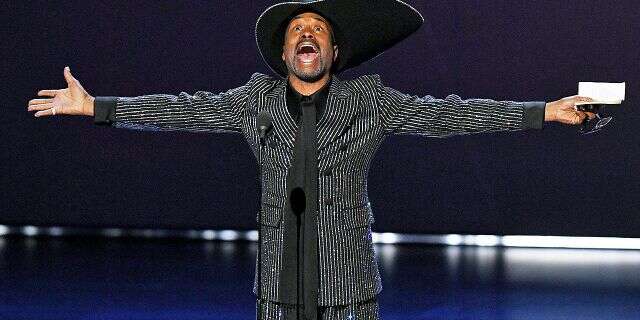
That’s Billy Porter above, by the way, the first openly gay actor to win a performing Emmy, after the many, many non-openly gay actors who have won over all these years. Making a big deal out of this diminishes his honor, since it suggests that his sexual orientation had something to do with his winning the award. I don’t see any reason why who an actor chooses to have sex with should have any relevance to an acting honor.
[UPDATE: Not that it matters, but the Emmy broadcast ratings hit an all-time low. What? People voluntarily passed up a chance to see actresses use their podium time to lecture about acceptance of trans individuals, and basing industry pay levels on gender equity rather than value?]
1. Country music’s Jackie Robinson. Ken Burns’ documentary “Country Music,” on PBS now, convinced me that Charlie Pride, the first black country music star, deserves more accolades than he has received, as do the white producers and allies, like Chet Akins, Jack D. Johnson, and Louis Allen “Al” Donohue, who made it possible for him to break that culture’s color barrier.
Inspired by Robinson, Pride resolved as a teen to escape the cotton fields. He played minor league baseball, and sang in bars to make extra cash. Then he was “discovered” by two country music figures and advised to go to Nashville.
It’s an amazing story (why Pride’s life hasn’t been made into a movie, I don’t know). Apparently at the beginning of his career, stations played his records without noting his race. In the documentary, Pride describes a Detroit concert where he was introduced to an all-white audience of nearly 20,000 that roared and applauded when he walked out, and then suddenly became silent when they saw his skin color. Do you think that scene might have inspired Richard Pryor to write this one?
2. Jerk of the Year? Just being the NFL Jerk of the Year is an achievement (there is so much competition), but Antonio Brown, the star receiver signed by the New England Patriots (in their own bid for NFL Jerks of the Year) after he had jerked his way off his previous two teams, then released after two sexual misconduct allegations against him surfaced, went out in a blaze of jerkness.
Some employers are troubled by the avocations and outside activities of employees, a concern that often deserves a defiant “none of your business” in response. However, sometimes the concern is justified, such as when the avocation adversely reflects on the individual’s reputation to the extent that it harms his or her ability to perform, or when the avocation actually interferes with the job, such as a when a recreational rugby player keeps missing work because of injuries. Another problem is when the avocation creates a conflict of interest in which conduct that may be good for the avocation undermines the job.
The latter is exemplified by Major League Umpire Joe West, who fancies himself a country music singer and songwriter when he isn’t calling balls and strikes. As nicely narrated on the blog “It’s About the Money,” West has long been the most flamboyant and combative of umps, as proven by the fact that a lot of people know his name. Umpires aren’t supposed to be stars, celebrities or personalities: if you notice a particular umpire, it is almost always because he has made a mistake. They are important, however. Their acuity of sight and judgment are called upon many times in every game, and can make a significant difference in scores, standings, championships and careers. Like judges, they have to be trusted, and their integrity above suspicion. “The Common Man,” who wrote the blog post, believes that West’s singing career, such as it is, creates a conflict of interest that undermines that trust, and worse, warps his judgment on the field. Continue reading →
 Ethics Alarms