Third Of July Ethics Concert, 2020, Part 1: Pickett’s Charge, Custer’s First Stand, And More

Charge!

The anthemic music is the finale to the 1993 film Gettysburg, which has one of my all-time favorite scores, by Randy Edelman. I have worn out three CDs, and this particular selection, “Reunion and Finale,” almost lost me my drivers license once when I was playing it loudly in my car and blew past the speed limit by 25 mph or so.

I will be interested to see if any channel shows Ted Turner’s epic this weekend. I’m sure it is now regarded as politically incorrect because the film does not portray the Southern generals and soldiers as vicious racists, and the balance that the film was praised for when it was released is now regarded as “pro-Confederacy propaganda.” That is a fatuous take on the film, which is about human beings, not politics, and arguably the most historically accurate historical drama ever made, based on what may be the best historical novel ever written, “The Killer Angels,” by Michael Shaara, just a wonderful book. Read it. You can thank me later.

Unlike July 2, one of the most significant dates in U.S. history with multiple major events, July 3 stands out for one momentous event. Even in the sequence of events leading to American independence, July 3 was relatively boring:  it was devoted to the debate over Jefferson’s Declaration, resulting in more than eighty additions and redactions.

July 3  was the final day of the pivotal Battle of Gettysburg in 1863, reaching its bloody climax in General Robert E. Lee’s desperate  gamble on a massed assault on the Union center. In history it has come to be known as Pickett’s Charge, after the leader of the Division that was slaughtered during it.

At about 2:00 pm this day in 1863, near the Pennsylvania town of Gettysburg,  Lee launched his audacious stratagem to pull victory from the jaws of defeat in the pivotal battle of the American Civil War.  The Napoleonic assault on the entrenched Union position on Cemetery Ridge, with a “copse of trees” at its center, was the only such attack in the entire war, a march into artillery and rifle fire across an open field and over fence. When my father, the old soldier, saw the battlefield  for the first time in his eighties, he became visibly upset because, he said, he could visualize the killing field.

The battle lasted less than an hour. Union forces suffered 1,500 casualties,, while at least 1,123 Confederates were killed on the battlefield, 4,019 were wounded, and nearly 4000 Rebel soldiers were captured. Pickett’s Charge would go down in history as one of the worst military blunders of all time. Continue reading

Ethics Dunce: The Anonymous University of California, Berkeley History Professor

A professor (allegedly) at the University of California in Berkeley is being praised on social media and conservative websites for the letter below, which the claimed member of the History department distributed to the faculty, and has been subsequently re-posted elsewhere.

The writer won’t get any praise here. “I am worried that writing this email publicly might lead to me losing my job, and likely all future jobs in my field,” the message says. Well, tough. Anonymous arguments and declarations of principle are cheap, easy, and ineffective. People in positions of influence and authority have an obligation to take stands when stands are required, and to do so openly and boldly. They also risk the enmity of the mob and others by doing so, which is what makes their stands legitimate and powerful.

Anonymous sentiments like the one below are a particularly wan form of grandstanding, allowing the writer—the courageous rebel!—to feel like he or she (heck, this could be an articulate spaniel) is resisting societal pressure and peer manipulation and trying to persuade others to do likewise, when in fact the message is dead on arrival. Why should anyone respect such a cowardly iconoclast? We can assume, can we not, that this professor, if it is a professor, will nod  and agree with all  race-baiting, police-bashing, America-denigrating colleagues until escaping into the safety and privacy of a private office.

Such people fueled Joe McCarthy’s reign of terror. Such people allowed Hitler to take over Germany. They are worse than sheep; they are sheep who imagine themselves as something better, and they are not.

It’s a powerful, tough, persuasive and much-needed letter, or would be, if the author had the guts to put his name on it. Here, for example, the letter lays out what I have been longing to see or hear expressed:

“As a final point, our university and department has made multiple statements celebrating and eulogizing George Floyd. Floyd was a multiple felon who once held a pregnant black woman at gunpoint. He broke into her home with a gang of men and pointed a gun at her pregnant stomach.

He terrorized the women in his community. He sired and abandoned multiple children, playing no part in their support or upbringing, failing one of the most basic tests of decency for a human being. He was a drug-addict and sometime drug-dealer, a swindler who preyed upon his honest and hard-working neighbors.

And yet, the regents of UC and the historians of the UCB History department are celebrating this violent criminal, elevating his name to virtual sainthood. A man who hurt women. A man who hurt black women. With the full collaboration of the UCB history department, corporate America, most mainstream media outlets, and some of the wealthiest and most privileged opinion-shaping elites of the USA, he has become a culture hero, buried in a golden casket, his (recognized) family showered with gifts and praise. Americans are being socially pressured into kneeling for this violent, abusive misogynist. A generation of black men are being coerced into identifying with George Floyd, the absolute worst specimen of our race and species. I’m ashamed of my department. I would say that I’m ashamed of both of you, but perhaps you agree with me, and are simply afraid, as I am, of the backlash of speaking the truth. It’s hard to know what kneeling means, when you have to kneel to keep your job.”

Wow. Too bad that it’s worthless, except to alert us to how many enablers there are who will let our society and our values rot and express their objections in whispers.

Dear profs X, Y, Z

I am one of your colleagues at the University of California, Berkeley. I have met you both personally but do not know you closely, and am contacting you anonymously, with apologies. I am worried that writing this email publicly might lead to me losing my job, and likely all future jobs in my field. In your recent departmental emails you mentioned our pledge to diversity, but I am increasingly alarmed by the absence of diversity of opinion on the topic of the recent protests and our community response to them.

In the extended links and resources you provided, I could not find a single instance of substantial counter-argument or alternative narrative to explain the under-representation of black individuals in academia or their over-representation in the criminal justice system. The explanation provided in your documentation, to the near exclusion of all others, is univariate: the problems of the black community are caused by whites, or, when whites are not physically present, by the infiltration of white supremacy and white systemic racism into American brains, souls, and institutions.

Many cogent objections to this thesis have been raised by sober voices, including from within the black community itself, such as Thomas Sowell and Wilfred Reilly. These people are not racists or ‘Uncle Toms’. They are intelligent scholars who reject a narrative that strips black people of agency and systematically externalizes the problems of the black community onto outsiders.

Their view is entirely absent from the departmental and UCB-wide communiques. The claim that the difficulties that the black community faces are entirely causally explained by exogenous factors in the form of white systemic racism, white supremacy, and other forms of white discrimination remains a problematic hypothesis that should be vigorously challenged by historians. Instead, it is being treated as an axiomatic and actionable truth without serious consideration of its profound flaws, or its worrying implication of total black impotence.

This hypothesis is transforming our institution and our culture, without any space for dissent outside of a tightly policed, narrow discourse.

A counternarrative exists. If you have time, please consider examining some of the documents I attach at the end of this email.

Overwhelmingly, the reasoning provided by BLM and allies is either primarily anecdotal (as in the case with the bulk of Ta-Nehisi Coates’ undeniably moving article) or it is transparently motivated. As an example of the latter problem, consider the proportion of black incarcerated Americans. This proportion is often used to characterize the criminal justice system as anti-black. However, if we use the precise same methodology, we would have to conclude that the criminal justice system is even more anti-male than it is anti-black.

Would we characterize criminal justice as a systemically misandrist conspiracy against innocent American men? I hope you see that this type of reasoning is flawed, and requires a significant suspension of our rational faculties. Black people are not incarcerated at higher rates than their involvement in violent crime would predict. This fact has been demonstrated multiple times across multiple jurisdictions in multiple countries. And yet, I see my department uncritically reproducing a narrative that diminishes black agency in favor of a white-centric explanation that appeals to the department’s apparent desire to shoulder the ‘white man’s burden’ and to promote a narrative of white guilt.

If we claim that the criminal justice system is white-supremacist, why is it that Asian Americans, Indian Americans, and Nigerian Americans are incarcerated at vastly lower rates than white Americans? This is a funny sort of white supremacy. Even Jewish Americans are incarcerated less than gentile whites. I think it’s fair to say that your average white supremacist disapproves of Jews. And yet, these alleged white supremacists incarcerate gentiles at vastly higher rates than Jews. None of this is addressed in your literature. None of this is explained, beyond hand-waving and ad hominems. “Those are racist dogwhistles”. “The model minority myth is white supremacist”.

“Only fascists talk about black-on-black crime”, ad nauseam. These types of statements do not amount to counterarguments: they are simply arbitrary offensive classifications, intended to silence and oppress discourse. Any serious historian will recognize these for the silencing orthodoxy tactics they are, common to suppressive regimes, doctrines, and religions throughout time and space. They are intended to crush real diversity and permanently exile the culture of robust criticism from our department.

Increasingly, we are being called upon to comply and subscribe to BLM’s problematic view of history, and the department is being presented as unified on the matter. In particular, ethnic minorities are being aggressively marshaled into a single position. Any apparent unity is surely a function of the fact that dissent could almost certainly lead to expulsion or cancellation for those of us in a precarious position, which is no small number.

I personally don’t dare speak out against the BLM narrative, and with this barrage of alleged unity being mass-produced by the administration, tenured professoriat, the UC administration, corporate America, and the media, the punishment for dissent is a clear danger at a time of widespread economic vulnerability. I am certain that if my name were attached to this email, I would lose my job and all future jobs, even though I believe in and can justify every word I type.

The vast majority of violence visited on the black community is committed by black people. There are virtually no marches for these invisible victims, no public silences, no heartfelt letters from the UC regents, deans, and departmental heads. The message is clear: Black lives only matter when whites take them. Black violence is expected and insoluble, while white violence requires explanation and demands solution.

Please look into your hearts and see how monstrously bigoted this formulation truly is. No discussion is permitted for nonblack victims of black violence, who proportionally outnumber black victims of nonblack violence. This is especially bitter in the Bay Area, where Asian victimization by black assailants has reached epidemic proportions, to the point that the SF police chief has advised Asians to stop hanging good-luck charms on their doors, as this attracts the attention of (overwhelmingly black) home invaders. Home invaders like George Floyd. For this actual, lived, physically experienced reality of violence in the USA, there are no marches, no tearful emails from departmental heads, no support from McDonald’s and Wal-Mart.

For the History department, our silence is not a mere abrogation of our duty to shed light on the truth: it is a rejection of it.

The claim that black intraracial violence is the product of redlining, slavery, and other injustices is a largely historical claim.

It is for historians, therefore, to explain why Japanese internment or the massacre of European Jewry hasn’t led to equivalent rates of dysfunction and low SES performance among Japanese and Jewish Americans respectively. Arab Americans have been viciously demonized since 9/11,as have Chinese Americans more recently. However, both groups outperform white Americans on nearly all SES indices – as do Nigerian Americans, who incidentally have black skin. It is for historians to point out and discuss these anomalies. However, no real discussion is possiblein the current climate at our department. The explanation is provided to us, disagreement with it is racist, and the job of historians is to further explore additional ways in which the explanation is additionally correct. This is a mockery of the historical profession.

Most troublingly, our department appears to have been entirely captured by the interests of the Democratic National Convention, and the Democratic Party more broadly. To explain what I mean, consider what happens if you choose to donate to Black Lives Matter, an organizationUCB History has explicitly promoted in its recent mailers. All donations to the official BLM website are immediately redirected to ActBlue Charities, an organization primarily concerned with bankrolling election campaigns for Democrat candidates. Donating to BLM today is to indirectly donate to Joe Biden’s 2020 campaign. This is grotesque given the fact that the American cities with the worst rates of black-on-black violence and police-on-black violence are overwhelmingly Democrat-run. Minneapolis itself has been entirely in the hands of Democrats for over five decades; the ‘systemic racism’ there was built by successive Democrat administrations.

The patronizing and condescending attitudes of Democrat leaders towards the black community, exemplified by nearly every Biden statement on the black race, all but guarantee a perpetual state of misery, resentment, poverty, and the attendant grievance politics which are simultaneously annihilating American political discourse and black lives. And yet, donating to BLM is bankrolling the election campaigns of men like Mayor Frey, who saw their cities devolve into violence. This is a grotesque capture of a good-faith movement for necessary police reform, and of our department, by a political party. Even worse, there are virtually no avenues for dissent in academic circles. I refuse to serve the Party, and so should you. The total alliance of major corporations involved in human exploitation with BLM should be a warning flag to us, and yet this damning evidence goes unnoticed, purposefully ignored, or perversely celebrated. We are the useful idiots of the wealthiest classes, carrying water for Jeff Bezos and other actual, real, modern-day slavers. Starbucks, an organisation using literal black slaves in its coffee plantation suppliers, is in favor of BLM. Sony, an organisation using cobalt mined by yet more literal black slaves, many of whom are children, is in favor of BLM. And so, apparently, are we. The absence of counter-narrative enables this obscenity. Fiat lux, indeed.

There also exists a large constituency of what can only be called ‘race hustlers’: hucksters of all colors who benefit from stoking the fires of racial conflict to secure administrative jobs, charity management positions, academic jobs and advancement, or personal political entrepreneurship.

Given the direction our history department appears to be taking far from any commitment to truth, we can regard ourselves as a formative training institution for this brand of snake-oil salespeople. Their activities are corrosive, demolishing any hope at harmonious racial coexistence in our nation and colonizing our political and institutional life. Many of their voices are unironically segregationist.

MLK would likely be called an Uncle Tom if he spoke on our campus today. We are training leaders who intend, explicitly, to destroy one of the only truly successful ethnically diverse societies in modern history. As the PRC, an ethnonationalist and aggressively racially chauvinist national polity with null immigration and no concept of jus solis increasingly presents itself as the global political alternative to the US, I ask you: Is this wise? Are we really doing the right thing?

As a final point, our university and department has made multiple statements celebrating and eulogizing George Floyd. Floyd was a multiple felon who once held a pregnant black woman at gunpoint. He broke into her home with a gang of men and pointed a gun at her pregnant stomach.

He terrorized the women in his community. He sired and abandoned multiple children, playing no part in their support or upbringing, failing one of the most basic tests of decency for a human being. He was a drug-addict and sometime drug-dealer, a swindler who preyed upon his honest and hard-working neighbors.

And yet, the regents of UC and the historians of the UCB History department are celebrating this violent criminal, elevating his name to virtual sainthood. A man who hurt women. A man who hurt black women. With the full collaboration of the UCB history department, corporate America, most mainstream media outlets, and some of the wealthiest and most privileged opinion-shaping elites of the USA, he has become a culture hero, buried in a golden casket, his (recognized) family showered with gifts and praise. Americans are being socially pressured into kneeling for this violent, abusive misogynist. A generation of black men are being coerced into identifying with George Floyd, the absolute worst specimen of our race and species. I’m ashamed of my department. I would say that I’m ashamed of both of you, but perhaps you agree with me, and are simply afraid, as I am, of the backlash of speaking the truth. It’s hard to know what kneeling means, when you have to kneel to keep your job.

It shouldn’t affect the strength of my argument above, but for the record, I write as a person of color. My family have been personally victimized by men like Floyd. We are aware of the condescending depredations of the Democrat party against our race. The humiliating assumption that we are too stupid to do STEM, that we need special help and lower requirements to get ahead in life, is richly familiar to us. I sometimes wonder if it wouldn’t be easier to deal with open fascists, who at least would be straightforward in calling me a subhuman, and who are unlikely to share my race.

The ever-present soft bigotry of low expectations and the permanent claim that the solutions to the plight of my people rest exclusively on the goodwill of whites rather than on our own hard work is psychologically devastating.

No other group in America is systematically demoralized in this way by its alleged allies. A whole generation of black children are being taught that only by begging and weeping and screaming will they get handouts from guilt-ridden whites.

No message will more surely devastate their futures, especially if whites run out of guilt, or indeed if America runs out of whites. If this had been done to Japanese Americans, or Jewish Americans, or Chinese Americans, then Chinatown and Japantown would surely be no different

to the roughest parts of Baltimore and East St. Louis today. The History department of UCB is now an integral institutional promulgator of a destructive and denigrating fallacy about the black race.

I hope you appreciate the frustration behind this message. I do not support BLM

I do not support the Democrat grievance agenda and the Party’s uncontested capture of our department. I do not support the Party co-opting my race, as Biden recently did in his disturbing interview, claiming that voting Democrat and being black are isomorphic.

I condemn the manner of George Floyd’s death and join you in calling for greater police accountability and police reform. However, I will not pretend that George Floyd was anything other than a violent misogynist, a brutal man who met a predictably brutal end.

I also want to protect the practice of history. Cleo is no grovelling handmaiden to politicians and corporations. Like us, she is free.

Before The Rot Set In: Wendell Willkie And James Beggs [Corrected]

A quote in an obituary for long-time NASA chief James Beggs, who died this week at the age of 94, shocked me into realizing once again how alien basic ethics have become to our leaders in business, government, politics…hell, just about anywhere.  And once again, I’m wondering what good I’m doing, and why I bother.

Beggs had overseen more than 20 successful space shuttle launches, but he was on administrative leave due to an investigation of his conduct when the Challenger launched and exploded in 1986. As we have discussed on Ethics Alarms, a landmark example of failed ethics and decision-making caused the temporary leadership of NASA to ignore dire warnings from two engineers and send the shuttle and its precious human cargo up in dangerously cold weather.  Indeed Beggs called NASA  from his exile that fateful day to express his concern about icing. He resigned from NASA in 1986, about a month after the Challenger disaster.

Beggs was reluctant to criticize his former agency’s culpability in the accident, but he was adamant that “they shouldn’t have launched.”  “Whether I would have done anything different at the time, I’ve thought about that,” he said. “I think I would have, but that’s pure conjecture.”

Remarkable. How often does a critic of a past decision have the intrinsic fairness and integrity to say that? The Wuhan virus landscape has been polluted by extravagant and unjust second-guessing from the start, as everyone from politicians to pundits to plumbers are just certain that they would have known how to handle an unprecedented situation with significant unknown factors and substantial risk. They would have reached a different, quicker,better approach than the individual who actually had to make the call.

It’s a disgusting spectacle, and an unethical one. The “right” decision can always be made to seem obvious after the fact; critics cannot possibly know what their state of mind would have been at the actual time the decision had to be made by someone else. Beggs’ acknowledgement of that, in a situation where he could have credibly second-guessed his colleagues without equivocation, demonstrates the character of a decent and ethical professional determined to do and say the right thing even when opportunities are present for personal gain.

That story, in turn, reminded me of…Wendell Willkie. Continue reading

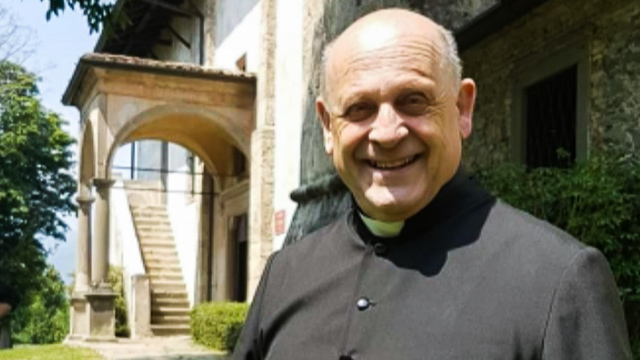
Ethics Hero: Don Giuseppe Berardelli

Be sure to tell David Brooks about this..

Don Giuseppe Berardelli, an Italian priest, died from the Wuhan virus after giving up his respirator to a younger patient, a stranger.  The following is from the Google Italian to English translation of this source:

 Don Giuseppe had been archpriest of Casnigo for almost fourteen years and would have concluded his mission in Casnigo. He ended it earlier, in a hospital in Lovere, hit by the coronavirus. Already last year he had had health problems. His perennial smile, his availability, but also his activism in the realization of important and expensive works, that smile hid the worries.

He was a simple, straightforward person, with a great kindness and helpfulness towards everyone, believers and non-believers. His greeting was ‘peace and good’. Always friendly and available to the public administration, associations and not only those of the parish, he participated in all the events without ever being intrusive…. He was loved by everyone: his former parishioners still came from Fiorano after years to find him. But he also had an incredible ability to solve economic problems, to knock on the right doors for help.

This is the testimony of Giuseppe Imberti, long mayor of Casnigo: “Don Giuseppe died as a priest.  And I am deeply moved by the fact that the archpriest of Casnigo, Don Giuseppe Berardelli – to whom the parish community had bought a respirator – announced his will to assign it to someone younger than him.” Continue reading

From The Ethics Alarms Archives: “Age and the Judge,” And A Current Day Example.

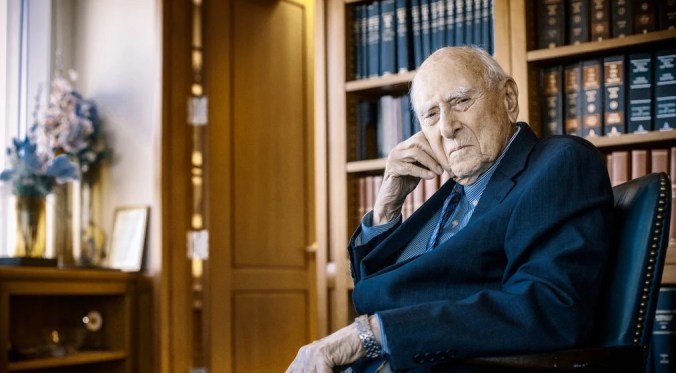
The discussions regarding Joe Biden’s age-related decline reminded me of a post that had been languishing on the runway since mid February. It was prompted by a tip from Neil Doer (I think it was Neil) who pointed me to this article about  a well-respected federal judge in Brooklyn, Jack B. Weinstein who was retiring after more than a half-century on the bench. He’s 98 years old, and it seems like he’s been an outstanding judge. My position was and is, however, that it is unethical for a judge, and indeed any professional, to continue in a position of responsibility at such an advanced age.

Obviously, I would apply that principle to politicians and leaders as well. This is another area where professional sports, especially baseball, provides useful case studies that can be instructive. Players who were great at 25 are also better when they are 40 than the more average players, whose natural decline as the result of aging will usually cause them not be able to perform  at an acceptable standard by late middle age. The great player often will still be good, but almost no player (almost) will be as excellent in his late 30s and early 40s as he was in his prime. As the financial benefits and other perks of playing major league baseball have increased over time, fewer aging greats are willing to go gentle into the good night of retirement. Their last years are often sub-par, certainly for them, or worse, but they will not voluntarily retire. Check the records of Miguel Cabrera, Pete Rose, Willy Mays, and Mickey Mantle, to name just a few.

Famously brilliant and contrary judge Richard Posner took the unpopular position among his colleagues that federal judges ought to have a mandatory retirement age. He recommended 80, but in his own case, when everyone expected him to stay until the bitter end, he retired at 78, because, he said, it was time. I’m not convinced that 80 isn’t still too old, but at least it’s a limit.

I remember well my one meeting with Antonin Scalia at a bar function not long after he had joined the Supreme Court.  He was relaxed and jovial, and when I asked him how long he thought he’d stay on the Court, he laughed and said that he couldn’t imagine staying until they “carried him out,” like so many other justices. He said it was important to leave the bench “while you still have most of your marbles.,” and to him, this meant before 80. He said he would stay about ten years.

Antonin Scalia died while still on the Court, in his 20th year of service, just short of his 80th birthday.

Here, from 2009, is “Age and the Judge.”

___________________________________________

Continue reading

Remember The Alamo Today, March 6, When The Fort Fell, And Entered American Lore And Legend Forever.

The following post was mostly assembled from past essays here about my favorite event in American History…

I will never forget my first visit to the Alamo, and seeing Texans weeping, openly, proudly, as they read the plaque with Travis’s words engraved on it:

Commandancy of the Alamo
Bejar, Feby. 24, 1836

To the People of Texas & All Americans in the World

Fellow citizens & compatriots

I am besieged, by a thousand or more of the Mexicans under Santa Anna I have sustained a continual Bombardment and cannonade for 24 hours & have not lost a man The enemy has demanded a surrender at discretion, otherwise, the garrison are to be put to the sword, if the fort is taken I have answered the demand with a cannon shot, and our flag still waves proudly from the walls. I shall never surrender or retreat. Then, I call on you in the name of Liberty, of patriotism and everything dear to the American character, to come to our aid, with all dispatch. The enemy is receiving reinforcements daily & will no doubt increase to three or four thousand in four or five days. If this call is neglected, I am determined to sustain myself as long as possible and die like a soldier who never forgets what is due to his own honor & that of his country VICTORY OR DEATH.

William Barret Travis.

The story of the Alamo isn’t taught in schools outside of Texas. It wasn’t taught in my school, either: like most American history, I learned about the event though a thick mixture of pop culture, reading (Walter Lord’s “A Time To Stand” was a birthday present in 1961) and ongoing research. I recently completed “Texas Rising,” which was also just broadcast on cable as a mini-series starring the late Bill Paxton as Sam Houston. Historian Stephen Moore is a plodding writer, but he nicely puts to rest the currently popular politically correct slander that the defenders of the Alamo and the Texas rebels were fighting to keep their slaves, and trying to steal Mexico’s land. The Texians were opposing a dictator who had changed the terms under which they had come to the territory, and anyone familiar with the American character could have predicted what would happen when a despot demanded that they submit to unelected authority. The Alamo was a fight for liberty and democracy, and its martyrs exemplified sacrifice for principle and country.

From the official Alamo website:

While the Alamo was under siege, the provisional Texas government organized at Washington-on-the-Brazos. On March 2, the convention declared independence and the Republic of Texas was born, at least on paper. The Alamo’s garrison showed its support for independence from Mexico by sending its own delegates to the convention.While they were unaware that Texas had declared independence, the roughly 200 Alamo defenders stayed at their post waiting on help from the settlements. Among them were lawyers, doctors, farmers and a former congressman and famous frontiersman from Tennessee named David Crockett. While the youngest was 16 and the oldest defender was Gordon C. Jennings, age 56, most defenders were in their twenties. Most were Anglo, but there were a handful of native Tejano defenders as well. Legendary knife fighter and land speculator James Bowie was in command before falling ill and sharing duties with Travis. Several women and children were inside the Alamo, including 15-month-old Angelina Dickinson. Just before the final battle, Travis placed his ring around her neck, knowing she would likely be spared. One of the last messages from the Alamo was a note from Travis asking friends to take care of his young son Charles.

The final attack came before dawn on March 6, 1836. As Mexican troops charged toward the Alamo in the pre-dawn darkness, defenders rushed to the walls and fired into the darkness. Travis raced to the north wall but was soon killed. Bowie was most likely killed in his bed, while reports differ as to Crockett’s death. Many believe Crockett survived the initial attack but was put to death by Mexican soldiers soon afterward.

Mexican soldiers breached the north wall and flooded into the compound. The fierce battle centered on the old church, where defenders made a last stand.

The battle lasted about 90 minutes.

From the San Antonio Express News: Continue reading

A University Demonizes Diversity Of Thought

The headline in the New York Times last month read, “Indiana University Admits That Professor’s Views Are Vile, And That It Can’t Fire Him.” Nice. First, another party can’t “admit” someone else’s opinions are vile, as if there is a universal standard for “vile.”  Second, the headline assumes that the professor is the villain in this controversy, but then, that’s the Times for you: taking sides instead of reporting the facts.

I apologize for missing this chapter in the ongoing effort to intimidate and persecute anyone whose views do not align neatly with the mandated progressive orthodoxy.  The Times piece in question is dated November 23; not only was that my wedding anniversary, but I was also on an ethics training road trip without a functioning laptop. (I have one now.) I’m pretty sure I would have perceived the need for Ethics Alarms to bring some fairness to the assault on Professor Eric Rasmusen, though, as you will see, he is very capable of defending himself, if he could get a fair hearing (or reading).

The reason he can’t is because the news media has already decided that he should be shunned, as students try to run him out of academia and the marketplace of ideas.

To be clear, Professor Rasmusen is the victim of unethical conduct here, not the perpetrator of it. His “crime,” and it is not supposed to be a crime in the United States or academia, is asserting non-conforming views on his personal blog.  The news media framed the story to undermine Rasmusen by stating as fact that he “used his social media accounts to denigrate women, people of color and gay men.” That is a false and unfair characterization, Rasmusen uses his blog and social media accounts to cover a wide range of topics, often brilliantly, from the perspective of a Christian conservative. Continue reading

The Forgotten Ethics Hero: William Ruckelshaus (1932-2019)

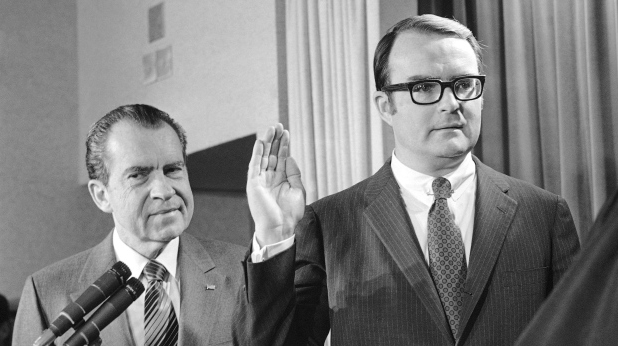
I’m supposed to be student of American Presidential history, and even I had virtually forgotten about William Ruckelshaus, who just died. It was Ruckelshaus who, along with Attorney General Elliot L. Richardson,  rejected Ethics Rationalization #15, The Futility Illusion or  “If I don’t do it, somebody else will” when the United States of America needed a hero, and got two.

His moment of courage arrived on an October night in 1973 destined to be known in the annals of American history as  the “Saturday Night Massacre.” Ruckelshaus was then Assistant Attorney General, and President Richard Nixon, was panicked that the ongoing investigation by Special Watergate prosecutor Archibald Cox was closing in on his blatant obstruction of justice. A White House-triggered burglary of the Democratic National Committee’s offices at the now-famous Foggy Bottom condo complex and hotel in Washington, D.C., seemed about to bring Nixon down, so Nixon resolved to have cripple the investigation by having Cox removed.  Ruckelshaus was the second of three officials the beleaguered POTUS ordered to fire the Harvard law professor. For some reason Nixon thought this might relieve him from having to produce the  nine incriminating Oval Office tape recordings that Cox had subpoenaed.

Ruckelshaus, under Nixon the first head of the new Environmental Protection Agency,  had been named acting head of the FBI in April of 1973, replacing L. Patrick Gray III. He was soon named the top deputy to Attorney General Elliot L. Richardson. When Nixon ordered the mild-mannered Richardson to fire Cox that fateful night, Richardson shocked Nixon by refusing, and resigning immediately. That made Ruckelshaus the Acting Attorney General, and he was suddenly on the hot seat, tasked with carrying out Nixon’s legally and ethically questionable orders.

Cox had been guaranteed complete independence by Nixon and Attorney General Richardson during the prosecutor’s Senate confirmation hearings in May of 1972.  Congress directed that he could be  be removed only for “gross malfeasance” in office, and by October 20, 1973, there had been none. “I thought what the president was doing was fundamentally wrong,” Ruckelshaus said  later. “I was convinced that Cox had only been doing what he had the authority to do; what was really of concern to the President and the White House was that he was too close. He hadn’t engaged in any extraordinary improprieties, quite the contrary.” Continue reading

Thoughts Upon Reading The Comments To The Recent “Conscience Clause” Post

The comments on the recent post regarding the so-called conscience rule being voided in court generated the comments the topic always does. What follows is a relatively short, general post to frame the issues as clearly as possible.  Admittedly, when a post is titled “When Law and Ethics Converge,” perhaps I shouldn’t have to explicate with a post focusing on the difference between law and ethics. I strongly believe that conscience clauses undermine the law, and are unethical, as you will see.

Law and Ethics are not the buddies people think they are, or wish they were. If you look around Ethics Alarms, you see why. Ethics, as the  process by which we decide and learn what is good and right conduct, evolves with time and experience. A predictable cut of a society’s ethics are always going to be a matter of intense debate. Ethics are self-enforcing, for the most part and by nature, because being ethical should make us feel good.  Once an authority or power starts demanding conduct and enforcing  conformity, we are mostly out of the realm of ethics and into morality, where conduct is dictated by a central overseer that, if it is to have genuine authority, must be voluntarily accepted by those subject to its power.

Society cannot function on ethics alone. Without laws, chaos and anarchy result. Because chaos and anarchy are bad for everyone, no individual who has accepted the social compact may decide which laws he or she will follow and which he or she will defy—at least, not without paying a price, which is society’s punishment. In ethical terms, this is a utilitarian calculation: we accept laws that individually we may find repugnant, because allowing citizens to pick and choose which laws they will obey as a matter of “conscience” doesn’t work and has never worked. Ethics pays attention to history.

Thus it is ethical to obey the law, and unethical not to,  even if good arguments can be made that particular laws are themselves unethical. This is where civil disobedience comes in: if a citizen chooses to violate a law on a the basis of that citizen’s conscience or principle, the citizen also has to accept the legal consequences of doing so as an obligation of citizenship. Continue reading

When Law And Ethics Converge: Goodbye To The Trump Administration’s Unconstitutional and Unethical “Conscience Clause”

Today’s decision by U.S. District Judge Paul Engelmayer, voiding the Trump administration’s “conscience rule” that resuscitated the Bush Administration’s similar rule, is right on the law, and, more important for this blog, right on ethics. The Trump version, which was yet to go into effect,  allowed health-care providers to refuse to participate in abortions, sterilizations or other types of care they if they disagreed with them on religious or moral grounds.

It was an invitation to open-ended discrimination, and as objectionable in principle as allowing public accommodations to refuse to serve Jews, blacks or gays. This topic has been thoroughly explored on Ethics Alarms over the years, and I don’t have anything much new to say. In fact, perusing my various essays on the topic, my favorite is one that is so old, it was on the Ethics Alarms predecessor the Ethics Scoreboard (on which I am slowly making progress in my efforts to get it back online) and mentions Paris Hilton, working at Blockbuster, and an earlier incarnation of Colin Kaepernick in the NBA.

I wrote, in 2005, Continue reading