Ethics Hero (sort of, maybe, a bit): Google

Google is a little like the turncoat in an action movie who almost sinks the hero but then makes a surprise return at the climax to save the day. In 2006, many of us were disgusted when Google agreed to help the oppressive Chinese government censor speech and information in exchange for getting a crack at the biggest market on the planet. We heard the company’s rationalizations about compromising their principles now to help open up Chinese society, but the truth always was that “Do no evil” Google was willing  to do evil for four years in exchange for a lot of yen.  At last the company finally decided that it couldn’t look at itself in its virtual mirror anymore, abandoned its agreement to help China control what its people could read and say, and moved its server to Hong Kong.

Google has garnered a lot of praise on-line and elsewhere for its decision. The company did the right thing, it is true, but it would have been far more admirable if it had taken the same position four years earlier, and refused to play the part of China’s cyber-muzzle in its quest for big bucks.

That feckless guy in the action movie who comes back in the last reel isn’t really a hero, you know. The only reason he is in a position to act like one is that he did the wrong thing in the first place. We’re glad he had a change of heart, sure. But let’s not get carried away.

__________________

Update: In the category of getting “carried away,” here is a stunning example from “Op-Ed News”:

“…again Google has found itself in a situation where its ethics are being challenged by one of the most oppressive governments (In our opinion) in the Global Community, and rather than backing down, Google has chosen to stand-up for their belief that moral values and ethics trump corporate profit, an occurrence so rare these days that we believe Google  deserves special recognition for refusing to compromise their core ethics of “Don’t be Evil,” even in a situation where it could result in the loss of huge profits in China’s booming economy and what may one day be one of the largest Internet markets in the world…”

The author, William Cormier, conveniently ignores the fact that Google’s decision that “moral values and ethics trump corporate profit” has only come after four years of letting profit trump its values. What does he think Google has been doing the last four years? Does he really believe China just started  censoring Google searches? You can read his entire, hilarious hosanna to Google here.
Remember Davy Crockett (and thank you, Fess Parker!)

If you don’t remember Fess Parker, who died this week as an 85-year-old winery owner, you missed the Fifties. Parker played Davy Crockett in Walt Disney’s TV miniseries about the lively Tennessee frontiersman, and did it with such sincerity and style that he not only turned coonskin caps into a national craze, he also rescued Davy Crockett from creeping obscurity. Continue reading

Ethics Train Wreck: Step-Dancing, Racism, and Coke

I missed this story last week. I am almost sorry it came to my attention.

February 20 witnessed the national finals of the Sprite Step Off competition in Atlanta, billed as “the largest Greek stepping competition ever.” I never heard of “step-dancing,” but that is apparently because I’m not black. It is a lively type of dancing favored by black fraternities and sororities. Although the performance by the all-white Zeta Tau Alpha team from the University of Arkansas—the only white team in the competition—received uproarious applause, mixed with amazement on the part of the almost all-black crowd that a white team could master the art, the cheers turned to jeers when they were announced as the winners.  Although few disputed that the Zeta team had been one of the very best, angry e-mails and on-line protests from African Americans began building into a tidal wave. There were accusations of “cultural theft,” and the general message was that a white team should not have been declared the winner in a step-dancing competition. That was a black tradition, and only bias could explain the white team’s success. Most of the protests came from people who had not seen the performances. Continue reading

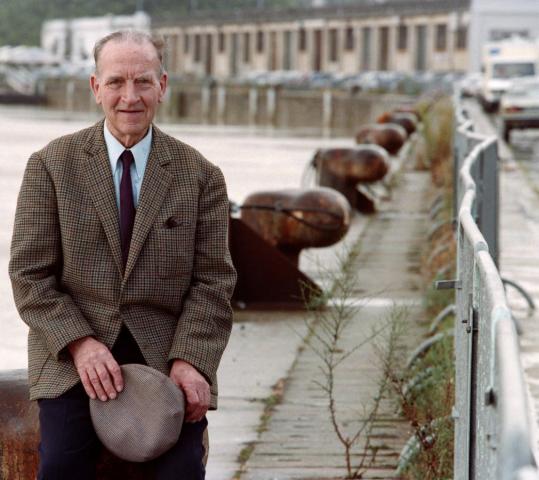
Ethics Hero Emeritus: Henri Salmide, 1919-2010

Henri Salmide by the port he saved, and came to love.

Henri Salmide by the port he saved, and came to love.

In the Nuremberg war crimes trials following World War II, the Allies took the high-minded position that “just following orders” was no defense to “crimes against humanity” committed during wartime. It is and has always been much easier to argue for defying military orders in the abstract, however, than in real combat situations. Conveniently, the victors in a war can take such a position, even knowing in their hearts, as most honest soldiers do, that they themselves might not be able to muster the courage and conviction to tell a commanding officer, “No!”

Henri Salmide, a former German soldier in World War II who died in France this week, would have been an appropriate judge for the trials, for he would not have been plagued by any such conflict or hypocrisy. For Salmide, back when he was called by his birth name of Heinz Stahlschmidt, was a rare and remarkable man who did defy an order he knew was wrong, and saved a city with his courageous, dangerous, and principled actions. Continue reading

Ethics Heroes Odd Couple: Sen. Jim Bunning and the Washingon Post

“The point Mr. Bunning was trying to make was a reasonable one: At some point, Congress has to stop borrowing and spending, even for worthy purposes.”

This wasn’t Rush Limbaugh talking, or some Fox News talking head. This was the Washington Post, in an editorial, validating the Kentucky senator’s lonely stand in which he single-handedly placed a five-day “hold” on a $10 billion bill to pay for extended unemployment benefits and other popular programs.

Bunning’s symbolic protest was vilified by the Democrats and disowned by most Republicans. As the Post editorial pointed out, it was “spectacularly bad politics,” giving the Democrats a perfect foil to symbolize the heartlessness of “the Party of No.” Courage and principle are often, and perhaps, sadly, always bad politics. Continue reading

Nancy Pelosi and Forced Virtue

I’m sure my friend and colleague Bob Stone will forgive my picking on a casual phrase he used in a comment on the previous post, for it is the inspiration for this one, and it involves the important issue of forced virtue.

Bob alluded to Speaker Nancy Pelosi finally doing “the right thing” when, as reported in the morning media, she told House Ways and Means Committee Chair Charles Rangel that he had to resign his post because of multiple ethics violations. Pelosi, we now know, had avoided this for as long as possible, first ignoring Rangel’s actions, then making the dodge that the Ethics Committee first had to make its ruling (Rangel’s egregious violations have never been in doubt), then suggesting that the violations were not significant (knowing that among them was a failure to pay taxes on $75,000 of income as well as acquiring hundreds of thousands of dollars of unreported—that is, hidden—income, all on the part of the reigning chair of the committee that oversees tax legislation) because the country wasn’t “jeopardized” by them. But now the press is calling for Rangel’s head, the Republicans are making accusations that seem, for once, reasonable, and other Democratic House members have joined the chorus demanding that Charlie must go. And this is all occurring as Pelosi is trying to martial her House majority as she attempts to ram the latest health care reform package past the nation’s gag reflex.

In short, Pelosi isn’t really doing the right thing. She’s doing the only thing. Continue reading

Ethics Hero: Liev Schreiber, an Actor Who Understands the Duty to Act

The rescue situation is finally beginning to come into focus. If you are in need to be rescued in a public venue, you don’t want to have to depend on the rapid response of off-duty EMT’s or the assistance of on-duty security personnel. No, what you need nearby is a good, professional, quick-thinking, courageous Broadway actor.

Liev Schreiber, the star of the Broadway revival of Arthur Miller’s drama “A View From the Bridge,” rushed to the aid of an audience member who lost consciousness during a performance. The man’s wife began screaming for help, and when the theater house lights were turned on, Schrieber could be seen emerging from backstage and running down the aisle to where the unconscious man was sitting. The actor tried to offer aid to him until a physician emerged from the audience, and eventually the stricken audience member was placed in the care of paramedics. Continue reading

The Dishonest or Cowardly Joke Excuse

An enthusiastic commenter to the post on Tony Kornheiser’s suspension by ESPN bases his defense of the suspended sports commentator on what I call “the joke excuse”: poor Tony was only joking when he insulted colleague Hannah Storm on his syndicated radio show, and that should insulate him from any negative consequences because humor is subjective, and we don’t want people without senses of humor snuffing out laughter in the world.

As anyone who actually has read the contents of this blog (the commenter in question has clearly not), I tend to be in general sympathy with the concept of giving humor free reign. The problem with its application here is that I see no evidence that Kornheiser was joking. His words:

“Hannah Storm in a horrifying, horrifying outfit today. She’s got on red go-go boots and a catholic school plaid skirt … way too short for somebody in her 40s or maybe early 50s by now. She’s got on her typically very, very tight shirt.She looks like she has sausage casing wrapping around her upper body … I know she’s very good, and I’m not supposed to be critical of ESPN people, so I won’t … but Hannah Storm … come on now! Stop! What are you doing?”

I’ll pause a second so you can catch your breath from uncontrollable laughter at Tony’s wit, deft use of irony. brilliant wordplay and creative absurdity. Continue reading

Ethics Hero: Sen. Scott Brown

It doesn’t matter whether the Obama Administration jobs bill Sen. Brown voted for is a good bill or not. He is an Ethics Hero for not marching in lock-step according to the demands of those who voted him into office to break the Democratic so-called “filibuster-proof” majority. A U.S. Senator, any Senator, has an ethical duty to excercise independent judgment. In light of the weight of expectations placed on him by conservatives and Obama opponents in the wake of his upset victory in Massachusetts, Scott Brown’s willingness to break ranks so early in his tenure speaks well of his character. Continue reading

Shin-Soo Choo and the Duke’s Dilemma

You wouldn’t think that a South Korean baseball player could have much in common with John Wayne, but a slugging first baseman for the Cleveland Indians named Shin-Soo Choo now faces an ethical dilemma strikingly similar to the one “the Duke” encountered in 1942. Continue reading