Life Imitates Saul

Lawyer Billboard

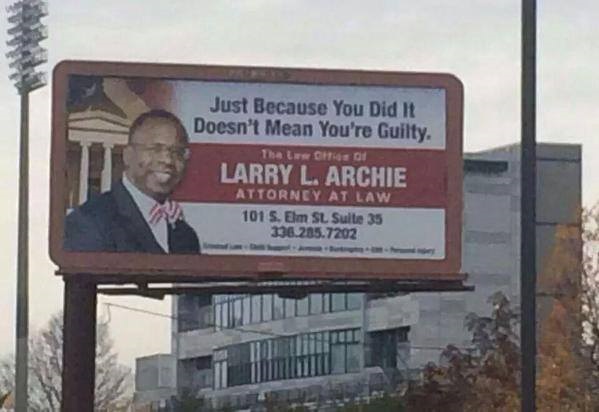
 The billboard ad of North Carolina lawyer Larry Archie has drawn a lot of attention in the state and on legal ethics forums.

Some observations:

1. I was a little late seeing “Breaking Bad” ( I tend to avoid show with drug dealers as heroes) so I didn’t see the obvious connection between the popular AMC show’s cynical, unethical and effective slime-ball lawyer Saul Goodman, played by Bob Odenkirk, and last year’s jaw-dropping—but funny!—video ad for the services of Pittsburgh criminal lawyer Daniel Muessig.

2. This is why we ignore popular culture at our peril….and I think the legal profession needs to stop laughing and start worrying. People really do think Saul who is a criminal lawyer, is typical, and bar associations are doing very little to dissuade them. This is irresponsible, dangerous, and stupid. The profession has a duty to educate the public about how lawyers are supposed to act and why, and if it whiffs on that obligation (as it has for about the last hundred years) public respect for the justice system will continue to drop. Continue reading

Lawyer Daniel Muessig’s Clever, Effective, Legally Ethical And Thoroughly Despicable Ad

Just as I’ve been desperately trying to explain that lawyers do not represent bad people because they like them or want to loose them upon the world,  here comes innovative Pittsburgh lawyer Daniel Muessig, whose clever TV ad proclaims that this is exactly what he wants to do. Here it is:

Is this an ethical ad? According to the Pennsylvania Rules of Professional Conduct, it is within the conduct permitted by the state’s legal ethics rules. The ad isn’t misleading. It doesn’t make promises the lawyer cannot keep. It doesn’t represent dramatic recreations as fact, or use broad metaphors and exaggerations. (Lawyer ads are held to a standard of literalness that presumes the public has never see any other kinds of advertising in their entire lives.) Once upon a time the various state bar advertising regulations included prohibitions on “undignified” communications, or those that undermined public trust in the profession, but those days are long past: the standards were necessarily vague, and breached free speech principles.

So we have this: a lawyer who appeals to his future criminal clients by saying that he thinks like a criminal, believes laws are arbitrary, that other lawyers will “blow them off” and that he visits jails frequently because that’s where his friends are. He attacks his own colleagues and profession, denigrates the rule of law he is sworn to uphold, and seeks the trust of criminals not because of his duty as a professional, but because he’s just like them. Muessig is willing to undermine the law-abiding public’s belief in the justice system and the reputation of his profession and his colleagues in order to acquire clients. I’m sure his strategy will work, too. Continue reading

Ethics Heroes: Criminal Defense Lawyers Katie Kizer And Amanda Graham

It's hard to picture Perry in a skirt.

It’s hard to picture Perry in a skirt.

Setting out to change a culture is a daunting challenge, and most of us, given the opportunity to succeed without attempting such a risky task, opt for an easier path. Yet whether it is Jackie Robinson, Danica Patrick, Rosa Parks or Jason Collins, cultures need courageous reformers to keep evolving into more ethical horizons, and fortunately, the heroes eventually come along.

One culture that has been remarkably resistant to change is the practice of law, and the criminal defense bar in particular. Criminal defense is still  overwhelmingly a man’s realm, and a self-perpetuating one. The classic image of the defender of innocent (and guilty) accused criminals has been masculine for centuries, and as a result, few defendants needing a champion are likely to entrust their freedom and perhaps their lives to a defense attorney who looks like one of Clarence Darrow’s young mistresses, Perry Mason’s comely secretary Della Street, or Ann Rutledge. They want Clarence, Perry, or Abe: why take a chance?  Obstructed by such entrenched stereotypes and the need to pay off massive student loans, capable female law grads reasonably choose other legal fields, like family law, where female stereotypes work to their advantage, and avoid criminal law entirely. Consequently, no high-profile criminal trial lawyers with two x chromosomes break through the public’s consciousness, and the bias, the stereotype, and the cycle continues. Continue reading

Bizarro World Legal Ethics Update….

This just in:

You know that aneurysm-inducing defense in the case of the Republican consultant who created a robocall designed to trick black Democrats into not voting on election day?

It worked. Continue reading

Criminal Defense Ethics: The Aneurysm-Inducing Argument

Darrow would understand.

Apoplectic stand-up comic Louis Black has a classic routine in which he describes how a snippet of a conversation he over-heard at an IHOP nearly killed him. The statement, “If it hadn’t been for that horse, I never would have spent that year in college,” made no sense to him at all and kept going around and around in his brain, threatening to cause a fatal aneurysm.

I know exactly how he feels.

A week ago, I read a news account of the election fraud trial of one Julius Henson, a former campaign consultant to ex-Maryland Governor Robert Ehrlich. This was the second trial arising out Ehrlich’s dirty and unsuccessful campaign in 2010 to win re-election over Democrat Martin O’Malley. In the first one, Ehrlich’s campaign manager, Peter Schurick, was convicted of election fraud for approving an election day robocall that went out to African-Americans in Maryland who were registered Democrats, suggesting that they “relax” and stay home, because O’Malley had already won. In the article, it said that Henson’s attorney had offered the defense that the call, which was created by Henson with his wife’s voice on the recording, was not designed to suppress the black vote for O’Malley. It was, argued Edward Smith, intended to prompt them to go to the polls and vote for Erhlich through the use of “reverse psychology.”

WHAT??? Continue reading

The Ethics of Stopping the Condemned From Accepting Death

In Oregon, a judge has granted death row inmate Gary Haugen’s motion to dismiss his lawyers after they persisted in taking measures to block his execution. They had declared he was not mentally competent to waive his appeals and allow his own state-decreed death to proceed.

Leave it to lawyers to be convinced that they know what’s best, even when it involves someone else’s wishes about his own life and death.

Is the condemend prisoner who approves of his own excecution insane, or courageous?

In an attorney-client relationship, the lawyer is ethically bound to do what the client wants as long as it is legal and within the bounds of the ethical constraints on the lawyer. A lawyer can render advice and should; a lawyer can explain the legal consequences of a course of action. But substituting the attorney’s judgment for that of the client is taboo…except, all too often, in cases like this one, in which a death row inmate decides that letting justice take its course and accepting the state’s death decree is preferable to rotting in prison.  Continue reading