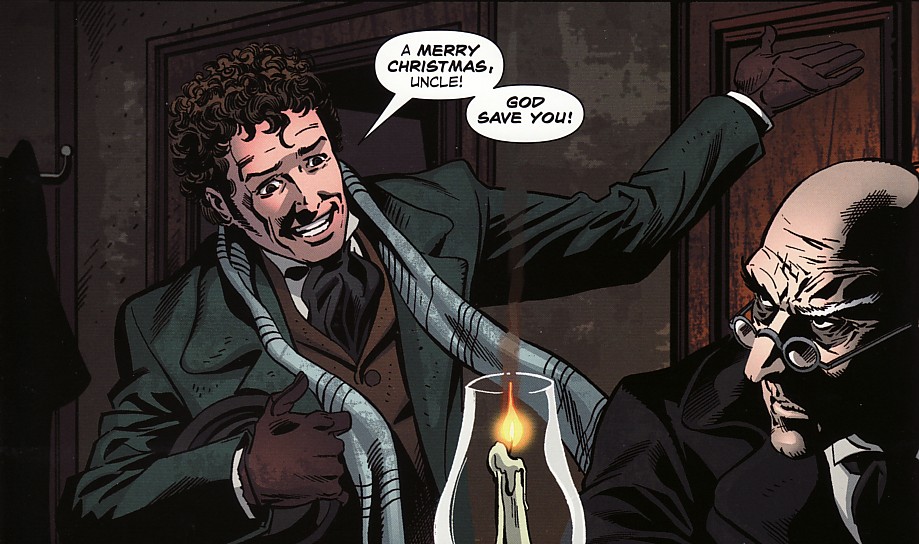
Prof. Turley is a lawyer, of course, and trained to express himself with precision. Thus I have to ask: what the heck is he trying to say here?
Is he wishing good tidings only those who, like his family, are celebrating Christmas, and rotten times to the rest? Is he editing the humanist message of Christmas to “Peace on Earth, and good will to those who are putting up Christmas trees and giving gifts, other wise you’re on your own”?
Or, as I fear greatly, given the fact that he is part of the U.S. education establishment and thus prone to have a spine of cream cheese, just observing the trendy political correctness that infects our times, and bowing to those who contrive to take offense when anyone smiles at them and offers a greeting that only says, at minimum, “We’re all in this together, so let’s try to be as good to each other as we can, OK?”Continue reading →
It is slowly dawning on me that Christmas music, one of the annual joys of my childhood and perhaps yours, is in a perilous state, both culturally and aesthetically. The best of the songs musically are religious in nature, which means that schools won’t pass them along to their charges as happened routinely when I was a child, and even playing them on the radio is likely to be regarded as a religious statement. I just loved the music, as I think most kids would if they ever got the chance before they were brainwashed into believing the ancient songs were subversive.
A full court cultural press is underway to make those songs as rarely heard outside of church as hymns, and I don’t see the trend as reversible. One obvious bar to a comeback: current pop stars don’t have the pipes to sing most of them without causing a sound pollution emergency. Or, if one of the few singers who could actually hit the notes dared to cover a carol like “O Holy Night,” he or she would feel required to apply flourishes of the sort that make every rendition of “The Star Spangled Banner” at a major sports event an invitation to PTSD.
Even for the more secular Christmas repertoire, the clock is running out. The most listenable versions, and the definitive ones in most cases, are by performers of the past who are not just dead, but also long forgotten by the current culture. An hour of classic Christmas recordings on the radio is now a reminder of how old I am and close to joining great singers like Bing Crosby, Judy Garland, Andy Williams, Nat King Cole, Jo Stafford, Burl Ives, Gene Autry, Frank Sinatra, Dean Martin, Elvis—dead, dead, dead. I guess Brenda Lee is still alive, so “Rockin’ Around The Christmas Tree” is a little less depressing, but it’s a minor classic at best. It’s gotten so bad that when I hear “The Little Drummer Boy,” I find myself wondering if the whole Harry Simeone Chorale is dead too—Harry died in 2005, and the recording is 56 years old, after all.
Meanwhile, our post-modern culture is sneering at the whole idea of Christmas songs, and Christmas itself. Most modern Christmas songs either are making fun of Christmas, about sex, or just lousy. The tradition is being undermined in more creative ways, too: this week I watched a 2012 straight-to-video movie called “12 Disasters of Christmas,” based on the loopy premise that “The Twelve Days of Christmas” was really a coded recipe for stopping the 2012 apocalypse predicted by the Mayan calendar. “The Mayans knew that the knowledge would have to be preserved for centuries, so they devised a song that would carry the secret and would be passed on and learned by children for generations,” explains the old codger who’s figured it all out. (But why would they choose such a monotonous and stupid song?) Come on, guess: How does the “Chosen One” stop the end of the world?[Answer below.]*
The movie is on to something, though. The Christmas songs that have the best chance of persevering though this age of cynicism and cultural illiteracy may be those that either tell a story or that have an interesting one related to their creation. The simple and beautiful tune of “Silent Night,” for example, as one of those films they used to show in school assemblies every year before some anti-religious hysteric sued, was composed for guitar in response to a Christmas Eve crisis for a small church in the Austrian alps in 1818: the church organ wasn’t working. I have found that Irving Berlin’s “White Christmas” affects me far more deeply since I learned that the Berlins’ infant son died on Christmas day, and that while his children celebrated Christmas as a cultural holiday, Berlin and his wife did not. They spent each Christmas after their son’s death in mourning. The song is a wistful remembrance of a happier time that the composer will never experience again.
Maybe another Christmas song will persevere if its origins are remembered; I was reminded of its history this week as a result of the thaw in U.S. relations with Cuba. Though my wife hates it, the song is one of my favorites, perhaps because it brings back warm memories: I watched the song’s first national broadcast with my sister and parents, and the Marshalls bought the recording the next day.
It was 1962. Noel Regney and Gloria Shayne were a husband and wife songwriting team of modest success. They were saddened by the lack of any spiritual content in popular Christmas songs then; imagine what they would think today.
Like all Americans, they were petrified during the thirteen days of the Cuban Missile Crisis, when the world stood on the brink of nuclear annihilation. As the crisis intensified, Regney found himself inspired to write down a simple poem with a Christmas theme. (Later, the couple would say that neither of them could ever sing the song through, because of the strong emotions it recalled.) When the nation could finally take a deep breath of relief as the threat ended, Gloria devised a melody for her husband’s words, though he had always been the composer when he and wife wrote songs together.
The result of this unique variation on their collaboration was recorded before the end of 1962, but it wasn’t until the following year, when Bing Crosby sang the team’s creation live on ABC’s “Hollywood Palace,” that it became widely known. The song written during the Cuban Missile Crisis became a best-seller, Crosby’s last hit Christmas record, and also the last popular Christmas song to have a religious theme.
It was, and remains, a prayer for peace.
____________________________
* By finding and wearing FIVE GOLDEN RINGS, of course!
This belongs in an emerging sub-category: future legal weenies. We have already seen black law students insisting that they be able to defer exams because the Eric Garner death has them too preoccupied to concentrate, and other law students protest an “insensitive” exam question involving the Ferguson riots. This trend does not bode well for the ability of citizens to receive competent representation in years to come. The latest entry was revealed by Harvard law professor Jeannie Suk, who registers her observations in the New Yorker. Suk says rape law is becoming impossible to teach and may be dropped from criminal law courses because many students can’t handle the stress of the subject matter. Criminal law professors at several schools confirmed that they are no longer teach rape law because they fear student complaints. Suk writes, “Many students and teachers appear to be absorbing a cultural signal that real and challenging discussion of sexual misconduct is too risky to undertake—and that the risk is of a traumatic injury analogous to sexual assault itself.” Continue reading →
[This happens sometimes with 5000 posts in the bank: some topic causes me to find one that I can’t even remember writing, and I realize that I still agree with it, and if I forgot about, everyone else probably did too. The previous post led me to link to this one, and I decided that the list of steps I recommended to try to halt the culture’s slide into permanent vulgarity and incivility was worth re-posting, especially since five years ago the blog got less than a fifth of the traffic it does today. Thus I am re-posting this one, slightly edited to remove a few rhetorical excesses and outdated references, from November 18, 2010.]
“Every action done in company ought to be with some sign of respect to those that are present.”
This was the very first edict in the list of civility rules memorized by George Washington as a child, rules that shaped his character and significantly influenced not only his life and career but the fate of America. Like most of Washington’s 11o rules, the first has universal and timeless validity, pointing all of us and our culture toward a society based on mutual respect, caring, empathy, and fairness.
Recently, however, there has been a powerful cultural movement away from George’s rules and the culture of civility that they represent. Rudeness has always been with us, of course, and public decorum has been in steady decline since the Beatniks of the Fifties, to the point where it is unremarkable to see church-goers in flip-flops and airplane passengers in tank-tops. Something else is going on, however. Like the colored dots of paint in a George Seurat painting, isolated incidents and clues have begun to converge into a picture, and it is not one of a pleasant day in the park. I believe we are seeing a dangerous shift away from civility as a cultural value, which means that we are seeing a cultural rejection of ethics. Continue reading →
Everywhere we look, it seems, we see the United States culture being threatened by weenies and the rise of Weenyism. In a nation founded on the principles of self-reliance and individual liberty, built and shaped by stunningly brave men and women who hacked civilization out of an uncertain and perilous wilderness, there is a growing mass of citizens—the cancer imagery is intentional—who are committed to giving the government near total control over every conceivable danger, threat, peril, offense, inconvenience or annoyance, real or imagined, as the role of individual Americans devolves into pointing and saying, “There! Fix that! I don’t like that! Arrest them. Fine him.” Increasingly, the primary motivation for public policy is fear, planted by activists and politicians to panic, terrify and mobilize the weenie base, who are ever eager to trade individual freedom for protection against, well, almost everything.
I know I am hyper-sensitive to the weenification problem right now, having spent three weeks reviewing the history of the American West and its portrayal by Hollywood in preparation for my Smithsonian Associates program last week on how the Hollywood Western shaped American culture. Around the same time that the Sixties exploded, the culture’s unified acceptance of traditional American values began to collapse, just as the primacy of the Western as an entertainment genre declined. Now weenyism is in its ascendency. There are those who claim that the name of a distant football team causes psychological trauma to Native Americans who don’t follow football. Blogger Andrew Sullivan (a candidate for Head Weenie) asserts that the United States should have the “courage” to do nothing about ISIS and allow it to run amuck (the ultimate goal of the Weenies: an Orwellian “Weenies Are Heroes” motto). Feminists insist that women are so vulnerable to male sexual predations on campus that due process, fairness, common sense and much of the respect as equals their predecessors fought for must be surrendered, in a new system that begins with the presumption that all men are potential rapists and all women simpering, helpless victims, even when they say “yes.” College students and other are demanding that books, stories, essays and blog posts contain “trigger warnings” to alert weenies that words and topics in the text might give them the vapours. Needless to say—I hope—this not a healthy development for the United States, or our culture.
The resistance to Weenyism ought not to be a partisan issue. The obligation to help the weak, disadvantaged and powerless become stronger, overcome their handicaps and acquire power is part of the American tradition too. Somewhere, however, this obligation was distorted by the realization that in a system where the government is looking for victims to justify its existence, Weakness Is Power (Orwell again). Weenies—fearful, risk-averse, passive-aggressive citizens who shrink from conflict, confrontation and the messy process of democracy— have realized that they can mobilize power to satisfy their narrow biases and interests, often at the expense of their fellow citizens’ right to liberty and the pursuit of happiness. Now the culture is tilting away from the uniquely American model that encouraged individuals to fight their own battles and succeed or fail on the merits of their causes and their own determination and skill, to one that rewards the perpetually offended, victimized, and passively unsuccessful.
It is unethical to be a weenie, and equally unethical to allow Weenieism to overcome what has been an American cultural strength.
Part I:The Lipreading NFL Fans
Several TV viewers who watched the NFL’s New England Patriots-Green Bay Packers made official complaints to the Federal Communications Commission because they could see Patriots quarterback Tom Brady saying “fuck” repeatedly on the sidelines in frustration over his own play. They couldn’t hear it, mind you: they were just able to read his lips. This was so horrible that they felt that the Federal government needed to investigate and take remedial action.
One complaint was from an Indianapolis parent who wrote that their “6 year old children know how to read lips.” Another was from a Pennsylvania grandparent who complained to the FCC, “My 8 year old grandson was watching the game with me and even commented that he should not have said that.”
The Horror. Law professor Jonathan Turley opined on his blog, “I do not believe that this was a good thing for a NFL QB to be doing.” Well, sure: he should be picking his nose of grabbing his crotch, either, but this isn’t scripted, and its a football game. The whistle has to be blown for Federal retribution for mouthed obscenities to nobody in particular, as these sensitive parents and grandparents happily allow their delicate charges to cheer men in the process of maiming themselves and risking that their children will be changing their fathers’ diapers in the disturbingly near future?
The really frightening thing is that our regulatory morass encourages such attempts at censorship. Continue reading →
I’m watching “It’s A Wonderful Life,” Frank Capra’s ultimate ethics movie. Don’t forget to review its ethics dilemmas, conflicts and conundrums with the handy
In a jaw-dropping essay for her employer, The Wall Street Journal, alleged culture critic Joanne Kaufman proudly and candidly disabuses readers of any misconceptions they might have had regarding her qualifications for her job. She is not merely unqualified, but willfully, shamelessly, spectacularly unqualified. In a smug screed in which she admits to habitually walking out on Broadway shows at intermission, Kaufman reveals herself as lazy, arrogant, disrespectful of artists, and most crippling of all, to be afflicted by the attention span of the average Twitter addict.
“Don’t ask me what happened during the second acts of “Matilda,” “Kinky Boots,” “Pippin” and, reaching back a few seasons, “Boeing-Boeing” and “Billy Elliott, ” Kaufman boasts. “Really, I have no idea. But I am nothing if not cosmopolitan in my tastes, or distastes—French farces, English musicals set in gritty industrial cities, and American entertainments involving Charlemagne ’s Frankish kin.”
You can read her entire piece here; if the Journal doesn’t fire her, it is run by fools. “I’m of the “brevity is the soul of wit” school and of the belief that only a few bites are required to determine that you just don’t like a particular dish,” she happily admits. “My ideal night in the theater runs 90 minutes without an intermission (it is best not to put temptation in my path), which means that Shakespeare and I don’t tend to see a lot of each other.” This is the culture writer, remember. Yet she is admitting to membership in the lazy, sound-bite, bumper-sticker, multi-processing, distracted, ADD-addled public that has caused writers, playwrights, producers, book publishers, film-makers and song-writers to dumb down, redact, trivialize and simplify entertainment in an accelerating death cycle: plots don’t make sense, explosions start early, subtlety is forbidden, and no issue, thought or topic that can’t be fully explored in the time it takes to do a load of laundry is going can find its way on stage or screen. The Journal’s culture writer doesn’t have the time or interest to sit through King Lear, Hamlet, The Ice Man Cometh, or Death of a Salesman, or to view all of “Seven Samurai,” “A Man for All Seasons” or “Gettysburg”—hey, a movie about one of those short Civil War battles for Joanne, please: she’s got a 15 minute segment of “Robot Chicken” to catch. Continue reading →
Traversing such seemingly unrelated topics as aphrodisiacs, “Mr. Ed,” post-war culture, literacy, and the evolution of childhood, Penn’s Comment of the Day is one of my all-time favorites. Here it is, a response to the post, “Daily Comics Ethics: When Did Erection Gags Become Appropriate For The Funny Pages?” I have a lot of reactions, but here are three:
If kids really don’t read the funny papers any more, what good are they? Who does read them? The Washington Post and other papers used to take “Doonesbury” out of the section and place it in the main body of the paper on the theory that it’s humor was “adult.” (Of course, “Doonesbury’s” humor has also been non-existent since around 1978—but I’ve never seen an erection joke there, either.)
Just because little kids are familiar with the term “horny” doesn’t mean they have any idea of what it refers to.
I like the “Mr. Ed” song!
In reply to your rhetorical (and tertiary) query, Jack, you missed (that small part of the) evolution just as we all did and do, because it was an evolution, a slow-moving American tsunami of post-war change beginning in the late 40s.
As a child, I recall controversy, strictly among adults, over things that wouldn’t be even thought of today such as the idea of having a girl (Lois Lane?) take up a weapon against a villain instead of waiting, albeit bravely, for Superman, to come rescue her. It was argued to be unladylike – and therefore, unsuitable for children’s comics — for females to fight for themselves if there was a man around, even as the WACS, nurses and ambulance drivers returned home, joining widowed moms & rosie-riveters in job-hunts. Or unless it was Wonder Woman. And oh the struggles to allow Wonder Woman — she of the skin-molding, crotch-height tights and the noticeable chest bumps, however well armored — into the son’s bedroom. Or the daughter’s wardrobe (next, she’ll want a bra!) Continue reading →
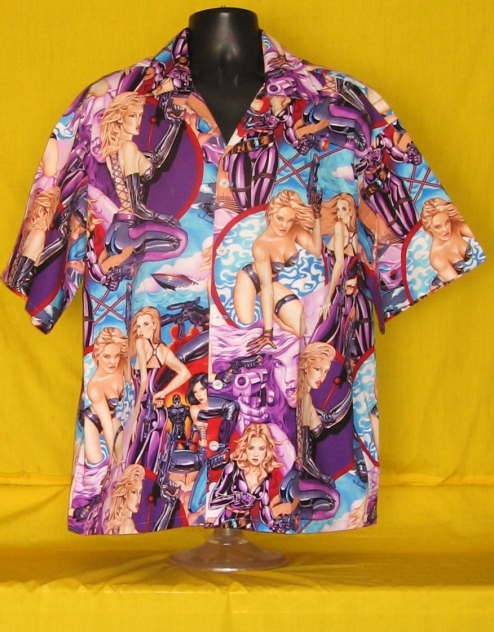
The European Space Agency’s probe managed to land on a hurtling comet millions of miles away to collect scientific data, and has begun sending images from the surface of the body, known as 67P/Churyumov-Gerasimenko. However, Dr. Matt Taylor, one of the scientists responsible for the Rosetta probe mission found himself at the center of a feminist uprising after he appeared on television earlier this week….because of his choice of shirts.
Here’s a good view:
Taylor, who appears to superficially fit the template of clueless scientific geniuses presented in the hit comedy “Big Bang Theory,” appeared live wearing a garish Hawaiian-style shirt with a design made up of Heavy Metal comic book images of busty women in various states of undress, carrying guns and generally enacting the fantasies of 14-year-old boys. This somehow managed to overwhelm the astounding scientific achievement he has been part of, and angry feminists attacked:
“No no women are toooootally welcome in our community, just ask the dude in this shirt,” tweeted Atlantic journalist Rose Eveleth. Astrophysicist Katie Mack said, “I don’t care what scientists wear. But a shirt featuring women in lingerie isn’t appropriate for a broadcast if you care about women in science.”
So furious was the reaction of some feminists and others on social media and elsewhere that Taylor felt constrained to apologize, which he did during another televised update regarding the mission, saying, as he choked back tears, “I made a big mistake and I offended many people and I am very sorry about this.”
Yes, I know the New York Post has made an art form of in-your-face, outrageous, I-can’t-believe-they-printed-that headlines and front page shenanigans, epitomized by the deathless classic, “Headless Body Found In Topless Bar.”
Yes, I know that Post is owned by Australian schlockmeister Rupert Murdoch, and yes, I know that the Obama-hating market is large and especially enthusiastic after the Tuesday Night Massacre Democrats just suffered under President Obama’s leadership.
And yes, I know that this is essentially a cartoon via photoshop, and that insisting that the Office of the President must retain its dignity after Bill Clinton got through with it and Democrats en masse declared that it didn’t matter how disgusting a POTUS’s “personal” conduct was in the White House as long as poll numbers were high and unemployment was low, so come on, Bill: lead our national convention in condemning how Republicans denigrate women!
I know all that. It doesn’t matter. Barack Obama is the President of the United States, and this kind of personal, disrespectful ridicule insults not just him, but the office he holds, the nation, and every citizen of the United States of America. If this front page were published in France or England, I would regard it as an attack and an insult. Where is the line where legitimate editorial criticism becomes vicious, culture-poisoning disrespect and a breach of ethical journalism standards? I don’t know; we can argue about it. Wherever the line is, this is over it, by a lot. Continue reading →