by Curmie
[My post yesterday about ESPN’s decision to ignore the pre-game events at the Sugar Bowl attracted almost no commentary at all, but it did prompt this installment of Curmie’s Conjectures, which makes it all worthwhile. This is cross-posted on Curmie’s blog; once again, I encourage everyone to visit it regularly. Curmie doesn’t post often, but as Spencer Tracy says of Katherine Hepburn in 1952’s “Pat and Mike,”…what’s there is cherce.” —JM]
There’s a lot of brouhaha at the moment, including Jack’s apt commentary, about ESPN’s coverage of Thursday’s Sugar Bowl game in New Orleans, or rather of the pre-game. The game was postponed for a day in the wake of the horrific events of early New Year’s morning only a few blocks from the Superdome, where the game was played.
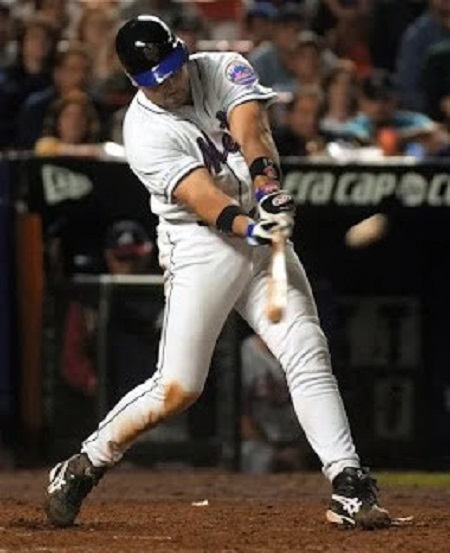
So why is the photo for this piece of a baseball game? Allow me to explain. I have been a fan of the New York Mets since 1962, the year of the team’s inception. I can tell you with certainty that the biggest home run in Mets history had nothing to do with their World Series championship years of 1969 or 1986. It was Mike Piazza’s two-run, come-from-behind, homer in the bottom of the 8th inning in Shea Stadium on September 21, 2001. That’s what you see above.
It was the game-winning hit and it came against the best team in the division, the arch-rival Atlanta Braves. Vastly more importantly, it was during the first major league game to be played in New York after the attacks of 9/11. And, for the first time in a week and a half, the locals had something to be happy about. That night, anyone who wasn’t a Braves fan per se (and probably a fair number who were) needed that home run. Not just Mets fans. Not just New Yorkers. Americans.
We’d been told the everything was going to be OK, but we needed more. David Letterman going back on the air helped, but everything was still somber. The Bush jokes that would cement the resolve—you don’t joke about the President if your country is in crisis—were to come later. But first, there was Mike Piazza. Sometimes, sports matter.
In the winter of 1980, I lived in a small town in rural Kentucky. I remember watching the “Miracle on Ice” Olympic hockey game on the TV. After the incredible upset of the powerhouse Soviet team by a bunch of American college kids, after the most famous line of Al Michaels’s career—“Do you believe in miracles? Yes!”—there was a lot of noise outside, loud enough to be not merely audible but intrusive in my second-floor apartment.
Outside, there was a string of cars with horns blaring; their windows were down (even in Kentucky it can get a little nippy in February), with a bunch of mostly teenagers leaning out and chanting “USA! USA! USA!” I’m willing to bet that I was one of fewer than a dozen people in the entire town who’d ever seen a hockey game live, but here were these kids who didn’t know a poke check from a blue line getting excited about the Olympic semi-final.
In the midst of the Iranian hostage situation, with the country only showing the slightest signs of emerging from the energy crisis (is it any wonder the incumbent President was routed in the election a few months later?), we—again, all of us—needed something to grab ahold of, something to suggest that we’d weather the storm. There have, of course, been other moments that transcended sports: Jesse Owens dominating at the Berlin Olympics in 1936, Joe Louis knocking out Max Schmeling in the first round, Billy Miles appearing from nowhere to win the 10,000m in the Tokyo Olympics; we might even add Spiff Sedrick’s improbable sprint to glory in the women’s rugby 7s in this year’s Olympics. But this year’s Sugar Bowl was most like that baseball game in September of 2001: what made it special wasn’t who won, or what political statement could be wrangled out of the victory, but the mere fact that the game went on was a sign of determination and perhaps a little bit of defiance. If you’re a Georgia fan, you’re disappointed that your team lost, but you were reminded before kickoff that there are more important things than football games.
 Ethics Alarms