Encore: “An Ethics Alarms D-Day Mission”

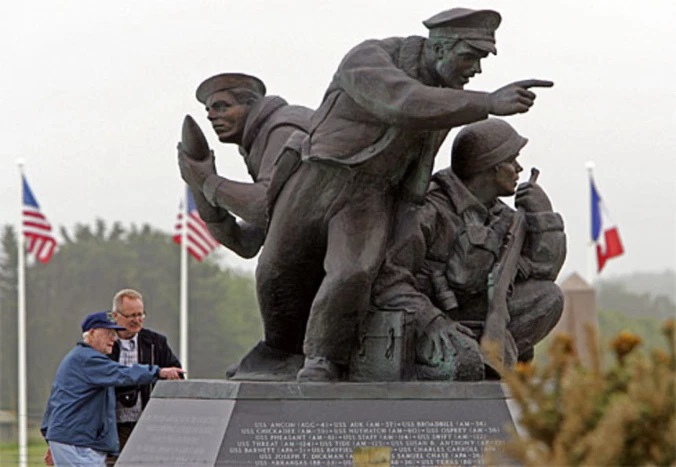
navy-memorial-normandy

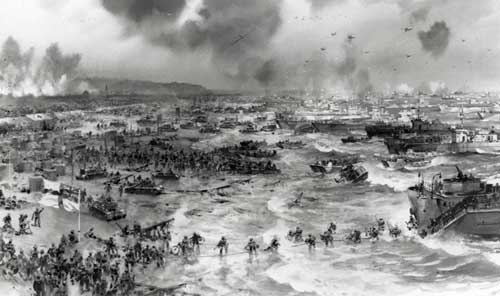
I first posted this essay on Veteran’s Day several years ago, and I re-posted it on the anniversary of D-Day in 2021. The crucial facts of the June 6, 1944 invasion of Normandy that it discusses are still hardly ever mentioned, at least not when I’m around to read or hear it, in any news media or historical features about the battle for Omaha Beach. As I wrote originally and will state now, I don’t understand this. The ongoing mystery constitutes one more “duty to remember” crusade by your windmill-tilting host. So up the post goes again this June 6, as I fulfill my pledge to post it on every D-Day anniversary until this largely untold story is as familiar as the sight of Robert Mitchum, as Brig. Gen. Norman Cota, sicking a fresh cigar in his mouth and saying, as the final line in “The Longest Day,” “Run me up the hill, son!”

***

After all these many years of reading about and watching movies and TV shows about D-Day, June 6, 1944,  I discovered how the US Navy saved the invasion and maybe the world after stumbling upon a 2009 documentary on the Smithsonian channel.

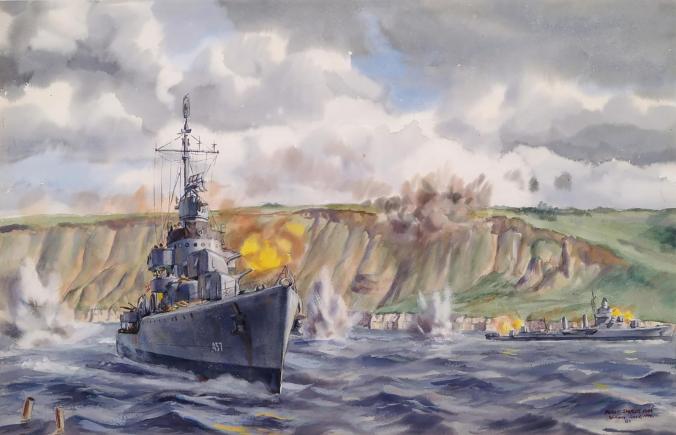
If you recall the way the story is told in “The Longest Day” and other accounts, US troops were pinned down by horrific fire from the German defenses on Omaha beach until Gen. Norman Cota (Robert Mitchum in the movie) rallied them to move forward, and by persistence his infantry troops ultimately broke through. Yet it was US destroyers off the Normandy shore that turned the tide of the battle at Omaha, an element that isn’t shown in “The Longest Day” (or “Saving Private Ryan”)at all.

Though it was not part of the plan, the captains of the Navy destroyers decided to come in to within 800 yards of the beach and use their big guns at (for them) point blank range to pound the German artillery, machine gun nests and sharpshooters. The barrage essentially wiped them out, allowing Cota’s troops to get up and over without being slaughtered. I’ve never seen that explained or depicted in any film, and according to the Smithsonian’s video, apparently it is a vital feature of the battle that had been inexplicably neglected. No monument to the US Navy commemorating its contributions on 6/6/44 was erected at Normandy until 2009.

Here’s the relevant part of account from the  Naval History website on “Operation Neptune,” the Navy counterpart to Operation Overlord:

Continue reading

Comment Of The Day: “An Ethics Alarms D-Day Mission…”

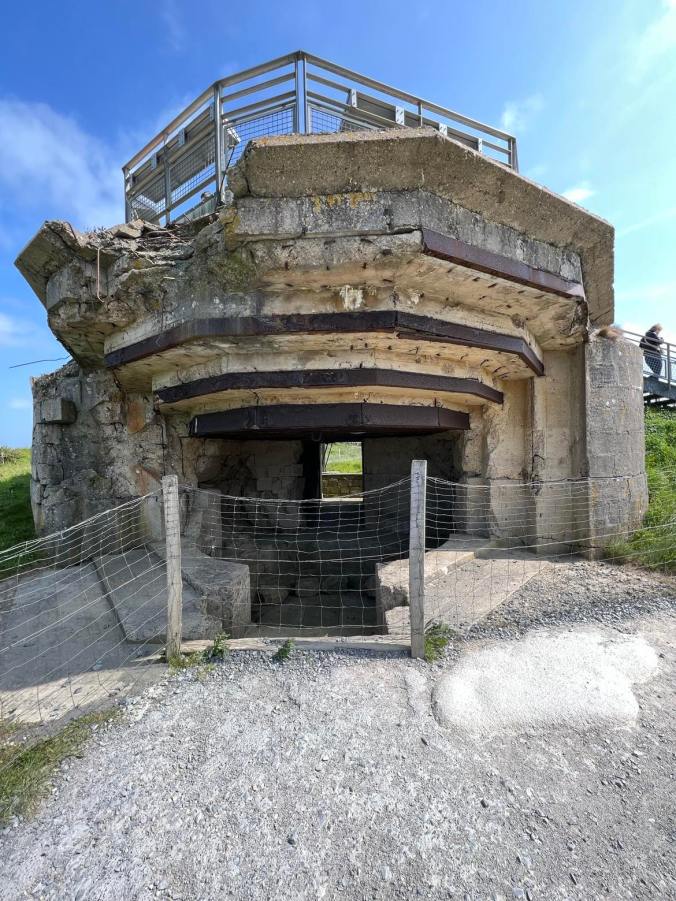
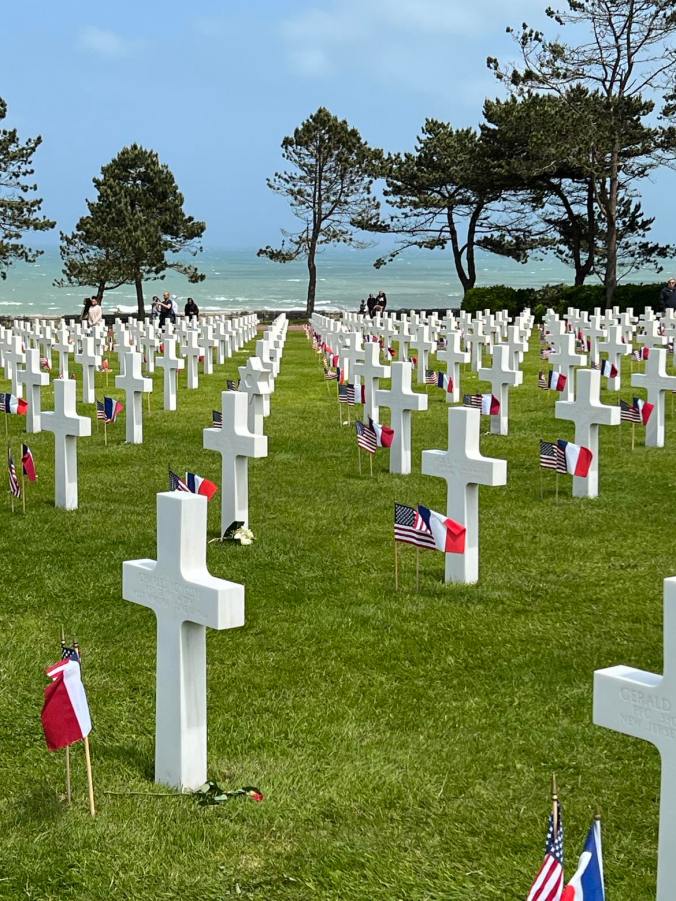
Michael, whose whole family is very dear to me, occasionally contributes a thoughtful comment here and this time brought me to tears with this Comment of the Day, his D-Day-inspired remembrances of his visits to Normandy. Those are some of his photos above: EA is honored to post both them and the post they represent.

***

Went to the beaches, yet again (been many times and always took guests who visited when we lived in France). I remain impressed by the outpouring of positive feelings from the residents of Normandy.

Although generations change, the memories are kept alive in the families. That is, no doubt, why the headstones at the American Cemetery have American and French flags planted by volunteers from the region.

Continue reading

An Ethics Alarms D-Day Mission: I’m Going To Post This Every June 6

navy-memorial-normandy

I first posted this essay on Veteran’s Day three years ago, and I re-posted it on the anniversary of D-Day two years ago. The crucial facts of the June 6, 1944 invasion of Normandy that it discusses are still never mentioned, or at least when I’m around to read or hear it, in any news media or historical features about the battle for Omaha Beach.

I don’t understand this, and the ongoing mystery sparks one more “duty to remember” crusade by your windmill-tilting host. So up the post goes again this June 6 and every D-Day anniversary henceforth, until readers start complaining, “Hey! Everybody knows about this!”

***

Continue reading

A Veteran’s Day Revelation: How Did I Not Know This About D-Day? [UPDATED]

After all these many years of reading about and watching movies and TV shows about D-Day, June 6, 1945,  I discovered how the US Navy saved the invasion and maybe the world only yesterday, thanks to stumbling upon a 2009 documentary on the Smithsonian channel.

If you recall the way the story is told in “The Longest Day” and other accounts, US troops were pinned down by horrific fire from the German defenses on Omaha beach until Gen. Norman Cota (Robert Mitchum in the movie) rallied them to move forward, and by persistence his infantry troops ultimately broke through. Yet it was US destroyers off shore that turned the tide of the battle at Omaha, an element that isn’t shown in “The Longest Day” at all.

Though it was not part of the plan, the captains of the Navy destroyers decided to come in to within 800 yards of the beach and use their big guns at (for them) point blank range to pound the German artillery, machine gun nests and sharpshooters. The barrage essentially wiped them out, allowing Cota’s troops to get up and over without being slaughtered. I’ve never seen that explained or depicted in any film, and according to the Smthsonian’s video, apparently was part of the story that had been inexplicably neglected. No monument to the US Navy commemorating its contributions on 6/6/44 was erected at Normandy until 2009.

Here’s the relevant part of account from the  Naval History website on “Operation Neptune,” the Navy counterpart to Operation Overlord: Continue reading

Morning Ethics Warm-Up, June 4, 2019: The All-Jerk Edition

You may notice that it’s no longer morning. This was begun at 7 am. Can it ever be a good morning that begins with a dentist appointment a likely root canal? Never mind that: my car broke down—transmission failure, and had just had the thing repaired—right in front of the dentist’s office, and after the appointment, I had to wait another hour to be towed home.

1. The end of the spelling bee. It seems clear that sick parental obsession with success has killed the spelling,  or should, as soon as possible. Just after midnight last week, the Scripps National Spelling Bee crowned eight contestants  co-champions after the competition ran out of challenging words. Why did these kids successfully spell auslaut, erysipelas, bougainvillea, and aiguillette, while previous winners had triumphed by spelling word like  croissant in 1970, incisor in 1975, and luge in 1984 ?

The primary reason is SpellPundit, a coaching company started last year by two former competitive spellers. For an annual subscription of $600, SpellPundit sends a huge list of words ,  sorted by difficulty level, for potential spelling champions to study. The company guarantees that it includes all words used in the spelling competitions.

Thirty-eight  of  this year’s top fifty spellers were provided the service by their proud parents. One of the this years champions, Sohum Sukhatankar, 13, of Dallas said he had spent about 30 hours a week studying the 120,000 words SpellPundit had selected from the 472,000 words in the dictionary.

Yechh. What a wonderful use of a 13-year-old’s time. When he’s on his deathbed, he’ll wihs he had those hours back.

So now the spelling bee stands for a combination of child abuse, unhealthy obsession, parental interference and rich, hyper-competitive  families buying an edge that normal families either can’t or have the sense not to. Such fun. In case you are in doubt, the jerks here are the parents.

As for the once fun and innocent national spelling bee: Kill it.

2. Soviet-style society creeps ever closer, thanks to political correctness. Dr Sandra Thomas, an associate medical examiner for the Georgia Bureau of Investigation in Decatur, was moved to make a spontaneous joke while performing an autopsy. Thomas asked another doctor at the GBI’s morgue if she knew how to do a ‘Muslim autopsy’, and then lifted the neck of the dead woman and made the unique sound known as an ululation, which is commonly used in Islamic cultures at weddings and funerals.

http://www.youtube.com/watch?v=Md7OvU5JIcI


Chief Medical Examiner Dr. Jonathan Eisenstat reported the incident to internal affairs, and Thomas was suspended for two weeks. Of course, she apologized profusely. The deceased person was not a Muslim. Continue reading

Ethical Quote Of The Day—D-Day, That Is : Gen. Dwight D. Eisenhower, Supreme Allied Commander

dday_landing

“Our landings have failed and I have withdrawn the troops. My decision to attack at this time and place was based on the best information available. The troops, the air and the Navy did all that bravery could do. If any blame or fault attaches to the attempt it is mine alone.”

—–Gen. Dwight D. Eisenhower, Supreme Allied Commander in Europe, as found on a piece of paper he wrote on just before the D-Day invasion began, and just after he ordered it to commence, on June 6, 1944.

Eisenhower wrote these words to be his own apology and acceptance of responsibility had the massive invasion at Normandy been a defeat rather than the history-altering victory it was.

It almost was a defeat, and as the note, which Ike’s naval aide, Captain Harry C. Butcher, found crumpled in his shirt pocket weeks later and saved for posterity, shows, Ike realized all too well that it might be. The secret dry run for the invasion had been a deadly fiasco, the weather was atrocious, and no military operation on this scale had ever been attempted before in the history of man. It took a combination of German mistakes, high command confusion, individual heroics and the usual twists and turns of chaotic fate that decide most battles to allow the Allies to prevail. Continue reading

“The Longest Day,” Darryl F. Zanuck, D-Day, And Us

title_longest_day_bluray

Today is June 6, the anniversary of the Allies’ invasion of Normandy, the audacious military strike that changed the course of history. I’ll be interested in seeing how it’s commemorated this year, 71 years later, especially by the news media. A lot of Americans under the age of 40 know almost nothing about it, or worse, the values it represents to the United States.

Fortunately, there is an easy and entertaining way to teach a young American about what happened on this day 71 years ago. That is to have him or her watch “The Longest Day,” producer Darryl F. Zanuck’s epic film based closely on historian (and sole credited screenwriter) Cornelius Ryan’s 1959 book. (You can get it at Amazon, here.)I usually find understanding military battles nearly impossible; written accounts completely confound me, and few movies about any battle make a serious effort to explain the tactics and strategy without reducing the facts to pablum. (I remember how much my father, who fought in the Battle of the Bulge, detested the big budget movie of the same name, which he found outrageously sloppy, and which he summarized as “Henry Fonda won the war.”)

Not “The Longest Day,” however. Since seeing the movie with my father as a kid, I have learned a lot about what was left out, but the movie is remarkably clear and accurate about what happened and why without being either too detailed or too simplistic. It’s also just a great, inspiring movie.

That we have “The Longest Day” is entirely due to the courage of one of Hollywood’s most dynamic, flamboyant and successful studio moguls, Darryl F. Zanuck. The original producer of the adaptation of Ryan’s book (which is terrific ) gave up on the project when 20th Century Fox refused to allow him an adequate budget. Zanuck, who was still producing films but no longer ran the studio he had built,  bought the rights, and was determined to do the story, the event, and the men who fought the battle justice by mounting a production almost as ambitious as the invasion itself. Continue reading

Memorial Day Ethics Hero Emeritus: Theodore Roosevelt, Jr., 1887–1944

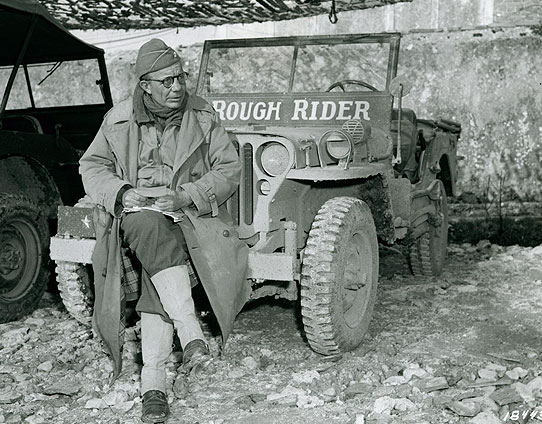
Teddy Jr

The latest inductee into the Ethics Alarms Heroes Hall of Honor has a familiar name that burdened him with exorbitant expectations his entire life. Yet against all odds, he managed to add to its prestige.

With some notable exceptions that you can probably name, being the son of a President of the United States has proven to be a burden and often a curse. Being the oldest son of our most flamboyant President was particularly hard on Teddy Roosevelt’s boy who shared his name, and through young adulthood, Theodore Roosevelt, Jr.  experienced migraine headaches and other symptoms of anxiety and stress. The President was even cautioned by a family friend and physician that his constant badgering was ruining his son’s health.

Young Ted still followed his father’s path to fame by enrolling at Harvard, then became a partner in a Philadelphia investment banking firm. With the U.S. entry into the Great War, Roosevelt enlisted in the army, fought in Europe, rose to the rank of lieutenant colonel, and was gassed and shot in the kneecap in 1918.  Roosevelt received the Distinguished Service Cross. He was renowned for his courage under fire as well as his unusual concern for the men under his command: at one point, he personally purchased new boots for his entire battalion. After the war, Roosevelt was instrumental in the founding the American Legion in 1919. Continue reading

D-Day Ethics: Honoring The Strange And Courageous Duty Of Bill Millin, “The Mad Piper of D-Day”

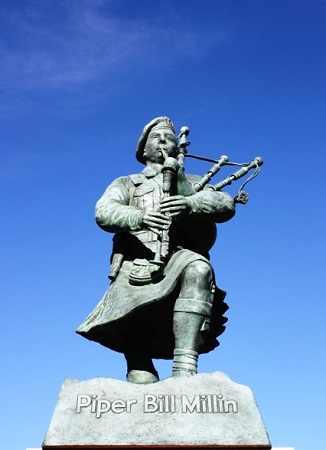
Millin statue

If you watch “The Longest Day” this weekend, as I am sure to do, you will see a portrayal of Bill Millin, though only fleetingly and without his character being identified. Although I have seen the film countless times over many decades, it was only recently, this morning, in fact, that I focused on this remarkable warrior and the unusual brand of courage he showed the world on D-Day.

Bill Millin is the apparently daft bagpiper you can see leading the troops of Lord Lovat (played by Peter Lawford) ashore on Sword Beach, and later blowing his infernal instrument as the 1st Special Service Brigade relieved the troops holding the crucial strategic crossing known as the Pegasus Bridge. Lovat, who, like Millin, was Scottish, defied the British War Office orders banning pipers in battle (too many of them had been killed in World War I), and directed his friend to play traditional tunes, including marches and bawdy drinking songs (including one with a chorus that ended with the shout,“Up your arse!”) , as the rest of his comrades were engaged in battle and under fire. His only weapon was a ceremonial dagger, and except for an incident when the men were in the sites of a sniper’s rifle and forced to take cover, he never stopped playing.

It will not surprise you to know that he was the only one who did this on June 6, 1944. Continue reading

June 6, 1944

D-Day-facts-Landing-on-Beach

If a Terminator wanted to get rid of me and Ethics Alarms, all he would have had to do, perhaps, would be to go back to June 2, 1944, and throw himself on the hand grenade that exploded and blew a hole in Jack Marshall, Sr.’s foot that day. The wound kept my dad in an Army hospital when he was scheduled to hit the beaches at Normandy, 7o years ago today. (He recuperated sufficiently to request a return to active duty, and ended up in the middle of the Battle of the Bulge.)

Thus it is that I have special appreciation and reverence for the American, Canadian* and British soldiers who risked, and in many cases lost, their lives winning a crucial battle in a war about freedom and human rights on June 6, 1944, and empathize with all the sons and daughters, and grandsons and grand-daughters, whose chances at existence were ended that day, while mine, by the sheerest luck, was not.

And I find myself wondering, as America retreats from its traditional ideal as the nation that stands up to evil, chaos, persecution and tyranny in the world, and as our government devalues “hero” and “service with honor” to the status of gratuitous application to a soldier who voluntarily abandoned his comrades on the field of battle, if our culture, our young, and our increasingly self-absorbed society would support the equivalent of a Normandy invasion today.  If not, the world is in greater peril than it knows.

I’m an optimist, and a firm, though shaken, believer in the unique cultural values of the United States of America. I believe that we are one admirable, wise, courageous leader of character away from getting back on the ennobling course charted by Washington, Lincoln, Roosevelt, Kennedy and Reagan.

I just wish that I could see, even faintly, such a leader coming over the horizon. I wish he…or she…would hurry the hell up.

* I stupidly omitted mentioning our Canadian allies when I first posted this, and was properly corrected. No slight intended. My apologies.