Comment of the Day: “Ethical If We Want It To Be: NBA Flopping and Fooling the Ref”

This is a wonderful comment by Dwayne N. Zechman, which goes to the heart of what makes sports ethics so perplexing. Let me leave it to Dwayne now, and I’ll have some comments at the end. Here is his Comment of the Day on the post Ethical If We Want It To Be: NBA Flopping and Fooling the Ref:

“I admit I’m having a little trouble with this one.

“If I understand correctly, your premise is that each sport has its rulebook, and what’s ethical or not is mostly determined by what’s in that rulebook. The outside margins of “mostly” come from long-standing traditions, and de facto rules related to safety or practicality. The game isn’t life–it’s a distinct “closed system” if you will, and the rules about life might not apply. Or perhaps it’s better to say that we can choose to declare (in the rulebook or through tradition) that certain rules of life do not apply within the game and that’s okay. Doing so diminishes neither the ethical rule nor the game itself.

“So the beginning of my trouble is that this smacks a little of a combination of “Everybody does it”, “If it isn’t illegal, it’s ethical”, and The Compliance Dodge. Okay, I can accept that, though, because we’ve already stipulated that specific ethical principles can be exempted from a game/sport.

“Next comes my own dissonance in trying to reconcile this article with other recent articles here on Ethics Alarms about pro football, where the same exemption of ethical principles is applied, but somehow shouldn’t be. Okay, I can accept this, too. There is a distinction in that an ethical principle shouldn’t be exempted from the game when there are clear, demonstrable consequences to the player that persist after the game is over and the player’s real life resumes. In a situation such as that, it’s impossible to exempt an ethical principle JUST for the game because the exemption itself renders the game no longer a “closed system”. Continue reading


Ethical If We Want It To Be: NBA Flopping and Fooling the Ref

“And in the category of Best Feigned Foul in An NBA Play-Off Game, the nominees are….”

Once again, the issue of players in professional sports intentionally deceiving the referees is enlivening the sports pages. I welcome it: the intersection of sports and ethics is always fascinating. This particular intersection is as old as sports itself. Is deceiving the referee (or umpire) for the benefit of one’s team competitive gamesmanship or cheating? Is it an accepted tactic, or poor sportsmanship? In short, is it ethical or unethical?

The current version of this controversy has broken out in the National Basketball Association, where  Commissioner Daniel Stern  has declared war on “flopping”—the maneuver where a player draws an undeserved foul on an opposing player by acting as if minor contact or even no contact at all was near-criminal battery. Stern has suggested that the NBA needs to start handing out major fines for these performances, which in the heat and speed of the game are often only detectable with the aid of slow-motion replay after the fact Continue reading

The Yahoo! Mess

Yahoo’s CEO, Scott Thompson, just “resigned” from his post after it was clear that he was going to be sacked. He had been on the job just four months. Why the sudden exit? A simple Google search by a Yahoo! board member revealed that Thompson had lied on his résumé, claiming to have a degree in computer science. This opened a can of worm, Pandora’s box, and an ethics cornucopia, all wrapped in one:

  • Thompson’s initial response was that the mistake was “inadvertent,” and that he regretted not having caught the error. This attempt t0 brass his way out of deception of his own making should probably ensure that he never leads another company. If he had taken 20 seconds to think about it, Thompson would have realized that using a second lie to try to cover the first would only make it clear that his curriculum vitae fabrication was not an aberration. Naturally, it was quickly discovered that he had the same fabrication on his résumé when he had applied for his previous job. Continue reading

The Worst Ombudsman Ever Strikes Again!

"Wait! Wait! It wasn't that good a story! Why did you have to pay so much attention to it? Now Our friends are all mad and everything!"

Patrick B. Pexton, whom Ethics Alarms dubbed The Worst Ombudsman Ever last Fall, has cemented his title with yet another example of bias and incompetence. By rights, he should be in a spirited battle for WOE with New York Times “public editor” (a.k.a ombudsman ) Clark Hoyt, who, among other derelictions of duty, has refused to criticize Times columnist Charles M. Blow for blatant anti-Morman bigotry. At least Hoyt writes about journalistic ethics, which is his (and Pexton’s) job to do, though not always well. The ombudsman’s proper role in any organization is to serve the public interest by answering and resolving complaints against the organization, calling foul when the organization does wrong, and making standards clear when it does not. In a new organization, the ombudsman is the guardian of journalistic ethics, and all that implies, from fairness to objectivity to competence. Pexton seems to see his function as an advocate for the Post when it is under attack, and for the Obama Administration when the opportunity presents itself. That does not serve the public interest.

Thus it is that Pexton has written a bizarre and gratuitous  defense of a Post story that went viral on the internet, arguing that it wasn’t the Post’s fault that so many people paid attention to it, that the story was no big deal, really, and that “only our reactive, partisan, hyperventilating media culture” made it one. Isn’t that strange? A newspaper’s story gets quoted and circulated, and its ombudsman feels that he has to apologize for it? What was the matter with the story? Was it wrong? That would justify Pexton’s professional <Cough!> attentions. Well, no, it wasn’t wrong. Was it unfair? Er, not really, no. What then? Continue reading

Unethical Website of the Month: The Ethical Psychic Project

Here’s all you need to know about “The Ethical Psychic Project” and the website that supposedly advances it. One of the ethical topics covered in the ethical forum section is “Animal Communication”:

“Our animal friends need help, too! Ask one of our Psychic Animal Communicators to connect with your pet, either on the Earthly plane or crossed over!”

Sounds ethical to me! I was surprised not to see other topics of similar ethical weight and credibility,  like “Want to win in at the slot machines?” and “Ever wonder what Joe Biden will say next?”

There appears to be nothing whatsoever ethical about the The Ethical Psychic Project, except that a bunch of people who decided they couldn’t make enough money selling phony deeds to imaginary uranium mines thought that the word “ethical” might suck in some marks. Oh, there’s an ethics code on the site, all right. This psychics code is considerably worse than the last one I wrote about, and that won no prizes. This one is funnier, though, because with a little tweaking, it could just as well serve an ethics code for Superman or Green Lantern, or the Good Witch of the North. It contains such self-validating blather as: Continue reading

Ethics Hero: Journalist Harris Meyer

Harris Meyer is an Ethics Hero because he won’t let a bad lesson go unchallenged.

Meyer is an award-winning  freelance journalist and a former editor at the Yakima (Wash.) Herald Republic. That was the paper that first broke the story of Gaby Rodriguez last year, which I wrote about here. With the encouragement of her high school principal, Rodriguez, a senior, embarked on some amateur social science research that involved deceiving everyone in her life except her mother, one (of seven) siblings, her boyfriend, and the principal. She pretended that she was pregnant, suing padding. She faked the pregnancy for months, finally announcing the sham in a student assembly. This extended hoax was supposedly designed to expose how pregnant teenagers are treated by their peers and others. It was, by any rational standard, a despicable thing to do—a betrayal and exploitation of her friends,  her boyfriend’s family, her siblings and teachers. Deception on such a scale must be justified, if at all, by both need and necessity. Were there other, less destructive ways to investigate the treatment of pregnant teens? Sure there were; interviews come to mind. Collecting published journals and other accounts. But Gaby’s unethical stunt was in spiritual synchronicity with a reality show-obsessed culture, where fake is entertaining and collateral damage is of no concern.  I wrote: Continue reading

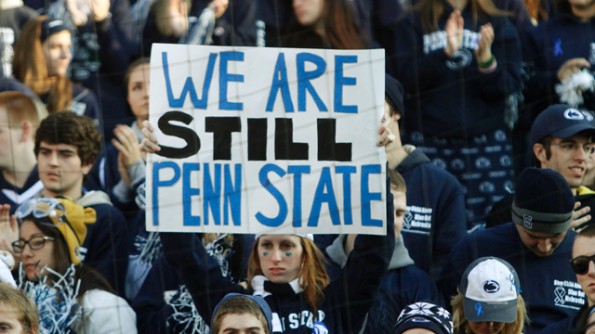
The Ethical Firing That Never Happened: Penn State’s Blindness Continues

...and you still don't get it.

Penn State didn’t think that allowing a probable sexual predator to continue to abuse kids was a firing offense, and still doesn’t.

Incredibly, Joe Paterno is still receiving his full salary. He was not fired, as all newsmedia reported, and the University, having released a deceitful and carefully worded misleading announcement in November, allowed that falsehood to be circulated and believed, even as students were rioting on campus against Joe Pa’s “dismissal.”

“The Board of Trustees and Graham Spanier have decided that, effective immediately, Dr. Spanier is no longer president of the University,” the announcement had stated. “Additionally, the board determined that it is in the best interest of the University for Joe Paterno to no longer serve as head football coach, effective immediately.

But it never said that Paterno was fired. Now, finally, the University’s sick subterfuge is coming to light. Continue reading

Unethical Website: NewtGingrich.com…But Not In The Way You Think

Ah, Dick, what might have been! If only your burglars had broken into Gingrich headquarters!

The pro-Democratic super PAC “American Bridge” bought the domain name http://www.NewtGingrich.com and now uses it to redirect anyone who reaches the site to various Web sites that highlight the ex-Speaker’s many failings, perceived flaws, or the attacks of critics. Among the places it hijacks users to are Freddie Mac’s Web site (a reference to Newt’s high-paid duty as “a historian”), Tiffany’s (where Newt infamously had a rather large bill, as if that has any significance whatsoever except to class-bashers), information about Greek cruises ( as Newt abandoned his campaign earlier this year for a cruise, while his staff labored away), or to the ad Gingrich filmed  with former House Speaker Nancy Pelosi in favor of addressing climate change (because being open-minded about climate change isn’t permitted in the GOP).

The Washington Post termed the stunt “clever.” Well, I no longer expect the Post to know the difference between bad ethics and applesauce. Of course the website trick is unethical, deceiving web users and misappropriating a domain that Gingrich himself, and only Gingrich, should be able to employ. Yes, it’s legal. It is still unfair, deceptive and dishonest—wrong. When Richard Nixon’s gang used dirty tricks to upset Democratic rivals in 1968, the Post condemned the conduct as proof of “Tricky Dick’s” willingness to distort the democratic process and win by schemes rather than merit. When a Democratic group uses dirty tricks on a Republican presidential candidate, however, it’s “clever.”

The Post, as well as many of the commenters on its reporting on the faux Gingrich website, embraces the concept of ethics that holds that harmful acts performed against someone it likes is unethical, while the same act taken against someone it opposes is ethical.

There is a word for this delusion.

It’s called bias.

Why Would Anyone Trust A Company That Tricks Them Into Opening Its Junk Mail?

" Disclaimer: This document isn't intended to be as misleading as it obviously is."

The firm is Ideal Tax Solutions, and I’m sure, really I am, that the people who run it, which include lawyers bound by the professional ethics rules prohibiting them from engaging in misrepresentation, dishonesty, deceit or fraud, are dedicated and well-intentioned. From an ethics stand-point, however, why anyone would trust a company that markets its services in a blatantly misleading way is beyond my comprehension. Someone must; a lot of someones must. Yet the company introduces itself to potential customers by deceiving them.

The letter arrives in an envelope that works very hard to look like it will contain an official IRS document. The mailing stamp has an elaborate eagle and flag logo; a large 2011 is posted in the lower right-hand column. Also there: a statute number TITLE 18 SEC. 1702 US CODE. There is a window in the envelope, and the address that is visible appears on institutional pink paper.

Oh-oh. Continue reading

Ethics Alarms Awards: The Sioux City GOP Candidates Debate

What do Mitt Romney, Ron Paul and Newt Gingrich have in common with "Blazing Saddles'" Gabby Johnson?

There were ethics revelations, lessons and cautionary tales in last night’s final debate before the Iowa Caucuses. The envelopes, please!

The Boy Who Cried Wolf Award

Winner: Rep. Michelle Bachmann

Bachmann  twice protested that she was constantly being accused of not having her facts right, when she really did. This is a hard lesson for people like Bachmann, but she might as well learn it now: when you habitually make factual errors and then deny that you made them, people aren’t going to trust you to be responsible with your claims or to be telling the truth. Nobody has spun as many whoppers and jaw-droppers as Bachmann in the last year, and nobody has more consistently tried to deny the truth when her misrepresentations were brought to her attention. Or to put it another way: once a candidate has claimed that 6th President John Quincy Adams, who was all of 8-years-old when the Declaration of Independence was signed, qualifies as “Founding Father,” nobody is going to credit your representation of “facts” whether they are accurate or not.

The Gabby Johnson Award

Winners (tie): Newt Gingrich, Mitt Romney, Rep. Ron Paul Continue reading