Ethics Quote of the Month: Illya Somin

“Democracy is supposed to be rule of the people, by the people, and for the people. But in order to rule effectively, the people need political knowledge. If they know little or nothing about government, it becomes difficult to hold political leaders accountable for their performance. Unfortunately, public knowledge about politics is disturbingly low. In addition, the public also often does a poor job of evaluating the political information they do know. This state of affairs has persisted despite rising education levels, increased availability of information thanks to modern technology, and even rising IQ scores. It is mostly the result of rational behavior, not stupidity. Such widespread and persistent political ignorance and irrationality strengthens the case for limiting and decentralizing the power of government.”

Illya Somin, Professor of Law at George Mason University School of Law, from his paper and 2013 book of the same name, “Democracy and Political Ignorance.”

Those were the days...

Those were the days…

Somin, who writes frequently on the mostly libertarian law wonk blog The Volokh conspiracy, is a political scientist, but big government progressives should restrain themselves from dismissing his statement (and my endorsement of it) as right wing or partisan rhetoric. Facts and logic should not be partisan or ideological, and it seem inarguable to me that Somin’s statement is correct, and that certain ethical truths follow. If one is going to dispute his conclusion, one must be able to fairly contest the assertions leading up to it. Let’s examine them in that light:

  • “Democracy is supposed to be rule of the people, by the people, and for the people.” Yes, we can agree on that, can’t we?
  • “But in order to rule effectively, the people need political knowledge.” True… at least this was the conviction of Madison, Adam Smith and virtually all of the political philosophers who championed democratic government. I have never heard it seriously questioned. Continue reading

A Handbook For Manipulation and Deceit, Rationalizations Included

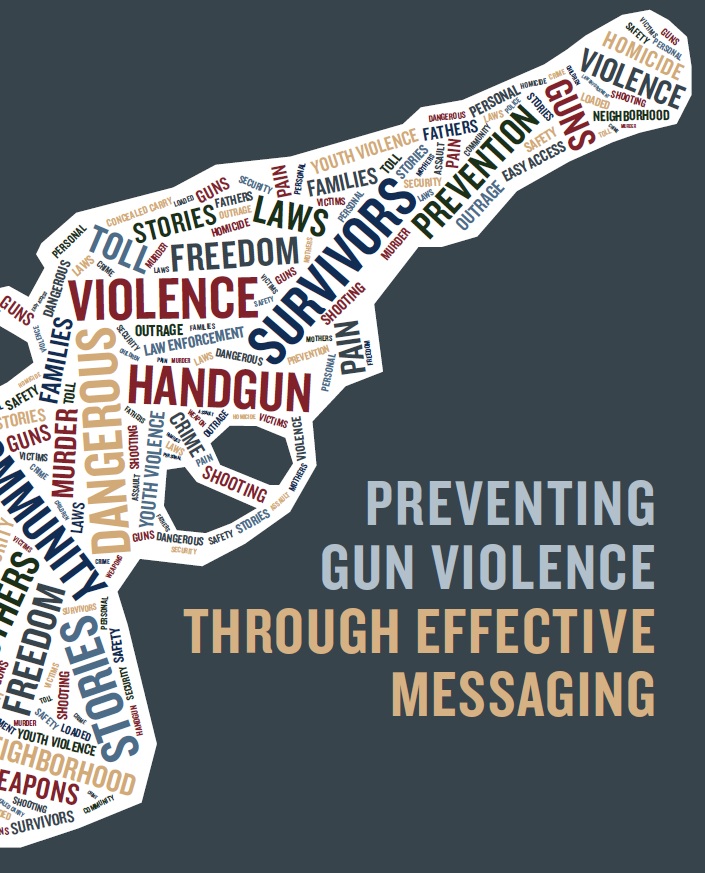
PreventingGunViolence

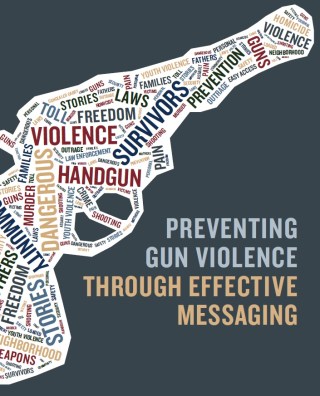
This wasn’t considered newsworthy by the mainstream media, and that alone is worthy of some pondering: a 70-plus page how-to guide titled “Preventing Gun Violence Through Effective Messaging” has surfaced, produced last year by the Washington, D.C.-based firm of Greenberg Quinlan Rosner.* The guide is a political strategy lesson for anti-gun advocacy, and its favored tactics involve emphasizing emotional hot-buttons over rational discourse and informative debate. The manual was produced, it appears, for the Seattle-based Washington Alliance for Gun Responsibility (WAGR) before the Sandy Hook tragedy, but its advice tracks in every way with the approach employed by Democrats, including President Obama, during the disgraceful rush to exploit public horror over the shooting in an effort to pass strong anti-gun measures in the states and nationally.

Of course this is newsworthy. The public is the target of manipulation, deception and persuasion tactics that are designed to provoke half-baked opinions and positions based on emotion rather than rational analysis. If the public recognizes such tactics as the cynical ploys they are, such tactics will not be as effective. Such tactics shouldn’t be effective, and should be employed by honest, ethical advocates on any side of any issue. The mainstream media chose not to publicize the manual because 1) most reporters agree with the manual’s objective, and 2) the mainstream media eagerly facilitated the unethical methods recommended, and will probably continue to do so.

“The debate over gun violence in America is periodically punctuated by high-profile gun violence incidents including Columbine, Virginia Tech, Tucson, the Trayvon Martin killing, Aurora, and Oak Creek,” the guide points out. “When an incident such as these attracts sustained media attention, it creates a unique climate for our communications efforts.”  Early on, the document it makes it clear that the “communication efforts” must always concentrate on stirring up emotions, not relying on facts or engaging in substantive debate. “A high-profile gun violence incident temporarily draws more people into the conversation about gun violence. We should rely on emotionally powerful language, feelings and images to bring home the terrible impact of gun violence.”

For example,  the guide addresses Stand Your Ground laws and advises substituting pejorative (and misleading) descriptions like  “Shoot First” and “Kill at Will,” asserting that these terms are “more accurate and persuasive.” At every turn, the guide cautions against getting bogged down in potentially nuanced statistics and facts, and urges anti-gun advocates to overwhelm any efforts at balancing or considering pros and cons with talking points based on  emotion salted with one-sided, group-tested statistics and generalities...”The core frame should be personal and emotional—centered on ‘people’ and not on facts, laws, or legislation.”  The top things to remember, cautions the guide,

#1: ALWAYS START WITH THE PAIN AND ANGUISH THAT GUN VIOLENCE BRINGS INTO PEOPLE’S LIVES

#2: USE STATISTICS TO REINFORCE AN EMOTIONAL ARGUMENT, NOT TO REPLACE IT.

Recommended phrases to use in forums and interviews include,

  • “It breaks my heart that every day in our country (state or city) children wake up worried and frightened about getting shot.”
  • “Just imagine the pain that a mother or father feels when their young child is gunned down.”
  • ” The real outrage – the thing that makes this violence so unforgivable – is that we know how to stop it and we’re not getting it done”

To the authors of the guide, effective persuasion “means emphasizing emotion over policy prescriptions, keeping our facts and our case simple and direct, and avoiding arguments that leave people thinking they don’t know enough about the topic to weigh in.”

That’s right, keep them ignorant and thinking that they aren’t. It’s the American way.

The guide is professional and well-thought out. It is certainly a useful document for any advocate to study before going on a talk show, or before drafting remarks at a rally, and it is obvious that this is exactly what such advocates do, if not with this document, then with similar ones. It is creepy to read line after line that is immediately recognizable as an endlessly repeated “talking point” during the Trayvon Martin uproar and the Sandy Hook aftermath. The manual also could grow cynicism on a rock. There is nothing honest or genuine about the political and policy-making process that the guide presupposes and attempts to control. There is nothing productive either. The objective is only to win—to get a desired policy initiative past the stage where public support is important and into the back rooms where the deals can be cut . You know that there was an equivalent document during the Affordable Health Care Act. These are blueprints for rushing policies into law, not for educating the public or fairly exploring complex issues before taking giant leaps of faith. They are, in short, instruction books on how to exploit the ignorance of the American people and distort the democratic process.

This is a bi-partisan practice, of course. The only difference between this guide and those produced by conservative consultants is that if one of those was found, the mainstream media would have reported it, Media Matters would have announced that it was a smoking gun document showing how evil Republicans corrupt America with their lies, and on MSNBC, Lawrence O’Donnell would have smirked over it for a week.

The number of rationalizations at the ready, therefore, begin powerfully with “Everybody does it” (#1 on the Rationalizations list). So is, as a direct result, #2, “They’re just as bad” and #7, “Tit for tat,” Such a document and the politics behind it also invokes #3, Consequentialism, and #4, Marion Barry’s favorite, “If it’s legal, it’s ethical.”  It employs # 11, the Dissonance Drag, since the reason it will be deemed acceptable by anti-gun types is because they happen to like the people using the strategy; if the same document outlined the NRA’s approach, they would sincerely and passionately feel it was despicable.

It is the very embodiment of The Saint’s Excuse (#12), otherwise known as “It’s for a good cause,” as well as #13, Self-Validating Virtue. #17,  Hamm’s Excuse or “It wasn’t my fault,” is one of the predictable responses to criticism: “Hey, this is how the game is played. We didn’t make these rules; this has been going on for decades. Don’t blame us!”  My least favorite rationalization of all, #22, Comparative Virtue,  “There are worse things,” is also in play; so is “We have no choice” (because the evil NRA keeps buying legislators and rational debate doesn’t work!), # 24#27, “These are not ordinary times!” is a natural, of course.  So is #30, The Troublesome Luxury, usually expressed as “Ethics is a luxury we can’t afford right now!”

Politics being politics, it’s perfect for #31, The Unethical Role Model, as in “Thomas Jefferson/Abe Lincoln/ Jack Kennedy would have done the same thing.” Heck…A new book suggests Jesus might have done the same thing!

Fourteen out of thirty-two possible rationalizations is an impressive arsenal, all right, but they are still rationalizations for what is a Machiavellian, “the ends justifies the means,” “by any means necessary,” unethical strategy that intentionally aims at the weaknesses of democracy and exploits them through the cynical use of psychology, manipulation, and deceit. Yeah, I know, it works, just as so many methods used by governments and interest groups to deceive the public and warp their perceptions have worked and work still.

That’s not really working, though, is it now? Causing a system designed to involve an informed and rational citizenry  to malfunction by exploiting laziness, ignorance and hysteria isn’t working, just because it succeeds. In fact, such tactics result in the kind of politics and government we have right now.

That is called, not working, but failing.

* According to the guide, Quinlan was part of “a team of communicators” with “decades of experience advising organizations on message development and strategic communications.” Other members of this team were Frank O’Brien, creative director and founder of OMP, another Washington, D.C.-based firm, and Jeff Neffinger and Matthew Kohut at KNP Communications, also headquartered in Washington, D.C. Among GQR’s clients are the Mayors Against Illegal Guns, the Joyce Foundation, several state education associations, Defenders of Wildlife, National Public Radio and the Sierra Club. Among OMP’s clients are Planned Parenthood of America and the Natural Resources Defense Council.

_______________________________________

Sources: WSJ, Washington Examiner, Examiner

Anthony Weiner, Gov. McDonnell, Mayor Filner and the Rest: Degrading Democracy, Tainting Leadership

Hey, Mayor Filner, if San Diegans decide they have a proble being led by a serial sexual harasser, you can run for Mayor of New York!

Hey, Mayor Filner, if San Diegans decide they have a problem being led by a serial sexual harasser, you can run for Mayor of New York!

The mandate for leaders and potential leaders who have engaged in blatantly dishonest, corrupt, undignified or otherwise unethical conduct to remove themselves from office or consideration for office is not that, as hundreds of foolish pundits (like this guy) will try to convince you, hypocrites with a keyboard or a vote falsely pretend that such conduct is unique. There are two justifications for the unethical to resign from office, both undeniable and ancient. I have written enough, for now, about the first—that such conduct demonstrates untrustworthiness, the quality a leader must not have— and want to focus on the second, which is this: if they do not step down and away, such leaders and potential leaders mock the aspirations of democracy, insult its underlying hopes, and degrade, by their persistence, the standards of future leadership.

Once, this was thoroughly understood. Leaders who were exposed as lacking honesty, integrity, responsibility and respect for their own office resigned or withdrew from public life, as self-executed punishment and their last chance at redemption. Democracy, as John Adams wrote, is supposed to be a system that elevates the most accomplished, the most able, the most trusted and the most ethically sound to leadership, for obvious reasons. They are qualified to be leaders because, bluntly, they are better than the rest of us. They are also, because they are better, supposed to be capable of sacrifice and humility, and to recognize that power is a privilege, not a possession to be retained at all costs. Continue reading

Let Me Explain It To You, Ruth: It Is All About Trust

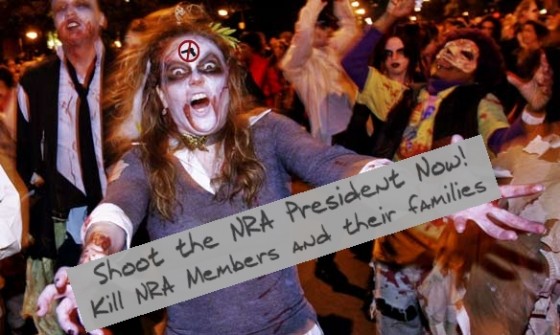
zombies-anti-gun-560x335

Washington Post editorial writer Ruth Marcus gave us a jaw-droppingly arrogant and willfully obtuse lament yesterday. She is in despair. Why would such a sensible, unthreatening gun control measure as the Manchin-Toomey background check amendment fail to pass the Senate? Poor Ruth just can’t understand it. The Senators voting against the bill were so “impervious to logic.” It just didn’t make sense!

What is ruefully amusing and telling about Marcus’s “how dare anyone disagree with us?” rant is that her essay answers its own question.  It is stuffed full of the elements that completely justify Senators or anyone who respects gun-ownership, the Second Amendment and guns opposing any proposals at all that come out of the post-Sandy Hook exploitation campaign by Marcus and her political compadres. It all comes down to trust, Ruth, and you are one of those who is untrustworthy on the topic of guns. Your column proves it, just as President Obama’s petulant outburst of contempt against gun rights absolutists proves his untrustworthiness. Continue reading

“Walking Dead” Ethics: The Worst Leader Ever

Follow this leader at your peril...

Follow this leader at your peril…

The Walking Dead’s” resolution of the ethical dilemma facing Rick Grimes—give up a member of his group to be tortured by a deranged sadist, on the basis of a dubious promise by said deranged sadist not to attack Rick’s group with a superior force if he receives the sacrificed member as his torture-toy, or resolve to fight said superior force despite the likelihood of defeat—was consistent with what we know of Rick as a leader from past episodes. He is hopeless. With this crucial decision, however, he forged new ground in fecklessness, stupidity and incompetence even for him:

  • He made the wrong decision, deciding to turn over the sword-weilding Machonne as the Governor demanded;
  • He did not tell his group what his decision was;
  • He confided in the most untrustworthy member of the group, the cynical, homicidal Merle, because Rick knew he would have no compunction with executing such a twisted choice;
  • After doing so, Rick changed his mind, but not before Merle, being certain that Rick couldn’t follow through on his decision, went ahead and subdued Machonne on his own and began transporting her back to the Governor’s lair for the trade.

In the end, Machonne wasn’t handed over to the Governor, and Merle ended up dead, but that’s irrelevant here. “The Walking Dead,’ in addition to being a handy primer on how ethics evolves when civilization collapses and zombies outnumber human beings, is a tutorial on leadership do’s and don’ts. Sheriff Rick, who has been the leader of the central band of survivors from the start, is the George Constanza of leadership: to be successful, do the opposite of what Rick would do. Continue reading

Ethics Dunces: The Hugo Chavez Fan Club (Michael Moore, Sean Penn, Rep. Jose Serrano (D-NY), Oliver Stone and Joe Kennedy III

"We love you Hugo, we really do-oo! There isn't anyone, we love like you-oo! When you're not with us, we're blue! Oh, Hugo, we love you!"---From the new musical, "Bye-Bye Chavez," written by Oliver Stone, starring Sean Penn!

“We love you Hugo, we really do-oo! There isn’t anyone, we love like you-oo! When you’re not with us, we’re blue! Oh, Hugo, we love you!”—From the new musical, “Bye-Bye Chavez,” written by Oliver Stone, starring Sean Penn!

What do we learn from those who mourn the passing of Venezuelan autocrat Hugo Chavez and praise his leadership? Chavez leaves his nation with a corrupted judiciary, an intimidated and manipulated press, a soaring violent crime rate, massive debt, crumbling infrastructure, galloping inflation, government-sanctioned anti-Semitism, and the prospect of political instability for the foreseeable future. When we hear an American praise Chavez, we learn that he or she neither trusts or values the institutions of democracy, like a free press and independent judiciary. We learn that such an individual believes that indeed the ends justify the means; that lies, repression, manipulation of news and public opinion, cultism, divisiveness and class warfare are all forgivable and even laudable in pursuit of “social justice,” roughly defined in the manner of Lenin, Stalin, Mao and Castro, murderers all. Continue reading

Jesse Jackson, Jr. and Our Sick Democracy

Exactly what we deserve.

Exactly what we deserve.

In the end, the fact that Jesse Jackson, Jr. is going to jail in disgrace is less significant than what his disgraceful career represents. Jackson is only one man, and many men have failed their responsibilities to society while showing dire deficits of character in the process. Jackson’s career, however, is smoking gun evidence of the travesty we have allowed America’s democratic system of government to become. If there are any who still wonder why the nation seems incapable of addressing its problems and challenges responsibly,  look no further. This is a democracy whose citizenry has become too complacent, lazy, apathetic and ignorant for the privilege of self-government. The implications of this are terrifying.

Reading the various articles about Jackson’s imminent guilty plea to conspiracy charges, I was struck by the realization that this one-time rising political star is a child. He misappropriated over $750,000 in campaign funds to buy, among other gewgaws like a Rolex watch, such indefensible treasures as Bruce Lee memorabilia ($10,105), Michael Jackson mementos ($14,200), a “Michael Jackson and Eddie Van Halen” guitar for $4,000, and a Michael Jackson fedora, a bargain at $4,600…all with money donated to his political campaign. This is the caliber of mind and the considered priorities of the man entrusted by an Illinois congressional district to participate on their behalf in crucial decisions affecting jobs, the economy, and the course of the nation, while being consistently endorsed by our toadying news media. Continue reading

Be Very Afraid: Why Fake Statistics Become “True”

"Those nachos were COLD!!!"

“Those nachos were COLD!!!”

Last week, I wrote about how fake statistics become “true,” after Gabriella Giffords’ husband Mark Kelly asserted as fact that “85% of all children killed by gunfire worldwide die in the U.S.” while ABC’s Diane Sawyer tut-tutted approvingly. Credible advocate, shocking statistic, passive, lazy and biased journalist, politically correct objective—all the elements were in place. We will hear this lie for decades now, probably in a future Presidential debate.

Now the perceptive and watchful James Taranto of the Wall Street Journal has found a smoky gun that tells us much about why we get so many bad statistics, and why the media supports them. A U.S. World and News Report article combined the recent passage of  the Violence Against Women Act with the upcoming Super Bowl, to get this:

“Urban myths rarely have a useful purpose other than to confound, outrage, and frighten people into passing them along. But there’s a silver lining to this one—the idea that Super Bowl Sunday is linked to the highest incidences of domestic abuse in the country. While experts in the field dismiss that theory, they value the increased attention paid to domestic violence on the occasion.

“‘The Super Bowl does not cause domestic violence, and it doesn’t increase domestic violence, but it does increase the public’s awareness of the issue, which will help victims learn about help and resources,” says Cindy Southworth, vice president of development and innovation at the National Network to End Domestic Violence.'”

Oh. Well then the lie is all right then! Continue reading

Unethical Smoothie Bar of the Month: The “I Love Drilling Juice & Smoothie Bar” of Vernal, Utah

Smoothies

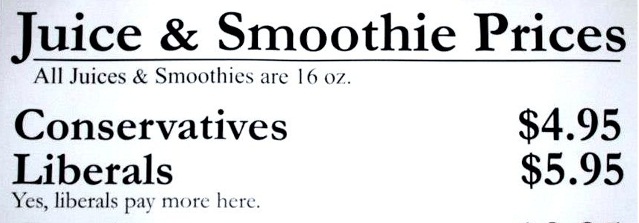
 As you can see from the sign above, the I Love Drilling Juice and Smoothie Bar in Vernal, Utah, owned and operated by a local pro-oil and gas activist George Burnett, charges liberals an extra dollar for its fare. The smug owner then donates the proceeds from his partisan surtax to  the Heritage Foundation and other conservative organizations.

I hate to pop Mr. Burnett’s self-satisfied balloon, but his stunt is unethical and profoundly un-American. The former is best illustrated by the scheme’s obvious failure to satisfy Kant’s Rule of Universality, a.k.a. the “What if everybody did this?” test. If every business discriminated on the basis of political and ideological belief, daily life would be unbearably complicated, contentious, and nasty, with all communities broken into exclusive, inconvenient and hostile camps. The practice of making people pay extra for basic goods and services according to whether their politics are Blue or Red is also hostile to basic American principles of respectful diversity, open minds, and civil discourse. Yes, Burnett’s  liberal tax is legal and constitutional. But it is unfair, and violates the principle, if not the letter, of equal treatment for all. Punishing citizens for their beliefs is bullying, whether the culprit is a city mayor who wants to ban a business because its owner opposes gay marriage, or an arrogant activist who wants to make anyone who disagrees with “drill baby drill!” to have to pay more for smoothies. Continue reading

Incompetent Elected Official of the Month: Michigan State Representative Doug Geiss (D-Taylor)

Ah, those were the good old days!

Ah, those were the good old days!

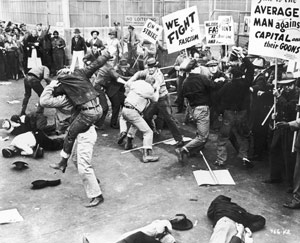
There is a strong likelihood that the Michigan state legislature will pass “right to work” legislation that limits the political power of labor unions, preventing unions cannot from requiring members to pay dues as a condition of employment. Twenty-four states have such measures, all passed through the democratic process, with voter-elected representatives debating and approving the legislation, and bills being signed by duly elected governors.  State Rep. Doug Geiss (D-Taylor), however, a union-supporting legislator in Michigan, has a provocative alternative strategy to offer when debate and democracy fail to reach the result he and his supporters desire: threaten violence. Continue reading