Death On K2 And The Duty To Rescue

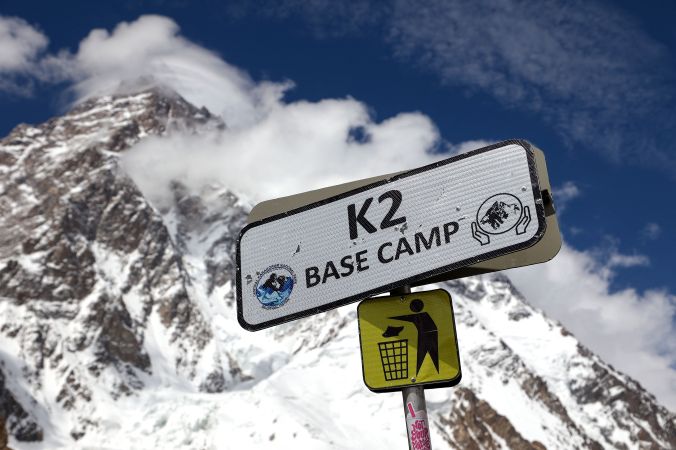
The AP story and ensuing controversy about Norwegian climber Kristin Harila and her decision, along with many other mountaineers, to leave a climbing companion dying in the snow on K2 immediately rang a metaphorical bell: Haven’t we discussed this issue before on Ethics Alarms? Indeed we have.

Back in 2011, I reposted a 2006 essay from the old (but still useful) EA predecessor The Ethics Scoreboard about the death of 34-year-old David Sharp on Mount Everest, after over 40 other climbers walked past him on their trek to the famous peak. It concluded,

The significance of the David Sharp tragedy is not that the mountaineers did the wrong thing. Of course they did the wrong thing. Nor is it that they are callous or unethical people, for they are probably no more so than you or I. The importance of the story is that it vividly shows how difficult it can be to make even obvious ethical choices when powerful non-ethical considerations are in our sights. Every one of us has a goal or a dream or a desire that could make us walk by a dying man. It is our responsibility to recognize what those goals, dreams and desires are, and to force ourselves not to forget about right and wrong as we approach them.

Harila was on K2 to set a record, and she did: along with her Sherpa guide, Tenjin, they became the world’s fastest climbers by getting to the top of the world’s second highest peak, scaling the world’s 14 highest mountains in 92 days. But of course that mission had nothing to do with her decision to leave Mohammad Hassan, a Pakistani porter and father of three, to die after he slipped and fell off the narrow path to the summit. The Norwegian climber told The Associated Press on Sunday that “in the snowy condition we had up there that day, it wouldn’t be possible to carry him down.”

It was impossible! All righty then, case closed!

Drone footage showed dozens of climbers pushing past Hassan to reach the mountain peak, the path to which was unusually crowded that day (July 27), because it was the last day of the season for a possible ascent. The nerve of that guy losing it all up by falling!

Austrian climber Wilhelm Steindl, who shot the drone footage after he had abandoned the climb because of bad weather, told the AP that more could have been done to save Hassan. “Everyone would have had to turn back to bring the injured person back down to the valley. I don’t want to kind of directly blame anybody, I’m just saying there was no rescue operation initiated and that’s really very, very tragic because that’s actually the most normal thing one would do in a situation like that.”

Well, to be fair, it isn’t. What might have changed the way the climbers reacted would have been a strong leader with the personal magnetism and persuasive skills to reorient the climbers from pursuing powerful non-ethical considerations to embracing an ethical one. No doubt about it, trying to get the injured man down the mountain involved sacrifice and risk, and might not even succeed. There is, however, an ethical duty to try. A life was at stake.

Continue reading

Ethics Hero Emeritus Desmond Doss, And “Hacksaw Ridge,”

desmond-doss

Desmond Doss, who died on March 23, 2006 at the age of 87,  was the very first hero to be enshrined in the Ethics Alarms Hall of Heroes. I wrote about him before there was an Ethics Alarms, shortly after he died.  I had never heard of Doss before, and I remember being angry that I had never heard of him. Everyone should know about him. There literally are no Americans who were any more heroic, and whose ethical conduct was any more astounding, than Desmond Doss.

If the values of this nation, and especially Hollywood, were healthy and correctly aligned, he would be a household name, and the film about his World War II heroism would have been made long ago. Finally “Hacksaw Ridge” was produced in 2016, and has been nominated for an Academy Award, although it will never win.

When I first read about Doss, I couldn’t get my mind around what he had done to be awarded the Congressional Medal of Honor, the only conscientious objector ever to achieve that honor during combat. During the battle of Okinawa, we were told that he survived heavy enemy fire as he struggled to carry seventy-five wounded soldiers to the sheer cliff at Hacksaw Ridge, personally picking up each one and lowering them over the edge the cliff 400 feet to safety.   How is that possible? Now that I’ve seen the film, it still seems impossible.

Desmond Doss proved that principled opposition to violence against his fellow human beings need  not be based on fear, self-interest or self-preservation. It is often impossible to tell whether those who oppose armed combat really object to the spilling of all human blood in battle, or only their own. With Desmond Doss, there was never any doubt. He didn’t like the term “conscientious objector,” preferring the term “conscientious cooperator.” He enlisted in the army following Pearl Harbor, believing that the war against the Axis had to be fought and wanted to be part of the war effort despite believing, as a devout a Seventh Day Adventist, that it was a sin to kill, with no exceptions. Thus he refused to carry a rifle (or shoot one, even in training) but yet insisted that he be involved in combat as a battlefield medic. He achieved conscientious objector status  but would hot accept a deferment. Assigned to the 307th Infantry Division as a company medic, Doss was hazed, abused and  ridiculed  for his dedication to non-violence, and as the Mel Gibson-directed film shows, many of his tormentors eventually owed their lives to his astonishing heroism. All of his compatriots were amazed by his evident fearlessness under fire and remarkable dedication to duty, never hesitating to go after a wounded soldier no matter what the personal risk. As a combat medic on Guam and at Leyte in the Philippines, Doss had already been awarded the Bronze Star  before the three-day battle at Hacksaw Ridge.

Many of the soldiers in Doss’s 307th Infantry, 77th Infantry Division were driven off the ridge by a furious Japanese counter-attack, and  wounded G.I.s were stranded atop it. Doss remained with the wounded, and, according to his Medal of Honor citation refused to seek cover, carrying them, one by one, to the edge of the ridge in the face of enemy fire, some of them from behind enemy lines. He lowered each man on a rope-supported litter he improvised on the spot, using double bowline knots he had learned as a youngster and tying the makeshift litter to a tree stump to serve as an anchor. Every wounded man was lowered to a safe spot 35 feet below the ridge top by the 145 pound medic. Finally, Doss came down the ridge himself, incredibly, unharmed. Continue reading

Presenting the Ethics Alarms Heroes’ Hall Of Honor

remember

Today, the anniversary of September 11. 2001, American minds should be occupied with thoughts of gratitude for heroes, the often anonymous and unknown people we may pass in the street every day, as well as the justly famous and celebrated, who make our lives and many others better by living their own selflessly and well. They are our salvation, role models and neighbors, and they teach us the lesson that all is never lost, and hope is always thriving, as long as there are good and courageous people who will do the right thing, no matter what the cost, when fate turns to them.

This seems like a propitious time to dedicate the Ethics Alarms Heroes Hall of Honor, the list of the Ethics Heroes Emeritus whose stories have been told here (and on this site’s predecessor, The Ethics Scoreboard.) Every current member of the Hall is now deceased, like the brave men and women who died this day, 12 years ago. Each of them, in a unique way, teaches how human beings can rise above the vicissitudes of mere survival, self-interest, personal benefits and the base desires of the species  to live  meaningful and virtuous lives. Some accomplished this over decades, some with one brilliant and transforming act of distinction.

There are currently 32 members enshrined in this virtual Hall. Obviously, it is far from complete. They are just symbolic representatives, worthy ones, of millions more who once breathed the same air we do today, and like those who perished twelve years ago, face the prospect of being forgotten over time, as we all go about the consuming task of getting from one day to another. Each one of us, I believe, is capable of emulating their example.

Here are the thirty-two members and their stories, as of this date,

September 11, 2013... Continue reading