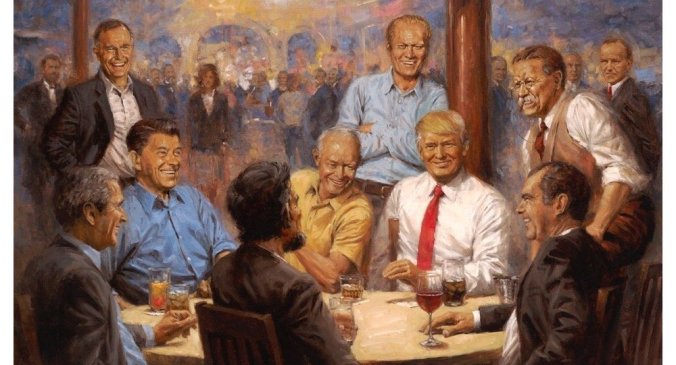
Oh, You Didn’t Think I Would Forget Presidents Day, Did You? [Embarrassing Gaffe Corrected]

Well, to be truthful, I almost did. The contrived holiday seldom occurs this early. Nevertheless, I’m going to recognize Presidents Day with re-posts of two essays about U.S. Presidents, neither of which were originally written for the holiday.

The first is one of my favorite mysterious tales about any President, in this case George Washington, and the second, from 2015 and re-posted five years ago, is my favorite story about any President ever.

Here they are:

Pssst! Bill Maher! The “Saved By God” Belief Has Inspired Some of Our Greatest Presidents. Shut Up.

Atheists and agnostics in the public sphere don’t have to be obnoxious, but an awful lot of them are. Their explanation for where the universe came from is no more persuasive that that of the faithful (The Big Bang? Come on.) but they just can’t restrain themselves. HBO’s Bill Maher is a prime example: along with mocking committed relationships (he hates the concept of marriage), extolling drugs and debauchery, and generally keeping his Axis of Unethical Conduct membership current, he ridicules Christianity at every opportunity.

The fact is, and it is a fact, that the United States of America had a much healthier and ethical culture before organized religion had discredited itself so thoroughly, driving whole generations away. Moral codes are especially essential for those who don’t have the time or ability to puzzle through ethics, and believing in God is the best catalyst for an ethical society that there is….and it has always been thus.

Heck, just look at what a jerk Maher is. That’s what atheism can do to you. But I digress.

My target here is more narrow. On last week’s “Real Time,” Maher sneered at the belief that God saved Donald Trump from being assassinated as stupid and “dangerous.” “People see signs because they want to see them. It’s why stalkers think Taylor Swift is blinking ‘marry me’ to them in Morse Code,” he explained. “It gets dangerous when the signs make someone think God is on their side,” Maher continued.  “Republican Congressman Mike Collins said after the shooting, ‘God spared Ronald Reagan for a reason. God spared Donald Trump for a reason. God doesn’t miss.’ Really? Tell that to John Lennon, Lincoln, JFK, RFK, and Martin Luther King. Look, the asshole who shot at Trump was cowardly, unpatriotic, selfish, vile, and weak, and he should rot in hell, but thinking that God protects your heroes but not mine? That isn’t cool either.”

How do you know, Bill, that God doesn’t protect your heroes for a very good reason? I can think of several good reasons for that, as well as for squashing you like a bug. Of course the certitude that God is responsible for anything is confirmation bias: my wife, the daughter of a Methodist minister, frequently expressed contempt for the faithful who simultaneously said that “God works in mysterious ways” and “there are no coincidences” while conveniently asserting that they had figured out those mysterious ways. But if Bill knew as much about American history, leadership and the Presidency as he should, he would know that the belief that God has saved them for a reason motivated many of America’s greatest leaders. It could have been dangerous, I suppose, but so far, that belief had been overwhelmingly beneficial to our nation. Perhaps even its salvation.

Leadership requires special character traits, the right formative experiences and a lot of luck. National leadership arises out of an individual’s conviction that they are uniquely qualified to do a better job than anyone else, accompanied by the passion, conviction and charisma necessary to convince others of their abilities. That’s why so many of our Presidents have been narcissists, true, but the anti-American trope that our leaders only seek power, wealth and personal benefits is, based on my lifelong study of history, garbage.
A Presidents Day Encore: “How Julia Sand Saved A President And Changed The Nation”

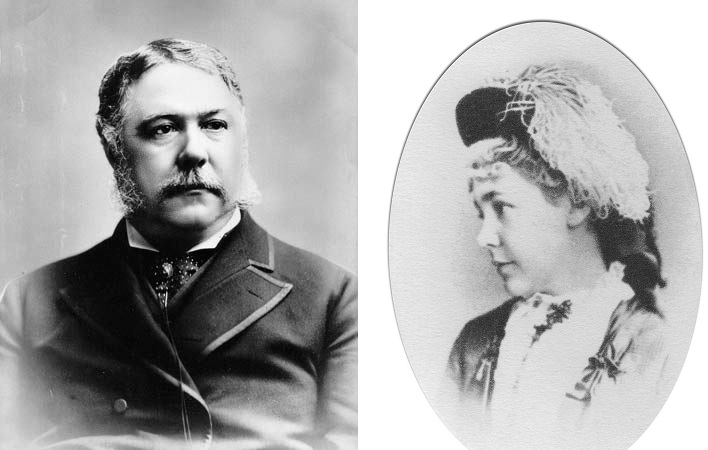
Chester Arthur and Julia

I’m pretty sick of U.S. Presidents and Presidential history at the moment, so for my own state of mind and perhaps yours, I’m re-posting a 2015 article about my favorite story about a President ever. Here it is…

In my overview of the U.S. presidency (the four parts are now combined on a single page under “Rule Book” above), I noted that our 21st President, Chester A. Arthur, was one of my personal favorites and an Ethics Hero. He confounded all predictions and his previous undistinguished background, not to mention a career marked  by political hackery and toadying to corrupt Republican power broker Roscoe Conkling, to rise to the challenge of the office and to effectively fight the corrupt practices that had elevated him to power. Most significantly, he established the Civil Service system, which crippled the spoils and patronage practices that made the Federal government both incompetent and a breeding ground for scandal.

I did not mention, because I did not then know, the unlikely catalyst for his conversion. Recently a good friend, knowing of my interest in Arthur, his tragic predecessor, James Garfield, and presidential assassinations sent me a copy of Destiny of the Republic, the acclaimed history of the Garfield assassination and its aftermath by Candace Millard. It’s a wonderful book, and while I knew much of the history already, I definitely did not know about Julia Sand. Her tale is amazing, and it gives me hope. If you do not know about Julia and Chester, and it is not a well-known episode, you should.

Continue reading

Ethics Tales: How Julia Sand Saved A President And Changed The Nation

open book on concrete background

In my recent overview of the U.S. presidency (the four parts are now combined on a single page under “Rule Book” above), I noted that our 21st President, Chester A. Arthur, was one of my personal favorites and an Ethics Hero. He confounded all predictions and his previous undistinguished background, not to mention a career marked  by political hackery and toadying to corrupt Republican power broker Roscoe Conkling, to rise to the challenge of the office and to effectively fight the corrupt practices that had elevated him to power. Most significantly, he established the Civil Service system, which crippled the spoils and patronage practices that made the Federal government both incompetent and a breeding ground for scandal.

I did not mention, because I did not then know, the unlikely catalyst for his conversion. Recently a good friend, knowing of my interest in Arthur, his tragic predecessor, James Garfield, and presidential assassinations sent me a copy of Destiny of the Republic, the acclaimed history of the Garfield assassination and its aftermath by Candace Millard. It’s a wonderful book, and while I knew much of the history already, I definitely did not know about Julia Sand. Her tale is amazing, and it gives me hope. If you do not know about Julia and Chester, and it is not a well-known episode, you should.

Allow me to tell it to you?

James Garfield, an Ohio Congressman, had been the dark horse nominee of the Republican Party in 1880, foiling the ambitions of many powerful politicians, the most powerful among them being Sen. Roscoe Conkling of New York. In order to cement New York’s electoral votes, the convention gave the Vice Presidential nomination to Conkling’s lackey, the dignified-looking but otherwise unimpressive Chester A. Arthur, who may have been the least qualified individual ever to run for that office. The highest position he had ever held was Collector of Customs of the Port of New York, which had been handed to him by Conkling, and he was later removed from that post for incompetence and corruption.  He’d never been elected to significant office or been any kind of executive. Arthur’s career before becoming Vice President makes Sarah Palin look like Winston Churchill.

After the election, Arthur got to work being a disloyal Vice-President, acting as Conklin’s agent in the White House. (Arthur, a widower, even lived as a guest in Conkling’s Washington mansion.) He actively undermined Garfield’s efforts at government reform, at one point going so far as signing a petition supporting Conkling when Garfield refused to appoint only Cabinet members with the Conkling stamp of approval. Then,  on July 2, 1881, less than six months after taking office, the impressive Garfield was shot in Washington D.C.’s Union Station by Charles Guiteau, easily the craziest of the various crazies who have taken a shot at our leaders. (He was also the only lawyer in that group.)

Everybody was horrified, initially at the crime, but also at the prospect of Arthur becoming President. Some even suspected him of being complicit in the act; Guiteau didn’t help by writing Arthur a letter prior to his attack telling him what he needed to do as President.  Most, however, were just aghast at the prospect of the brilliant, courageous, skilled and honorable Garfield being replaced by this utter non-entity under Conkling’s thumb.

None were more aghast than Chester A. Arthur. He may have been a hack, but he was no fool, and he knew he wasn’t up to the job. It was reported that when he learned of Garfield’s shooting, Arthur began weeping like a child. During the nearly three months it took the hardy Garfield to die—he was killed by sepsis induced by the unsanitary prodding of his doctors as they searched for Guiteau’s bullet: the wound itself was probably survivable—Arthur descended into panic, shock, and depression.  For nearly two months, he stayed at home with the blinds drawn, fearing his own assassination. So invisible was he that there were  rumors that Arthur had poisoned himself.

Then Arthur received a letter, dated August 27, 1881, from a woman he did not know, Julia Sands. It immediately got his attention, for she addressed him in a manner he had never been spoken or written to before. The remarkable letter said in part… Continue reading