There Is No “Debate”: Graffiti Artists Are Vandals, And The First Step To Stopping Them Is To Eliminate The Myth That They Might Be Anything Else

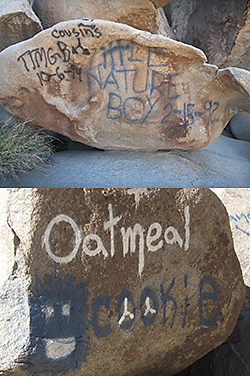
Rattlesnake Canyon "art": Breathtaking!

Rattlesnake Canyon “art”:
Breathtaking!

Since I don’t get out to the ol’ hiking trail that often, being chained to my desk, I was blissfully unaware that a group of lawless and arrogant vandals masquerading as “graffitti artists” are moving their ugly misappropriation of public spaces to the wild.

From the L.A. Times:

Andre Saraiva is an internationally known graffiti artist. He owns nightclubs in Paris and New York, works as a top editor of the men’s fashion magazine L’Officiel Hommes and has appeared in countless glossy magazines as a tastemaker and bon vivant. Two months ago he showed up on the decidedly un-fashionista website Modern Hiker, along with a photo of a boulder he tagged in Joshua Tree National Park. Since then, Saraiva, who lives in France and is known by his fans as Mr. Andre and Mr. A., has been scorned by American nature lovers and thrust into a highly charged debate. Saraiva is of a new generation of graffiti artists who regard nature — not just the built environment — as their canvas. They tag national parks, then post photos of their work on the Internet.

The Times—they are so open-minded in California!—goes on to say that “those acts infuriate outdoor enthusiasts,” as if there is any reason for the acts not to infuriate every thinking and reasoning human being on the planet. This is the awful journalistic device I have flagged in a political context, minimizing clearly unethical conduct by suggesting that only those with an agenda see it as wrong. “GOP critics assail Hillary Clinton for foreign donors,” for example, is a misleading characterization suggesting that one would and should only object to blatantly unethical conduct if one was a Clinton foe. Wrong. There is something ethically rotten about anyone who doesn’t see Clinton’s conduct as seriously unethical, just as everyone, not just “outdoor enthusiasts,” should recognize that defacing rocks, trees and landscapes is indefensible, ethically and legally.

Andre Saraiva is a fick–a person who acts unethically and celebrates it shamelessly. He is an art fick, a sub-species Ethics Alarms has not encountered often.

Jonathan Turley, a hiking enthusiast as well as a Constitutional scholar, makes his conclusion crystal clear, in the embodiment of the Ethics Alarms principle that “where ethics fail, law steps in”: Continue reading

Ethics Quiz: The Vigilante Cell Phone Police

Say goodbye, cell phone!

Say goodbye, cell phone!

National Review blogger and theater critic Kevin Williamson raises an issue that especially interests me, as part of the management of a professional theater company. How far can an audience member ethically go to quite a persistently rude and disruptive spectator who insists on using her cell phone during a performance? Here’s how far Williamson went while viewing the musical Natasha, Pierre, and the Great Comet of 1812 that a woman was in the process of ruining for him, after he complained to the management without success and received this series of responses from the woman:

“I asked her to turn it off. She answered: “So don’t look.” I asked her whether I had missed something during the very pointed announcements to please turn off your phones, perhaps a special exemption granted for her. She suggested that I should mind my own business.”

Williamson then grabbed the phone from her and hurled it against the wall. She slapped him, and complained. He, not she, was then escorted from the theater.

Let’s stipulate that hurling the phone was over the line. But let’s suppose that he had just confiscated the phone, walked into the lobby, and hidden it in a planter, promising to reveal the hiding place after the performance (having already failed to police the situation as was their duty, Williamson can not be blamed for bypassing management).

Your Ethics Alarms Ethics Quiz Question:

Is it ethical to confiscate the cell phone of a deliberately rude user during a theatrical performance, after appropriate warnings have been given and ignored? Continue reading

When The Ethics Alarms Don’t Sound: A Cautionary Tale From Seattle


%$#@*#!!!

Like all of us, Seattle attorney Ronald Clarke Mattson was infuriated when he found cars parked straddling the lines in crowded parking lots and garages.

It really is rude, inconsiderate, obnoxious and unethical behavior, especially when it is blatant, as when the owner of the Lexis or the Jaguar intentionally takes up two spaces to guard his baby against any accidental dings. This is a statement that rings out loud and clear: “My car is more important than your convenience, and I’ll take up two spaces, robbing you of your right to one, because I matter, and you don’t.” 

I’ve left nasty notes for these jerks, for all the good that does. I’ve complained to stores, and even had them make announcements over their public address systems. On a couple of occasions, when one was handy, I’ve recruited a police officer, and several times I’ve waited for the owner of the car so I could tell him off (if he wasn’t armed or too big).

Once, when the car was a brand new, loaded, shiny  sports convertible, I engaged in the intentional infliction of emotional distress, leaving a note that said that I had used a tool to leave a fairly deep, but small, indentation on his now no-longer-pristine car, and I hoped he had fun looking for it. (There was no such wound, but I am not proud of this.)

If I had a momentary desire to really harm the car, as I may have had once or twice, several considerations set off my various ethics alarms. The Golden Rule alarm wouldn’t sound, because this isn’t a Golden Rule situation: I would never take up two spaces.  Others, however, would:

  • The “Two Wrongs Don’t Make a Right” alarm.
  • The “It’s Against the Law” alarm.
  • The “What If Everybody Did This?” alarm
  • The  “Don’t Take Action That Has No Purpose Other Than To Do Harm” alarm
  • The “Sons of Maj. Jack Marshall Sr./ Lawyers/Ethicists Don’t Act Like This” alarm
  • The “I Would Be Ashamed If Anyone Found Out” alarm, and most of all,
  • The “You Know This Is Wrong” alarm.

And if they all failed to sound, due to poor installation and maintenance? Then I might have done as Ronald Clarke Mattson did, more than once. He pleaded guilty this week to a reduced count of attempted second-degree malicious mischief, a gross misdemeanor, for keying three automobiles in retribution for their owners’ parking misconduct.  He received a one-year suspended sentence, 240 hours of community service, restitution for the three victims, and has to attend an anger-management class.

But his problem isn’t anger management. His problem is malfunctioning ethics alarms.

Mattson has been a lawyer since 1972, and could now face punishment from the Washington State Bar Association, which is charged with making sure that attorneys with faulty ethics alarms seek immediate repairs.