Idaho Student Massacre Ethics…And A “Hate Speech” Issue

Issue I: The Banned Subreddit. Above you see a posted photo of some sick fan-girls’s shrine to University of Idaho student massacre suspect Bryan Kohberger. On the massive social media site Reddit, a “subreddit” titled “Brynation” emerged after Kohberger’s arrest late last year for the murders of University of Idaho students Kaylee Goncalves, Madison Mogen, Xana Kernodle and Ethan Chapin. The Reddit group, which included women professing to be infatuated with the accused killer as well as amateur sleuths who maintained that he was innocent, had grown to more than 500 members before it was banned from the platform for allegedly violating Reddit’s Moderator Code of Conduct. As is typical with such social media bans, Reddit didn’t specify the exact offense.

Reddit can ban whatever and whoever it chooses; the question is when it is ethical to do so. There are too many arguably sick subreddits to list, including many involving fetishes, which the common phenomenon of women being smitten by murderers certainly is. At this point, Bryan Kohberger is presumed innocent in the eyes of the law. I just heard an “expert” opine that social media outlets have an “obligation” to control and minimize “hate speech” on their platforms, which he defined as speech that could provoke violence or “harm” individuals, and cited Reddit’s action as an example of responsible social media management. The Fox News interviewer just nodded like one of those plastic dogs people used to put in the rear windows of their cars.

How is chatting online about an accused murderer “hate speech”? The expert’s fatuous (but popular!) position demonstrates exactly what’s unethical about the anti-“hate speech” movement on the Left: the term literally can mean any speech the censors don’t like, disagree with, or find “icky.” The participants in the banned subreddit were not doing anything likely to result in violence: has anyone ever become a serial killer to be more attractive to women? Thinking isn’t dangerous; talking on line about one’s thoughts isn’t dangerous either, or unethical.

In a purported democracy, the culture should lean hard in the direction of free expression, with all expression given a strong presumption of legitimacy. People like Fox’s “expert” do the opposite, and are working to shift our culture toward concepts of GoodThink and BadThink, with the distinctions being dictated by powerful corporations, Big Tech, social media, the news media, educational institutions and, of course, the government.

Weird people have rights too.
Continue reading

Dictionary Ethics: Thanks, Cambridge, But I’ll Ask Billy Joel Next Time…

I was going to make this an Ethics Quiz, but decided that the verdict was pretty clear.

Conservative media and blogs have been fulminating over the Cambridge Dictionary’s decision to add a definition of woman—perhaps to help out Justice Ketanji Brown Jackson, whose answer at her conformation hearing that she wasn’t a “biologist” and thus couldn’t define “woman” will haunt her forever (good!)—that jibes with woke fantasies. Now, along with the standard definition of woman as “An adult female human being,” we are stuck with (at least if we consult the Cambridge Dictionary, which I don’t) “An adult who lives and identifies as female though they may have been said to have a different sex at birth.”

At a basic level, the publication is getting criticism it doesn’t deserve. Dictionaries follow language use trends, they don’t lead them. My language maven friends often complain about the loss of useful distinctions in the English language when they become erased by such frequent sloppy use that even dictionaries endorse the misuse. But in language, unlike in ethics, “everybody does it” is usually decisive. I find the distinction between “that” and “which” useful, but many dictionaries have given up and define the words as interchangeable. Nonetheless, I will continue to honor the distinction, just as I will not use the Cambridge alternate definition of “woman. I will acknowledge that many people, perhaps not enough to justify the definition but apparently enough for this one dictionary, do use the new meaning—which to me means “If you say you’re a duck and quack like a duck, that’s literally enough to make you a duck.”

Continue reading

Ethics Train Wreck Update: Now The Dictionary People Have Boarded The Post-2016 Election Freakout

It’s really depressing. I did not expect to see so many professions and professionals debase themselves and their ethical principles because they couldn’t deal with the results of a presidential election. . Historians. Judges. Scientists. Professors. College presidents and administrators. Performing artists. Intelligence community professionals. Judges. Journ–well, no, that one wasn’t a surprise.

My own profession, legal ethicists, booked a seat on the ethics train wreck, a development that was profoundly disappointing. Wrote one member of the profession who has remained clear -eyed while keeping his integrity, Steve Lubet in Slate,  “As a liberal Democrat, I have no sympathy for Conway’s habitual disregard for truth. As a professor of legal ethics, however, I think this complaint is dangerously misguided and has the potential to set a terrible precedent…The professors no doubt have faith in the professionalism of the District of Columbia Office of Disciplinary Counsel, but the bar authorities in other states may not always be reliably even-handed or apolitical. It is hardly inconceivable that lawyer discipline might somewhere be used as a weapon against disfavored or minority candidates, or as a means to squelch protest movements and insurgent campaigns. In the 1940s and 1950s, suspected Communists and alleged “fellow travelers” found their law licenses in jeopardy in many states. In the 1960s and 1970s, civil rights lawyers were hauled before the bar authorities in the South. The complaint against Conway is an unfortunate step back in the direction of using lawyer discipline against political enemies….”

Bingo.

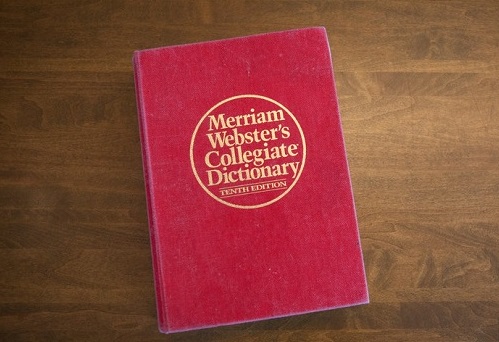
Now “America’s dictionary,” Merriam-Webster, has decided that it is within its mission and purview to attack and mock the President of the United States..

Almost immediately after his election, the dictionary’s editors began trolling Trump and his administration, defined, by Merriam-Webster, as “to antagonize (others) online by deliberately posting inflammatory, irrelevant or offensive comments or other disruptive content.”

The website Acculturated has observed that on social media and its website Merriam-Webster has ridiculed the President  “for his every spelling mistake, grammatical error, and verbal gaffe. In honor of the election, they changed their header photo to a picture of a German word defined as the “collapse of a society or regime marked by catastrophic violence and disorder.” Then they highlighted what they claimed was the word most frequently looked-up, “fascism.” On Inauguration Day, they tweeted “Welp,” a word that conveys dismay or disappointment. The company also derided Betsy DeVos, Sean Spicer, Steve Bannon, and, of course, Kellyanne Conway.

This, needless to say, is not their job, their mission, or responsible professional conduct. It is, as it is for the other derailed professionals, smug virtue signalling and tribalism. Acculturated again:

[T]he dictionary’s editors are clearly partisan. They didn’t harass Hillary Clinton, and they don’t needle sports stars, celebrities, or, well . . . anyone else like they needle the President and his people.Theoretically, even that could be okay—a good, playful, occasional joke from the dictionary could have the whole country laughing. But if you mock one person too often, you start to reveal a pattern. If that pattern persists, the fun and games lose their light-hearted feel, and begin to betray bias instead.

Ya think???

Continue reading