Now Here’s A Terrible Idea: Mandated Disclosures for Photoshopped Images of Celebrities!

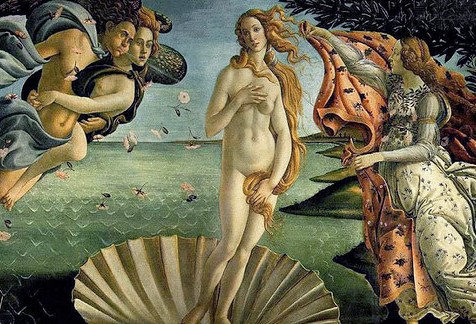
And if you look real closely at the lower left corner, you'll read, "The model for Venus was a short, middle-aged bald man named Gino. His appearance was altered by the painter in the creation of this painting."

Here is another candidate for enshrinement in the Pantheon of Well- Intentioned But Terrible Ideas.

In an article published Monday in the journal “Proceedings of the National Academy of Sciences,” Dartmouth researchers Hany Farid, a professor of computer science, and Eric Kee, a doctoral student, propose a rating system of publicly displayed photographs of models, actors and celebrities to let viewers know exactly how and how much an image has been altered by photoshopping, airbrushing or other means.

“Impossibly thin, tall, and wrinkle- and blemish-free models are routinely splashed onto billboards, advertisements and magazine covers,” the two write. “The ubiquity of these unrealistic and highly idealized images has been linked to eating disorders and body-image dissatisfaction in men, women, and children.” In the interest of limiting the damage caused by unrealistic images of human beauty, the researchers argue that graphic images should include labels that disclose  “geometric adjustments” such as slimming legs, hips and arms, as well as adjusting facial symmetry—reducing a nose in size, or slightly enlarging eyes.  Users of such photos should also flag photometric adjustments that change the appearance of skin tone, blemishes and texture, such as wrinkles, dark circles under the eyes or cellulite, say the researchers.

Please, for the love of God, nobody introduce these guys to Sarah Deming and her lawyer, who are suing the distributers of the film “Drive” because the trailer was more exciting than the movie. And let us all remember this proposal when we are tempted to pooh-pooh accusations that the government is regulating creativity, commerce, art and enterprise right out of existence, and with them, individual liberty as well.The tea parties should use Farid and Kee’s article for recruitment. Continue reading

Comment of the Day #3 on “Ethics Dunces: The Senate and House Leadership”

Come back, Ross! We need your charts!

The third Comment of the Day on this “Comment of the Day Friday” is an epic from Michael, expanding on the theme of my original post.

“I hate the fact that no one is talking facts, only ideology. In such an atmosphere, these selections make sense. The S&P statement said our downgrade was because we failed to tacked long-term indebtedness especially the main drivers of long-term debt: Medicare and SS, but no one really wants to deal with that. To talk facts, you really need some tables, figures, and analysis. I’m not just talking about politicians, here. Isn’t this the reason we tolerate the media? Aren’t they supposed to keep us informed of about things like this so we can then get outraged by such a stupid selection of people to ‘fix’ our problem.

“Why can’t we find a news outlet that will break things down like this?” Continue reading

Scent Branding, Mind-Control, and Ethics

Agreed: this is scary. We're not there yet. We don't even know if "there" exists.

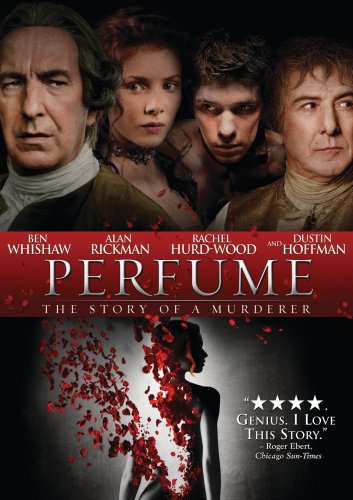
A recent article on the web that purported to explore the ethics of “scent branding” was fascinating for two reasons.

First, “scent branding” is a term I had never encountered before, for a practice that I had not focused on. About five seconds of thought, however, made me realize that indeed I was aware of the phenomenon, and had been for quite a while. “Scent branding”—using fragrances in a commercial environment to create a desired atmosphere and to prompt positive feelings, recollections and emotions from patrons—has been around a long, long time, though not under that label. When funeral parlors made sure that their premises smelled of flowers rather than formaldehyde, that was a form of scent branding. Progress in the science of scent allowed other businesses to get into the act: I was first conscious of the intentional use of smell when I spent a vacation at the Walt Disney World Polynesian Villages Resort. The lobby and the rooms had a powerful “tropical paradise” scent, a mixture of beach smells, torches and exotic fauna. It was obviously fake, like much in Disney World; also like much in Disney World, I found it effective, pleasant, and fun. I certainly didn’t think of it as unethical. I was normal in those days, however.

Well, more normal.

The second aspect of the article, entitled “Is it Ethical to Scent Brand Public Places?”, that caught my attention was that it had an obvious agenda. The piece was opposed to scent branding, and set out to find the practice unethical in order to justify condemning it. Continue reading

Ethics Dunce: CBS

"That's Entertainment!"

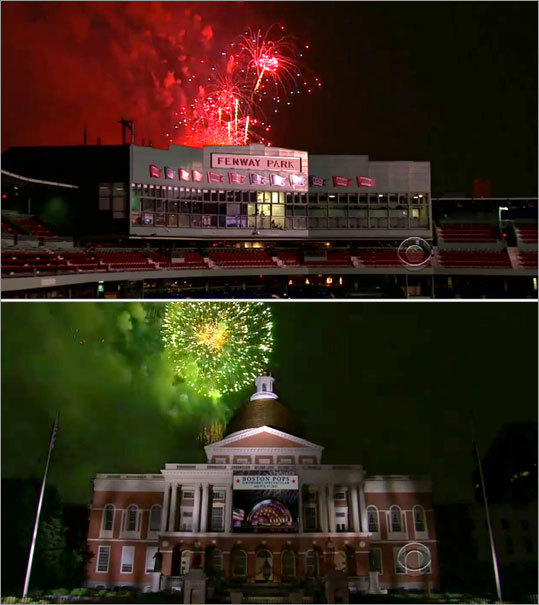
It took a few days, but Boston viewers finally figured out that CBS’s broadcast of the city’s famous Fourth of July fireworks display was digitally altered to present a spectacular view of the display that is geographically impossible. Yes, CBS, network of Murrow and Cronkite, presented a phony, enhanced version of the fireworks without bothering to disclose to viewers what they were really seeing.

Yesterday Boston bloggers and observers began pointing out that it was  impossible to see the fireworks above and behind such famous locales as the State House, Quincy Market, and home plate at Fenway Park, because the display, as always,  was launched from a barge in the Charles River, located where it could not be seen from those places.

“According to CBS, you can see the fireworks from the right side of Quincy Market, even though Beacon Hill is in the way,’’ wrote Karl Clodfelter, a research scientist and a commenter on the Boston blog UniversalHub.com. “Also, they come up behind the State House when you’re standing across the road . . . which means the barge must have been parked on the Zakim* this year.’’ Continue reading

Ethics Hero: Arizona Governor Jan Brewer

There is hope for Arizona yet...

Earlier, I wrote about a bill passed by the Arizona legislature that would broadly allow religious practices and beliefs to trump professional obligations, ethics codes and discipline. The bill, SB 1288, directed in part:

A. Government shall not deny, suspend or revoke a professional or occupational license, certificate or registration based on a person’s exercise of religion.

B. Government shall not deny, suspend or revoke a professional or occupational license, certificate or registration based on a person’s refusal to affirm a statement that is contrary to the person’s sincerely held moral or religious beliefs, regardless of whether those beliefs are specifically espoused by a recognized church or religious body…

C. A person’s exercise of religion is not unprofessional conduct.

It was widely assumed, including by me, that Republican governor Jan Brewer would sign this stunningly awful bill into a law which would allow any practice that could be called “religious” to be immune from community, cultural and professional norms of right and wrong unless they were explicitly illegal. She did not. She vetoed it, an act of responsible leadership and political courage.

You can read her veto letter here.

Arizona’s Anti-Ethical Free Exercise of Religion Bill

While I was worrying about the unethical nature of so-called “conscience clauses,” which allow certain professionals, like pharmacists, withhold their services when they clash with the professional’s religious convictions, the Arizona legislature was cooking up something unimaginably worse. Last week the Arizona House of Representatives passed and sent to the Governor Brewer to sign into law SB 1288, a mind-blowing bill prohibiting the denial of occupational licenses or positions on public bodies because of an individual’s exercise of religion.

The soon-to-be-law states:

A. Government shall not deny, suspend or revoke a professional or occupational license, certificate or registration based on a person’s exercise of religion.

B. Government shall not deny, suspend or revoke a professional or occupational license, certificate or registration based on a person’s refusal to affirm a statement that is contrary to the person’s sincerely held moral or religious beliefs, regardless of whether those beliefs are specifically espoused by a recognized church or religious body… Continue reading

Ethics Quiz: Find The Tell-Tale Mistake!

Unfortunately, James O'Keefe is no Nellie Bly

Kansas City Star reporter Mary Sanchez has posted an excellent column entitled “James O’Keefe and the Ethical Bankruptcy of ‘Gotcha’ Journalism.” Outside of an unfortunate final “Let’s see some genuine evidence that NPR’s coverage is biased” conclusion (you mean, other than its choice of stories, its lack of ideological balance, Nina Totenberg, its treatment of Juan Williams, and its institutionalized positions on issues like Palestine, gun control, abortion,  and illegal immigration?), she makes a strong case. But her piece is marred by a tell-tale gaffe that makes me doubt her own ethical orientation.

Your challenge in today’s Ethics Quiz: Find it! It occurs in this section: Continue reading

Note to Ethics Alarms Readers: No More Ads! (And I’m Sorry It Took So Long For Me To Kill Them)

Dear Ethics Alarms Readers,

As discussed here last week, I only recently learned that WordPress has been planting ads in Ethics Alarms according to some mysterious formula. Whatever it is, the formula managed to keep me in the dark and deface my blog, giving some readers the impression that I had approved of, or profited from the ads. I never saw them, nor did WordPress ever give me notice what the ads were, how they were being placed, or that they were being run at all. Some of the ads, I learned, were for products that I find objectionable: for example, Barack Obama-mocking T-shirts in questionable taste.

Without checking to make sure, because it is pointless, I will stipulate that somewhere in the vast number of Conditions of Use provisions I must have agreed to at some point in time now lost to posterity, there must have been a statement in fine print giving WordPress permission to do all this. Had I read it, I would have probably agreed to it anyway, and would still be in the same position today, coming late to the realization that because I never saw ads on Ethics Alarms doesn’t mean some readers aren’t. I take full responsibility for this, and I apologize. I have a duty to you, just like WordPress has a duty to me. It should have kept me informed, particularly when their conduct affected the content of my website. It didn’t.

Anyway, I have paid the 30 bucks that buys me, and you, a year of ad-free content. If you see another ad on Ethics Alarms, please let me know. And There Will Be Blood.

Thank you for your patience, passion, loyalty and understanding. In the year since Ethics Alarms began, we have begun to build a diverse community of readers who constantly surprise, challenge, amuse and enlighten me with its insight and opinion on ethics and related matters. I know I don’t express my appreciation to all of you frequently enough; I will try to do better.

Sincerely,

Jack Marshall

WordPress Ethics, Or How Offensive Obama T-Shirt Ads Ended Up On My Blog

WordPress supplies a versatile and useful product that is user-friendly (if I can manage it, believe me, it is user-friendly), inexpensive, and well-serviced. It also seems to be diligent about supplying regular information, which is especially important to me. So many companies, and especially the government, regularly surprise me with unpleasant, disrupting, or costly changes in what they provide that I only learn about by accident, or when they start causing me trouble.

A few months back, for example, Direct TV gave me no-charge charge access to HBO, just a couple of months after I had canceled it. There was no notice about this, and as a result, we didn’t watch the network at all for some time, since we didn’t know we were receiving the signal. It was puzzling that the access to HBO just appeared, and when it had hung around a few months, I decided to look at the bill, which we paid automatically. Now, I discovered, we were being charged for HBO, which I had just canceled.

When I called Direct TV, the representative apologized, took off the charge, credited me with a past months charge before I had realized what had happened, and removed HBO. He also gave me a long explanation about why this had happened, which boils down to this: when your service is interrupted (as it was several months ago; I was late with a bill payment), it is my responsibility to tell Direct TV what channels I was getting before the interruption, or it might just slip in premium channels without telling me when it reconnects my service. Is this written anywhere? No, it isn’t.

I no longer trust Direct TV.

I don’t trust the Transportation Security Administration, either. Last week, in the middle of a trip that involved several flights, I set off the gate alarm, as is my custom (I have a metal hip), and prepared for the ceremonial wanding. But this time, it wasn’t a wanding; oh no no no! It was a bona fide, full-body, rough massage feel-up that included a sprightly hello to my throat, rear-end, and naughty bits. In many cities, such stimulation would have cost me a pretty penny, though only if it were not performed by a large, heavy, middle-aged guy named Carl, as mine was. Yes, in rapid response to the underwear bomber, whose attempted act of terrorism was more than a year ago, TSA has now instituted new pat-down procedures designed to determine, among other things, what’s in your BVDs. There was no advance notice of this to flyers, of course, until I was actually at the feel-up point of no return, having made my meeting schedule and bought my non-refundable ticket. In fact, the new procedures had been instituted mid-day, after I had taken a flight including the usual game of Wand Me.

Now, back on the ground, I learn that some readers of my WordPress blog see a string of Google Ads in the text, ads triggered by key words and automatically generated. Continue reading

Next On The Tea Party Disgrace Parade: Joe Miller

Does anyone know what ethics is in Alaska?

Apparently nobody who runs for office up there. Fresh off of defeating GOP Senator Lisa Murchowski (who became senator in a blatant act of nepotism by her father)  in the primary for this years U.S. Senate race, thanks to the endorsement of former Alaska governor Sarah Palin (who abandoned her post to cash in on her media fame), Joe Miller announced to the press that he will no longer answer reporters’ questions about his background and personal life.”We’ve drawn a line in the sand,” he said. “You can ask me about background, you can ask me about personal issues, I’m not going to answer them. I’m not. This is about the issues. … This is about moving this state forward, and that’s our commitment.”

Ethics alarm! Whenever a candidate says that “personal issues” are off the table, and that the election is about “moving the state forward,” you can bet the candidate has a bloody skeleton or six in his or her closet that will tell the voters something important about whether the candidate can be trusted. Continue reading