Comment Of The Day #3: “Back To The Bigoted Baker: It’s Complicated…More Than I Thought”

And now there are FOUR Comments of the Day on the post about the Great Cake Controversy. This is a record number for a single Ethics Alarms post. It is a true ethics conflict: which should have priority in a pluralistic society, the right of all citizens to be treated equally under the law, and to have the government ensure their right to the pursuit of happiness, or the individual right to act and live in concert with one’s sincerely held religious beliefs, and to not be forced into expressive speech, part of the right to liberty? This part of the controversy doesn’t even include the ethical question of whether either party should have allowed this to be come a legal dispute.

When I post the fourth COTD, with was a response to #3, I’ll include links to the other three and include a poll for readers to register their opinion regarding which comes closer to their own view

Here is Extradimensional Cephalopod’s  Comment of the Day on the post Back To The Bigoted Baker: It’s Complicated…More Than I Thought:

There’s an obvious question here (well, several) that occurs to me: What if I walked into the shop and asked for a wedding cake for no reason at all? Nobody’s getting married; I just want the cake. Is it against his religion to make that style of cake for anything other than weddings? Do I have to show him a marriage license? I’m an atheist; will he refuse to acknowledge my marriage because you can’t have marriage without a god? Does only the Christian deity count for a “real” marriage?

I would argue that the artistic quality of the cake has nothing to do with who is getting married, or if there’s even a marriage at all–at least, as far as religion is concerned. If I asked someone to draw me a picture of a bird, they don’t have to know anything about me in order to make it. Their art doesn’t have anything to do with me, and they are not expressing any objectionable ideas. They’re not endorsing me in any way by taking me on as a customer. Therefore, this isn’t like refusing to make a swastika cake. This is like refusing to sell a cake to Nazis. (Yes, Nazis should be able to buy cake like anyone else. Preventing them from doing so is just bullying, and won’t teach them anything except more hate. How will they learn how to appreciate different people if only other Nazis talk to them?) Continue reading

From The Ethics Alarms “Stop Making Me Defend Sarah Huckabee Sanders!” Files: “The Advocate” Lies About The Masterpiece Cakeshop Case


Wouldn’t it be wonderful if activists had integrity? Unfortunately, most of them don’t, and I only say “most” because I haven’t checked all of them. Virtually all that I have checked spin, distort facts, and lie outright, because the ends justify the means to them, and they, of course, are Right. It’s the Saint’s Excuse. Lies that advance the cause are benign.

The latest disgraceful example of wilful deception in support of a passionately felt cause came from the LGBT publication “The Advocate,” as well as many Democratic and progressive news sources. They all chose to deliberately misrepresent what the President’s spokesperson said about his position was on The Great Cake Controversy…all the better to rev up hate and fear among their readers. You see a typical example in the label to the video above. “Sarah Sanders: Trump OK with businesses hanging anti-gay signs.” She did not say that. The video proves she did not say that. She was asked if the President agreed with the Solicitor General in his oral argument before the Supreme Court in the Masterpiece Cakeshop case when he said that it would be lawful and possible for a baker to hang a sign saying, “We don’t bake cakes for gay weddings.” She said yes. Of course yes. The government’s case is that a baker should not be forced to “participate/endorse” a ceremony that his religion declares morally wrong, and thus is not discriminating by refusing to make cakes for same sex weddings, as long as the baker does not generally discriminate in providing service on the basis of sexual orientation. If the Court agrees, then a baker such as the owner of Masterpiece Cakeshop can legally follow the dictates of his faith and not make same- sex wedding cakes, and if he isn’t selling them, he not only could but should inform potential same-sex couples of that fact.

This is not, by any fair assessment, an “antigay sign.” It makes no antigay assertions at all. The statement is false. Unequivocally, intentionally false. Continue reading

Comment Of The Day #2: “Back To The Bigoted Baker: It’s Complicated…More Than I Thought”

This the second of the Comments of the Day on the post about the Great Cake Controversy; a third arrived last night, which will appear shortly. It was authored by the always provocative Mrs. Q—you can tell because she always uses ampersands. I used to turn them back into “and,” and then decided that this was a signature feature.

The three Comments of the Day on this topic are as different as they could be. I detest the Colorado baker controversy, because three people could have and should have avoided the whole thing, saved a lot of time, money, and ink, and just exhibited some empathy and proportion rather than avoiding the Golden Rule so emphatically. I detest it, but it certainly is a rich ethics subject.

Here is Mrs. Q’s  Comment of the Day on the post Back To The Bigoted Baker: It’s Complicated…More Than I Thought:

When my wife & I were looking for wedding rings we stopped at a place where the owner after talking to us went on a strange rant about some NFL player who came out gay. The owner went so far as to physically mimic kissing another guy in telling his story, and shivering with wide toothed disgust at the thought. He didn’t say he wouldn’t sell us a ring, but obviously we didn’t want one from his store & the feeling was mutual.

We could have gone on Yelp and given the store a bad review or complain to someone who could “go after” him politically, but at the end of the day our relationship didn’t (doesn’t) need others affirmation. We were certainly hurt – not by his thoughts but the manner in which he shared his thoughts. Yet we picked our proverbial battle and let it go. Why? because we too are Christian and know no one person can ever really give us what we need. Hurt feelings can be gotten over and forgiveness heals wounds far faster than enacting revenge because someone doesn’t agree with us or what we do.

We have to ask what will be next. I don’t believe suddenly we’ll see “No Homo’s Allowed” signs on shops. And ultimately that’s not what I believe this case is about. Also I’m not convinced that these bakers are bigots either. Instead I suspect what this case is ultimately about religion and thought police. Orthodox Muslims having to make non-Halal foods, Jewish deli’s selling pork, Christians making Satanic themed confections. I’d rather see a few victim-minded SJW’s get butt-hurt than force others to sign off on what are ultimately another persons *private* beliefs. Forcing business owners to think as we wish sets a dangerous precedent while walking away from a shop not being affirmed only requires one to find another place to go. And honestly it’s fairly easy to find smug leftist affirmation at businesses. Yes…even in small towns too. Continue reading

Comment Of The Day #1: “Back To The Bigoted Baker: It’s Complicated…More Than I Thought”

There were so many thoughtful and diverse comments on the post about the Great Cake Controversy that I could have justified four or five Comments of the Day. I chose two. This is the first, by the indefatigable Michael Ejercito. Here is his Comment of the Day on the post Back To The Bigoted Baker: It’s Complicated…More Than I Thought:

“Art is notoriously difficult to define. To that list, I could argue for the addition of gardeners, landscapers, bathroom floor tilers, interior designers, architects, website designers, marketing consultants, and on and on. Is a sign-maker an artist? A printer?”

This is a feature, not a fault, of the First Amendment. Courts must make findings of fact based on evidence and testimony. Courts did in fact do just that in Hurley v. Irish American Gay, Lesbian, and Bisexual Group of Boston, 515 U.S. 557 91995) and Rumsfeld v. Forum for Academic and Institutional Rights, Inc., 547 U.S. 47 (2006).

In its amicus brief, the Department of Justice spent a total of six paragraphs detailing how public accommodations laws do not ordinarily implicate freedom of expression.

“Justice Kennedy became involved in some of this discussion about where to draw the lines — the ready-made/custom cake distinction, the speech/conduct distinction, and the distinction between selling a cake in a shop and supervising the cutting of a cake at a ceremony…”

It is a distinction that must be made.

It is a tenuous argument, at best, that the sale of sign-making supplies constitutes expression. Thus, Colorado’s laws properly apply to such, and it is unlawful to refuse to sell sign-making supplies because the purported customer is a Westboro Baptist or a militant Islamist. And religious discrimination laws must cover unpopular religions, or else it fails to achieve its own purpose. Continue reading

Back To The Bigoted Baker: It’s Complicated…More Than I Thought

The last time (in July) I dealt with the apparently thornier-than-I-thought issue of the Colorado baker who refused to sell a wedding cake to a gay couple, I assumed that the Supreme Court would treat this as a pure public accommodations case, and side with Colorado and the couple. I was wrong. Now it is beginning to look like baker Jack Phillips may even prevail, based on the justices’ comments during oral argument.

Then I wrote, quoting my post when this case first surfaced…

“The court’s conclusion  is impossible to rebut. The cake the baker was asked to bake for the gay wedding differed not at all from one he would normally sell a straight couple. In truth, this had nothing to do with expression. He was just refusing to serve a gay couple because of their sexual orientation. Selling them a standard cake would neither constitute, nor would it be recognized as a “message” in support of gay marriage.

The Court agreed that a wedding cake with a customized message celebrating a same-sex marriage as such might implicate First Amendment speech issues, but “we need not reach this issue,” the court said. “We note, again, that Phillips denied Craig’s and Mullins’ request without any discussion regarding the wedding cake’s design or any possible written inscriptions.”

In other words, Phillips was gratuitously and unnecessarily being a cruel jerk. An alleged Christian who is unable to detect the basic Golden Rule application in treating fellow citizens with the minimal level of respect inherent in allowing them to buy a standard wedding cake requiring no “Yay Gay!” or “Charlie and David Forever!” messages in pink frosting deserves no sympathy or quarter from the law. Could the couple have just shrugged and found another bakery? Sure, they could have. Linda Brown could also have just shrugged and found an all-black school to attend, too.

The gay couple are not the villains here. Jack Phillips broke the social contract, as well as the law.”

Recent articles about the SCOTUS appeal have added some facts that I had missed, or not given sufficient weight. For example, Continue reading

Comment Of The Day: “Given The Opportunity And The Power, Blacks Will Discriminate Against Whites…I Recommend “In The Heat OF The Night”….”

Once again, a Friday yielded multiple “Comments of the Day.” I’ve noticed this trend for some time, and have no explanation for it, but I am grateful nonetheless.

Here is Isaac’s latest Comment of the Day on the post,Given The Opportunity And The Power, Blacks Will Discriminate Against Whites, Women Will Discriminate Against Men, Gays Will Discriminate Against Straights, And Liberals Will Discriminate Against Conservatives, Because That’s What Human Beings Tend To Do. Now What? I Recommend “In The Heat Of The Night”….

What with the current generation being famously ignorant about just about everything and all, it’s a shame they don’t know much about the Rwandan genocide (there are countless similar tales throughout history, but Rwanda was only 25 years ago and you’d think it’d be fresh in everyone’s mind.) The oppressed can very easily, and very quickly become the oppressors.

The Hutu were every bit the marginalized, persecuted victims. Exploited for labor by Europeans for generations, forced to obey and serve the fairer-skinned, wealthier Tutsi minority. Treated as second-class citizens. Gradually discrimination against them became illegal and the Hutu gained equal rights, and protection against discrimination. The Belgians had cleared out and the Hutu and Tutsi had a chance to treat one another as equals, share the country, and put the past behind them, which the Tutsi were for the most part willing to do. The laws were in place, there was a shared government with a Hutu majority, and the stage was set for reconciliation, but the Hutu were still, on the whole, poorer and less educated by the Tutsi. There was intense resentment among them, constant dredging up of the past, and an unwillingness to wait until time and intermingling evened things out economically. And of course, politicians and media-types willing to stir up the racial enmity for their own selfish reasons. Sounds awfully familiar. Continue reading

Given The Opportunity And The Power, Blacks Will Discriminate Against Whites, Women Will Discriminate Against Men, Gays Will Discriminate Against Straights, And Liberals Will Discriminate Against Conservatives, Because That’s What Human Beings Tend To Do. Now What? I Recommend “In The Heat OF The Night”….

I’ve been meaning to write about this for a long time, at least since February, when professional women’s basketball star Candace Wiggins, who retired from the WNBA last year after eight seasons in the league, told  reporters that she was bullied and harassed during her career because she was not gay.

“Me being heterosexual and straight and being vocal in my identity as a straight woman was huge,” Wiggins said. “I would say 98 percent of the women in the WNBA are gay women. It was a conformist type of place. There was a whole different set of rules they [the other players] could apply.” She says it drove her out of the league and the game. The WNBA denied her allegations, and the story wasn’t around very long.  Gays don’t bully, they ARE bullied! Then, this week, ThinkProgress reported that a former University of Southern California point guard, Camille LeNoir, alleged she was denied an assistant coaching job in the New Mexico State University athletic department because she had the “wrong” sexual orientation.  She claims that she had a firm job offer when the school thought she was a lesbian, but when she announced that she no longer regarded herself as gay, the offer was rescinded. This week, a federal judge in California decided to allow her discrimination case to advance.

I don’t know whether the perceptions of either Wiggins or LeNoir are accurate, but I don’t doubt that the kind of bullying and prejudice they describe goes on. There have been similar accounts in other women’s sports, like tennis and golf. Yes, it appears that unlike the male side (with the exception of men’s figure skating), gay women dominate many if not all women’s sports. I will eschew writing something arch like, “Who would have suspected?” in favor of the more direct, “This should come as no surprise, but saying so will offend feminists, female athletes and lesbians anyway.”

One would think that when a historically oppressed and discriminated-against group gains power or perceives that it has power, it would behave toward others as it wishes it had been treated during all those years of being marginalized. Alas, the opposite is usually the case, and most of the time. In one of my worlds, professional theater, gay men dominate, and there are theaters that have the reputation of actively discriminating against straight actors. Hollywood, of course has become a workplace where being revealed as a conservative is to face virtual blacklisting. Give a minority power, and as often as not, what emerges are bullies and bigots. Continue reading

Reminder: Hateful Racist Mass Murderers Have The Same Rights You Do

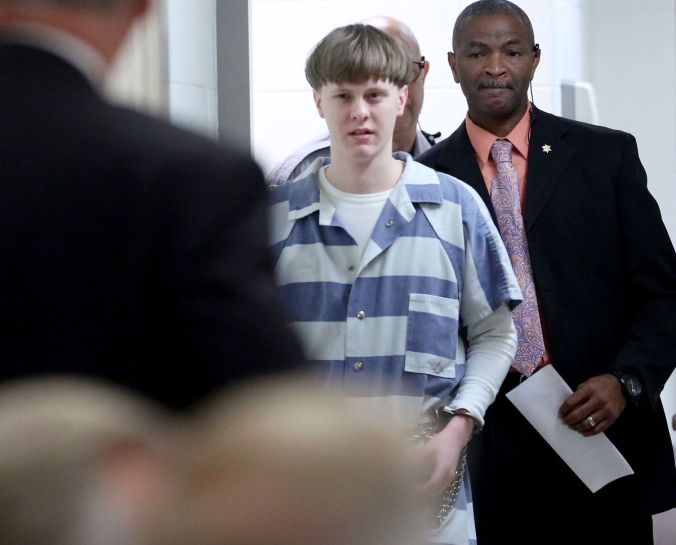
Dylann Roof, the white supremacist sentenced to death after killing nine black church members as an attempt to start a race war, asked a court to replace his appointed appellate lawyers because they “are my political and biological enemies.” The Richmond, Virginia-based 4th U.S. Circuit Court of Appeals denied his request.

Roof’s pro se motion stated that his lawyers, Alexandra Yates and Sapna Mirchandani, “are Jewish and Indian, respectively. It is therefore quite literally impossible that they and I could have the same interests relating to my case.”  Roof had difficulties on the same basis with his court-appointed lawyer, David Bruck, during his trial. The murderer wrote  in his motion that Bruck is Jewish and “his ethnicity was a constant source of conflict even with my constant efforts to look past it.”

I have been shocked at the reaction of the legal profession, the news media and the public to the 4th Circuit’s ruling. It really does appear that all the education in the world, ethics rules, principles and the Constitution will still be steamrolled by hate and emotion, even when crucial, indeed existential values for our society are at stake. My trust and respect for all professions—all of them—have been grievously reduced by their conduct and ethics blindness over that past several months. No wonder the First Amendment is under attack. No wonder our institutions are being weakened to the point of collapse.

The public literally  not understand the principle I am going to explain now. Apparently naively, I thought lawyers, judges and law professors did. In the interest of clarity, I am going to do this in short, straightforward segments.

I. The Court’s ruling is not just wrong, but frighteningly wrong.

Roof, like all citizens accused of a crime, has a right to a competent, zealous legal defense. A  competent, zealous legal defense requires that the defendant be able to participate fully in that defense. If a defendant does not or cannot trust his lawyers, he cannot be assured of a competent, zealous legal defense.

II. A client has to trust his lawyer.

It doesn’t matter why a client doesn’t trust his lawyer, and the lawyer need not agree that the lack of trust is warranted. The question is whether a lawyer who is not trusted by his client can do an adequate job representing him. The answer is no. The Sixth Amendment, which guarantees a fair trial and legal representation in criminal cases, is not there for the lawyers, or courts, or government. It exits to protect the accused—all accused.

In a famous medical ethics case, an elderly Korean man in a hospital wanted his doctors, specialists in his malady, replaced because they were Japanese-Americans, and as a survivor of the horrors Japan inflicted on Korea, he was convinced that they would kill him. The hospital ethics committee held that he was an irrational bigot, and that he either had to accept the qualified physicians despite their race, or get out. The AMA disagreed. It said that the patient’s welfare is paramount in medical ethics, and a patient who does not trust his doctors—the reason doesn’t matter—will have his welfare and health endangered as a result.

The same principle should apply to Roof. A client who does not trust his lawyer will not, for example, be candid with him, or trust him to keep confidences.

Under the circumstances Roof described, the lawyers have an ethical obligation to withdraw. Two rules are involved:

Client-Lawyer Relationship
Rule 1.7 Conflict Of Interest: Current Clients

(a) Except as provided in paragraph (b), a lawyer shall not represent a client if the representation involves a concurrent conflict of interest. A concurrent conflict of interest exists if:

(1) the representation of one client will be directly adverse to another client; or

(2) there is a significant risk that the representation of one or more clients will be materially limited by the lawyer’s responsibilities to another client, a former client or a third person or by a personal interest of the lawyer.

(b) Notwithstanding the existence of a concurrent conflict of interest under paragraph (a), a lawyer may represent a client if:

(1) the lawyer reasonably believes that the lawyer will be able to provide competent and diligent representation to each affected client;

(2) the representation is not prohibited by law;

(3) the representation does not involve the assertion of a claim by one client against another client represented by the lawyer in the same litigation or other proceeding before a tribunal; and

(4) each affected client gives informed consent, confirmed in writing. Continue reading

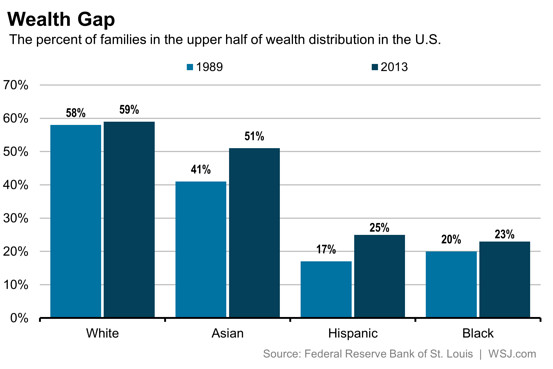
“Racial Wealth Gap Persists Despite Degree, Study Says”…Now What?

The story ran as the front page lead in the New York Times more than a week ago, and was promptly ignored as the more pressing matter of criticism Donald Trump’s erudition in condemning the violence in Charlottesville obsessed the media:

“The long-term trend is shockingly clear,” said William R. Emmons, an economist at the Federal Reserve Bank of St. Louis and one of the authors of the report. “White and Asian college grads do much better than their counterparts without college, while college-grad Hispanics and blacks do much worse proportionately.”

A college degree has long been recognized as a great equalizer, a path for minorities to help bridge the economic chasm that separates them from whites. But the report, scheduled to be released on Monday, raises troubling questions about the ability of a college education to narrow the racial and ethnic wealth gap.

“Higher education alone cannot level the playing field,” the report concludes.

Great. What will level the playing field, and if the only solutions are ethically flawed, can the nation ethically accept that the playing field cannot be leveled? Is it necessary that all races achieve identical levels of success? Does the fact that a race, or an ethnic group, either exceeds or falls short of statistical parity signal that draconian measures must be undertaken by the government? Are we really committed to results based policies, or opportunity-based policies?

In the Times print version, there was a chart that labelled, among other things, Asian families as “over-represented” among wealthyl households headed by a college grad. “Over-represented” is a provocative word, suggesting that something is wrong with Asian American achieving beyond what pure statistical analysis would predict. Is it so unimaginable that the group itself may have something to do with its success—that its culture and values may allow it to be “over-represented”?

No, it isn’t unimaginable, but it is inconvenient and politically explosive. If culture and values can explain over-achievement, it will be difficult to avoid the conclusion that culture and values also play a part in under-achievement as well. The Times report (I haven’t read the whole study)  doesn’t hint at such a conclusion, while citing many other potential causes:

Researchers have repeatedly found discrimination in the job market. When two nearly identical résumés are sent out, for example, it has been documented that the candidate with a white-sounding name receives more callbacks than the applicant with a black-sounding name.

Discrimination like this and other factors contribute to the persistent and substantial pay gap between whites and minorities. Blacks, for instance, hold a disproportionate share of government jobs — a sector that has shrunk in recent years and provides fewer opportunities for big wage gains. Blacks have fewer advanced degrees, and the ones who do are more often in lower-paying fields or graduates of colleges with lesser reputations.

“Blacks and Latinos at all education levels, including college and advanced degrees, earn less than their white counterparts, which means lower lifetime earnings” and less ability to save, said John Schmitt, research director at the Washington Center for Equitable Growth, who reviewed an advance copy of the report.

Blacks and Hispanics are also less likely than whites to inherit money or receive help from their parents to cover a tuition bill or a down payment on a house.

William A. Darity Jr., a professor of public policy at the Samuel DuBois Cook Center on Social Equity at Duke University, points out that a family headed by a black college graduate has less wealth on average than a family headed by a white high school dropout.

That last fact is especially discouraging.

The relative disinterest of the news media in the implications of the report is troubling, or perhaps I should say its disinterest in pursuing an open and honest discussion of what the implications are, and what new policies should be considered. The status quo, with historically oppressed and disadvantaged groups perpetually lagging behind and perpetually blaming white society for their persistent plight, is a recipe for chaos, generating shrill and divisive prescriptions like this one, from Chanelle Helm,  a Black Lives Matters leader in Louisville:

Some things I’m thinking about that should change (in that Southern, black grandmama voice):

1. White people, if you don’t have any descendants, will your property to a black or brown family. Preferably one that lives in generational poverty.

2. White people, if you’re inheriting property you intend to sell upon acceptance, give it to a black or brown family. You’re bound to make that money in some other white privileged way.

3. If you are a developer or realty owner of multi-family housing, build a sustainable complex in a black or brown blighted neighborhood and let black and brown people live in it for free.

4. White people, if you can afford to downsize, give up the home you own to a black or brown family. Preferably a family from generational poverty.

5. White people, if any of the people you intend to leave your property to are racists assholes, change the will, and will your property to a black or brown family. Preferably a family from generational poverty.

6. White people, re-budget your monthly so you can donate to black funds for land purchasing.

7. White people, especially white women (because this is yaw specialty — Nosey Jenny and Meddling Kathy), get a racist fired. Yaw know what the fuck they be saying. You are complicit when you ignore them. Get your boss fired cause they racist too.

8. Backing up No. 7, this should be easy but all those sheetless Klan, Nazi’s and Other lil’ dick-white men will all be returning to work. Get they ass fired. Call the police even: they look suspicious.

9. OK, backing up No. 8, if any white person at your work, or as you enter in spaces and you overhear a white person praising the actions from yesterday, first, get a pic. Get their name and more info. Hell, find out where they work — Get Them Fired. But certainly address them, and, if you need to, you got hands: use them.

10. Commit to two things: Fighting white supremacy where and how you can (this doesn’t mean taking up knitting, unless you’re making scarves for black and brown kids in need), and funding black and brown people and their work.

I read this, and find myself wondering if one of the reasons for that discouraging study’s results is the increasing influence of voices like Chanelle Helm’s.

Ethics Dunces: The 8th U.S. Circuit Court of Appeals

I don’t understand this ruling at all.

In 2011, Cooper Tire & Rubber Co. had locked out union workers. After the company later settled a contract dispute, they all returned to work except for Anthony Runion, who had been fired. Runion had shouted at a van carrying replacement workers onto the company’s grounds: “Hey, did you bring enough KFC for everybody?” and “Hey, anybody smell that? I smell fried chicken and watermelon,” the opinion noted, adding that most of the replacement workers were black.

In the 2-1 ruling for the fired worker, Judge William Duane Benton cited the law protecting unions, strikers and pickets, 29 U.S.C. § 157. Section 7 of the Act guarantees employees the right to “assist labor organizations . . . and to engage in other concerted activities for the purpose of collective bargaining or other mutual aid or protection.” Section 7
gives locked-out employees the right to picket. Section 8(a) prohibits an employer from interfering with, restraining, coercing, or discriminating against employees in the exercise of their Section 7 rights.

How would firing  a worker for uttering undeniable racially hostile verbiage in the process of striking? Benton writes, citing various cases in the line of labor decisions:

“One of the necessary conditions of picketing is a confrontation in some form between union members and employees.” Chicago Typographical Union No. 16, 151 NLRB 1666, 1668 (1965), citing NLRB v. United Furniture Workers of Am., 337 F.2d 936, 940 (2d Cir. 1964). “Impulsive behavior on the picket line is to be expected especially when directed against nonstriking employees or strike breakers.” Allied Indus. Workers No. 289 v. NLRB, 476 F.2d 868, 879 (D.C. Cir. 1973) (internal citation omitted). This court analyzes picket-line conduct under the Clear Pine Mouldings test: a firing for picket-line misconduct is an unfair labor practice unless the alleged misconduct “may reasonably tend to coerce or intimidate employees in the exercise of rights protected under the Act.” NMC Finishing v. NLRB, 101 F.3d 528, 531 (8th Cir. 1996), citing Clear Pine Mouldings, Inc., 268 NLRB 1044, 1046 (1984), enf’d, 765 F.2d 148 (9th Cir. 1985). The test is objective.

Wait: racially prejudiced rhetoric is “impulsive behavior”? Not by non-racists, its isn’t. Non-racists don’t suddenly start talking like racists on impulse. Anthony Runion unmasked himself as a racist by his behavior on the picket line. It may not have been “picket line misconduct,” but it was certainly unacceptable workplace and employee conduct, with a strong indication of more to come. Benton wrote that there was no evidence the black “scabs” heard Runion’s racist words, though dozens of others nearby did, and that the comments were not directed at any individual. Wait again: is the judge arguing that using racial epithets in the workplace isn’t a firing offense as long as the offender can say, “I didn’t mean you” ?

The lone dissenting judge, Judge C. Arlen Beam  dissents by stating the obvious: Continue reading