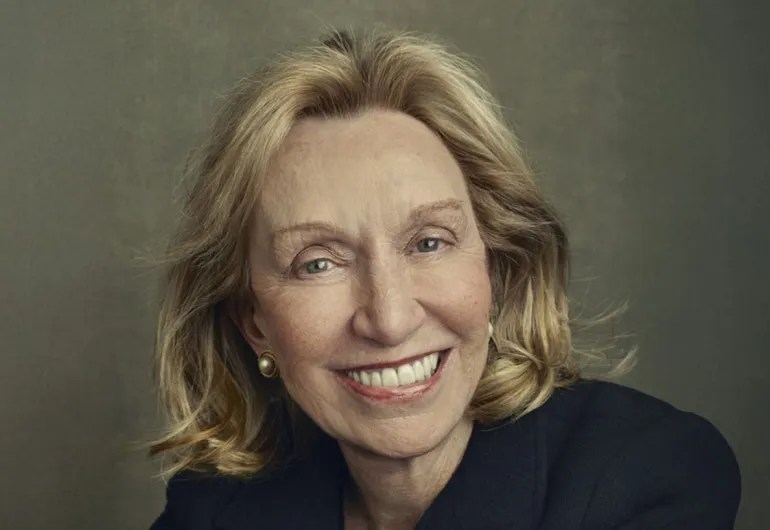
A Halloween Season Ethics Dunce For Historian Doris Kearns Goodwin

Doris Kearns Goodwin is probably about as well known as any historian right now, thanks to her frequent appearances on TV (48 times on Charlie Rose’s PBS show alone). In addition to being a much published and acclaimed Presidential historian, she went through a period where she was often talking and writing about baseball, so yes, I have a warm spot in my cold heart for her. Goodwin is perhaps best known for her Pulitzer Prize -winning book “Team of Rivals: The Political Genius of Abraham Lincoln, much of which was adapted by Tony Kushner into the screenplay for Steven Spielberg’s 2012 film “Lincoln.”

Doris taught the American Government course on The American Presidency when I took it, succeeding Richard Neustadt who literally wrote the book on the subject, His “Presidential Power” is considered a masterwork even today. I got Doris in her first year teaching before “Goodwin”: she wasn’t very good, but she was cute, a pert redhead who arrived at Harvard with a whispered reputation of being one of LBJ’s conquests when she worked as a White House Fellow. A professor like Doris was a rarity at Harvard back then, for she was less than half the age of the typical Government Department prof.

Doris is in her 80s now, and yet that photo above is still the one she sends out for her appearances. She has a gig in a couple of weeks: the Humphrey School of Public Affairs will host her as she gives the 2026 Distinguished Carlson Lecture at the University of Minnesota’s Humphrey School of Public Affairs, titled, “Leadership for a More Perfect Union: Lessons from America at 250”. I think it’s mildly unethical for people to use photos of themselves that make it seem like they have the equivalent of the “Picture of Dorian Gray” in their attic. Kearns hasn’t looked like that in 40 years.

All of this is just a prelude to her Ethics Dunce exploits, however. I was watching an episode of American Horror Story Season Six, “Roanoke,” about a legendary mansion in North Carolina with a bloody and ghostly history. Imagine my surprise to see my old college professor showing up in an interview about the house, explaining its origins, the owner, Edward Philippe Mott, whose actions sent the house on its way to damnation, the many horrible demises of subsequent residents. The interview concluded with Doris saying that she doesn’t believe in ghosts but wouldn’t want to spend a night there—like the recent reality “ghost hunters” show crew that had been found slaughtered.

Unethical Tweet Of The Month: “Civil Rights Activist” Danielle Muscato

“In the event of an impending head explosion, immediately place both hands, fingers spread,  firmly around your skull, applying pressure to both the top and the sides, until the pressure begins to subside…”

This could have been an Ethics Dunce, or an Unethical Quote of the Month. It was nearly a KABOOM!, if I hadn’t immediately clasped my hands, hard, over my skull when I read it, just in time to stop my brain from exploding. I also almost included it in draft post called A “This Helps Explain Why Trump Is President” Potpourri.

Upon reflection, I decided that a self-described “civil rights activist” tweeting this was so unethical, so ignorance-promoting, not to mention hateful, bigoted and sexist, that it deserved to stand alone.

An ethical,  sane, democracy and American values-supporting “lady” , confronting such a curfew, would realize that a totalitarian regime had taken over, and either join a citizen rebel army, or get the hell out of the country. Yeah, I read the thread, being a “dude,” and realized that what passes for feminism in a lot of cases is misandry and hypocrisy. Also that what passes for a “civil rights activist” is occasionally a crypt-fascist who neither understands civil rights nor supports them.

Imagine if her tweet had substituted “African-Americans” or “Muslims” for “men,” and “dudes”, and “White, law-abiding citizens” for “Ladies.”

If Muscato is to be believed, and frankly, I wouldn’t believe someone who tweets something this stupid to tell me what number comes after “3”, Danielle is often featured in or on the New York Times, Time, CNN, NPR, and Rolling Stone.

What does that tell you? Continue reading →

Reconsidering “Lincoln,” Lincoln…And Trump

I’ve been reading a lot about Abraham Lincoln of late. A book by William Hanchett called “The Lincoln Murder Conspiracies” reminded me that while President Jackson is the closest historical match for the populist, outsider aspect of Donald Trump’s rise, the startlingly close match for the antipathy and hatred Trump has faced from the moment of his election eerily traces the experience of Abraham Lincoln.

Like Trump a minority President, Abe won only 39.8% of the popular vote but was still comfortably elected by the Electoral College. As with Trump, his opposition refused to give him a chance to govern or unify the nation, although in his case, the Democrats divided the country literally, seceding from the union before Lincoln took the oath of office. Today’s Democrats are without that option (thanks to Lincoln!), but are doing everything else in their power to undermine the elected leader. (And California, the most Democratic state, is saber-rattling about seceding.) Also like Trump, Lincoln did not concede that his lack of a popular vote majority in any way robbed him of a mandate to govern.

From the moment the election results were known, many Democrats proclaimed the election of Lincoln itself to be an act of aggression, a “declaration of war.” Many in Lincoln’s own party—even his own Attorney General—accused him, with some justification, of engaging unconstitutional measures. The Governor of New York evoked the Revolutionary War generation, saying that they would not stand for such incursions on their rights. Constitutional expert George Ticknor Curtis of Massachusetts predicted that the Lincoln Presidency would “be an end to this experiment in self-government.”

Meanwhile, pundits and critics heaped personal abuse on Lincoln, calling him grotesque, a barbarian, ” gorilla.” Diarist George Templeton Strong, whose words are so often quoted by Ken Burns in his documentary about the Civil War, called him a “yahoo.” It was said that fashionable New Yorkers would be ashamed to be seen in the presence of someone as boorish and uncultured as Lincoln;  it was rumored that he rejected handkerchiefs and “blew his nose through his thumb and forefingers, frontier-style.” As late as 1864, a New York editor wrote,

“[The President] is an uneducated boor. He  is brutal in all his habits and in all his ways. He is filthy. He is obscene. He is vicious.”

Somehow, despite this cruel barrage of ad hominem rhetoric, arguably more successful then that it would be now since the public has more knowledge of the President and can make their own observations, Lincoln persevered to meet the greatest challenges any President ever faced.

While still pondering some of the parallels with today’s relentless attacks on our current President, I watched again the 2012 Stephen Spielberg-directed film “Lincoln,” which was almost unanimously praised when it was released, and which I enjoyed a great deal when I first saw it. This time, however, “Lincoln” revealed itself as an ethics corrupter. Continue reading →