
Ethics Dunce And Dead Ethics Alarms Don’t Begin To Describe This Admission By The Duck Duck Go CEO

Wow.

What an idiot.

Those who use Duck Duck Go do so (or did so) because the search engine was deemed more trustworthy than Google, the high-tech monster that breaches user privacy regularly and lies about it, as well as plays games with its search algorithms to bolster its ideological agenda, all while actively engaging in censorship with its wholly owned platform, YouTube.

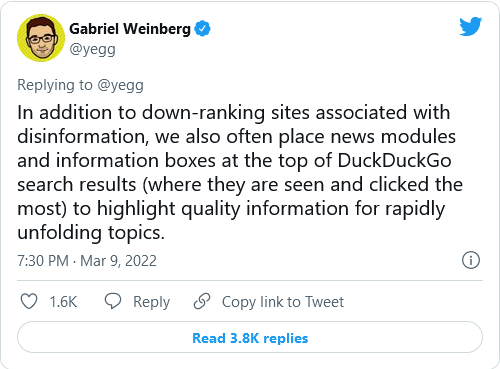
Now Duck Duck Go’s CEO, Gabriel Weinberg, actually boasts about manipulating search results to “highlight” what the company, in its vast and unquestioned wisdom, deems “quality” information, while burying links to what it calls disinformation.

Only dead ethics alarms could explain why he thinks this is a positive revelation. He is admitting that his platform engages in censorship, and does not support free expression, dissenting opinions, or controversial views. As a mass of critical Twitter commenters pointed out, by what divine guidance does he or his underlings know what is “disinformation”? The arrogance is staggering. What does “associated” mean? It is an open ended generality to allow silencing by association. But that’s not all:

  • Weinberg is madly virtue-signaling, presuming that Russia-hate will lead his search engine’s users to applaud a confession that Duck Duck Go will manipulate results when it feels like it, because rigging searches will only hurt “bad people.” I don’t trust Big Tech execs to decide who are bad people; too many of them are bad people. Nobody should.
  • It is more proof (on top of thousands of years of human folly)  that those with power can’t resist abusing that power.
  • His admission of the practice, and the practice itself, is gross incompetence. All Duck Duck Go had going for it was an image of trust. No one can trust a company run by someone who says, openly and without shame, “We manipulate our searches because we know best!” It is signature significance: no ethical executive would approve of  such a policy.

The company’s board should fire Weinberg immediately, and if it doesn’t, its members are as unethical, irresponsible and dim-witted as he is.

THREE Comments Of The Day (Really Useful Ones): “Tech Dirt’s Mike Masnick On The Internet Privacy Bill”

There were not one but three excellent, informative, detailed comments, one after the other,  in response to the post about the GOP’s elimination of the recent Obama FCC regulations of Big Data gathering by broadband providers. Technology competence is, I believe, the greatest looming ethics issue for the professions, and it is important for the general public as well. All three of these Comments of the Day are educational. If only the news media and elected officials were as well-informed as Alex, John Billingsley, and Slick Willy.

I am very proud of the level of the discourse on Ethics Alarms, and these three Comments of the Day on the post Ethics Quote Of The Month: Tech Dirt’s Mike Masnick On The Internet Privacy Bill are prime examples.

First, here’s slickwilly:

How to be safe with electronic data

First rule: anything online is vulnerable, no matter who secures it. It follows that any computer/device connected online is also vulnerable.

Second rule: Public WiFi is hack-able, and doing so is not that difficult. Someone just has to want to. Using it for playing games could make you vulnerable, and using it to access your financial information (banks, brokers, etc.) is stoopid

Third rule: Anything you do electronically is forever. Any tweet, snap chat, Facebook post, cell phone text or conversation, email, web post, browsing activity, and anything else may be saved by someone. Some of those are harder to get than others: browsing activity takes a snooper on the data line, or a court order to set a snooper up at your ISP. For instance, all cell phones activity is now all saved by the NSA, including where the phone was when. No, no one looks at it, not until they have a reason to research a person, perhaps years later. ‘Smart’ TVs can record you in your own home, without your knowledge, unless you take steps to stop it (electrical tape over cameras/microphones is a start, but still not enough)

Fourth rule: Any public activity can be recorded today. Besides CCD cameras everywhere and license plate readers on many roads, facial metrics can track you in most urban and many rural areas. Even going into the desert or mountains could be spotted via satellite, should the motivation be enough to look your way.

So don’t leave your computer connected to the Internet 24/7 (a power strip that stops electricity from reaching the computer helps cut connectivity when ‘off’), do nullify the ability of other devices to spy on you in your home, and never say anything electronically you do not want going public. Use complex passwords, and never the same for multiple sites. Password safes are better than written notes (and Apple Notes are silly to use for this.) How much you protect yourself depends on your level of paranoia.

Do you have something to hide? A secret you would rather not be made public? Do not document it electronically! Or use the method below.

Now, how to be safe with electronic information: Place it exclusively on an air-gapped (no network connection at all) computer. Place that computer in a heavy steel safe. Encase that safe in concrete, take it out to a deep ocean trench, and drop it overboard. Forget the coordinates where you dropped it.

The point is, nothing is fool-proof

You can take steps to lower the probability that your information gets out, but even using paper and quill pen was only so good as the physical security the document was placed under. Learn some simple steps and you will remove yourself from the radar of most predators. People are careless, apathetic, and just plain dumb, so anything you do helps keep you safer.

I keep such information in a secure, encrypted flash drive that is not stored in a computer USB slot. Could someone break the encryption, should they find the drive and wish to spend the effort? Sure. But if they want me that badly they will get me, one way or another. Why would they? I do not have any deep dark secrets or hidden crimes in my past. Even so, why should my business be available to anyone just to browse through?

Your mileage may vary, but doing nothing is unethical in my responsibilities to my family.

Now John Billingley’s contribution:

Continue reading