D.C. Ethics: Q: What’s Worse Than Delta Airlines Dumping Passengers For The Convenience of The University Of Florida Basketball Team? A: American University Ruining A Ballet School’s “Nutcracker” For The Convenience Of Chris Matthews

The victims of Washington DC values and priorities. AU must be so proud...

The victims of Washington DC values and priorities. AU must be so proud…

Full disclosure: In the past I have been an American University (in Washington, D.C.) employee, teaching legal ethics for a couple of semesters at its Washington College of Law. If I was still an adjunct professor there, I would resign and lead a protest against the despicable, callous, unethical actions of  A.U administrators, and, as I will explain later, I know just how to do it. Later. First, the tale of AU’s disgrace:

President Obama, understandably desperate to address his falling poll numbers in the wake of the dawning realization that 1) his administration is a mess, 2)  he doesn’t really do anything, 4) the health care law he has been selling is dysfunctional, dictatorial and expensive and 5) he lies, is hustling to shore up his base, conveniently identified as anyone who can watch his 24-hour cable shill, MSNBC, for five minutes without laughing or getting nauseous. Thus his staff whistled up loyal sycophant Chris Matthews, he of the “thrill up my leg” Obama fixation, for an exclusive interview this week. This is a blatant political appearance, make no mistake about it. MSNBC is not a legitimate news organization, is intentionally and by design biased in favor of all things related to President Obama, and in Matthews, the President could not possibly have a less objective or more fawning foil. Continue reading

The Cabbie’s Ethics Tale

Back of a cab

A frustrating aspect of my business travel, other than that raw fact that travel itself is inherently frustrating, is that I accumulate a backlog of ethics issues but am often unable to take the time to write about them until I return home, where I am again free of airplane delays, unreliable internet connections, sleepless nights and dimly lit hotel rooms apparently designed for the comfort of Jose Feliciano. The occasional compensation arrives in the form of enlightening conversations with fascinating people.

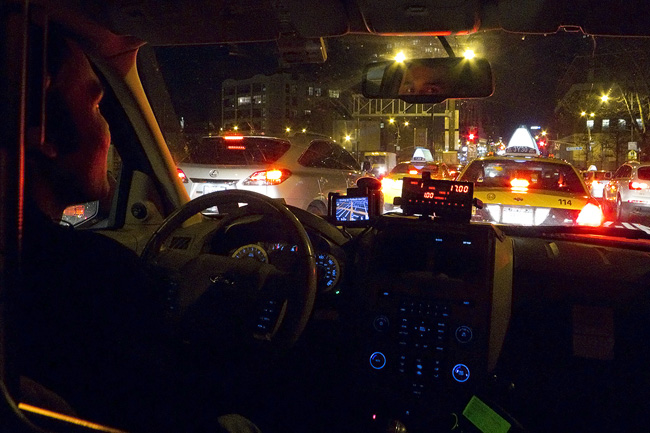
One of these was a cab driver on my latest trip. We shared the same space on an interminable ride from the airport to the hotel, the last leg of a theoretical ninety minute journey that stretched into 6 horrible hours. He was an educated, articulate, lively minded man whose life story (so far) would make an entertaining, if inherently incredible, movie. An African American son of two wealthy academics, he misbehaved in a ritzy private school and was sent, as punishment, to finish his high school years in an inner city private school. There he encountered drugs, gangs, bullying and racism, and became a strong social conservative. He dropped out of high school, entered the military and ended up in the Special Forces in the Middle East; he returned, graduated from college, went into the financial industry, rose quickly, got rich. He told me that he saw all of the cheating and manipulation in his own company and the industry in general, but did nothing about it (the money was too good, he said). Then came the crash. He lost everything, including his wife and kids, in the carnage. Resolved, he said, to work for justice and ethics, my driver had just graduated from law school and flunked his first try at the bar exam. (So did my dad, who would have liked this guy a lot.)

We got on the topic of the “bystander syndrome” and our duty to intervene and sometimes confront wrongdoers even at some personal risk—-the subject came up in the context of the Brooklyn EMT who has  been cleared of criminal charges arising from her refusal to assist a pregnant woman who had a heart attack (The EMT was on break, you see. I wrote about that terrible incident here. ) My cabdriver was a large, burly man, but he said that every time he intervened to confront a wrong doer in public, he feared that he would be shot. Once, when he stopped a man in a wheelchair from beating the man’s apparent girlfriend, he told me, my cabbie found himself staring down the barrel of a .44. This story, however, had a very different resolution: Continue reading

Ethics Quiz: The Vigilante Cell Phone Police

Say goodbye, cell phone!

Say goodbye, cell phone!

National Review blogger and theater critic Kevin Williamson raises an issue that especially interests me, as part of the management of a professional theater company. How far can an audience member ethically go to quite a persistently rude and disruptive spectator who insists on using her cell phone during a performance? Here’s how far Williamson went while viewing the musical Natasha, Pierre, and the Great Comet of 1812 that a woman was in the process of ruining for him, after he complained to the management without success and received this series of responses from the woman:

“I asked her to turn it off. She answered: “So don’t look.” I asked her whether I had missed something during the very pointed announcements to please turn off your phones, perhaps a special exemption granted for her. She suggested that I should mind my own business.”

Williamson then grabbed the phone from her and hurled it against the wall. She slapped him, and complained. He, not she, was then escorted from the theater.

Let’s stipulate that hurling the phone was over the line. But let’s suppose that he had just confiscated the phone, walked into the lobby, and hidden it in a planter, promising to reveal the hiding place after the performance (having already failed to police the situation as was their duty, Williamson can not be blamed for bypassing management).

Your Ethics Alarms Ethics Quiz Question:

Is it ethical to confiscate the cell phone of a deliberately rude user during a theatrical performance, after appropriate warnings have been given and ignored? Continue reading

Movie Ethics: The Disruptive Child, the Weenies, and The Duty To Confront

Over at Consumerist there is a ridiculous post about a woman, “Kelly,” whose recent movie-going experience was ruined by a couple of boorish and irresponsible parents who brought their pre-schooler to the movie and did nothing while he annoyed the woman, talking to her, nudging her, and generally being a nuisance. You can read her account of the whole fiasco here.

Apparently it never occurred to the woman, or her equally passive and impotent brother, who has apparently been writing indignant e-mails to Regal Theaters after the incident, to tell the couple that 1) they have no right to let their child interfere with other audience members trying to enjoy the movie, 2) they either need to control their child or leave, and 3) if they don’t, then she will go make such a fuss in the lobby with the staff that they will be asked to leave. Continue reading

The Cowardly GOP Presidential Field

Cowards. All of them.

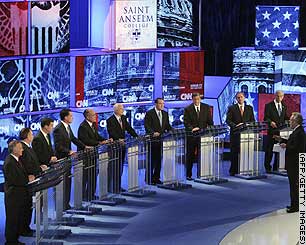
In three consecutive Republican presidential debates, members of the partisan audience have displayed obnoxious and callous attitudes in response to questions directed to the candidates. In the first, a portion of the assembled conservatives cheered an accounting of the convicted murderers put to death by the Texas penal system. During the second, vocal members of the audience shouted “Yeah!” to Wolf Blitzer’s questioning whether uninsured Americans should just be allowed to die without medical care. Then, in this week’s debate, the crowd jeered a videotaped soldier who declared himself as gay before asking if the candidates would support the recent elimination of “Don’t Ask Don’t Tell” as military policy.

Pundit efforts to characterize these outburst as typical of the Republican, conservative or Tea Party constituencies are blatant stereotyping, cynical and unfair. Anyone who has any experience speaking or performing to an audience knows that a few people can dominate audience reaction without being representative of it. No, it is not the Republican constituency that was exposed by these incidents, but the contenders for that party’s and the nation’s leadership. The failure of any one of the assembled candidates, nine in the first two debates, ten this week, to clearly and emphatically condemn the offensive reactions and the “thinking” underlying them suggests that none of the candidates possess the integrity, courage, confidence and values required to be a trustworthy leader of the United States. Continue reading

Shameless Oglers, Ethics Chess, and the Duty to Confront

Men who openly ogle the body parts of women in public make me want to turn in my Man Card and start dating Chaz Bono. I don’t know how people get like that, but no male should survive into his twenties with the idea that it is socially acceptable to stare at a woman’s breasts, legs, derriere or comely visage without an express invitation—and yes, some clothing choices can constitute such invitations. Absent that, however, a woman has the right not to be made to feel like a pole dancer, meat on the hoof, or a Sports illustrated swimsuit model simply because she is in public and in the presence of Y chromosomes.

The great relationship advice columnist Carolyn Hax addresses herself today to the lament of a woman who found herself unable to muster a response to a man in a restaurant who continued to stare at her chest, ruining her dinner. Hax initially disappointed me by suggesting that the woman should have simply switched seats, removing the attractive nuisance from his view. But she redeemed herself as she went on to urge the woman to prepare for her future encounters with ogling pigs, since given her natural endowments these were likely to occur:

“Learn to perform under duress through preparation.Ask yourself, now, what you can realistically hope to do in these situations, then prepare the words, gestures and/or actions. Say your plans out loud in the shower (seriously); repeat them to your friends by telling them the restaurant story and spelling out what you wish you had done. Even when practicing feels stupid, use repetition to teach your brain where the path is. In time, you’ll be able to find it no matter how rattled you get.”

This is what I like to call “ethics chess;” preparing yourself to handle ethical problems and dilemmas when they arise…thinking ahead regarding your tactics when a predictable event occurs, so you do the responsible and ethical thing. Continue reading

A Cautionary Ethics Tale From Texas

A Good Samaritan Teddy could relate to

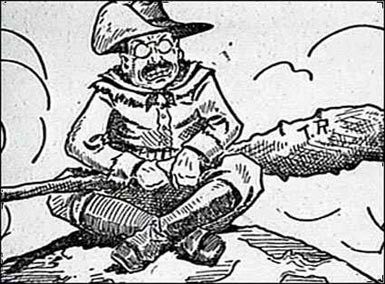
In Texas, a 62-year-old man pulled over on the highway to help a couple whose truck had run out of gas. While he was assisting, the Good Samaritan apparently objected to the demeaning way the 31-year-old husband was addressing his wife, and said so. The husband then attacked the older man…who drew his concealed gun and shot him in the shoulder.

<sigh> Continue reading

Ethics Hero: Tampa Bay Rays Manager Joe Maddon

Joe Maddon, fulfilling his duty to confront racist jerks

During a Sunday Spring Training game at Charlotte Sports Park in Florida, Tampa Bay Rays  manager Joe Maddon heard a fan berating Rays centerfielder B.J. Upton with a racial insult. Maddon summoned stadium security and had the fan thrown out of the park.

This may have happened before, but I can’t recall a similar incident. Racist catcalls and epithets are rarer at baseball games than they once were; they are far from gone. Baseball players have to endure a certain amount of abuse, true, but not this kind. Heaping racist insults on an athlete from the safety of the stands is cowardly as well as uncivil, and the First Amendment doesn’t extend to “fighting words” in a private venue.  Every manager, coach, usher and spectator should follow Madden’s lead.

The fan, by the way, denies Maddon’s account. Since baseball managers are not in the habit of ejecting fans for nothing, I find the denial less than credible.

Cranky Ethics Encounters In A Rotten Week

The unexpected death of my mom on Saturday tends to make everything else in my life the past week fade to insignificance, but the last seven days featured more than my usual quota of confrontations when thrust in the path of conduct that seemed just wrong to me:

  • Staying at a Fairfield Inn and Suites, a Marriott chain, in Greensboro, North Carolina, I found myself running behind schedule for a morning presentation. Rushing to take my shower, I was stopped cold by the shower controls, which made no sense at all. The long handle didn’t seem to do anything, and the round knob inside it had no effect either. Since I have the mechanical skills of a rodent, and am constantly embarrassed by my ineptitude, I fiddled with the knobs longer than I should have before giving up in a panic and calling the front desk.

“I can’t get the shower controls to work, and I’m late!” I blurted out to the woman manning the desk. “Send someone up right away!” Continue reading

ABC News’ Unethical, Dishonest and Biased “What Would You Do?”

ABC’s News’ periodic segment “What Would You Do?” is public opinion manipulation crossed with bad social behavior research, seeking the entertainment value of hidden camera shows. The segments stage outrageous public scenarios—a caretaker mistreating a wheelchair-bound senior, for example, to see how bystanders will react. Any potential benefit of the segments—might they encourage people to consider intervening when they see blatantly unethical  behavior?—is swallowed whole by the more likely negative results. One is that the existence of a hidden camera show that stages such charades creates inevitable cynicism and skepticism. Most witnesses to crimes and other shocking public conduct have enough mental and social hurdles to clear before they can reach the decision to take action without ABC News giving them another. The thought “I wonder if this is fake?” may be just enough to still someone’s ethics alarms and cause them to discount the duties of rescue and confrontation. Indeed, several of the scenarios stages for the show have been unconvincing. “What Would You Do?” also provides a convenient rationalization for those who are inclined to ignore fellow human beings in peril: “This must be set-up.”

In addition, “What Would You Do?” often carries a more sinister feature, courtesy of the biased journalists at ABC. Sometimes the simulated conduct appears to be designed to portray the worst of human values, with the clear implication that such conduct is common in America. And sometimes, like last week, this is driven by a political agenda. Continue reading