July 2: A Good Day to Thank Minnesota For Saving The Country

If you know anyone from Minnesota, today would be a good day to say “thank you.”

July 2 was the second day of the decisive Civil War battle at Gettysburg, Pennsylvania, and the most complicated and wide-ranging day in the conflict. So much was going on at Seminary Ridge and Cemetery Ridge, on Little Round Top, the Peach Orchard, Devil’s Den and a half dozen other key features on the battle field that whether an instance of heroism was recorded or forgotten is as much a matter of chance as anything else. Even determining what was the turning point in the day’s conflict, which ultimately was won by the forces of the North, is an exercise in searching for order in chaos.

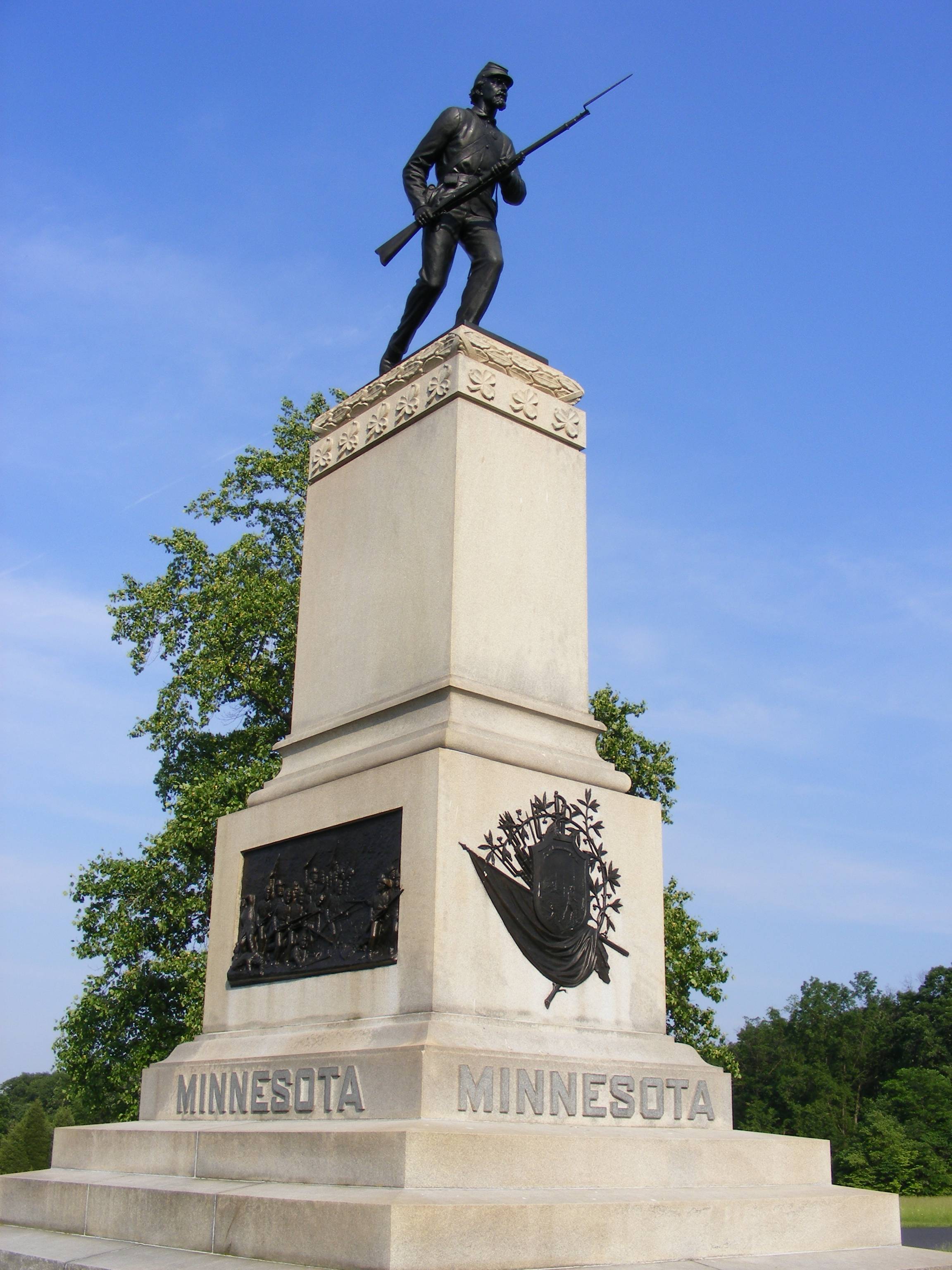
There is no question, however, that the First Minnesota Volunteer Regiment’s astonishing heroics stand out even among the many other examples of gallantry on that day. The battlefield monument to the First Minnesota is the one of the largest erected to any Union regiment, and yet it has not guaranteed our cultural memory of the epic sacrifice those soldiers made. Other second day exploits, due to sometimes arbitrary choices made by historians and film makers, have taken up the limited space available in the public’s attention to the details of the Civil War.

This is an injustice. As the battle raged for Cemetery Ridge, crucial high ground occupied by Union forces, General Winfield Hancock saw a serious breach in the Union line, and realized that Wilcox’s Alabama Brigade had to be opposed and stopped in their advance until he could round up reinforcements. He ordered the First Minnesota to charge the brigade and hold the position, even though its 262 men would be outnumbered by a force of more than 1200.  Continue reading

Remember Gettysburg

Today is July 1, which is being treated across the United States as the gateway to a long weekend and the Fourth of July, and little more. July 1 is also, however, the anniversary of the first day of the Battle of Gettysburg, the most important and most deadly battle of the many important and deadly conflicts in the American Civil War. The two American armies that clashed in the Pennsylvania town sustained more than 50,000 casualties on the Gettysburg battlefield, which may be the saddest and noblest place in America.

If you have not made at least one pilgrimage to the battlefield, you owe it to yourself, and to the memory of the combatants, to go. Continue reading

Frank Buckles, Speaker Boehner, and the Duty To Remember

Frank Buckles is our last chance to remember...

They fought overseas in battles with strange names like the Meuse-Argonne Offensive. They sang charmingly upbeat songs like “Over There!” and “Inky-Dinky Parley-Voo.” A lot of them were gassed, about 200,000 were wounded, 120,000 died, and many of them who  came home were never the same, dubbed “the lost generation” by Ernest Hemingway. They were America’s “doughboys,” the young homegrown heroes of World War I, who arrived late to a pointless war they didn’t start, and became the first American soldiers to die in large numbers in foreign lands.

The last of them died last week. His name was Frank Buckles, and he had lied about his age to become a soldier at the tender age of 16. In his 110 years, Buckles took part in a lot of history, sailing for the Continent on the Carpathia, the very same ship that rescued the Titanic’s survivors; traveling the world by sea as ship’s purser, which afforded him an accidental encounter with Adolf Hitler, and having the bad luck to be in the Philippines when the Japanese invaded, ending up as a prisoner for most of World War II.

Sen. Jay Rockefeller (D-W.Va.), and Rep. Shelley Moore Capito, (R-W.Va.) have introduced resolutions to allow fellow West Virginian Buckles to lie in honor in the Rotunda of the U.S. Capitol, where the public could pay their respects to him by filing past his casket. Though usually reserved for former presidents and distinguished members of Congress, unelected American citizens of distinction have laid in state in the Rotunda, such as civil rights icon Rosa Parks and Gen. Douglas MacArthur.

Apparently Speaker of the House John Boehner doesn’t think Buckles makes the grade, for he has rejected the idea and decreed that the last World War I soldier in a special ceremony at Arlington National Cemetery, but not at the Capitol. Continue reading

Dallas Forgotten and the Duty to Remember

Yesterday was November 22. According to the vast majority of the news and entertainment media, it was no different from any other day, apparently. In all likelihood, the same was true of most Americans. “Oh, yeah…November 22! Better buy that turkey!”

November 22 is not like any other day in America, however. It is the date in 1963 that John Fitzgerald Kennedy, 46 years old and the 35th President of the United States of America, was assassinated on the streets of Dallas. Continue reading