
Jack’s Anti-Political Correctness, Political Bloodsport and Contrived Offense Crusade: Progress Report

As I noted earlier, I am in New Mexico talking to journalists here about the Pat Rogers affair. You can sample one of the fruits of my labors here, a story in the Santa Fe New Mexican. It’s pretty accurate, as press interviews go, though the last quote was botched. I didn’t say that I was a “Greek American conservative Democrat with an anti-war war hero father,” but that my diverse views were the product of “a Greek American conservative Democrat mother and  an anti-war war hero father.” [ UPDATE: This has been corrected.]

If you’ve missed the various posts on this issue, you can find them here, here and here.

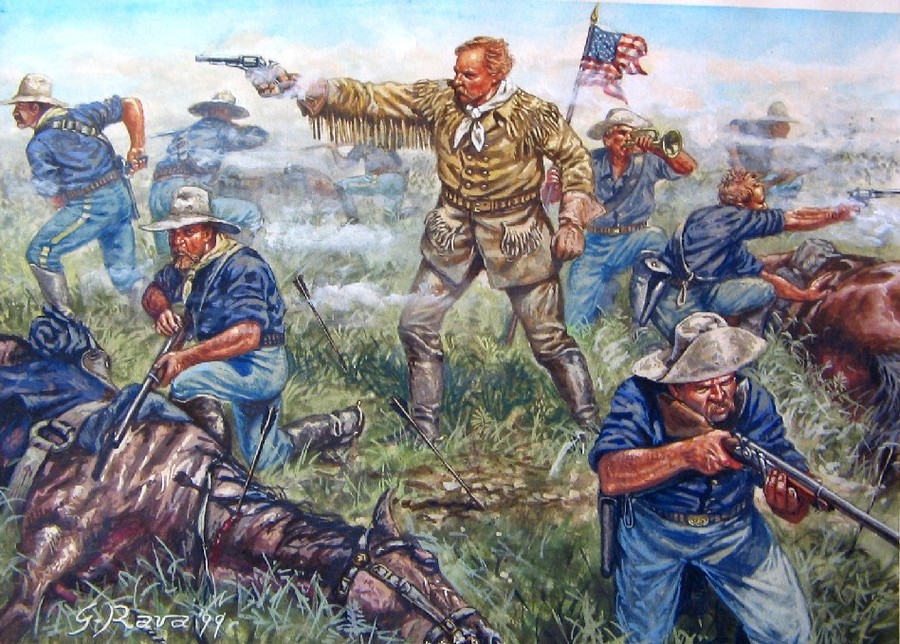
One odd note: during my meeting with several reporters from the paper, one of them suggested that making a joke about Custer’s Last Stand was like making a joke about the Holocaust. I let it pass, but the comment seems bizarre to me. Custer, after all, got himself and his men killed, and it was his opposition that was the object of genocide, not the cavalry. Why would ridiculing Custer offend Native Americans?

Putting My Mouth Where My Blog Is

I’m on the way to New Mexico today, to speak to the news media there and to try to build some consensus—New Mexico is as good a place to start as any—that using faux indignation over manufactured political correctness offenses is no way to run a political system, community, society or culture. It is, in fact, a cynical and despicable practice  used by special interest groups and unscrupulous politicians to stifle legitimate debate, or, as in the case that inspired my trip, to unfairly tar the character and reputation of a political adversary. The victim in the New Mexico incident was attorney Pat Rogers, who saw his obviously satirical e-mail intentionally twisted by partisan foes who almost certainly knew its real meaning into being represented in the press as a gratuitous racist slur—which it was not. I wrote about this here, and a similar incident, with parties reversed in Washington state, here.

What am I going to tell the various interviews and reporters I speak with over the next few days? I will tell them that political blood sport has got to stop. That the effort to discredit political positions by seeking ways to demonize their advocates is unethical and wrong. That contrived accusations of racism (or sexism, homophobia, or any other form of bigotry) should not be aided and abetted by the media or tolerated by the public. I will also assert that political warriors on the right or left who intentionally choose to misinterpret innocent expressions of irony, satire or humor as racist attacks both diminish the charge of true bigotry when it is justified, and expose themselves as polluters of our culture and national cohesion.

I don’t know Pat Rogers well; we have only met once. But I know who he represents: those who have been harmed as collateral damage in a hyper-partisan environment encouraged by Washington, D.C. and cheered on by the vilest members of the blogosphere, to the detriment of our sense of community, decency, and trust. My efforts, whatever they are, will be modest at best, and, in all likelihood, inconsequential. But you never know.

Wish me luck.

Real Life Bullying That Matters: The Persecution of Pat Rogers

Pat Rogers: prey.

Make no mistake about it, the word for what happened to New Mexico attorney Pat Rogers is bullying. Politicians, pundits and the public like to pontificate against bullying when it involves children, and are even willing to compromise basic First Amendment rights, so outraged are they over abuses of power that victimize kids. When it comes to the bullying of adults, however—good adults, innocent adults, adults who have done nothing to justify vicious efforts to crush them out of pure animus and nothing more—these supposed champions of fairness are as likely as not to side with the bullies.

This sickening hypocrisy is on display now in the persecution of New Mexico lawyer Pat Rogers in the ethics train wreck I first described here.  Rogers, whose first offense appears to be that he is a Republican, bared his throat to his attackers by sending an obviously satirical e-mail on the occasion of Governor Susan Martinez, whom he supports, participating in a state Native-American tribal summit. His jocular e-mail went to members of her staff with whom he had worked and who know him, and read, “Quislings, French surrender monkeys. … The state is going to hell. Col. Weh would not have dishonored Col. Custer in this manner.” Continue reading

E-Mail Ethics Train Wreck in New Mexico

This is how things spin out of control.

This really has nothing to do with anything.

In New Mexico, Gov. Susanna Martinez, a Republican, attended a summit of the tribal leaders in the state. For reasons known only to himself, this inspired Pat Rogers, a member of the Republican National Committee and a partner at the prestigious law firm Modrall Sperling, to send a bizarre e-mail to Gov. Martinez’s staff that read,

“Quislings, French surrender monkeys. … The state is going to hell. Col. Weh would not have dishonored Col. Custer in this manner.”

Quisling was the Nazi puppet head of Norway during World War II, and his name has become a term for “traitor.” “French surrender monkeys” is a quote from “The Simpsons.” Col. Weh, a Marine, was Martinez’s opposition in the GOP primary for governor. Taking all of this together along with the fact that this was New Mexico, Custer’s last stand was in what is now Montana, and occurred in 1876, I think it is obvious that Rogers intended the e-mail as a joke, a tongue in cheek remark satirizing the kind of wacky complaints that a Republican Governor probably gets on a regular basis. Either it was a joke, or Rogers is insane. I don’t think he’s insane. Continue reading

Banning the Privacy Bomb

Yes, I think posting this photo is a lousy thing to do to your dog, too.

The stories come out routinely, and the opposing opinions are predictable. A boorish date dumps a woman via arrogant e-mail, which is promptly forwarded to thousands, making him a national laughing stock and pariah. A movie star sends an angry and mean-spirited message to his teenage daughter, who places it in the hands of the celebrity-devouring media…which then use it to savage the star’s reputation.  A Harvard law student takes an e-mail sent by a friend and fellow-student as a follow-up to a contentious discussion about race, and forwards it to minority advocates on campus, who then condemn the “friend” as a racist. A model live-tweets her encounter with the married actor sitting next to her on a flight, as he engages in awkward flirtation. In each case, defenders of the punitive distributor of the embarrassing communication argue that the victim deserved it, while critics of the conduct insist that it is a betrayal of privacy and trust.
We need to decide, as a culture, whether we believe that reasonable expectations of privacy should be respected or not; indeed, whether they should survive or not. Those who endorse, defend and encourage the kind of conduct in these incidents and many more are, whether they realize it or not, fouling the nest of our national culture and community, making not just privacy, but also friendship and intimacy, almost impossible. Continue reading

Internet Betrayal: The Dork, The Spreadsheet, and the E-mail Avenger

If someone sends you an obnoxious, arrogant, idiotic or otherwise embarrassing e-mail, the ethical thing to do is to tell the individual what’s wrong with it, and perhaps save them from future embarrassment. The principle is simple: The Golden Rule. When you send a private message to someone and pour out your heart, empty your skull, vent your spleen, or otherwise express things you probably should have slept on and moderated in the clear light of day, you don’t want your correspondent to use the internet as a weapon against you and introduce you to millions at your worst. It is a terrible, cruel, indefensible thing to do…to anyone. Continue reading

Comment of the Day: “Incompetent Elected Official of the Week: Sen. Claire McCaskill”

Karl Penny’s Comment of the Day is further reflection on the futile effort to turn back the tide of new technology, which Senator McCaskill apparently believes can be accomplished with a good marketing campaign, making her a candidate for institutionalization.  A prize for the first reader who identifies what a klepsydra was!

“Jack, sometimes I get a little nostalgic about older technologies, generally ones that figured so prominently in my youth, but have now gone the way of the klepsydra. I get nostalgic enough that, almost, for a moment, ideas like Sen. McCaskill’s seem to make sense, and a gleam comes to me eye, and I begin to think, “Yeah….” Then I remember that it’s daylight out, and however pleasant dreams can be, they’re just dreams.

“I also remember that there are reasons—good reasons—why I and millions of others adopted email, wrote documents on a computer, listened to music through an MP3, read my books on a Kindle, and played games on a computer. Truth to tell, most of us don’t really miss those older technologies, except in brief spurts. I have an old Olympia Portable typewriter in a closet. I must have typed a million documents on that thing, from my freshman year of high school through college. Letters, papers, notes, forms, checks (!) even. It was so indispensable, I took it with me most everywhere. Now, it just sits in that closet, and I hardly ever take it out even to look at. The last time it saw any use was last year, when a local high school was doing a play, and they needed an old manual typewriter as a prop. Now, it’s back in the closet.

“Sen, McCaskill may have successfully deluded herself, but I don’t think she’s going to delude much of anyone else, and thank heaven. But, if this is what passes for progressive thought among our elected leaders, then God help us all.”

Incompetent Elected Official of the Week: Sen. Claire McCaskill (D-Mo)

This box of rocks also has an idea about how to save the Postal Service, and it's probably better than Sen. McCaskill's.

[ I know—I need some Republican IEOTWs. There have been a lot of Democrats lately. The problem is that the things presidential candidates say don’t qualify (Michele Bachmann’s claim that she could lwoer gas prices to $2 would have been a sure winner), and the Democrats have been unusually inept lately.]

From the New York Times, discussing the U.S. Post Office’s impending insolvency:

“An overarching trend that has fueled the Postal Service’s crisis — and reduced annual mail volume by 22 percent since 2006 — is that Americans are e-mailing, paying bills electronically and reading shopping catalogs and news online.

“Noting that some great books have been written based on letters sent by the Founding Fathers and by soldiers, Senator Claire McCaskill, Democrat of Missouri, urged the postmaster general to run an advertising campaign urging Americans to send more letters to each other.

““There is something special about receiving a piece of first-class mail, knowing that it comes from someone you care about,” she said. “I really believe that if someone would begin to market the value of sending a written letter to someone you love, you might be surprised what it will do for your Christmas season.”

That’s brilliant, Claire: spend money the Post Office doesn’t have to urge more people to use an archaic method of communication they no longer use since it is slower, less reliable and more expensive than the alternative, because there’s “something special” about it! That’s going to turn everything around. Continue reading

“Lethal Advocacy”: Not Ethical, and Not Protected Speech, Either

"Go ahead! Jump! You know you want to!"

William Melchert-Dinkel, aged 48, posed as a female nurse in internet chat rooms and preyed on depressed people by talking them into killing themselves.  A misguided mission? A perverted hobby? A salesmanship challenge? Who knows. But occasionally, he was successful.

Melchert-Dinkel was charged with assisting suicides after he encouraged IT technician Mark Drybrough, of Hillfields, Minnesota, to kill himself. Drybrough, who was recovering from a nervous breakdown, received e-mails from Melchert-Dinkel, found on his computer, containing detailed advice on how Drybrough could hang himself. He used that advice to commit suicide in 2005. Melchert-Dinkel also provided encouragement and guidance to Canadian Nadia Kajouji,  18, who drowned herself by leaping into an icy river in 2008. Continue reading

The Main Ethics Lesson of the Congressman Lee Affair

By now, you probably have heard the saga of ex-Congressman Christopher Lee (R-NY), a married man who was trolling Craig’s list for girlfriends and e-mailed a candidate shirtless photo of himself to prove to her that he was fit..and also, incidentally, as dumb as an unusually dumb brick. The young woman sent the photo to Gawker, which broke the story, resulting in the humiliated Congressman, supposedly a rising GOP star, resigning.

What is the most significant lesson of this rapid fall from political grace?

It isn’t that middle-aged men who don’t comprehend how the internet works should avoid e-mailing photos of themselves that recall George Costanza’s effort to flirt with the Fotomat girl, although that’s true.

It isn’t that horny and untrustworthy individuals who can’t control their libidos should avoid committing themselves to high-profile leadership positions in our government, since the public looks to them to exemplify the best in ethical values and the entire nation is embarrassed when they disgrace themselves. This is true too, but it is painfully clear that such individuals will never learn this, and we are stuck with them, at least until they reveal their true nature. Continue reading