Indoctrination And Intimidation At The University Of Arizona: Who Will Say, “So What’s The Matter With That?”

I feel the same way, Lucy…

There is a dumb joke in an old “I Love Lucy” episode that this story brings to mind.

Lucy is outraged when she reads that there is am all- filly race at the local race track and misunderstands. Horrified, she erupts, “How long  has this been going on? They’re racing little girls at Churchill Downs!” Ricky promptly explains why she was being an alarmist.

I hope that somehow the news item’s reporter got the facts wrong or I am missing something, because this story is far worse than racing little girls, and nowhere near as funny.

The University of Arizona is accepting student applications for what administrators call “social justice advocates.” The job requires the students to “report any bias incidents or claims to appropriate Residence Life staff,” and pays the student workers $10 an hour. They’re expected to work 15 hours a week, earning $600 a month in taxpayer funds—this is a public university—to police their fellow students speech and conduct.

Part of the job description reads:

“The position also aims to increase understanding of one’s own self through critical reflection of power and privilege, identity and intersectionality, systems of socialization, cultural competency and allyship as they pertain to the acknowledgement, understanding and acceptance of differences. Finally, this position intends to increase a student staff member’s ability to openly lead conversations, discuss differences and confront diversely insensitive behavior.”

Their #1 job, however, is to report “bias claims” so the student miscreant involved can face a Star Chamber, or the university equivalent. Such a claim can be what someone regards as  an outright act of “racism,’ which presumably could include anything from using a racial epithet to saying Maxine Waters is an idiot,  to  “microaggressions” like “cultural misappropriation,” or calling a transgender student by the wrong pronoun. The social justice advocate’s job will also include “fostering dialogue” related to “diversity, multiculturalism and social justice”—in other words, to be a full time left-wing scold— and  to “increase  awareness of diverse identities” while “promoting inclusive communities.”

I wonder if being stuffed in a closet or hung on a hook will be considered a “biased incident” by these paid political correctness snitches? That is, after all, what would happen to them on a healthy campus. Will they have little badges and whistles? I think they should get badges and whistles. Or get a uniform like Rolf at the climax of “The Sound of Music.”

They’re racing little girls at Churchill Downs! Continue reading
What Wellesley College Students Consider To Be Freedom Of Speech

A recent editorial in the Wellesley College student newspaper—Wellesley, as I’m sure you know, is the alma mater of Hillary Clinton—has justly set off ethics alarms across the political spectrum. That, at least, is good news: the hostility to free thought, expression and speech that I thought had decisively corrupted one side of that spectrum apparently is not as entrenched as I thought, or at least it is being diplomatically disguised.

The editorial with the Orwellian title of  “Free Speech Is Not Violated At Wellesley ” (it would have been accurate if the headline read “We Think Free Speech Is Not Violated At Wellesley Because Wellesley Hasn’t Taught Us What Free Speech Is”), contained several month’s worth of Ethics Alarms Unethical Quotes of the Week, such as

Many members of our community, including students, alumnae and faculty, have criticized the Wellesley community for becoming an environment where free speech is not allowed or is a violated right….However, we fundamentally disagree with that characterization, and we disagree with the idea that free speech is infringed upon at Wellesley. Rather, our Wellesley community will not stand for hate speech, and will call it out when possible.

Translation: We don’t oppose free speech. We just oppose speech we disagree with.

Wellesley students are generally correct in their attempts to differentiate what is viable discourse from what is just hate speech. Wellesley is certainly not a place for racism, sexism, homophobia, Islamophobia, transphobia or any other type of discriminatory speech. Shutting down rhetoric that undermines the existence and rights of others is not a violation of free speech; it is hate speech.

By this definition, the editorial itself is hate speech. This is the kind of rhetoric that Captain Kirk used to make evil computers blow their circuits on “Star Trek.”

The founding fathers put free speech in the Constitution as a way to protect the disenfranchised and to protect individual citizens from the power of the government. The spirit of free speech is to protect the suppressed, not to protect a free-for-all where anything is acceptable, no matter how hateful and damaging.

Now we know they don’t teach American History at Wellesley as well as philosophy and logic.

We have all said problematic claims, the origins of which were ingrained in us by our discriminatory and biased society. Luckily, most of us have been taught by our peers and mentors at Wellesley in a productive way. It is vital that we encourage people to correct and learn from their mistakes rather than berate them for a lack of education they could not control.  While it is expected that these lessons will be difficult and often personal, holding difficult conversations for the sake of educating is very different from shaming on the basis of ignorance.

Wait, wasn’t this endorsement of indoctrination written by Lenin or Stalin? Surely this section should be in quotes with attribution.

This being said, if people are given the resources to learn and either continue to speak hate speech or refuse to adapt their beliefs, then hostility may be warranted.

I’m sorry, I just ran screaming from my office and momentarily lost my train of thought.

Pointing to the worst sections of the editorial fail to convey its gobsmacking intellectual flaccidity, smug certitude and hostility to the open exchange of ideas. We know where this came from, too: the  education at Wellesley. This month, six Wellesley professors who comprise the college’s Commission on Race, Ethnicity, and Equity signed a letter maintaining that Wellesley should not allow challenges to the political and social views that the campus has decreed are the correct ones, arguing that speakers who are brought to campus to encourage debate may “stifle productive debate by enabling the bullying of disempowered groups.” Continue reading

The New York Times, And The Consequences Of Forfeiting Integrity

It was between Janus and the Four Season's song. "Two Faces Have I..."

It was between Janus and the Lou Christie song “Two Faces Have I…”

It would be extremely beneficial for the culture and enlightened civic discourse if there were a trustworthy, reliably objective observer with integrity and intelligence to provide fair, forceful pronouncements on the political controversies of the day. Such an observer would have to be seen as free of partisan and ideological bias, or at least show signs of actively trying to counter their effects. This, of course, is the idealized concept of what competent and ethical journalism is supposed to provide, and to the extent that any journalism organization was deemed capable of providing it, the New York Times was it.

Yesterday, the Times editors published an editorial called “The Stolen Supreme Court Seat” that was so partisan in tone and inflammatory, not to mention ridiculous, in content that it could only be taken as a biased political screed. Worse than that for the long term, however, is that the piece decisively disqualifies the Times as an arbiter of complex national issues whose judgment can ever be trusted as genuine and persuasive.  Many will argue that the Times’ biases have been blatant and unrestrained for many years, and this is true. That New York Times editorial may not be the first smoking gun, but it is the smokiest yet.

Do recall that Ethics Alarms substantially agreed with the Times in its main point that the Republican Senate’s refusal to hold hearings and consider President Obama’s nomination of federal judge Merrick Garland to fill the Supreme Court seat vacated last year with the sudden death of Justice Scalia was unethical:

“For Senate Republicans, holding hearings on President Obama’s qualified and moderate nomination for the Supreme Court is both the ethical course and the politically smart course. It is also in the best interests of the nation. In fact, the Byzantine political maneuverings by the President and the Republican leadership, by turns petty and ingenious, have handed Republicans a political chess victory, if only they are smart enough, responsible enough, and patriotic enough to grab it. Naturally, they aren’t.”

Note: unethical, but not illegal or unconstitutional. By using the inflammatory term “stolen” implying legal wrong doing, the Times intentionally adopted the language of political hacker, and Democratic Party talking points. Strike One: You cannot be trusted as objective and non-partisan when you intentionally endorse partisan rhetoric: Continue reading

Ethics Hero: The Daily Commercial’s Editorial Board

dailt-comm

The Daily Commercial, a local paper serving Leesburg, Florida, issued a striking editorial apology for its biased coverage of the Presidential race.

In an open letter titled “The media, the election and bias,” the editors apologized to its readers and observed that the paper “hasn’t done enough to mitigate the anti-Trump wave in the pages of this paper….You deserve a more balanced approach to the coverage of elections and other weighty issues.”

The editorial says in part… Continue reading

The New York Times Proves Why Journalists Can’t Be Trusted To “Fact-Check” Since They Don’t Know What A Lie Is

jaccuse2

Ugh.

I finally grabbed a barf bag and read the New York Times attack piece from the weekend titled “A Week of Whoppers.” Silly me: Donald Trump lies so often that I simply took it on faith that the Times would have no trouble finding real and substantive lies to expose from The Donald. Instead, what I found were a few genuine lies of no great significance lumpod with statements that were obviously not meant literally, off-the-cuff remarks that any objective listener would assume were just generalizations, self-evident hyperbole, or opinion. None rose to the level of outright attempts to deceive on the magnitude of “I never sent or received classified material,” or “wiped? Like with a cloth?”

Needless to say, but I’ll still say it, none came within a Washington mile of lies like “I did not have sex with that woman,”  which is one Hillary Clinton attempted to facilitate. It is depressing that any reporter, editor or reader would find the analysis that all 31 of these alleged “lies by Trump were “lies” fair, rational or convincing. Alexander Burns and Maggie Haberman prove themselves to be partisan hacks with this weak piece of anti-Trump hype. The statements flagged here are so clearly the result of a concerted anti-Trump bias that editors must have assumed that few would actually read them, and just take the headline and sheer size of the feature as proof that the Times had legitimately proven massive dishonesty.

And it had: its own.

Here are all 31 alleged Trump “lies,” with the Ethics Alarms verdicts on each. Continue reading

In Defense Of Hillary, A Perfect #22

Not running....

Not running….

Rationalization #22, Comparative Virtue or “It’s not the worst thing,” is my personal candidate for the worst rationalization of them all. It is so objectively so devoid of common sense, and so desperate in its relativism, that I am amazed at how often allegedly intelligent people employ it. Ethics Alarms is always on the lookout for a perfect #22, and this summer has brought a bumper crop. Donald Trump, master of rationalizations, had one in June, just four days after Madeleine Albright scored one, saying about Hillary Clinton’s e-mail scandal,

“…nobody is going to die as a result of anything that happened on emails”

Albright also could well have been wrong about that, as we now know, and only moral luck prevented one of Hillary’s carelessly handled e-mails from falling into hands that might have engineered harm for a U.S. agent abroad. Clearly, however, partisans trying to minimize Clinton’s absolute incompetence, recklessness and dishonesty regarding her private server and its illicit use are drawn to Rationalization #22, because today’s example is also an unethical attempt to excuse Hillary’s conduct by putting it in “perspective”—and what a perspective!

First let’s again review the rationalization…

22. The Comparative Virtue Excuse: “There are worse things.”

If “Everybody does it” is the Golden Rationalization, this is the bottom of the barrel. Yet amazingly, this excuse is popular in high places: witness the “Abu Ghraib was bad, but our soldiers would never cut off Nick Berg’s head” argument that was common during the height of the Iraq prisoner abuse scandal. It is true that for most ethical misconduct, there are indeed “worse things.” Lying to your boss in order to goof off at the golf course isn’t as bad as stealing a ham, and stealing a ham is nothing compared selling military secrets to North Korea. So what? We judge human conduct against ideals of good behavior that we aspire to, not by the bad behavior of others. One’s objective is to be the best human being that we can be, not to just avoid being the worst rotter anyone has ever met.

Behavior has to be assessed on its own terms, not according to some imaginary comparative scale. The fact that someone’s act is more or less ethical than yours has no effect on the ethical nature of your conduct. “There are worse things” is not an argument; it’s the desperate cry of someone who has run out of rationalizations.

(It is also the mark of someone corrupted by the Clintons. #22 got a workout, you may recall, when Bill Clinton’s lies, cover-up and obstruction of justice  regarding the intern he transformed into a Presidential sex toy got him impeached.)

Now here is the perfect #22, a headline on an editorial at MassLive, a Massachusetts news and politics website, Can it get better than this?

Clinton’s email shenanigans weren’t crime of the century

Continue reading

Why Dan Pabon’s DUI Stop Matters To Everyone, And Why He Must Resign

Pabon Apology

Colorado Rep. Dan Pabon (D. North Denver) was considered a rising political star. Among his well-publicized public policy triumphs was to  help pass a law forcing convicted drunk drivers to appear before a DUI victim-impact panel.

Then Pabon himself was pulled over in his vehicle on St. Patrick’s Day evening for driving under the influence of alcohol. Instead of Pabon accepting his fate as an honest lawyer and elected official should, the video of the stop shows the legislator trying to persuade the officer who stopped him not to make the  arrest. He tells the officer that he is a state representative who is driving a car without his legislative plates. He asks the officer to call a supervisor or the city attorney so they can direct the officer to give him mulligan. When Officer Brian Bienemann explains that he cannot let Pabon off and indeed would be subject to discipline if he did,  Pabon pleads,  “Is there any way we can avoid this possibility? This is going to change my life.”

After Pabon pleaded guilty and gave an emotional apology (above) to the public and the legislature, saying  “I have taken full responsibility. I have done everything above board,” the editors of The Denver Post begged to disagree. They called for his resignation in an edotorial. They were correct, but they weren’t clear enough about why.

The Post was upset that Pabon didn’t specifically apologize for trying to use abuse his position and power to avoid legal accountability for a serious violation of the law, even after the video of the stop was leaked to the news media. Of course he didn’t. Like most current elected officials, he didn’t see anything wrong with that. Don’t they deserve special consideration and privileges?

There can be no sufficient apology for what Pabon did. Elected officials and other government personnel must not view themselves as deserving special immunity from the laws and regulations they impose on society. Pabon’s attitude and attempt to play the “Do you know who I am?” card is poison to democracy, and exactly the kind of “fix” Donald Trump’s speech last night correctly condemned.

The public sees a Secretary of State expose sensitive information to discovery by the enemies of the United States, and not only is she not punished, she is selected to run for President. The public sees HUD Secretary Julian Castro blatantly violate the Hatch Act, combining an official appearance with campaigning for Clinton, and  then learns that the President will not discipline Castro in any way. Casrto is also considered a “rising political star.” A nation in which individuals who break the law are still considered “rising stars” and prospects for national leadership has its values in a tangle. Continue reading

Ethics Alarm: In Memphis, Facts Are Now Racist

Infamy. I hope.

Infamy. I hope.

This truly upsetting story is in part about headlines, and I had a hard time deciding on one for the post. It makes my head explode—I am trying out a new Swiffer now—but it really shouldn’t have exploded, considering recent developments. I could name Commercial Appeal’s editor Louis Graham (left) an Ethics Dunce, which he certainly is (in addition to being a fool, a coward, and a disgrace to journalism), but that doesn’t do him justice. I thought about making his editorial apologizing for stating facts in a headline as an Unethical Quote of the Month, but this was worse than a bad quote. This was surrender.

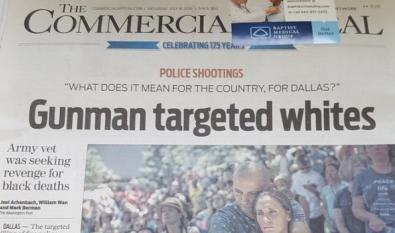
The Memphis, Tennessee newspaper the Commercial Appeal, a Gannett publication, headlined its front page story about the attack on police in Dallas “Gunman targeted whites.” Here it is:

memphiscom headline

Indeed, African-American gunman Micah Xavier Johnson specifically said that his objective was to  kill white police officers. Nonetheless, protestors attacking the paper for publishing a “racist’ headline gathered outside the paper’s office in downtown Memphis last week. Black Lives Matter signs were in evidence.

Commercial Appeal editor Louis Graham met with protesters, and apologized with a front page editorial titled “We got it wrong.” He wrote in part… Continue reading

A Conflict of Interest Lesson: The New York Observer’s Donald Trump Endorsement

Trumps

Stipulated: Jared Kushner, who is married to Donald Trump’s daughter Ivanka Trump, and who owns the The New York Observer, which he purchased in 2006, was in a difficult situation regarding the New York Republican primary. (That’s Jared on the right in the photo above.)

He had a clear and unresolvable  conflict of interest. If his paper endorsed Trump, the endorsement would appear to be dictated by family loyalty rather than objective analysis, and would harm whatever credibility the paper has left (it has been falling in influence and quality for a long time). If The Observer endorsed anyone else, in addition to whatever problems it would cause Kushner behind closed doors (and they would undoubtedly be considerable), a rejection by a paper with such a strong Trump family connection would be interpreted as having special significance, and would be handing a potent weapon to Trump’s adversaries.

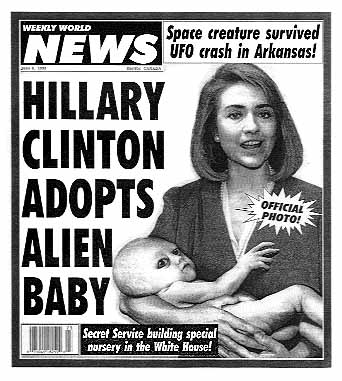
Kushner’s dilemma was made worse by the fact that for any newspaper to endorse Donald Trump for President without a conflict of interest that at least would explain such an idiotic position would be tantamount to an admission of collective insanity, instantly turning such a  paper into the successor of the late, lamented Weekly World News, which was prone to breaking scoops like this one:

Weekly_World_News_-_Cover_Art_4800

Faced with these two mutually unacceptable alternatives, there was only one ethical, rational, responsible course that would acknowledge the conflict of interest without falling prey to it: endorse nobody, and explain why.

Nah! Continue reading

Carol Costello To The Rescue: CNN Spins For The Boston Globe

Globe Parody

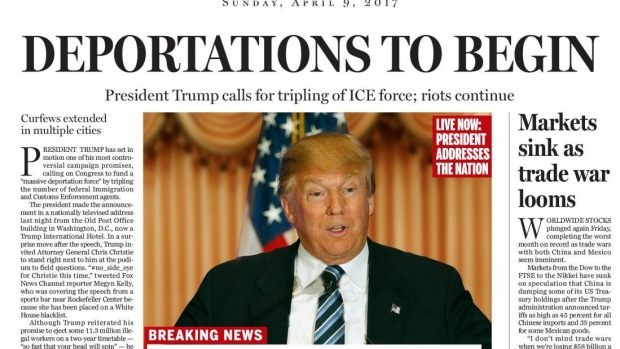
Many in the on-line pundit community feel that the Boston Globe’s use of a fake future news front page to attack Donald Trump was bad practice and a slippery slope not to be ventured upon by serious news outlets. They are correct.

Trump hate runs high in mainstream media-land, however, and the ethics alarms there sound softly if at all. I just witnessed that most biased and smug of TV anchors, CNN’s Carol Costello, furiously spinning for the Globe, because the foundering ship of untrustworthy journalism feels that the crew must pull together, or something.

Though Costello’s colleague Brian Stelter had sort of criticized the the fake front page  saying that it “resembles an April Fools Day prank by a college newspaper — but is bound to get a lot more attention,” Costello was in full defense mode. She began by mischaracterizing where the objections to the Globe’s stunt were coming from, citing only Trump himself as the critic—and we all know how crazy he is, right? Costello played a clip of Trump registering his objections—mostly reasonable and fair, by the way—as Costello gave her audience her trademark “Can you believe this idiot?” smirk, which she flashes virtually any time a conservative or Republican is saying anything. She then repeated portions of the Globe’s defenders’ talking points, and brought on the Globe’s Sunday Ideas Editor Katie Kingsbury to give its own, as if Trump owned the only two hands not applauding. What was offered was a series of rationalizations: Continue reading