The Boston Globe’s Fake Front Page: A Vile Ethics Foul, And The Beginning Of The End For Newspaper Journalism

Globe Parody

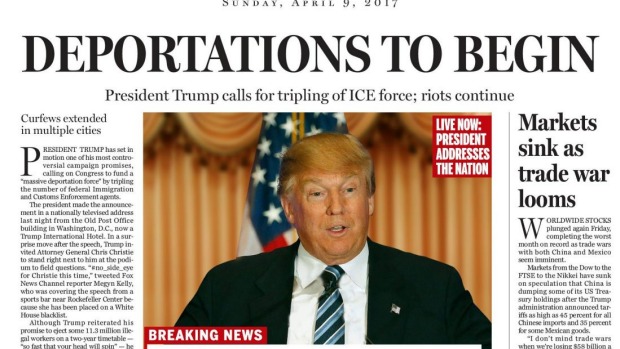
So disturbed is the editorial staff of the Boston Globe over the nauseating threat of a Donald Trump presidency that it has jettisoned all established principles of journalism ethics in an embarrassing, self-destructive effort to “stop” him. Mark this down as one more wound on the culture that Trump has inflicted with his luxury ego trip, with the assistance of his irrational supporters, of course.

Today the Boston Globe hit the news stands and front walks featuring a satirical front page with headlines about a fictional, future Donald Trump presidency accompanied by a fevered “Stop Trump” editorial. The page was headed the “Ideas” section in the paper.

The Globe placed a PDF of the hoax  page on its website yesterday. Dated April 10, 2016, the scare-headlined page shouts: “Deportations to begin, President Trump calls for tripling of ICE force; riots continue.” The articles about Trump’s actions as President contain no humor or satirical tone.  There are solemn references to an Attorney General Chris Christie, and we learn that  ex-Fox News anchor Megyn Kelly is hanging out, Ron Burgundy-style, in a bar because she’s been placed on President Trump’s black list. Readers are also informed that “U.S. soldiers refuse orders to kill ISIS families” and that there is a new libel law aimed at muzzling the press. Another story reports that Trump named  his new dog after the Chinese First Lady as a calculated insult. Continue reading

FACT: The New York Times’ Front Page Anti-Gun Editorial Was Misleading And Deceitful, And Here’s Why

silencers and guns

I already posted on the ethics deficits in the New York Times front page editorial (First time since the 1920s! AHHHHHHH!!!) that was gaining such embarrassing hosannas from liberals and anti-gun zealots over the weekend. To sum up that post, the Times wrongly connected its hype to a terrorist incident irrelevant to its argument, simply to gain emotional traction; made an impossible and largely symbolic demand, focused on a class of guns that has minimal impact on national gun deaths; and, like most calls for “gun control” of late, including the President’s, was aimed at gaining incremental public acceptance of gun confiscation and banning, while pretending otherwise.

That post did not point out, however, that the Times intentionally neglected to inform its readers and those it hoped to persuade (or mislead, panic, or stampede) of the above essential news that is not only “fit to print,” but that must be printed if a newspaper is going to claim that “the attention and anger of Americans should also be directed at the elected leaders whose job is to keep us safe but who place a higher premium on the money and political power of an industry dedicated to profiting from the unfettered spread of ever more powerful firearms.”

The fact is that per-capita murders in the U.S. are at their lowest level since FBI records began (in 1960), and they are trending downwards. There is no “crisis,” at least no gun crisis. Terrorism is another story.

The Times makes the point that “motives do not matter to the dead” (a failed attempt to justify piggy-backing the grandstanding editorial on a terrorist attack that no plausible gun regulations would have stopped), but it is just as true that lethal weapons “do not matter to the dead.” If it is, as the Times piously says in accusing them of callousness and corruption, the job of elected leaders “to keep us safe,” our elected leaders, by the evidence of the statistic, are doing an excellent job. Continue reading

Observations on the New York Times Front Page Editorial Advocating Gun Confiscation

new_york_times_logo

The New York Times, in a dramatic action that it has not engaged in since the 1920s, has published an editorial on page one. At such a moment, a newspaper subjects itself to a very high standard, since it is temporarily turning a news source into an organ of advocacy.  Though the Times’ editorial is motivated by good intentions, passion and (I hope) serious and careful thought, it fails that high standard.

Observations:

1. Early on, the Times says, “It is a moral outrage and a national disgrace that civilians can legally purchase weapons designed specifically to kill people with brutal speed and efficiency.”

Well, from that position, the Times cannot be doubted or criticized. It believes that citizens (the casual switch to civilians assumes that only police and military have a right to deadly force. The Constitution, thankfully, disagrees), apparently, should only be able to avail themselves of weapons that kill slowly and undependably. I don’t agree with that, and I think to agree with that premise undercuts the entire theory of constitutionally guaranteed individual rights.

2. Using the San Bernardino shooting as the launching point for such as editorial is emotional manipulation and unethical. This was almost certainly a terrorist killing. It is doubtful that any legal measures short of confiscating and banning all firearms would have prevented it. As has been the case with other shootings, why is this incident used to justify advocating laws and regulations that couldn’t stop a similar shooting? It’s simple: because people are upset, fearful, and not thinking straight; all the better to mislead them. By the very act of publishing its editorial now, the Times is making the implicit statement that its policy recommendations are germane to this episode. They are not, however. That’s unethical.

3. Reason has headlined its story about the editorial, “New York Times Calls for Immense Expense and Political Civil War To Maybe Possibly Hopefully Reduce Gun Violence by a Tiny Amount.” That is absolutely fair and accurate, and the Times had an obligation, even in an editorial, to reveal what it is really asking for. I know this was ideological advocacy, but even while acting as activists, the Times still has a duty to inform and be transparent.

4. The Times advocates banning and the confiscation of the weapons used in San Bernardino, even though doing this would not have prevented that massacre. Moreover, Slate estimated in 2013 that about 3.5 million such rifles or substantially similar ones are in in the U.S., so what the Times is demanding would require the government buying, confiscating, and searching residences to find all of those.  Notes Reason, with complete accuracy,

What the Times is calling for is, beyond its countable costs in money and effort and the likely further erosion of civil liberties, also (as they surely know) calling for a massive political civil war the likes of which we haven’t seen in a long time. The “assault weapon” ban of 1994-2004, though pointless, just barred the future making and selling of such weapons, and didn’t try to confiscate existing ones.

Is this really a responsible policy recommendation, or just an emotional one? The latter, certainly. As such, it takes the editorial out of the category of public service and places it in the range of partisan warfare. Continue reading

No, Washington Post, The Republican Party Has No Obligation To Condemn Donald Trump, But Nice Try Anyway.

"Hey Republicans! Step HERE! It's your DUTY!"

“Hey Republicans! Step HERE! It’s your DUTY!”

I’m sure the paper’s editors will get a holiday gift basket from the Democratic National Committee for their nakedly partisan trap.

Erupting with indignation over Trump’s recent “let’s make fun of the disabled reporter” performer and his subsequent lie that he wasn’t doing what video shows he did, the Washington Post editors concluded with a demand that Republicans condemn Trump, or else:

[I]t is time for Republican Party leaders to make clear that they do not approve of Mr. Trump’s politics of denigration. If they do not, their party will be seen as complicit in his hatefulness, and deservedly so.

There are two reasons this is partisan and hypocritical.

  • First, an official or coordinated Republican Party attack on Trump would violate the terms of Trump’s deal with the party that if he was treated fairly, Trump wouldn’t run as a third party candidate should he fail to get the GOP nomination. Since I have never heard of either party ever specifically reprimanding one of its own candidates for the nomination—I don’t think it’s happened—doing so would surely be regarded as “unfair” by Trump, and I’d agree with him. Of course, an independent Trump candidacy would guarantee the election of a Democrat. Fiendishly clever, Post!

The party could have and, I wrote here, should have scratched Trump from the nomination hunt and the debates early on, before it had given him a platform and he had become, for the nonce, a front-runner in the polls. His third party threat would have been more bluster than reality then, and without a national TV audience, Trump would have probably been content to file a lawsuit and throw a few tantrums. But it’s not called “the stupid party” for nothing. The GOP missed its window of escape. Turning on Trump now would undermine the party’s primary mission, not that the Post cares, and that is electing a Republican President. Continue reading

The Definition Of Irresponsible Leadership? Obama’s Keystone Pipeline Call

keystone-pipelineI am trying to find another example of a U.S. President taking action that harms the nation and its citizens while admitting that it will have no measurable beneficial effects whatsoever.

I can’t find any. I’d like to know about one, and see how it worked out.

When the Washington Post’s editorial staff essentially calls a Democratic President’s conduct an embarrassment. it really must have been embarrassing…and it was. Obama’s sole explanation for his decision, which he has, as is his style, dithered over for years, was this:

“Ultimately if we’re going to prevent large parts of the Earth from becoming inhospitable or uninhabitable in our lifetimes, we’re going to have to keep some fossil fuels in the ground rather than burn them.”

But killing the pipeline will keep no fossil fuels in the ground. So the reason really is this:

“America is now a global leader when it comes to taking serious actions to fight climate change and, frankly, approving this project would have undercut that global leadership.”

Ah. So America will show it is serious about climate change by killing a project that all agree will have no tangible, long-term, short-term, measurable effects on climate change at all. This is Obama logic, as we have seen many times: good intentions is enough; results don’t matter. If his decision won’t help reduce the risk of parts of the Earth  becoming “inhospitable or uninhabitable in our lifetimes”—a risk that is also measurable and speculative at best—then the purpose of it isn’t to prove leadership. True, it proves atrocious leadership, but Obama is cynical, not stupid. The decision is political. Its only tangible benefit is to the Democratic Party, which feels the need to make the welfare of the U.S. and its citizens subordinate to the fanaticism of the environmentalist movement. Continue reading

The New York Times Goes Full Orwell

ralphie_soap

Expanding on the recent alarm sounded here about the Democratic Party and progressives increasingly resorting to the tools and values of totalitarianism in order to by-pass democracy in their quest for power, I must flag today’s editorial by the New York Times, calling for the “retirement” of the word “alien.” As in all disguised efforts to indoctrinate by making opposing views impossible to express or even think, the Times uses a set of false arguments to achieve its goal, which is apparently open borders. Why does the most preeminent newspaper in the country have such a sickening and irresponsible view? I don’t know. These are the people who determine the content of the news, however. I’m not sure which would make this screed more frightening, the fact that the editors don’t recognize the methods of totalitarianism, or the fact that they do, and are embracing them.

Here, in part, is the editorial’s argument for “retiring,” as in “banning,” the word “alien,”  with my comments in bold:

Over the years, the label has struck newcomers as a quirky aspect of moving to America. Many, understandably, have also come to regard it as a loaded, disparaging word, used by those who regard immigrants as less-than-human burdens rather than as assets.

[ Straw man. Who that was not immediately condemned far and wide has ever described immigrants as less than human in the last 50 years? The Times is engaging in deceit: this editorial isn’t about “alien,” but illegal aliens—you know, the people that Donald Trump was obviously talking about and the Left and illegal alien advocates intentionally misrepresented his comments to push their agenda. As for the term “illegal immigrants,” damn rights it’s disparaging, because they are illegal, and citizens and newspaper editors ought to regard law-breakers as “burdens rather than as assets.”]
Continue reading

The Washington Post—Finally—Admits The Truth About President Obama

fingers-pointing

I will reprint The Washington Post’s lead editorial here nearly in full. I will have comments after, though I will make this one now: every character trait and leadership deficit the Post points to  was evident to objective observers—like me—from the beginning of Obama’s administration. That one of the most consistent and prominent Democratic Party and liberal policy boosters in the national news media finally mounts the integrity, honesty and integrity to admit it now is not all that satisfying.

Here is, with a few omissions so you will link to the site and read the whole thing (it’s only fair), is the damning and undeniable editorial:

Charles E. Schumer (D-N.Y.) decided he would vote against President Obama’s nuclear deal with Iran, he explained his reasoning in a 1,700-word essay. On balance, he concluded, “the very real risk that Iran will not moderate and will, instead, use the agreement to pursue its nefarious goals is too great.” We disagree with that conclusion, but not with serene confidence; we share the senator’s concern that Iran will use the lifting of sanctions to intensify its toxic behavior in the region. We understand and respect Mr. Schumer’s decision; also, it’s generally better to treat policy disagreements in good faith.

That has not been the spirit in which Mr. Obama and his team have met his Iran-deal critics. The president has countered them with certitude and ad hominem attacks, the combined import of which is that there are no alternatives to his policy, that support for the deal is an obvious call and that nearly anyone who suggests otherwise is motivated by politics or ideology. Mr. Obama’s rhetoric reached its low point when he observed that the deal’s opponents value war over diplomacy and that Iranian extremists were “making common cause with the Republican caucus.”

Continue reading

The Washington Post Editorial Board Demonstrates How Stupid Decisions Have Unprofessional Consequences

"As you can see, the logo and mascot are completely offensive. Well, you can see, but to let you see, you'd have to see it, and we won't take responsibility for letting you see it, because you shouldn't. Trust us."

“As you can see, the logo and mascot are completely offensive. Well, you can see, but to let you see, you’d have to see it, and we won’t take responsibility for letting you see it, because you shouldn’t. Trust us.”

Last August, the showboating Washington Post editors announced that they would no longer use the name of the city’s NFL team when writing about the city’s NFL team. It’s offensive you know. Well, to some. Well, to a theoretical some, those who want to make an ideological and philosophical point while forcing political correctness down the throats for the vast, vast majority of sports fans to whom “Washington Redskins” is the name of a well-loved (if lousy) football team, and nothing more or less, and no statement negative or positive about Native Americans at all.

In this the board is emulating the school that wouldn’t let a little deaf boy sign his own name, “Hunter,’ because the sign language designation was a hand-and-fingers approximation of a pistol, and pistols are offensive to even more people than politically incorrect team names are. This is really, really crazy stuff, even more for a newspaper than a school, in which it was just cruel. Newspapers are supposed to convey information clearly and unambiguously. Making symbolic stands requiring the self-censorship of words is a breach of professional duty and trust. The editors’ duty is to their readers, not to a theoretical Native American who reads a the footballs scores and has the vapors when he reads “Redskins.” (I still doubt that there are such people.)

Over the weekend the Post produced an embarrassing editorial that fulfilled all my dire predictions about the new policy: Continue reading

The Free Range Mom, Bias, and the Perils Of Blind Loyalty

About  the blind leading the blind---not only is it dangerous, it looks ridiculous to those who can see.

About the blind leading the blind—not only is it dangerous, it looks ridiculous to those who can see.

One of my favorite bloggers just fell into the blind loyalty trap. I’m sympathetic, but this is something that those who accept the responsibility of  teaching us important lessons and clarifying difficult issues must avoid at all costs. Bias makes us stupid, and blind loyalty breeds bias like carrion breeds maggots. It pains me to see Lenore Skenazy, author of the Free Range Kids blog, undermine her credibility like this.

She titled her post Horrible Editorial Chides Mom for Not Predicting Unpredictable Crime. In it, she takes the side of a mother who left her four-year-old son in an unlocked, running van while she picked up her daughter at a northeast school. Someone was drove her van off with her son in it, and subsequently crashed. The boy was unhurt. Under the circumstances, there is nothing horrible about the editorial, which uses the incident—even Skenazy agrees that the mother’s conduct was “dumb”—to caution parents about leaving children in cars. This is the editorial that aroused Skenazy to defend the indefensible:

“A Calgary mom has no doubt learned her lesson. The woman recently left her four-year-old son in her unlocked, running van while she picked up her daughter at a northeast school. The mother said she was gone about six minutes, and when she came out, someone was stealing her van with her son in it.

Fortunately, the incident ended well, with the child unhurt after the thief crashed the van, and the suspect was taken into custody.…charges of child endangerment need to be pressed to set an example, because no matter how often these types of things occur, other parents continue to leave their kids in similar situations. It takes just a few minutes to get your child out of a vehicle and bring him or her along with you on whatever errand needs running. Sure, it’s more convenient just to leave a child in the car and do the errand, unencumbered. However, child safety should trump inconvenience every time. Better a few extra minutes lost bundling a little one in and out of a vehicle than a lifetime of regret and what-ifs.”

The rationalizations in Skenazy’s defense begin with the title of her post, which is dishonest and in her own words, “dumb.” She is using moral luck as a defense, arguing that the sequence of events as they unfolded were merely unfortunate, and the mother just as easily could have returned to her van and car with nothing amiss. The odds favor nothing bad happening in six minutes; on the other hand, the odds of nothing bad happening are much better if a child isn’t in an unlocked vehicle with the engine running at all. Continue reading

Fundraising Ethics Controversy in Michigan! Naming Buildings After Big University Donors: Ethical or Not?

Enron-Field

I worked in the development (capital fundraising) office of Georgetown University for many years, and am well aware of the sausage-making that goes into attracting big donations. Thus the controversy that recently erupted in Michigan is of interest both for its ethical content and the way it dances around inconvenient truths.

With the college student’s wonderful knack for avoiding the obvious, the student newspaper of Grand Valley (Michigan) State University declared ethics war on what it called “billboards”: buildings and lecture halls named after corporate and individual donors. With naivete and boundless ignorance of the world of philanthropy and non-profit fundraising, the editorial declared (among other things)…

  • “What’s next? Will we turn Lake Huron 133 into the “Amway Lecture Hall?” Will the backs of our chairs have plaques dedicated to the lower-level donors?” COMMENT: For enough money, of course the university would rename the hall. Why should it care what a lecture hall is called, if it can avoid having to raise tuition? As for the backs of seats: did the editors do any research at all? Opera companies, theaters, museaums and other non-profit entities do exactly this. So what?

Continue reading