Culture, Truthteller Ethics, And Richard Dawkins’ Tweet

What can a leading intellectual say of value in 140 characters?

What can a leading intellectual say of value in 140 characters?

Philosopher/biologist Richard Dawkins, best known as the world’s most formidable atheist, does not shy away from rustling the feathers of some pretty fierce birds. Recently he even infuriated many of his admirers by tweeting, “All the world’s Muslims have fewer Nobel Prizes than Trinity College, Cambridge. They did great things in the Middle Ages, though.” He was immediately called an anti-Muslim bigot by some, while others chose to challenge his assertion with false analogies. Making a strong statement worthy of a treatise in 140 characters is a tricky enterprise, and perhaps an unwise one, but the politically incorrect observation he was making was not about the Nobel Prize’s perfection as a measure of accomplishment, but rather about how the Muslim culture has strangled human progress, creativity and advancement for centuries. In this he is correct. Continue reading

Scapegoating Ethics

Scapegoat

Meet Rick Eckstein. He understands. Really.

As it does predictably and constantly, the daily drip-drip-drama of baseball has given us another ethics quandary to ponder, arising in the context of the sport but with far more significant applications. The issue: is it ethical for an organization to deal with a crisis by firing someone for symbolic value, rather than for cause?

I have written about this traditional phenomenon in baseball before, but the current example is far less defensible on either tactical or public relations grounds. Last season, the Washington Nationals accumulated the best record in the sport, and though they flopped in the play-offs, were almost unanimously expected to be strong pennant contenders in 2013 by baseball prognosticators and more importantly, their fans. So far, at least, those expectations have been dashed. The season is almost two-thirds done, and the Nationals have been uninspiring at best. They have won fewer games than they have lost, and are trailing the Atlanta Braves by an alarming margin. Their pitching has been worse than expected, and their offense has been atrocious.

As is often the case in baseball when teams have a disappointing season after a good one, there is no obvious way to fix the problems mid-season, other than to hope the players start playing better. Unlike the other major team sports, baseball team performance is notoriously quirky, just like the game they play. Excellent players have down years frequently (though not the same players, or they would no longer be considered excellent). Team chemistry evaporates; the ball bounces funny ways. In the case of the Nationals, the most obvious problem has been a flood of sub-par years from almost all the starting position players, with an unhealthy serving of injuries.

The team’s response to its frustration and, really, lack of any substantive way to address it was to fire the team’s batting coach, Rick Eckstein, last week. Continue reading

ARRRGH! Outrageous Ethics Malpractice By “The Ethicist”!!!!

Well, you did it again, Chuck..you made my head explode. But now I have a place to keep my keys...

Well, you did it again, Chuck..you made my head explode. But now I have a place to keep my keys…

It’s time for Chuck Klosterman, the New York Times’ designated amateur who now handles “The Ethicist” advice column, to hang it up, and let some randomly chosen unemployed New Yorker take a shot at the job. Since assuming his post, Chuck has had good moments and bad, but this botch is embarrassing, and signature significance—no one who isn’t a bona fide Ethics Dunce could make such a terrible call.

Get this: Klosterman was asked whether surreptitiously taking cuttings from plants owned by a shopping center was unethical:

“…While walking through our local shopping center, we noticed a particular plant that we both liked and decided to get it for our patio….My wife thought she could grow it from cuttings, so we went back and took about three or four cuttings from one of the many plants that were scattered around the shopping center. The plant was not hurt or damaged in any manner or form, but my gut instinct told me that this was wrong. Was it?”

Does this question really need asking? Apparently, because the fraud masquerading as an ethicist at the Times thinks it’s a “thorny” question (Chuck likes puns…maybe the column should be called “The Punster”) about an “unethical act that has a positive impact.” ( Helpful hint to Chuck: the issue is stealing.Klosterman then embarked on a rationalization orgy: Continue reading

Unethical Smoothie Bar of the Month: The “I Love Drilling Juice & Smoothie Bar” of Vernal, Utah

Smoothies

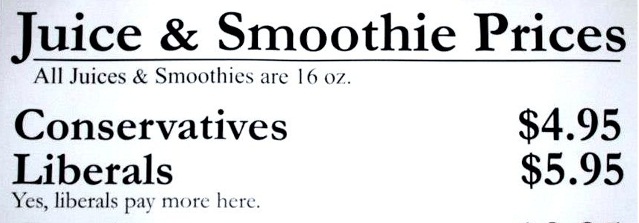
 As you can see from the sign above, the I Love Drilling Juice and Smoothie Bar in Vernal, Utah, owned and operated by a local pro-oil and gas activist George Burnett, charges liberals an extra dollar for its fare. The smug owner then donates the proceeds from his partisan surtax to  the Heritage Foundation and other conservative organizations.

I hate to pop Mr. Burnett’s self-satisfied balloon, but his stunt is unethical and profoundly un-American. The former is best illustrated by the scheme’s obvious failure to satisfy Kant’s Rule of Universality, a.k.a. the “What if everybody did this?” test. If every business discriminated on the basis of political and ideological belief, daily life would be unbearably complicated, contentious, and nasty, with all communities broken into exclusive, inconvenient and hostile camps. The practice of making people pay extra for basic goods and services according to whether their politics are Blue or Red is also hostile to basic American principles of respectful diversity, open minds, and civil discourse. Yes, Burnett’s  liberal tax is legal and constitutional. But it is unfair, and violates the principle, if not the letter, of equal treatment for all. Punishing citizens for their beliefs is bullying, whether the culprit is a city mayor who wants to ban a business because its owner opposes gay marriage, or an arrogant activist who wants to make anyone who disagrees with “drill baby drill!” to have to pay more for smoothies. Continue reading

Loop-Hole Ethics and The New York Times

The NYT’s website paywall plan floats in a sea of holes.

Ariel Kaminer, author of “The Ethicist” column in The New York Times Magazine, made an interesting assertion in her answer to a reader who asked about whether he could exploit several loop-holes in the Times’ new paywall plan for its website.

Noting that he was a struggling freelance journalist who visits the Times website often, he asked if it was unethical for him to use his parents’ free access to the content, since they are subscribers.  Then he Mused about other scenarios. “If I buy online access, can I share the password with my live-in girlfriend, even if I move to New York for the summer? What about our other housemates?” Continue reading

The MacDonald’s Beating Video, Another Dead Canary in The Ethics Mine

Vernon Hacket: videographer, violence afficianado, shameless bystander

Last week, In the early hours of  April 18,two teenaged patrons at a Rosedale, Maryland MacDonald’s brutally beat Chrissy Lee Polis, 22, into a seizure. The attack was captured on a video recorded by Vernon Hackett, one of the MacDonald’s workers, on a cellphone camera. Other employees can be heard laughing on the video, and Hackett apparently is heard warning the attackers that the police are coming. He has been fired by the restaurant’s proprietor.  (More on this here.)

His firing was well-deserved, but it doesn’t begin to address the disturbing implications of the incident. Continue reading

Baby Jesus Ethics

Perhaps it was the story about the camel falling over during the Nativity Scene rehearsal, but I have begun to have ethical qualms about the use of real infants to play Baby Jesus in Christmas scenes and pageants. This morning, Fox News featured another one, with Mary and the gang holding a five-month-old child outside in sub-freezing temperatures. “He’s very warm, ” Mary said of the star of the show (I guess a Christmas pageant is one show where the “star” is literally a star; Baby Jesus is, what, the leading man? A key prop?). “Jesus” was wrapped up like a mummy, though his face looked cold. Was it really necessary to have a real child? Continue reading

Ethics and the San Francisco Pet Ban Proposal

San Francisco is considering accessing its inner PETA by enacting a ban on a the sales of any pet with fur, hair or feathers, meaning that little Scotty will have to make do with a boa constrictor, an iguana or a guppy if he wants a non-human companion to cheer him through grade school. The measure began as a ban on pet store sales to stick it to unscrupulous puppy mills, then gradually morphed into a nearly China-like proposal  to ban almost all pets. True, the city’s proposal would still allow the adoption of dogs and cats from shelters, but don’t bet on that being the final result. PETA-ism, once it gains a foothold, won’t be satisfied until we are all tofu-sated and pet-free.

A Los Angeles Times story on the public debate over the ban concentrated on the business angle, for pets are big business. This is, however, an effort by the city government to set ethical values and standards, a legitimate government role when  necessary and reasonable. Protecting innocent and vulnerable animals is an important government function; the question is whether it is necessary to protect animals from those who love them as well as those who abuse them.

Well, why not? There are slippery slopes all over this issue, in all directions. Laws ban the sale of exotic animals like tigers, wolves and chimps in many jurisdictions, because keeping them in private captivity is viewed as inherently cruel. Hmmmm…more cruel than keeping Shamu in that small tank? More cruel than keeping a polar bear in a Washington D.C. zoo? The logic for banning birds and small mammals as pets is pretty much the same: it’s inherently cruel. Does the life of a hamster deserve as much protection as the life of a leopard? Why stop at hamsters, then?

Are ant farms cruel? ( I know what happened to mine, and I don’t want to talk about it…) Continue reading

Ethics Dunce Deux: Rand Paul Whiffs on Accountability

G.O.P Kentucky Senate nominee Rand Paul has pulled off a record-worthy achievement: he has earned Ethics Dunce status twice in a week’s time, something no one else, even serial Ethics Dunces like Sen. John Kerry and Tom DeLay, were able to do in the nearly seven years the designation has been in existence. He did not earn it the old fashioned way, however, as the old Smith-Barney ads used to say. Most Ethics Dunces do something, but in both cases Paul has proven himself worthy by what he says he believes.  This makes him kind of a classic Ethics Dunce. He literally doesn’t understand basic ethical values, or if he does, can’t articulate them. Continue reading

The Marcelas Owens Bias Test: What’s Wrong With This Picture?

The photo in question, which you can see here, shows young Marcelas Owens being embraced by Vice President Joe Wash-My-Mouth-Out -With-Soap Biden as President Obama signs the health care reform bill.

If you see nothing wrong with using an 11-year-old boy who has lost his mother as a PR prop, go to the back of the ethics class. Sure, Marcelas probably enjoyed the trip to Washington and all the attention. Those microcephalics (pin-heads, in carny-speak) who used to be exhibited in circus freak shows enjoyed the attention too. But an 11-year-old cannot give consent to being used as a cynical political “freak” to tug at the heart strings and convince easily swayed people with an intellectually dishonest inference. Continue reading