Ethics Quiz: You’re the Prosecutor!

The facts are simple. The ethics are not.

Near Shiner, Texas, a father arrived home to find a 47-year old man sexually molesting his 4-year-old daughter. So the father beat him to death, apparently in the process of stopping him.

Assuming that the father has no criminal record or history of violence, and that this is really what happened—and ignoring the fact that the incident occurred in Texas—your Ethics Quiz is this: If you were the local prosecutor, would you seek to prosecute the father? Continue reading

Ethics Heroes: Seniors at Lexington (Ky) Catholic High School

The fun prom…in the parking lot.

When Lexington (Kentucky) Catholic High senior Hope Decker, 18 tried to take sophomore Tiffany Wright, 16, to the school’s senior prom as her date, school officials told the couple that they would not be admitted, because their unholy same-sex coupling violated the Catholic Church’s teachings. Defiant, the couple tried to enter the school’s gymnasium that night, where the prom was held, but as promised, their tickets were refused. So their fellow students held an impromtu protest prom outside the official one, in the parking lot. They played music from their cars, and set up a table for refreshments.

“We had a wonderful night, and we were surrounded by true friends,” Wright said. “I’ll remember it for the rest of my life.”

Here is what else she will remember for the rest of her life: Continue reading

Amendment 1: When Apathy Is Unethical

As you probably know by now, North Carolina voters went to the polls yesterday and passed a constitutional amendment that made same-sex marriages and even civil unions invalid under the law. Amendment 1, as it is called, is unusually brutal, as it will almost certainly take away the health insurance of many individuals in long-term committed relationships who were covered by their partner’s workplace insurance, and if they have pre-existing conditions, it will be difficult and expensive finding new coverage. Even that however, is less harmful and hurtful than having their home state declare that they are a second-class citizens, which is what this and similar provisions around the country do. Continue reading

Revisiting the Tragedy of the Dead Child in the Locked Car

Almost two years ago, I wrote about Washington Post feature writer Gene Weingarten’s provocative and sensitive 2009 exploration of the tragic cases in which a distracted parent leaves a small child in an over-heated car. The issue, now as then, is how society should treat such parents, who are without exception crushed with remorse and guilt, their lives and psyches permanently scarred. Weingarten’s original piece, which won him a 2010 Pulitzer, did not take a position on how such parents should be treated by the criminal justice system. In today’s Washington Post, he does.

Weingarten writes:

“The parents are a continuing danger to no one, nor could anybody sanely argue that fear of prison is even a minuscule factor in preventing this. So we are left with the nebulous notion of punishing, for punishment’s sake alone, an act of accidental negligence that by its nature subjects the doer to a lifetime of agony so profound that it is unfathomable to anyone who has not lived it. Prosecution is not, in my view, warranted.”

Weingarten is thoughtful, analytical, reasonable, compassionate and fair. He is also, in this case, dead wrong. Continue reading

Ethics Hero: Pastor Thomas Keinath

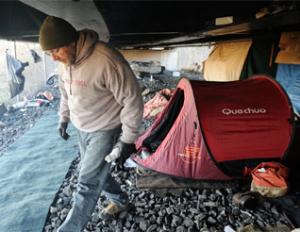
Rev. Keinath on holiday, under the overpass

Thomas Keinath is the pastor at Calvary Temple in Wayne, New Jersey, a so-called mega-church with a 2,000-plus seat sanctuary in an affluent community. It was time for him to take some vacation time, so he did. And what did he do?

Keinath spent his week off living with the homeless in the very un-affluent community of nearby Paterson, New Jersey. During the day, he wandered through the streets along with desperate, sick and destitute. At night, he stayed with them as they built fires to keep warm in freezing cold,  and slept with them, under a bridge, surrounded by discarded hypodermic needles.  He wrote down the life stories of the people he met, so he could learn from their life stories.

“I needed to understand what they were experiencing, and I needed to feel their pain.  How could I bring help or healing to the streets if I did not know what their needs are?” the pastor told reporters. Continue reading

Comment of the Day: “Unethical Quote of the Week: Roxanne Dunbar Ortiz”

I found Michael’s personal and heart-felt reflections on the fact that Democratic Senate candidate Elizabeth Warren has been distinguishing herself so-called “1%” thought-provoking on many levels. Its relevance to the Golden Rule is especially interesting. How can we treat others as we would want to be treated if we were them, when we don’t have sufficient common experiences to know what those others want and need? When a politician claims to be “one of us” and really is not, it is more than a misrepresentation. It is an appeal to trust based on false information.

Here is Michael’s Comment of the Day, on the post Unethical Quote of the Week: Roxanne Dunbar Ortiz:

Continue reading

Romney, Firing, Leadership, and Ethics Bob’s Lament

Yes, yes, firing people is one thing Donald Trump does well too. Shut up.

Ethics Bob Stone sent in a comment late last night that I replied to, but that I think deserves more discussion, on several points. Responding to my Ethics Hero designation for Ron Paul for coming to his adversary’s defense over Romney’s now infamous remark about firing people, Bob wrote:

“…I think Romney’s “I like to fire people”–even taken IN context–displays an inner heartlessness. I know about creative destruction, and I myself have taken actions to lay off people, and even fired a couple face-to-face. I did what needed to be done. No apologies.

“But did I like it? I HATED it.

“Romney’s comment seems of a kind with his strapping the family dog on his car roof for a 500-mi trip, or his advocacy of breaking up families to deport the parent or child who’s illegal. Gingrich was right.”

There are several issues here, some minor. Continue reading

A Word to the Wise-asses

Dear Wise-Ass,

I know that the fact you know I am a Boston Red Sox fan presents an irresistible opportunity for you to taunt, mock and tease me about the catastrophic choke-job my team just displayed to the world. To give you the benefit of the doubt, I am assuming that you are not a devoted and loyal fan of a sports team yourself, and thus think baseball is “just a game.”  If that is the case, I forgive you for your supposedly humorous comments, which have approximately the same level of sensitivity and kindness in my current state as the following:

  • “So I hear your mother kicked off! Aren’t you a little old to be an orphan? “
  • “Lost your house, did you? Hey, I have a big cardboard box you can have!”
  • “Still unemployed? I know: why don’t you start a career as a professional loser?”

I’m pretty sure you wouldn’t say any of these things (unless you’re a Yankee fan, in which case your whole moral compass is suspect), and I wonder if you understand that picking at the raw and bloody wound that is a beloved team’s tragedy is every bit as cruel and hurtful as such cracks would be. Incomprehensible as it may be to you, this was and is very important to me. My devotion to the Sox began when I was 12, and the team has given me more pleasure, grounding and wisdom than 99% of the people I have met in my life. Irrational though my emotional reaction may be, I’m in pain, and you shouldn’t have to empathize with the source of the pain to know that intentionally prolonging or magnifying that pain isn’t a very nice thing to do, and is nowhere near as funny as you seem to think its is.

I just thought you should know.

                                                                Jack
Perry, Insomnia, Leadership, and the Death Penalty

When should a leader lose sleep over a decision?

A lot of ink has been spilled over NBC’s Brian Williams’ question to Rick Perry regarding the death penalty, the Republican candidates debate audience’s strange reaction to it, and Perry’s response. Conservatives see Williams’ question—“Your state has executed 234 death row inmates, more than any other governor in modern times. Have you struggled to sleep at night with the idea that any one of those might have been innocent?”—as a loaded query by a biased questioner who is pressing the progressive anti-death penalty agenda. Liberals see Perry’s answer as proof-positive that he is an unthinking, unfeeling, blood-thirsty monster. Continue reading

Toronto: Religious Bullies Distort the Alcoholics Anonymous Mission

In Toronto, two Alcoholics Anonymous groups that specifically removed reference to God and religion in their version of the Twelve Steps have been de-listed by the central organization there, a straight exhibition of the abuse of power and a breach of integrity in the pursuit of selfish ends.

Alcoholics Anonymous, as anyone who has listened to Charlie Sheen’s anti-AA rants knows, employs repeated evocations of God and “a higher power” in its formula for treating alcoholism.  But while many have successfully turned to faith in their journeys to sobriety, most individual AA chapters neither insist on religious belief nor preach it, leaving it to each member to decide what his or “her higher power” is. To many, it is a God, and to many it is the fellowship of AA itself. The point of the higher power is to help an alcoholic discover the spiritual strength and resolve to conquer a pernicious and powerful disease with no known cure. the objective of AA, however, is not to seek to strengthen religion. Continue reading