Comment of the Day: “No, Washington Post Editors, THIS Is What Stephen Colbert’s Spat With CBS Is REALLY About…”

Glenn Logan, once a prolific blogger himself, is an EA veteran who periodically shows his talent for forceful commentary, as in his Comment of the Day finishing off the Washington Post editors with a rhetorical haymaker after I had softened up the miscreants a bit. I admire Glenn’s precision in pointing out just how disingenuous the paper’s protest over the FCC’s revitalization of the Equal Time rule, which would never have been necessary if TV “entertainment” hadn’t devolve into single party propaganda.

Here’s Glenn’s Comment of the Day on the post, “No, Washington Post Editors, THIS Is What Stephen Colbert’s Spat With CBS Is REALLY About…”

***

Consider this:

“The government shouldn’t be dictating the political content of late-night television — or of any other entertainment Americans choose to consume. But that’s exactly what the equal-time rule does. It is rooted in an entirely different technological landscape; in the early 20th century, scarce radio frequencies meant that the means of mass communication were limited. That’s why Congress saw fit to try to mandate that all candidates got a hearing.”

First of all, in its “explanation” of the Equal Time rule, the Post deliberately muddles the intent of Congress in passing it. Congress wisely (omg, did I actually write that??) thought that it would be in the public interest to prevent networks from supporting only one side of the public debate on the publicly-owned broadcast spectrum. That spectrum, last time I checked, is still publicly owned, CBS is still a lessee and the subject broadcast was supposed to air on broadcast television.

For a Leftist outlet like the Post, fairness is supposed to be perhaps the most cherished touchstone of any debate, yet because reminding its audience of the two fundamental motivations for the FCC rule — fairness and the public interest — would undermine its argument, the post just glosses over them altogether and argues by implication that freedom of entertainment choice is the most important thing.

Again, it is with sadness that I observe many people, perhaps even a majority, are so unfamiliar with the concept of critical thinking that they will accept this editorial as holy writ. But make no mistake — this was a malicious, deliberately partisan and utterly facile argument, and the Post knows it.

Verdict: Deliberately and intentionally unethical.
No, Washington Post Editors, THIS Is What Stephen Colbert’s Spat With CBS Is REALLY About…

….and you all know it as well as I do.

Proving that the Washington Post wasn’t recently gutted by its Gazillionaire owner Jeff Bezos to make it more fair and objective but just to try to save money while keeping it dishonest and partisan, the paper’s Editorial Board published a disingenuous, politically motivated and deliberately misleading editorial [gift link!]explaining that the Trump Administration’ resuscitation of the long dormant—but still on the books—FCC “Equal Time” rule is simply a pretense for using the regulation for political censorship. You see, as the Post editors “explain,” the rule is no longer needed! here is how they frame the current controversy:

“Passed by Congress as a part of the 1934 Communications Act, the equal-time rule says that if a broadcast station features a candidate for public office, it “shall afford equal opportunities to all other such candidates for that office.” The FCC is charged with enforcing it. On Monday, Colbert said that CBS prohibited him from airing an interview with Texas Senate candidate James Talarico (D). He claimed the network’s lawyers were worried about clashing with the FCC.

“CBS told a different story. It said Colbert wasn’t prohibited from airing the interview, but rather warned that it might “trigger the FCC equal-time rule for two other candidates, including Rep. Jasmine Crockett.” Talarico, a state representative, and Crockett are the leading contenders for the Democratic nomination in the 2026 Texas Senate race. The network claimed it presented Colbert with “options for how the equal time for other candidates could be fulfilled.”

“On Tuesday night, Colbert rebuked the network again, but the finger-pointing misses the point of how a zombie regulation created this mess in the first place.

“The government shouldn’t be dictating the political content of late-night television — or of any other entertainment Americans choose to consume. But that’s exactly what the equal-time rule does. It is rooted in an entirely different technological landscape; in the early 20th century, scarce radio frequencies meant that the means of mass communication were limited. That’s why Congress saw fit to try to mandate that all candidates got a hearing.

“Since the advent of cable news and the internet, the possibilities for transmitting information and entertainment have exploded. Colbert’s Talarico interview, for example, was posted on YouTube, where it already has more than 6 million views — far more than it probably would have received if not for this controversy. Politicians can compete for attention without government help….”

The Post’s subterfuge would be a legitimate argument except for the democracy-rotting condition that the paper is ignoring because it is part of it. That condition is the near total ideological monopoly of the entertainment industry, giving the Left—again, the Post and its pals—access to the controls of the powerful propaganda and indoctrination weapon television still is.

On the Colbert “Equal Time” Nonsense…

Gee, what a surprise. Democrats don’t like the Federal Communications Commission “Equal Time” rule applying to non-news shows when hey try to influence elections.

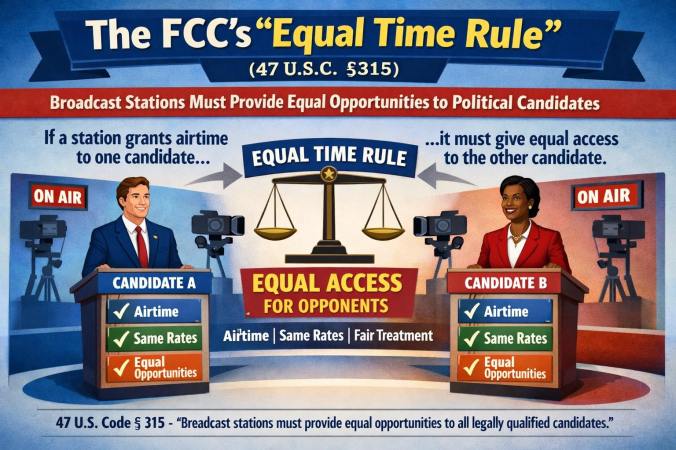
The Communications Act of 1934, once aimed at radio, now mostly applied to television, includes a provision regarding coverage of political candidates. If a station gives airtime to one candidate, then the same station must offer comparable time to other candidates competing in an approaching primary or election.  Regarding campaign ads, a station selling airtime to one candidate also has to offer to sell the same amount of time to other candidates for the same office. Exceptions to this rule include newscasts, “bona fide” interview programs, and coverage of live events or documentaries. Candidates appearing in non-news, entertainment programming near to elections now trigger the provision.

As they should.

CBS late-night host Stephen Colbert, on the way out already from his all-Democratic-cheer-leading-all-the-time show, attacked his own network this week after he was stopped from airing an interview with Texas state Rep. James Talarico (D), a U.S. Senate candidate, because of the FCC ’s equal-time rule.

“You know who is not one of my guests tonight?” Colbert asked his audience. “That’s Texas state representative James Talarico. He was supposed to be here, but we were told in no uncertain terms by our network’s lawyers, who called us directly, that we could not have him on the broadcast.” On cue, his partisan studio audience booed.

“Then I was told, in some uncertain terms, that not only could I not have him on, I could not mention me not having him on,” Colbert continued. “And because my network clearly does not want us to talk about this, let’s talk about this.”

Boy, isn’t he funny? My sides ache from laughing! No wonder Colbert is regarded as a comic genius. Admit it, the guy is hilarious.