Ethic Quiz: Is Eva Kor An Ethics Hero, Or An Ethics Dunce?

Kissed by a murderous Nazi. Yum.

Kissed by a murderous Nazi. Yum.

81-year-old Holocaust survivor Eva Kor recounted her memories of being one of Dr. Josef Mengele’s human guinea pigs  in a letter to Oskar Groening, a former member of the SS at Auschwitz-Birkenau who is on trial in Germany for 300,000 counts of accessory to murder:

In May 1944, when we were taken to Auschwitz, my name was Eva Mozes. My family and I were part of the Hungarian transport. My family included my father Alexander Mozes, 44 years old; my mother Jaffa Mozes, 38 years old; my older sister Edit, 14 years old; my middle sister Aliz, 12 years old; and my twin sister, Miriam, 10 years old. Within thirty minutes after arriving on the selection platform, Miriam and I were ripped apart from our family forever. Only she and I survived, because we were used in experiments conducted by .

Within half an hour we became part of a group of twin girls aged two to sixteen: thirteen sets of little girls and one mother. We were taken to a processing center where they cut our hair short and took our clothes away. That evening they returned them with a red cross at the backs. Then they lined us up for tattooing. When my turn came, I decided to cause them as much trouble as a ten year-old could. Two Nazis and two women prisoners restrained me with all their force. They began by heating a needle. When the needle got hot, they dipped it into ink and burned into my left arm, dot by dot, the capital letter A-7063. Miriam became A-7064…

For the next two weeks I only have one clear memory: I was crawling on the floor because I could no longer walk. I was crawling to reach a faucet with water because they did not even give us water anymore.

In 1984, Kor founded CANDLES (Children of Auschwitz Nazi Deadly Lab Experiments Survivors), in an effort to locate other surviving Mengele twins; and in 1995 she opened the CANDLES Holocaust Museum and Education Center in Terra Haute, Indiana. She calls herself a “forgiveness advocate,” teaching children:

1. Never give up on yourself or your dreams. I did not know how to survive Auschwitz, but I was determined to do it. Here I am 70 years later because I never gave up.

2. Treat people with respect and fairness to eliminate prejudice from your life.

3. Forgive your worst enemy and forgive anybody who [h]as ever hurt you. I forgave the Nazis and I forgave everybody who hurt me.

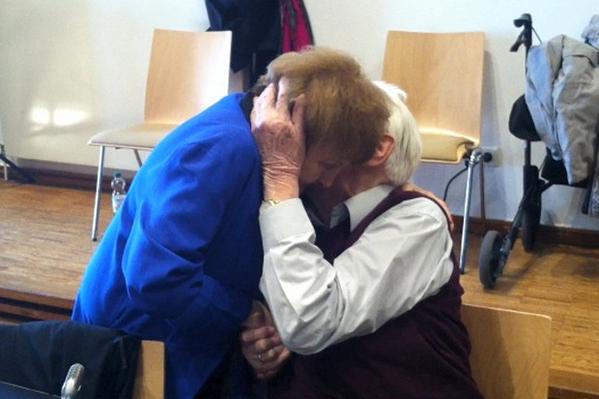
Kor is one of the Holocaust survivors testifying at Groening’s trial. On its first day, Groening told the court that  “it is beyond question that I am morally complicit. This moral guilt I acknowledge here, before the victims, with regret and humility.”  Kor told him, “I appreciate the fact that you are willing to come here and face us.” She offered the defendant her hand, and he took it, brought her into a near embrace, and kissed her on the cheek. 

Your Ethics Alarms Ethics Quiz as this week ends is…

Is Eva Kor an Ethics Hero, or an Ethics Dunce?

Continue reading

Presenting the Ethics Alarms Heroes’ Hall Of Honor

remember

Today, the anniversary of September 11. 2001, American minds should be occupied with thoughts of gratitude for heroes, the often anonymous and unknown people we may pass in the street every day, as well as the justly famous and celebrated, who make our lives and many others better by living their own selflessly and well. They are our salvation, role models and neighbors, and they teach us the lesson that all is never lost, and hope is always thriving, as long as there are good and courageous people who will do the right thing, no matter what the cost, when fate turns to them.

This seems like a propitious time to dedicate the Ethics Alarms Heroes Hall of Honor, the list of the Ethics Heroes Emeritus whose stories have been told here (and on this site’s predecessor, The Ethics Scoreboard.) Every current member of the Hall is now deceased, like the brave men and women who died this day, 12 years ago. Each of them, in a unique way, teaches how human beings can rise above the vicissitudes of mere survival, self-interest, personal benefits and the base desires of the species  to live  meaningful and virtuous lives. Some accomplished this over decades, some with one brilliant and transforming act of distinction.

There are currently 32 members enshrined in this virtual Hall. Obviously, it is far from complete. They are just symbolic representatives, worthy ones, of millions more who once breathed the same air we do today, and like those who perished twelve years ago, face the prospect of being forgotten over time, as we all go about the consuming task of getting from one day to another. Each one of us, I believe, is capable of emulating their example.

Here are the thirty-two members and their stories, as of this date,

September 11, 2013... Continue reading

Ethics Hero Emeritus: Eric Lomax, 1919-2012

Eric Lomax was a hero of forgiveness.

Eric Lomax, his book, the Bridge on the River Kwai,, and his friend, the man who tortured him.

In 1942, Eric Lomax, was a 19 year old  member of the British Royal Corps of Signals stationed in Singapore when he joined thousands of British soldiers in surrendering to the Japanese. It was 1942. He was one of those shipped to Thailand and became one of the slaves laboring to build the Burma Railway, also known as the Death Railway. The building of the railroad and the brutal treatment of the English prisoners by their Japanese captors  formed the plot of the classic 1957 David Lean film, “The Bridge on the River Kwai,”

After Lomax was discovered to have built a radio receiver from spare parts, he was mercilessly tortured and interrogated by his captors.  After his release, fantasies about murdering his main torturer, a man named Nagase Takashi, obsessed him. Lomax spent the early years of his retirement in the 1980s looking for Takashi, and eventually learned that he had become an interpreter for the Allies after the war. In 1992, he stumbled across an article profiling Nagase and noting that he was haunted by guilt over his mistreatment of one British soldier. That soldier, Lomax realized, had been him. He arranged to meet the man who tortured him, and whom he had spent the rest of his life dreaming of murdering.

Torturer and victim met in 1993, on the infamous bridge Lomax had been forced to help construct (and which was not blown up, the film ending notwithstanding). Continue reading