I was going to let this go, but it kept gnawing at me, and nobody in the news media called out Anderson Cooper on his outrageous misrepresentation of history and human character. I guess it’s up to me.
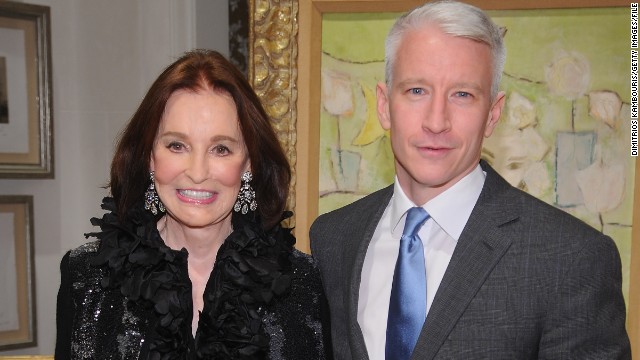
“Thanks for nothing, Mom!”
Cooper is the son of fashion designer Gloria Vanderbilt, and thus an heir to one of the most storied of American family fortunes. Apparently Cooper has known for some time that he’s getting none of his mother’s estimated 200 million dollar estate, and he told Howard Stern recently that he was fine about it, an had no bitterness or regrets.
“I don’t believe in inheriting money, ” he told Stern. “That’s a total fantasy … I think it’s an initiative-sucker, I think it’s a curse. Who’s inherited a lot of money who’s gone on to do things in their own life? If I felt that there was some pot of gold waiting for me, I don’t know that I would have been so motivated.”
As for his mother, who inherited many millions and who still made a name for herself by launching a line of designer jeans, Cooper told Stern, “I think that’s an anomaly.”
Cooper is free to adopt whatever myths and rationalizations that help him get over the fact that his mother is cutting him off. He is not free to misinform the historically ignorant that a tendency exists which may describe his own mental state but which is far from the presumptive norm with others throughout the centuries. “Who’s inherited a lot of money who’s gone on to do things in their own life?” The answer to that question is “Too many to mention, Anderson. Are you kidding? Do you know anything about history?”
Just counting U.S. Presidents, which I think even in this period of reduced stature among White House occupants, would still qualify as “doing something with your life,” we have Washington, Madison and Monroe, all of whom inherited substantial property and assets from their families, as did William Henry Harrison and his grandson, Benjamin Harrison. Both Roosevelts inherited substantial wealth; so did William Howard Taft, whose family was (and is) one of the richest in the U.S. Both Bush’s managed not to let the curse of inherited wealth undermine their wills to succeed. Continue reading

 Ethics Alarms