The Classic Ethics Problem That Isn’t As Hard As Everyone Thinks It Is…

I’ve been hearing and reading debates about the old (1884) criminal case The Queen v. Dudley and Stephens since law school, and I must say, I’m a bit sick of it.

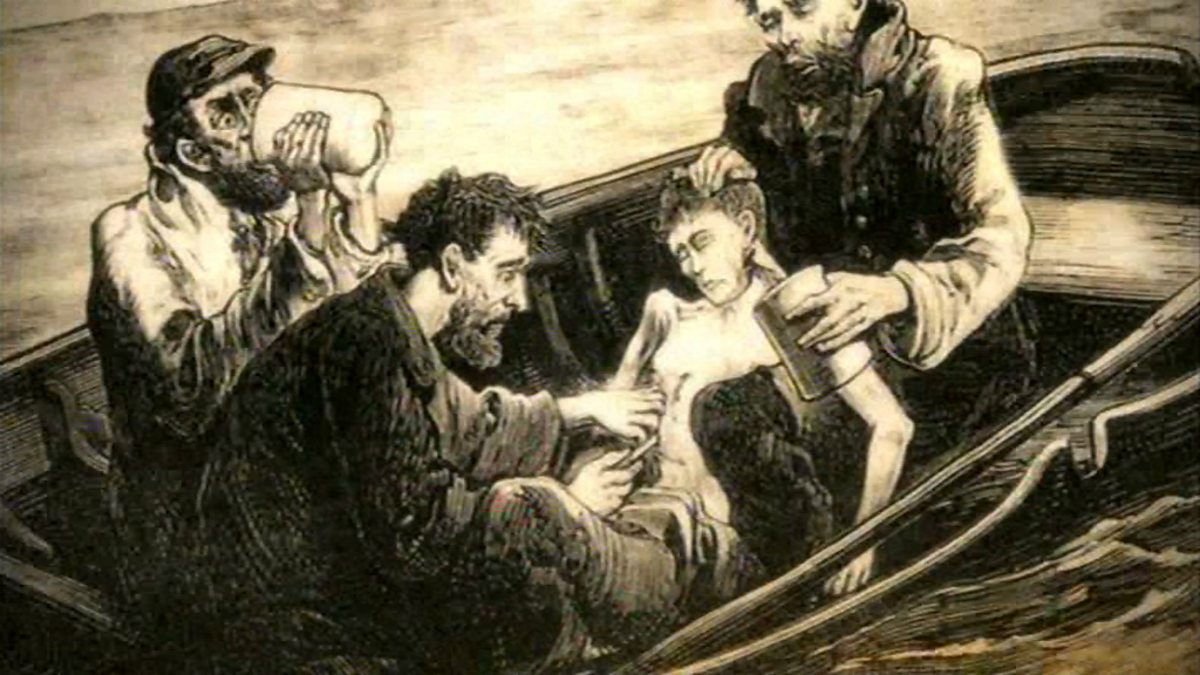
A wealthy lawyer from Australia purchased bought a yacht named the Mignonette and hired a Captain Dudley to sail it to him it from England. Dudley and his three crew members encountered a violent a storm off the coast of Africa, and the Mignonette was swamped. Its captain and crew escaped in a lifeboat with minimal provisions. After more than three weeks adrift, the captain decided that all of them would die of hunger and thirst unless extreme measures were taken, so he took them. He decided that cabin boy Richard Parker, a 17-year-old orphan, should be slaughtered and eaten. The captain’s reasoning: Parker was already delirious from drinking seawater, so he was deemed the weakest and least likely to survive anyway. The three men killed to boy, collected his blood in a bailer and drank it, then removed his heart and liver and ate them.

It worked! They were rescued in time, just a few days later in fact. Dudley and the First Mate Edwin Stephens were also prosecuted and found guilty of murder, a result that was considered revolutionary, since resorting to cannibalism in such dire circumstances was considered a normal course of action, “the custom of the sea.” In the U.S. at the time, the courts widely accepted the “necessity doctrine,” which excuses some illegal acts if they are performed in good faith to prevent a greater harm.


New York City And The Mayor: Case Study In The Simpson Principle

simpson

The Simpson Principle does not refer to Homer but Alan, the now-retired Republican Wyoming Senator who once sat next to me at a press conference announcing the Reagan administration amnesty for illegal immigrants. Conservatives hated amnesty back then, too, and Simpson was regarded as a conservative. When I found myself seated next to him at lunch (my Foundation for the Chamber had done a study on immigration reform), I took the opportunity to quiz him on why he took the lead in this issue. (Those Chamber events were fun: another time, I ended up alone at a table with Gene McCarthy.)

Simpson said, as I remember it, “Well, ideology is great, but eventually you have to use real measures to solve real problems. If you keep flogging ideology when you know it won’t work, you’re a fool. It’s dumb, it’s irresponsible, and it’s wrong.”

You will note that 1) Simpson’s plan didn’t work either, though it wasn’t the plan’s fault, 2) Conservatives still oppose what they call amnesty, and yet haven’t a single rational, practical recommendation for how to handle the 13 million illegal immigrants who have slipped into the country since that Eighties luncheon chat, and 3) both liberals and conservatives have been meeting Simpson’s definition of fool lately.

[Aside: I ran into Simpson at LaGuardia last year, introduced myself and thanked him for that wisdom. He remembered me, amazingly, but didn’t remember that comment. “I said that?” he said. “Wow. I was smart that day. Thanks for reminding me of it. I wish I had run into you a few years ago.”]

One of the primary fools who is running amuck these days is Mayor Bill de Blasio, who is determined to again try the lassez faire, look the other way, “compassionate,” kinder, gentler law enforcement policies of his former boss, the infamous Mayor David Dinkins. In the 1980ss, Dinkins continued the transformation of  New York City into a declining, filthy, crime-riddled hell, and only the long, painful, much-criticized introduction of the so-called “broken window” theory into the city’s management by Rudy Giuliani turned the crisis and the city’s fate around.

As chronicled by Myron Magnet on one of my favorite blogs, City Journal, de Blasio is determined to relive the Dinkins experiment, because it would be nice if that way of running a big city works. Already, the completely predictable results are in evidence.

He writes: Continue reading

Bizarro World Ethics At Harvard

Bizarro

We will pass with little notice or comment the weird exploits of Eldo Kim, the 20-year-old Harvard University sophomore accused of emailing a bomb threat that cleared out Harvard Yard this week during exams, apparently because be wasn’t ready for his. How completely devoid of ethics does one have to be to do something like this? And how dumb! He undermines the efforts of all his fellow students who are prepared for their exams, causes fear and panic on campus, causes disruption, inconvenience and expense to the university, and all because he either didn’t study sufficiently or wasn’t prepared to fake his way through an exam like most students, all while risking arrest, trial and conviction for a serious crime that will harm his future prospects far more than any poor exam performance might. Today we learned that Kim was a psychology major studying partisan taunting. He was worried about passing an exam in partisan taunting?

Adding to the strangeness, a controversy erupted this week when veteran Harvard professor Harvey Mansfield expressed his outrage that a recent study had revealed that the most common grade given to Harvard students is A, a practice, he says (and correctly so) that penalizes genuinely outstanding students and allows slackers to slide through Old Ivy without breaking a sweat. Jeff Neal, the hapless Harvard spokesman assigned the job of spinning this revelation, confirmed the accuracy of the Mansfield’s claim, and said, maybe without giggling: Continue reading