Ethics Alarms On The Air!

onair

I have been on the radio a lot recently. The opinions expressed there will not surprise anyone who is a regular reader of Ethics Alarms, but for those curious about whether I speak with a British accent or a bi-lateral lisp, or those who are aurally inclined, below are links to three radio shows that had me as a guest of late, and one that interviewed me as background, and included some of my comments.

Here you go:

1. This is WGAN’s examination of the Hillary Clinton e-mails scandal, delivered by me while in shock after listening to Karen Finney spin herself sick on CNN, ably hosted as always by Arthur King…

2. Here is national host for the Local Job Network, Tim Muma, a terrific interviewer, on a podcast chatting with me about the “Ick!” and “Awww!” Factors and their relationship to ethics.

3. Tim again, this time cross-examining me about the Brian Williams mess and related issues.

4. Finally, NPR reporter Hawes Spencer’s report on the Sweet Briar closing.

“House of Cards” Ethics: Why Should We Believe TV Journalists and Pundits Have Any Integrity When They Don’t Value It Themselves?

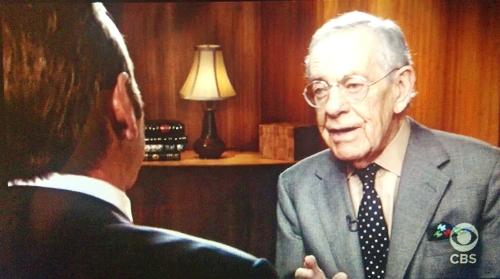
Safer interviews "President Frank Underwood." Morley, Morely, Morely...

Safer interviews “President Frank Underwood.” Morley, Morely, Morely…

The third season of “House of Cards,” a Netflix series about the corruption in Washington, continues to corrupt real Washington journalists and talking heads. On the third season  episode I just watched, “This Week With George Stephanopoulos” was drawn into this alternate universe (or Hell) and George, along with regular panel members Donna Brazile and Matthew Dowd, rendered trenchant if predictable opinions about fictional President Frank Underwood with exactly as much passion and certitude as they do when they aren’t just playing themselves, but being professional analysts whose job it is to objectively enlighten the TV news audience. With that, they joined CNN’s John King ,Candy Crowley,and Carol Costello, Soledad O’Brien, now with Al Jazeera America, NBC’s Kelly O’Donnell, MSNBC’s Rachel Maddow, Fox’ Sean Hannity, CBS’s Morley Safer of “60 Minutes,”  and Matt Bai as “House of Cards” journalist/actors. I’m sure I missed a few. The mystery is why none of these journalists (and whatever Sean Hannity and Brazile are) don’t hear ethics alarms ringing when invited to sully their already dubious credibility (they are in the news media, after all), by showing themselves reporting and commenting on fiction exactly the way they are seen reporting on reality. Brian Rooney, a media critic who writes “The Rooney Report,” states succinctly what’s the matter with this:

“The trouble with journalists appearing as themselves in entertainment is that the public already has difficulty discerning fact from fiction in the news. Reporters and news organizations survive on truth and trust. Readers and viewers need to believe what they are told so they can make informed decisions. When real reporters allow themselves to be part of fiction, the trust is shattered. They do it with a wink, like they are in on the joke, but it costs them their credibility.”

Well, it would cost them credibility, if they had any. Continue reading

Jackie Robinson West Little League Baseball Team Epilogue: Who Says “Cheaters Never Prosper”?

Littel League champs

As described here, Chicago’s Jackie Robinson West Little League Baseball team was stripped of its U.S. title after Little League International found out–later than it should have— that the team’s adult leadership changed the district boundaries without permission to create what was really an all-star team. The championship, to be blunt, was won through cheating.

Since the team’s members were all African-Americans, Jesse Jackson and many of the parents immediately claimed that racism was behind the forfeit. If, however, a white team had been found to have prevailed over a black team by cheating and was allowed to keep its ill-gotten championship, Jackson would also scream racism. (This was a #11. on the Draft Ethics Alarms Race-Baiting Scale: Presumed Racism: Accusations of racism based on no other factors but the races of the individuals involved.) Jackson and Chicago Mayor Rahm Emanuel then pressured the Little League to reverse its decision, essentially allowing cheating to be 100% successful, as it often is in politics. To its credit, the organization refused to bend.

Never mind:  Emanuel is a veteran of the Obama administration, and also has a large black constituency to pander to. Thus he plans on giving the team championship rings at next month’s city council meeting. Emanuel found private donors to fund championship rings shortly after the Little League World Series. Each ring has the player’s name, jersey number and the number 42, in tribute to Jackie Robinson.  On the inside of each ring, the legend, “Who says cheaters never prosper?” is engraved in script.

Just kidding about that last part. Continue reading

Refining The Race-Baiting Scale (“The Knight Scale”)

Untitled Race cards

I am slowly updating and expanding the resources on Ethics Alarms, including adding some of the tools that I have initiated on the blog but never put on the home page to accompany the much-used Rationalization List and the Apology Scale. I thought one of these was a race-baiting scale, as I referred to one, dubbed “The Knight Scale,” here and here. I discovered, however, that I had just given numbers to a few examples of race-baiting along least bad-to-worst spectrum without specifying specific varieties of race-baiting for each.

This was a major failing, and I apologize. Race-baiting has been one of the primary features of public discourse embedded in our culture by having a black President, was well as one with so many unscrupulous race-obsessed supporters and so much evidence of incompetence and dishonesty to try to defend. Its widespread use, tacitly approved if not orchestrated by the White House, has also contributed to the vastly deteriorating race-relations in the U.S., along with the racial distrust and anger fueling it. I have stated, and strongly believe, that this will be, above all else, Barack Obama’s legacy. The tragedy this represents cannot be over-stated.

I am offering now and belatedly a revised Race-Baiting Scale, running from 1, the least offensive and significant form of race baiting, to 11, the worst and most unethical.  Two notes: 1) All entries are based on the assumption that no actual racist or bigoted conduct has occurred, and 2) It is stipulated that all actual racist conduct or bias is unethical and should be called out and condemned.

The Race-Baiting Scale

Continue reading

Unethical Ex Of The Month, Paige Dunham: Hell Hath No Fury Like A Ventriloquist’s Wife Spurned…

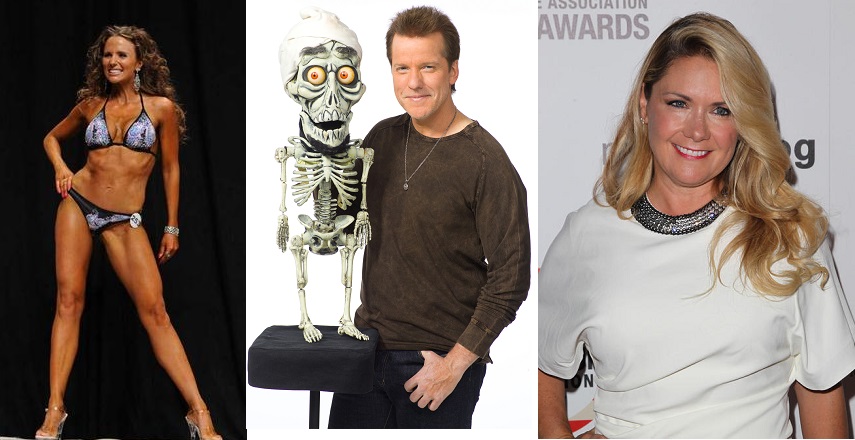
The ventriloquist and his spouses. Can you guess which is the ex?

The ventriloquist and his spouses, past and present. Can you guess which is the ex?

I suspect there’s a sad story behind this one that many a betrayed spouse can identify with. Did Paige Dunham stand shoulder to shoulder with her husband, Jeff Dunham in the lean years when he was struggling ventriloquist (and really, what could be worse, struggling accordion virtuoso?) only to have him toss her away like an old shoe once he hit the jackpot and became a rich and famous celebrity, as he sought and won a flashier spouse to match his flashier lifestyle? It sure looks like it.

Nevertheless, what Paige Dunham did to her ex-spouse’s Shiny New Model Audrey Dunham can’t be justified ethically. It is also apparently illegal. Continue reading

Bias Check

Confirmation bias

Detecting and overcoming one’s own biases is one of the most important features of being ethical. “Bias makes you stupid,” after all, and stupidity can make you unethical. As the author of an ethics blog, this is of special concern to me, as I am constantly making choices that bias could seriously affect. Some of those choices include what issues and events have ethics components, which are most important to publicize, how should the ethical issues be analyzed, what conclusions are fair and reasonable, even how long a particular post should be, what authorities and references should be included, and what style—scholarly? humorous? bemused? indignant? outraged?—will best illustrate a point.

As regular readers here know, I can be harsh, often too harsh, when a commenter dismisses my commentary as partisan or ideologically motivated. First of all, it isn’t, and I resent the accusation. Second, it’s a cheap shot, essentially attacking my motives, objectivity and integrity rather than presenting substantive arguments. Third, it is a simpleminded approach to the world in general, and democracy in particular, and life, presuming that “there are two kinds of people,” and one type is always wrong, while the other type is always right. There is nobody I agree with all the time, and I am far from alone in that trait. People who agree with the same people all the time are not really thinking. They are just taking the easy route of picking sides, and letting others think for them.

Obviously, my approach to controversies, problems and ethical analysis are influenced by thousands of factors, including my parents,  my upbringing,  where I have lived,  teachers, friends, and family members, experiences, books, plays, movies and popular culture, interests  and passions (like leadership, American history, and baseball), what I’m good or successful at and I’m not, and so much else. These are not biases: once such influences mold your way of looking at the world and passing through life, they are, in fact, who you are. I’m comfortable with who I am. I just don’t want biases making me me stupider than I am.

Thus I am always interested in trying to identify where I stand on a the ideological scale. Some of my conservative friends think I’m liberal; all of my liberal friends think I’m conservative. Two sides again: I am confident that it is their place on the scale that leads to those perceptions. Today I encountered another test that supposedly divides liberals and conservatives sharply.  It comes from political scientist and philosopher James Burnham’s  1964 book “The Suicide of the West.” Burnham was one of those radical leftists who did a complete reversal in middle age and became an influential conservative theorist. You are asked to agree or disagree with these 39 statements, and the result reveals your ideological bent.

Here are the questions: Continue reading

Comment of the Day: “A Failure To Understand Legal Ethics Kills”

armchair quarterback2

It shouldn’t shock anyone to see yet another Comment of the Day here authored by texaggo4. He has been the most prolific commenter—other than me, and he’s ahead of me so far in 2015— since the legendary tgt went into voluntary keyboard retirement, and has led all visitors in commentary the past two years. Last year, he contributed a staggering 3, 048 comments, more than twice as many as runner-up Steven Mark Pilling, who was hardly a piker with 1,082. (The rest of the top five: Ablativemeatshield/Scott Jacobs close behind at 1, 079—he would have finished #2 if he hadn’t quit the field in a pro-pot snit; Beth, with 881, and dragin-dragon at 809. Thanks, everyone, and all other commenters too. That’s a lot of quality content, some of the best on the web anywhere.)

The list is especially relevant to this COTD, as tex rebuts an accusation of “Armchair quarterbacking” against Beth from new commenter gokafilm. Beth had offered a comment to the post about Tampa lawyer Gienevee Torres, who called 911 to report a deranged client—he was wearing pajamas and thought she was God– who had just left her office with his 5-year-old daughter after making an ominous comment. The police decided that the man was harmless despite her warning, and the man eventually dropped the girl off a bridge. Beth wrote:

“I am furious at this lawyer — not the police. She should have said something like, “Yes, I am God. He commands you to give me your child and leave my office now and run to the nearest hospital.” I would have happily stood before the Bar Committee defending my actions if it meant that I had saved a child’s life.”

Gokafilm replied:

Easy to say Beth from the safety of your home/office/wherever. She had to be concerned for her safety and her staff as well. This most likely is a split second decision. Get the individual out and call the authorities…Did she not have a responsibility to herself and her staff to consider their safety as well? What’s to say he wouldn’t have harmed them if they forcibly tried to keep the girl. This lawyer did the right and only thing she could have. Got the individual out of her office, and contacted both 911 and DCF in order to protect the child. Any other conclusion is merely arm chair quarterbacking from the safety of your computer screen.

Another term for “armchair quarterbacking” is hindsight bias, the tendency to judge a difficult decision unreasonably harshly when it doesn’t work out well. “Obviously” conduct is “wrong” after the results are known. My response to Beth’s comment was that the whole, horrible incident was moral luck: if the lawyer had done the same thing and the girl had been rescued as a result of her violating client confidentiality, everyone would have said that her actions were appropriate and even heroic.

On the other hand, post-event analysis is invaluable; this website is based on it. The argument that nobody should criticize an individual’s conduct “unless he’s walked a mile in his shoes” is a lazy cop-out that impedes cultural wisdom and learning from the mistakes of others. I don’t completely agree with many, perhaps most, Comments of the Day, but I concur with this one.

Here is texaggo4’s Comment of the Day on the post, A Failure To Understand Legal Ethics Kills: Continue reading

The State Of Ethics Alarms, 2015

Driving on an empty road towards the setting sun 2014

The 2014 Ethics Alarms Best and Worst of Ethics Awards will be along shortly, but right now I want to provide an overview of the blog itself as 2015 dawns.

Posts: There were slightly more than 1,000 posts to Ethics Alarms in 2014.

Traffic: Ethics Alarms had 1,195,812 page views, up about 6% over 2013.

Most Viewed Posts: Outside of the home page, the Rationalizations List remained the most popular. The top ten 2014 posts that drew the most interest were, in order of most visits; Continue reading

Just A Reminder: I Warned About This From The Start, Almost Three Years Ago

Poor Cassandra. I know how she felt.

Poor Cassandra. I know how she felt.

The Ferguson Ethics Train Wreck, which encompasses the shooting of two police officers in New York City, is just the second section of the Trayvon Martin-George Zimmerman Ethics Train Wreck. The coordinated effort to represent the American justice system as hostile to blacks, and white society as determined to harm them, was launched in Florida in early 2012, nearly three years ago.  It might have failed then, as it deserved to since there was no genuine racial element in the actual Martin-Zimmerman episode, had not the President of the United States used his bully pulpit, credibility with black Americans and the power and influence of his office to declare the local incident as emblematic of societal hostility to African-Americans, and Obama personally. This, as I wrote earlier this week, lit the fuse that exploded into racial violence against police this past week.

I saw it then. I have seldom seen anything more clearly.  So I wrote:

What does {Obama] think he’s doing? Teens, children and adults are murdered every day, many of them right where Obama lives, in Washington, D.C. Aren’t all of the violent deaths “tragedies”? Why is this one, and only this one, worthy of specific presidential attention? Is it because black leaders called for the President to overstep his proper role? Who cares what activists call on the President to do—certainly he shouldn’t. Does this now justify their calls for retribution and violence, or validate high school students who are staging walk-outs to protest law enforcement officials investigating a case before they make any arrest? (Are high school students now empowered to dictate law enforcement policy? Suspend every single one of them.)

What earthly difference does it make what Trayvon looked like, who his death makes the President think about, or whether he looked like the son Obama never had? So what? What if he looked like my son? Not good enough? When a white, Hispanic or Asian kid in a hoodie is shot by some gun-wielding hysteric, can those parents also count on a statement of concern by Obama? What if they are just run down by a drunk driver, or killed by being left in an over-heated car? Not tragic enough? Doesn’t strike the same chord of of “seriousness”? Or will these tragic deaths not be viewed as sufficiently important to the President’s “base” in an election year? Do you think these questions are unfair? Who laid the groundwork for them?

Misusing his office and prestige in such matters simultaneously diminishes the presidency and warps its function. The position has always included the role of Mourner-in-Chief, at times of genuine national tragedies, such as the Twin Tower bombings, the Challenger disaster, and Pearl Harbor. Cheapening this solemn function by intervening in local crimes and contentious race-charged controversies accomplishes nothing positive: it is divisive, intrusive, and dangerous.

Got that? Dangerous. I chose that word deliberately. March 12, 2012.

Reading the comments again now is fascinating: readers conservative and liberal denounced my criticism as unfair, after the usual “Bush did it too” spin from the reflex Obama defenders.

Arthur in Maine wrote: Continue reading

Israel’s Home Razing Policy: You Disappoint and Depress Me

bulldozer

There are times, not many, but a sufficient number to make my existence significantly grayer than I wish it to be, when I feel as if my professional endeavors have been in vain, and indeed, a waste of time. One such instance was the widespread defense of torture during the Bush administration. Another has been the reaction of some readers here to my post about Israel razing the homes of the families of presumed terrorists. I do not see how anyone who grasps the basic principles of ethics as they are explored and explicated on Ethics Alarms daily can pronounce such a policy as justified, justifiable, or anything other than unethical. If regular readers hear can come to a different conclusion, I am either not doing my job well, or the job itself is not worth doing.

Yesterday, Human Rights Watch called on Israel to stop razing the homes of Palestinians accused of attacking Israelis. The group called it a war crime, and I don’t like the concept of war crimes generally. The New York based organization’s argument, however, is irrefutable:

“Israel should impose an immediate moratorium on its policy of demolishing the family homes of Palestinians suspected of carrying out attacks on Israelis. The policy, which Israeli officials claim is a deterrent, deliberately and unlawfully punishes people not accused of any wrongdoing. When carried out in occupied territory, including east Jerusalem, it amounts to collective punishment, a war crime.”

Putting the war crime label aside, it is wrong enough that the act punishes those who have done nothing wrong other than be associated with a wrongdoer. There is no ethical system under which such an act is ethically defensible. It is an abuse of power. It fails any standard of Kantian ethics, using human beings as a means to an end, and proposing a standard that would, if universally adopted, send civilization into barbarism. It even fails extreme utilitarian ethics, for this means doesn’t even achieve a desirable end. The Israeli army believes that the razings do nothing to stem terrorist attacks, and there is no way that contention can be disproved. It is simply Old Testament justice of the most irrational and brutal kind. Continue reading