Biden’s Doctor Claims Privilege and Takes The Fifth

Former President Biden’s White House physician, Kevin O’Connor, refused to answer questions for the House Oversight Committee’s investigation into the White House and Democratic cover-up of Biden’s mental decline and disability. News accounts from the Axis keep stating that Biden’s condition and a cover-up are “alleged” only, but res ipsa loquitur: what we already know, have witnessed and heard tells us all we need to know except the who, how, and how long. Biden was (is ) suffering from dementia of one kind or another. His condition was carefully, if insufficiently, hidden from the public. The fact that his power had to be exercised by unelected figures using the President as their agent, puppet or beard constitutes at least as great a scandal as Watergate, and perhaps a more substantial attack on our democracy.

This betrayal of the public trust requires at least as thorough an investigation as that definitive scandal in the Nixon White House received. Democrats, however, unlike the Republicans of the Watergate era, are refusing to do their duty and assist in the inquiry, probably because they have metaphorical blood on their hands. They were complicit. They were guilty. The House inquiry includes questions about whether Biden’s staff used the autopen to illegally carry out official actions in Biden’s name. One would think both Democrats and Republicans would be concerned about this. Apparently not. Make of that what you will.

Continue reading

Friday Open Forum: Trying to Remember

Ugh. I woke up this morning, immediately got into a substantive discussion, and found myself unable to think of not one but two names I believe are important to remember. The most important of the two was Kurt Gödel, whose “Incompleteness Theorems” led me to the Ethics Incompleteness Theorem, which is an important concept I haven’t discussed lately but is in the Ethics Alarms concepts and special terms list above.

The other name that I had to dig into my neurons to locate was Jill Corey, whom I had vowed to remember because it is so unfair that she has been almost totally forgotten. I wrote about her in 2023, here, on the occasion of Corey’s death.

Try to remember what you have been thinking about in the world of ethics over the last week and share it with us, will you?

(Incidentally, almost nobody except musical theater geeks remember that before he starred in “Law and Order,” Jerry Orbach was the star of “The Fantasticks,” the longest running musical ever. That’s him singing in the video above, when he was in his twenties, in the original Off-Broadway production.

Look! Intersex Track And Field Athlete Caster Semenya Is Back In The News With An “It Isn’t What It Is” All-Time Classic

Let’s see: the last time I mentioned Semenya was at the end of last year, musing about what to do about another mutant in sports, Jeremiah Johnson, then a 12-year-old junior high school running back from Fort Worth, Texas who weighed 5-foot-11 and weighed 198 pounds, counting his facial hair. (I’m afraid to check on what size he is now.) The question is how schools and sports organizations should treat outliers who break all the rules naturally, and clobber the competition. Semenya, you will recall (we have discussed her a lot) is intersex, meaning that she has some of the primary and secondary characteristics of both sexes. It also gives her testosterone levels about 15 times higher than her female competitors. Though she has won many international competitions and set many women’s records (in the 400m, 800m, 1,000m and 1,500m races). A Swiss ruling in 2019 banned Semenya from international races between 400 meters, and Switzerland’s highest court backed the decision. To compete, she would be required to suppress her natural male hormones, which she refuses to do.

Writing about both Johnson and Semeya, I wrote last year,

“We can’t have special leagues and categories for however many gender categories science identifies and activists fight to have recognized, and there is no justification for creating artificial standards to eliminate outlier performers. The “solution” imposed on Caster Semenya—force her to take drugs that eliminate her natural advantage—is horrifying. How is this different from banging brilliant kids on the head until they have brain damage and no longer dominate their less gifted fellow students in school? What right do the sports czars have to declare an unprecedented, unique competitor unfit to compete because her, or his, unique qualities are advantageous? Why are so many woman condemning Caster as a cheat, when they should be defending her as a human being with as much right to compete as she is as anyone? Because she’ll win? Because it’s unfair that God, or random chance, or her own dedication rendered her better at her sport than anyone else?”


The unique physical characteristics of many, many other elite athletes can be said to have bestowed the exact same kinds of “unfair” advantages that allow Semenya to excel. The only question should be: Are these her real, natural abilities? If so, it is unethical to punish her for being born superior. Meanwhile, biological men transitioning into womanhood are allowed to dominate women’s sports competitions in the U.S. This makes no sense at all.

Continue reading

The “Immaculate Inning” Conundrum: A Fairness And Integrity Challenge

Yes, this perplexing ethics issue arises in baseball, but the principles it involves are applicable in other contexts. Attention should be paid.

Although there is no official definition, an immaculate inning in baseball occurs in baseball when a pitcher strikes out all three batters he faces in one inning throwing only nine pitches. This has only happened 114 times in Major League history, and been done by just 104 pitchers. The first immaculate inning was thrown by John Clarkson of the Boston Beaneaters against the Philadelphia Quakers on June 4, 1889. No-hitters, which automatically get a pitcher’s name in the Major League Baseball Hall of Fame in Cooperstown, are three times more common that immaculate innings. Throwing an immaculate inning is a career landmark for any pitcher.

A week ago, Tampa Bay Rays reliever Robert Stephenson threw nine pitches to three Cleveland Indi—I’m sorry, Guardians batters and struck them all out on three pitches each. But whether or not this constituted an immaculate inning is still being debated. Within the controversy is a welter of ethics lessons and problems.

Continue reading

An Ethics Incompleteness Principle Challenge: The Mutant Kid

Jeremiah Johnson, a 12-year-old running back from Fort Worth, Texas, is already 5-foot-11 and weighs 198 pounds. He has facial hair (the tattoo is fake—he just wanted to look older), and all of his photos look photoshopped, but that’s a real child in that picture.

Dallas Dragons Elite Academy (DEA) team won the 2022 Youth National Championships in Miami—big surprise there—and he was selected as the Most Valuable Player in the division, which is even less of a surprise.

The ethics conundrum is: what do you do about a mutant like Jeremiah?

Continue reading

Discrimination, Diversity, And The Tattooed Teacher

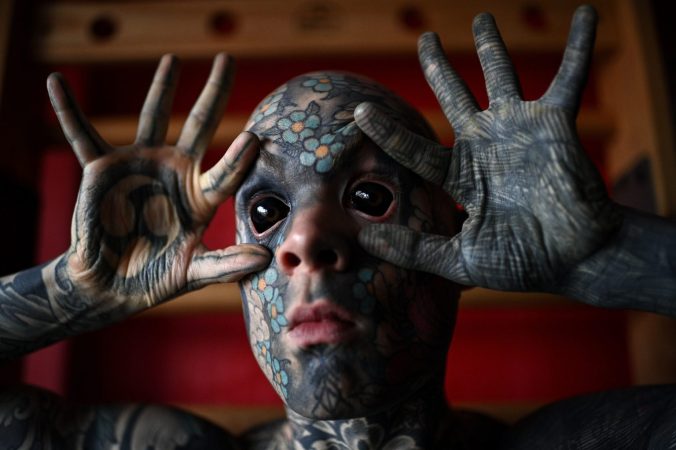
Sylvain Helaine, 35, has, as you can see above, gone to great lengths to cover nearly every centimeter of his body with tattoos, including the whites of his eyes. He is, believe it or not, a kindergarten teacher, and Helaine is complaining that he has been told he cannot teach young children because some of them find his appearance nightmare-inducing. This, he feels, is discrimination.  Nonetheless, he is still teaching older children.

He says that he hopes his tattoos will teach his students about acceptance so that “maybe when they are adults they will be less racist and less homophobic and more open-minded.”

I’m sorry this issue is emerging in France and not in the U.S. It’s an excellent Ethics Incompleteness Principle case. When an individual deliberately mutilates himself like this, a school rejecting him as a teacher of young children, and indeed older children as well, is fair, reasonable and responsible. His “disability” is self-inflicted, his appearance teaches that narcissism and lack of respect for others is admirable, and he is quite possibly mentally ill. Continue reading

Statue-Toppling, The Ethics Incompleteness Principle, And Calvin Griffith, Part Two

Where Cal Griffith’s statue once stood…

Here is what Calvin Griffith said in the 1978 remarks that led the Minnesota Twins to remove his statue in from of the team’s stadium, Target Field.

Griffith was invited to speak to the Lions Club in Waseca, a small city in southern Minnesota. Taking questions from the audience after his planned speech, someone asked Griffith  why he brought the Twins to Minnesota from Washington, D.C., in 1961. Griffith lowered his voice, asked if there were any blacks around, and  looked around the room. Apparently confirming that his audience was all white,  Griffith said,

“I’ll tell you why we came to Minnesota. It was when I found out you only had 15,000 blacks here. Black people don’t go to ball games, but they’ll fill up a ‘rassling ring and put up such a chant it’ll scare you to death. It’s unbelievable. We came here because you’ve got good, hardworking, white people here.”

It’s hard to get more racist than that, at least short of a Klan rally. I’ll poll this at the end of the post, but I believe that this is a case where the Ethics Incompleteness Principle applies, and the usually valid ethical objections to pulling down the statues of problematic, controversial or subsequently disgraced historical figures have to yield to other considerations, which are these: Continue reading

Statue-Toppling, The Ethics Incompleteness Principle, And Calvin Griffith, Part One.

The Ethics Incompleteness Principle, a core concept on Ethics Alarms, holds that even the most convincing ethics rules, moral codes, laws and principles have exceptions. The inspiration for this observation was the work of Czech-born mathematician Kurt Gödel, whose two Incompleteness Theorems, which relate to mathematical proofs, are his most famous contribution to civilization and science. A linguist as well as a scientist,  Gödel unintentionally delivered an essential blow against the ethics absolutism of Kant and rigid morality when he proved that human language is not sufficiently precise to define rules that will work as designed in every instance. The logical extension of Gödel’s theorems, which he applied only to mathematics and, by extension, physics, tells us that there will always be anomalies on the periphery of every normative system, no matter how sound or well articulated it is. If one responds to an anomaly by trying to amend the rule or system to accommodate it, the integrity of the rule or system is disturbed, and perhaps ruined. Yet if one stubbornly applies the rule or system without amendment to the anomaly anyway, one may reach an absurd conclusion or an unjust result. [ Here is an online discussion of the application of Gödel to ethics, which appeared years after the Ethics Incompleteness Theorem was posited on Ethics Alarms.]

The Ethics Incompleteness Principle suggests that when a system or rule doesn’t seem to work well when applied to an unexpected or unusual situation, the wise response is to abandon the system or rule—in that one anomalous case only— and use  basic ethics principles and analysis to find the best solution. Then return to the system and rules as they were, without altering them to make the treatment of the anomalous situation “consistent.”

Much as we would like it to be otherwise, for life would be so much simpler if it were so, no system or rule is going to work equally well with every possible scenario. This is why is why committing to a single ethical system is folly, and why it is important to keep basic ethical values in mind in case a pre-determined formula for determining what is right breaks down.

When a reader and frequent commenter sent me this announcement from the Minnesota Twins a few days ago, my reflex reaction was as you would expect: Continue reading

“Thank God It’s Friday” Ethics Warm-Up, 8/2/2019: Non-Reciprocal Loyalty, Woke Virtue-Signaling, Reasonable Vigilantes, And Pseudo-Plagiarism

http://www.youtube.com/watch?v=xnVMM-wbMoM

And I don’t even like Friday, since small businesses like mine acknowledge no weekends, and ethics never sleeps…

1. Loyalty Ethics. Joe Biden got knocked around in the debate this week for supporting Barack Obama’s policies. Joe remained steadfast, saying, “I was a little surprised at how much incoming there was about Barack, about the President. I’m proud of having served him. I’m proud of the job he did. I don’t think there’s anything he has to apologize for. He changed the dialogue, he changed the whole question, he changed what was going on. And the idea that somehow it’s comparable to what [ President Trump] is doing is absolutely bizarre.”

Obama, however, has been silent. Now talk-show host Jesse Kelly, among others, is questioning Obama’s loyalty, tweeting, “The silence from Barack Obama as his Vice President of eight years gets torn limb from limb on his behalf is fascinating. Not even a polite word of support. Either those two are really on the outs or Obama truly is a political machine with no sense of loyalty.”

Fair? I don’t think so. It is not appropriate for Obama to start playing favorites as this stage pf the nomination process. He may realize that being seen as having to come to Joe rescue might hurt more than help: can Biden stand up for himself, or can’t he? That doesn’t mean that Obama is not a political machine with no sense of loyalty; I suspect that he is, as most of our Presidents have been. I also suspect that Obama thought Biden was a dolt, which, as we know, he is.

2.  NBA sexual exploitation/ virtue-signaling ethics. I don’t know what to make of this story. Maybe you can explain it. The Milwaukee Bucks are eliminating their traditional, all-female T&A sideline “dance team” and replacing them with a gender-inclusive dance team named the 414 Crew. (Wait: my Facebook friends are arguing that an all-female editorial board is still diverse! Why was this necessary?) From the Bucks brass: “We’re kind of constantly looking to evolve and broaden our reach and be as inclusive as we possibly can.” Oh. That’s funny, I assumed that scantily clad women moving provocatively was a crude way to please the NBA’s and NFL ‘s overwhelmingly male market. If teams finally recognize that these acts were demeaning to women, why not just eliminate them? Why does a pro-basketball team need “dancing, tumbling, break-dancing, tricking and other unique talents” on display during the game? Why not magic acts? Fire-eating?  Continue reading

Sunday Morning Ethics Warm-Up, 2/23/19: “Spring Training Games Have Started, So NOTHING Can Upset Me Today” Edition [UPDATED]

1. This belongs in the “Bias Makes You Stupid” Hall Of Fame. [ Note of Correction: the story is two years old, dating from March, 2017. It was represented by my source as current, and I didn’t check the date on the link. My error. It changes nothing in the ethics commentary, however. ]

Three Oklahoma teenagers broke into a home last week and were greeted by a homeowner with an AR-15. He mowed them down, as he had every legal right to do, and may I say, “Good!” This is the perfect reason why someone might want to have the security of a semi-automatic weapon like the AR-15. This is a good example of why the “nobody needs a semi-automatic” is such a fatuous anti-gun argument. This homeowner needed one when three people tried to invade his home.

But I digress. The grandfather of one of the dead teenagers is protesting that it wasn’t a fair fight, telling  KTUL-TV:

“What these three boys did was stupid. They knew they could be punished for it but they did not deserve to die…Brass knuckles against an AR-15? C’mon. Who was afraid for their life? There’s got to be a limit to that law, I mean he shot all three of them — there was no need for that.”

Ah, yes, that word “need” again. I guess he should have knee-capped one, winged another in the shoulder, and counted on the third to surrender in tears. How was the homeowner supposed to know the kids “only” had brass knuckles with them—which are a potentially deadly weapon anyway? Yeah, the old man is just blathering away in grief, but then most anti-gun rhetoric comes out of emotion rather than logic. I’m sure the grandfather would also argue that it would have been preferable for the homeowner to get beaten to death rather than for three young men with their whole lives ahead of them to be killed.

Side note:  Getaway driver, 21-year-old Elizabeth Rodriguez was  arrested and charged with three counts of first-degree murder, along with one count of first-degree burglary and one count of second-degree burglary. That’s how felony murder works. No, I don’t feel sorry for her, either.

2. Today’s Jussie Smollett hoax item. Stop making me defend Van Jones! CNN’s dapper race-baiter  is getting criticized for calling Jussie an icon in this quote:

“This is the fall of an icon and I don’t think people understand how important he has been in the black community. ‘Empire’ as a show, to have him as a beloved character, I think did a great deal to knock back homophobia in the black community. The fact that he has been celebrated and you see homophobia in the black community through his eyes on the show, this is a Jackie Robinson against homophobia.”

Writes Hollywood conservative columnist Christian Toto: “Jones just served up arguably the worst “take” on the Jussie Smollett hoax story…You almost have to read it twice to appreciate the absurdity of the comparison. If Jones, brighter than the average pundit, can sink this low, it speaks poorly of the pundit class in toto.”

I think Jones is generally a blight on TV punditry, but there is nothing inappropriate about his observation. There is a lot of homophobia in the black culture, and Smollett had begun to loosen its grip by playing a popular, likable, admirable gay character on a one of the most popular TV shows with gay audiences. Sure, the Jackie Robinson comparison is excessive, but I get his meaning. The implication of what Jones is says is that as a figure who was more than just another actor because of his symbolic effect, Smollett had an obligation to protect his status and image. Jones wasn’t excusing Smollett at all. Continue reading