Dog Owner Ethics: The Suicide and the Pitcher

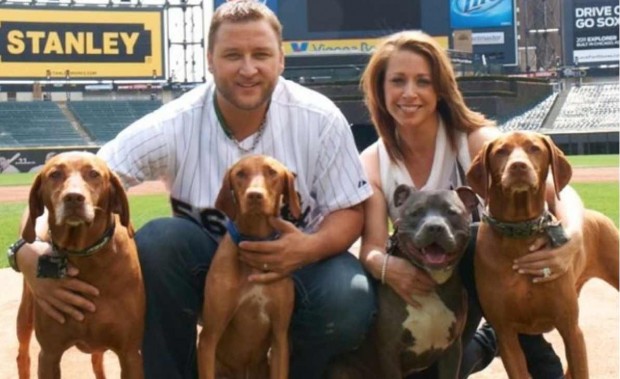
Does one of these nice creatures not belong in this picture? Ontario says yes. The correct answer is  no.

Does one of these nice creatures not belong in this picture? Ontario says yes. The correct answer is no.

Our life-changing events often become crises for our canine companions. In the news today: ethical  and unethical responses in such circumstances, by two individuals in the public eye.

The Unethical

Mindy McReady, the troubled country music star, committed suicide Sunday on the front porch of the home she shared with her boyfriend, who had recently committed suicide there as well. She apparently killed the couple’s dog before taking her own life. McReady’s friends insist that she didn’t kill the dog out of malice, but because she didn’t want to leave the dog alone. Granted, McReady deserves consideration and compassion, since her actions that day were not those dictated by a healthy or fully functioning mind. Still, I read of dog owners doing this a lot, and I’ve known a few—not committing suicide, but killing their dogs when they knew they wouldn’t be able to keep them any more, on the theory that the dog would be happier dead than with new owners. Continue reading


Please Kill My Dog

“The Ethicist,” whom I have not harassed for a while, a.k.a Ariel Kaminer, handles this week an odd query from a woman who has been asked by an elderly friend to pledge to euthanize her dog after she dies. Kaminer, as she often does, makes the issue more complicated than it is and muddles things by implying some kind of inconsistency on the part of pet owners who find the request unethical but who will dine on cooked animal flesh this evening. She even had to consult Peter Singer, the controversial Princeton ethicist, about whether an animal has a “right to life.”

Every living thing has a right to life, and also a right to live, which is why eating other animals as humans have evolved to do is not incontrovertibly  unethical. Killing an animal just because you can, or because it makes you happy, or because you have convinced yourself that it wants to die when in fact it doesn’t, however, is incontrovertibly unethical. Continue reading

PETA’s Definition of Being Ethical to Animals: Kill Them

Good...play dead, and maybe PETA will leave you alone...

I have long believed that PETA, the Norfolk, Virginia-based “People for the Ethical Treatment of Animals,” not only gave ethics a bad name, but also people, and you might as well throw in pita bread while you’re at it. This conviction was partially based on such stunts as PETA’s using Michelle Obama in ads without her permission and offering to pay Octomom money to put a billboard on her lawn comparing herself to an overly fecund pet.

Then there is PETA’s fondness for killing puppies and kittens. Continue reading

Unavoidable Bias in the Embryonic Stem Cell Research Controversy

In the embryonic stem cell research ethics debate, I come out on the “pro” side. Nonetheless, a New York Times article this morning shows clearly how thoroughly and unavoidably biased scientists and researchers in the field are, leading to the conclusion that the decision whether stem cell research is ethical or not, and whether, or to what extent, it should be permitted, cannot be left to them.

The article, by Amy Harmon, begins,

“Rushing to work at Cincinnati Children’s Hospital Medical Center one recent morning, Jason Spence, 33, grabbed a moment during breakfast to type “stem cells” into Google and click for the last 24 hours of news. It is a routine he has performed daily in the six weeks since a Federal District Court ruling put the future of his research in jeopardy. “It’s always at the front of my brain when I wake up,” said Dr. Spence, who has spent four years training to turn stem cells derived from human embryos into pancreatic tissue in the hope of helping diabetes patients. “You have this career plan to do all of this research, and the thought that they could just shut it off is pretty nerve-racking.” Continue reading