Pineda-Pine Tar, Part II: Baseball Clarifies Its Bizarro Ethics Culture

bizarro_world-baseballYou shouldn’t have to appreciate, care about or even understand baseball to find illumination in its latest ethics controversy, which shows how cultures can go horribly wrong, precluding exactly the values that any functioning entity must embrace to remain viable and healthy. For someone like me, to whom Baseball is Life, the whole thing just makes me want to jump out the window.

You will recall that a couple weeks ago, the sport embarrassed itself by making excuses and accepting lies regarding New York Yankees pitcher Michael Pineda being allowed to break the game’s rules against pitchers applying foreign substances (in this case, pine tar) on the baseball while pitching to the Boston Red Sox. I wrote about it here. I interpreted the post-incident consensus of the game and its pundits as “everybody does it, so let’s not make a big deal over a little infraction on a night when it was abnormally cold and hard to grip the ball.”  That’s unethical enough, but the truth, as revealed in Part II, is far worse.

Last night, fate had Pineda on the mound against the Red Sox again. Baseball’s ethics had already begun falling apart in chunks when Sox manager John Farrell, asked about whether he expected Pineda to cheat again (for that is what using pine tar on baseballs is—cheating. Official Rule 8.02 states: “The pitcher shall not apply a foreign substance of any kind to the ball.” ) answered that hopefully, if he did, he would be more discreet about it. Huh?

But Pineda was not discrete; in fact, he could not have been more obvious, or ridiculously so. After a rough first inning in which he gave up two runs, Pineda emerged from the dugout with a large, brown, greasy gob of pine tar on his neck. On TV. In nationally broadcast game. Against the same team that he was caught using pine tar against before. In that team’s home park.

In the Red Sox dugout, Manager Farrell and the team were laughing and rolling their eyes. Farrell finally shrugged, and walked out to complain to the home plate umpire, for it is an automatic ejection for a pitcher to be caught doctoring the ball. The umpire dutifully walked out to the mound—he had to have seen the offending gob before Farrell complained—and to add to the foolishness, checked Pineda’s glove, cap and jock strap before looking at the huge brown smear on his neck. Finally he did so, said, “That’s pine tar!” (in the previous game, Pineda told the press it was “dirt”) and threw him out of the game.

In subsequent interviews with Farrell and others, the explanation that emerged was this gibberish: “everybody” uses something to grip the ball better when it is cold (and often when it isn’t); hitters don’t mind because they don’t want to get hit. Pineda’s offense wasn’t that he used pine tar, but that, as Farrell suggested before the game, that he was “blatant” about it. That gave Farrell no choice, you see….even though his own pitchers also use foreign substances to grip the ball (in unequivocal violation of a baseball rule), and this sets his team up for “retaliation.”

I feel like I’m going crazy. Continue reading
The Abysmal Quality of Ethical Reasoning in Baseball: A Depressing Case Study

"Dirt."

“Dirt.”

The first bona fide ethics controversy of the 2014 baseball season has erupted, and it involves the team of my youth, the Boston Red Sox. It is not the controversy itself that is so noteworthy, for it is an old, old one: pitchers using foreign substances to doctor the balls so they dip, curve, and sing “Take Me Out To The Ball Game.” What is noteworthy is the reaction to the incident by players and the sports media, which has me feeling that as an ethicist, I need to think about following another sport. The ethics reasoning, or lack of it, is truly depressing.

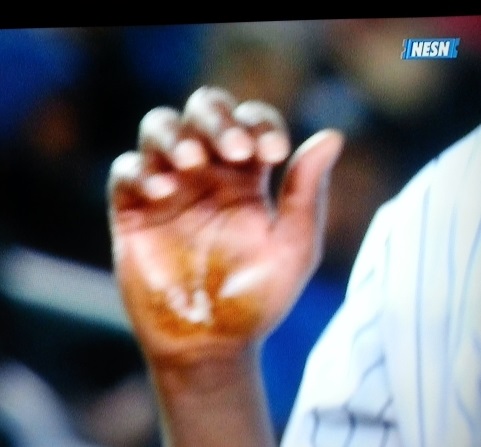
What happened was this: During last night’s Red Sox-Yankee game in Yankee Stadium, the Boston broadcasting team of Don Orsillo and Jerry Remy noticed a glossy brown substance on New York starting pitcher Michael Pineda’s pitching hand. It was very obvious, especially once the NESN cameras started zooming in on it.   “There’s that substance, that absolutely looks like pine tar,” play-by-play man Don Orsillo said. “Yeah, that’s not legal,” color commentator and former player Jerry Remy replied.

Indeed it isn’t.  According to rule 8.02(a)(2), (4) and (5), the pitcher shall not expectorate on the ball, either hand or his glove; apply a foreign substance of any kind to the ball; [or]  deface the ball in any manner.

The Red Sox, who probably knew about the gunk on Pineda’s hand, didn’t complain to the umpires, and just went about their merry way, losing the game. Asked about the stuff on his hand, Pineda demonstrated the full range of body language indicating that he was lying his head off. “It was dirt,’ he said. Later, when the ick appeared to be gone,  Pineda explained, he had just sweated his hand clean. Right. Whatever was on his hand—beef gravy, crankcase oil, chocolate syrup…the majority of pundits think pine tar—it wasn’t “dirt.” Pineda’s manager, Joe Girardi, was brazenly evasive.

The Yankee pitcher was cheating. This isn’t a major scandal, but cheating is cheating: sports shouldn’t allow cheating of any kind, because if a sport allows some cheating, however minor, it will encourage cynical, unscrupulous and unethical individuals on the field, in the stands, and behind keyboard to excuse all other forms of cheating, from corked bats to performance enhancing drugs. Cheating is wrong. Cheating unfairly warps the results of games, and rewards dishonesty rather than skill. Cheating undermines the enjoyment of any game among serious fans who devote energy and passion to it. Any cheating is a form of rigging, a variety of lying.

And yet, this clear instance of cheating, caught on video, primarily sparked the sports commentariat, including most fans, to cite one rationalization and logical fallacy after another to justify doing nothing, and not just doing nothing, but accepting the form of cheating as “part of the game.” I’ve been reading columns and listening to the MLB channel on Sirius-XM and watch the MLB channel on Direct TV since this episode occurred. Here are the reactions, my comments in bold:

  • This isn’t a new phenomenon. Show me the statute of limitations on ongoing misconduct, please. Also not new: torture, rape, adultery, incest, bribery and embezzlement. So what? That makes these things all right? Excuses society from trying to reduce their occurrence?

Continue reading

The Comfort Women Memorial Lawsuit: A “Disgusting” Legal Argument, Perhaps…Unethical, No

The Glendale Comfort Women Memorial

The Glendale Comfort Women Memorial

The large and respected law firm Mayer Brown has taken the ugly case of some Japanese-American clients who want the city of Glendale, California to remove a memorial to World War II “comfort women” from a public park. In doing so, and in the way it is proceeding, the firm has inspired harsh condemnation from two estimable legal commentators, both First Amendment champions: Marc Randazza, and Ken White. Their objections, which caused Randazza to call the firm “the least honorable law firm in the world,”and White to conclude, “This lawsuit is thoroughly contemptible. It should fail, and everyone involved should face severe social consequences,” are heartfelt, but, I think, misguided. Their argument, beside arguing that the lawsuit is frivolous, is best articulated by Randazza: Continue reading

Yes, It’s True: Conservative Warrior Brent Bozell Is The American Mamoru Samuragochi, “The Japanese Beethoven” Who Was Really The Asian Milli Vanilli

This, apparently, is the real L. Brent Bozell.

This, apparently, is the real L. Brent Bozell.

L. Brent Bozell, the outspoken head of the Media Research Center, doesn’t write the syndicated opinion columns that run under his by-line and has not for quite a while. Reporter Jim Romenesko did a little digging, and discovered that the red-headed face of the conservative group, a favorite guest of Fox talk show host Sean Hannity, uses Tim Graham, the MRC’s Director of Media Analysis as his ghostwriter, both for his columns and apparently his recent books as well.

Before the embarrassing deception was exposed, however—-Bozell’s special crusade is exposing and condemning dishonesty in the liberal news media—the company that distributes Bozell’s columns managed to expose its own flawed ethics as well. Confronted with Romenesko’s suspicions, Bozell’s syndicator wrote this response:

“If you know of one of our columnists who supposedly is not writing the column but rather ‘assigning an underling to pen them (an underling who is not credited),’ I think it only fair that you tell us who has been accused of this so we can talk to the columnist. Yes, we expect all of our columnists to write their own columns, though we understand that some work closely with researchers.

Once the evidence appeared too overwhelming to deny (as in “lie away effectively”)—-various Media Research Center employees confirmed that Bozell didn’t write his own copy, with one telling him in surprise, “I thought everyone knew it.”—the defense, predictably, began to evolve into “everybody does it.” Continue reading

The Science Guy, Debating Faith, and the Ethical Duty Not To Engage

creationism

Thanks for nothing, Science Guy.

You know, back when I was in college (stop me if I’ve told this story here before), a call-in show on one of the local TV talk shows (called “Cracker Barrel”)  staged a debate on the existence of God. On the “God exists” side was a religious fanatic named Mrs. Warren who had achieved Boston notoriety by picketing local banks for some reason; my father, in fact, had a confrontation with her in his capacity as a savings bank executive. On the atheist side was none other than Madeline Murray O’Hair, she of the Supreme Court case knocking down school prayer.

The “debate” was idiotic, unfair from the start since Mrs. Warren was a prattling dolt who also spoke in what sounded like a fake Italian accent, like Chico Marx, making it even harder to take her seriously. Mostly it was idiotic, though, because such debates can’t be anything but idiotic—the adversaries are not using the same assumptions, definitions, or modes of analysis. O’Hair would mention a scientific study, and Mrs. Warren would quote the Bible, which had to be true because God dictated it. As will always happen when one is debating a fool, O’Hair was dragged into the depths of stupid argument—and whatever she was, she was not stupid—by recounting that she realized that there was no God when her son was lost on a jungle expedition, and though she prayed for his return, he never came back. After being barely restrained by my roommates from calling into the show and shouting “MOM! I’m back! It’s a miracle!” (for some reason they thought it would be in bad taste), I got a toilet paper roll, put it up to the receiver and called into the show’s call-screener as “Jehovah,”from “Beyond.”

To my amazement, they put me through, and I heard the host cheerily utter the words, “Our next caller is Jehovah. Welcome to Cracker Barrel, Jehovah!” Echoing into my cardboard megaphone in my best Burning Bush voice, I told Madeline that I was the Lord God, and that I appreciated her testing the faith of the righteous with her blasphemy, and that despite the consensus among my archangel advisors in Heaven, I would not turn her into a pillar of salt.” Then the host said, “Thank you for your call, God!” and I was done. O’Hare was laughing.

The much-hyped debate over evolution between Bill Nye, a kids show performer with a legitimate science background, and Ken Ham, an extreme creationist whose views are ridiculous even by creationist standards, was just as foolish as the Cracker Barrel fiasco but far more harmful. Continue reading

Ethics Dunce (Again): Washington Post Columnist Richard Cohen

No danger of an innocent being unjustly executed here...

No danger of an innocent being unjustly executed here, Richard…Now what?

Most Ethics Dunces named on Ethics Alarms are being chided for one, possibly anomalous, instance of ethics cluelessness, but not Richard Cohen. He is a lifetime, career-long ethics dunce. It is noteworthy when he writes something that doesn’t reek of ethics confusion.

Today he is blogging about the death penalty. There are coherent, powerful arguments that have been and can be made against the death penalty, but Cohen doesn’t bother with any of them, which, as a reflex old-school liberal, he should at least know by heart. No, he attacks the decision of Eric Holder to approve his Massachusetts U.S. Attorney’s request to seek the death penalty for Dzhokhar Tsarnaev, the surviving Boston Marathon bomber as “political cowardice using one invalid argument after another, and by the way, curse you, Richard Cohen, for forcing me to defend Attorney General Holder.

Here are Cohen’s “arguments”:

  • The death penalty is a horrible crime on par with Tsarnaev and his brother intentionally killing and maiming innocent spectators of the Boston Marathon. Such an absurd statement carries a high burden of proof, which Cohen doesn’t even attempt to meet.
  • “[The death penalty] is the sine qua non of lack of thought, a medieval tick of the political right, a murder in the name of murder that does absolutely no good, unless it is to validate the killers’ belief in killing.” Ironically, Cohen’s post is the sine qua non of lack of thought. Since the death penalty has been around continuously since well before Medieval times, calling it a medieval tick is about as fair and accurate as calling religion, warfare, and property laws  medieval tics. Of course it does good: the fact that a vicious anti-social murderer is permanently removed from society and no longer uses up resources, space and oxygen that can be better employed in the furtherance of humanity is an absolute good, and that those contemplating similarly heinous acts are on notice that the same fate awaits them is also good. Continue reading

Virginia’s McDonnells, Masters Of Rationalization

Former_Governor_Indicted

The only question regarding the multiple count federal corruption indictment of Virginia’s most recent ex-Governor Bob McDonnell (R) and his wife is whether or not the relevant laws are so porous that they can’t be convicted on the evidence. Did they use McDonnell’s high office for personal enrichment? Yes. Did they go to great lengths to disguise the fact? Yes. Did the Governor betray the public trust? Yes. Were the gifts, loans and cash, totaling at least $165,000, received from a dietary supplements company CEO essentially bribes? Of course they were. This is another excellent example of why the admonition that the accused are innocent until proven guilty is often technical rather than true. Based on irrefutable facts, the Virginia’s former First Couple is guilty as hell—of dishonesty, greed, corruption, obstruction of justice, bribery, betrayal of trust, the appearance of impropriety and outrageously unethical conduct. They just may not have broken any of the laws regulating those actions.

The legal case will ultimately rest on whether there was a specific, provable quid pro quo, which is to say, were the gifts and loans from Jonnie Williams Sr., former CEO of Star Scientific, expressly made in exchange for the governor’s assistance in helping his company in the state? Williams, who has made a deal, will testify that this was his understanding; why else would he allow himself to be used as a piggy bank by McDonnell and his wife? But in politics, as we all know, the myth is otherwise. Big companies give lawmakers big campaign contributions out of the goodness of their hearts and patriotic fervor, and it’s just a coincidence that those same lawmakers subsequently support laws that make those same companies millions, or block laws that would get in their way. It’s a coincidence! The Feds are going to have to show that what McDonnell did was significantly more sleazy than what virtually the entire population of Congress does by reflex, and also a clear violation of law. Continue reading

Fun With Rationalizations: Considering Salon’s Attack On The New York Post

post_cover-620x412

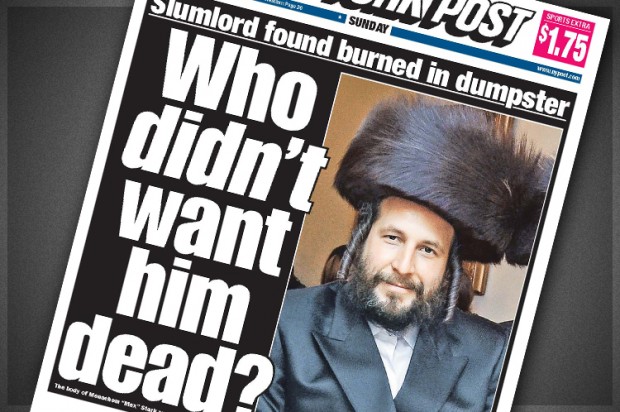
Let me dispense with the outrage over The New York Post’s brilliant (from their perspective, which is selling newspapers) and tasteless front page covering the death of Menachem Stark, a Hasidic real estate developer ( a.k.a. “slumlord”) who was found murdered and burned in a dumpster last Friday in Long Island.

The operative principle is not, as the reader who flagged the issue suggested, the Golden Rule. The Golden Rule does not often apply to the press, which is supposed to be truthful, not kind and diplomatic. There are provisions of most journalistic codes about avoiding unnecessary harm to third parties, which is pretty much a universal ethics rule in every field, from law to the military. When, however, you operate a tabloid, and not just any tabloid but a tabloid whose brand is defined by intentionally shocking, outrageous, assaultive and controversial headlines and photos, “Unnecessary harm to third parties” is almost an impossible principle to apply.

The headline is a perfect example of the Julie Principle, which I explained back in May. The Julie Principle comes into play when an undesirable or annoying  characteristic or behavior pattern in a person or organization appears to be hard-wired and part of their essence.  In judging such a person or entity, it is useful to keep the lyrics of Julie’s song from “Show Boat” (lyrics by Oscar Hammerstein Jr., music by Jerome Kern) firmly in mind, when she sings…

Fish gotta swim, birds gotta fly…

I’ve gotta love that man til I die

Can’t help lovin’ that man of mine!  Continue reading

Ethics Dunce: ESPN Blogger David Schoenfield

...reason is emotion, and emotion is reason...

…reason is emotion, and emotion is reason…

Every year about this time, a large group of baseball writers, not to mention fans, expose their ethics and analytical deficiencies by making terrible arguments for admitting steroid-using stars of note into baseball’s Hall of Fame. The voting for the Hall is going on now, you see, and this year a bumper crop of candidates were either proven steroid users or reasonably suspected of being so.

Also every year at this time, I pick one of those ethically-challenged writers as an Ethics Dunce. This year, the winner is ESPN’s David Schoenfield, by virtue of a sentence near the end of a recent post in support of Frank Thomas and Edgar Martinez, neither of whom are on the Performance Enhancing Drug suspicion list, as Hall of Fame candidates. Schoenfield wrote,

“The PED disagreements are all about emotion (“Cheaters!”) versus reason (“It was part of the game in that era, we don’t know who did what, etc.”).

Talk about a big, fat, hanging curveball over the heart of the plate! Continue reading

And This Is Why The Obama Administration Will Not (And Should Not) Regain America’s Trust

Hmmm..what possibly could account for this?

Hmmm..what possibly could account for this?

Consistent in their cynical view of human nature, their disdain for the intelligence of the American public and their refusal to believe the wisdom of Abraham Lincoln, officials in the Obama administration, we are told, are confident that the President’s poll numbers will rise and he will once again be believed and trusted. I’m sure President Obama believes the same thing. They are very wrong.

From today’s Washington Post:

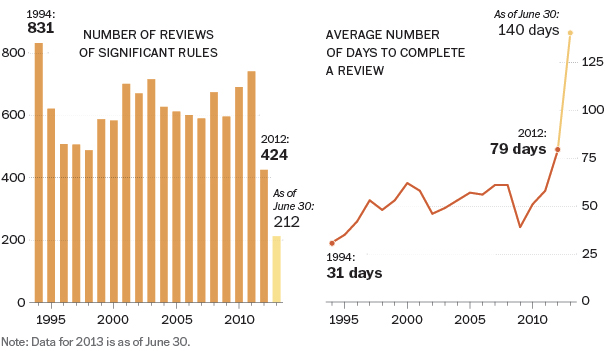
“The White House systematically delayed enacting a series of rules on the environment, worker safety and health care to prevent them from becoming points of contention before the 2012 election, according to documents and interviews with current and former administration officials.Some agency officials were instructed to hold off submitting proposals to the White House for up to a year to ensure that they would not be issued before voters went to the polls, the current and former officials said.The delays meant that rules were postponed or never issued. The stalled regulations included crucial elements of the Affordable Care Act, what bodies of water deserved federal protection, pollution controls for industrial boilers and limits on dangerous silica exposure in the workplace.The Obama administration has repeatedly said that any delays until after the election were coincidental and that such decisions were made without regard to politics. But seven current and former administration officials told The Washington Post that the motives behind many of the delays were clearly political, as Obama’s top aides focused on avoiding controversy before his reelection.” Continue reading