Unethical Quote of the Week: W.G. Hamm

“What I know about Lance Armstrong is that he inspired thousands of cancer victims and made their lives better. What I know about Mr. Armstrong is that when my wife and my son were both suffering from cancer, his story and his book helped them cope with their diseases. What I know about Mr. Armstrong is that the good that he did far outweighs the fact that he was trapped in a culture of drug use within the cycling fraternity. What I know about Mr. Armstrong is that he has been needlessly demonized by people who do not realize the balance between his good deeds and his bad deeds.”

—-W. G. Hamm, in his Letter to the Editor of the Washington Post. Hamm was praising a fatuous, rationalization-riddled  column by Post sportswriter Sally Jenkins in which she catalogued and endorsed every excuse and justification trotted out by Armstrong’s enablers and defenders.

would have loved Vlad.

W. G. would have loved Vlad.

I don’t know W.G. Hamm. I’m sure he’s the salt of the earth, and a part of me is queasy about picking on his letter praising Jenkins’ ridiculous column rather than tackling the truly ethically offensive and brain-dead column itself. One reason is that I have written extensively, frequently and recently about the arguments, if you can call them that, made by Jenkins. Her column really is spectacularly bad; here’s one passage that send me to the bathroom, for example:

“Maybe I’m not angry at Lance because for two decades now I’ve had serious questions about the wisdom and fairness of the “anti-doping” effort, which consists of criminalizing and demonizing athletes for what boils down to using medications without a prescription.”

No, it boils down to using medications without a prescription and using them to cheat in athletic contests for money and fame, while defrauding the public, you silly, dishonest woman. Continue reading

Ethics Quiz: What Rationalization Is This?

A gang of Washington, D.C. rocks, plotting an attack on city buses.

A gang of Washington, D.C. rocks, plotting an attack on city buses.

If living near the District of Columbia doesn’t transform you into a right-wing nut, it’s probably because you quickly learned not to read the columns in the Washington Post Metro Section. There refugees from the darkest, looniest corners of the Sixties have held sway for about fifty years, making illogical, emotional, angry and reliably leftist arguments, often in semi-literate form. The Post obviously believes, with good reason, that these would embarrass the paper if they were allowed to invade the Op-Ed Page, so they are buried in the middle of the paper.

The Post has a passel  of these writers, who only occasionally venture into the land of the fair and reasonable. About 30% of the time, their creative output is devoted to race-baiting. I decided decades ago that my sanity and political equilibrium depended on my ignoring these daily sanity-bombs, way back in the days when a community-revered wacko named Dorothy Gilliam regularly defied logic in her 700 word rants. I now only learn about the most absurd of these columns only when a Post letter-writer flags one of them as particularly mind-blowing.

Coutland Milloy has been the main offender on the Post’s Metro page since Gilliam retired to the Big Angry Leftist Padded Room in the Sky, and he was in top form last week, when he addressed the recent problem of city buses being pelted with stones in some of the poorer areas in D.C. Read his piece if you dare: his basic premise was that it is significant that at a public hearing about the problem, nobody “spoke up for the kids” or discussed “why” the rocks were being thrown. You don’t really have to read the essay to guess its larger thesis: the areas are poor, city resources are misaligned, gentrification is breaking up neighborhoods, kids are frustrated, so it’s not the kids fault that they are attacking Metro buses. In the printed version of the Post, his column was titled “Don’t Pin the Rock Problem On The Kids.” Continue reading

Presenting Rationalizations 28-31: The Altruistic Switcheroo, The Prospective Repeal, The Troublesome Luxury, and The Unethical Role Model

The Ethics Alarms list of rationalizations—the lies and fallacies we seduce ourselves with to make unethical conduct seem reasonable— continues to grow. Here are some worthy additions, bringing the current total to 31. I doubt that we have them all captured yet…not by a longshot.

28. The Altruistic Switcheroo: “It’s for his own good” – This rationalization is a pip, because it allows one to frame self-serving, unethical conduct as an act of good will and generosity. Cheating the young sprout will teach him to be more careful the next time, and it’s just a pleasant coincidence that you benefit from the deception. It is true that misfortune carries many life lessons, that what doesn’t kill us often makes us stronger, and that what hurts today may be the source of valuable wisdom and perspective later, but it really takes a lot of gall to cheat, lie to, steal from or otherwise harm someone else and claim it will be a good thing in the long term. Yet an amazingly large number of people possess this much gall, because the Altruistic Switcheroo is very popular, especially among parents who want to convince themselves that bad parenting is really the opposite. A marker for this rationalization is the statement, “You’ll thank me some day”—the specious theory of the sadistic parent who named his son “Sue” in the famous Shel Silverstein song made famous by Johnny Cash. No, he won’t. Continue reading

The Obama Campaign’s Ungracious Character

Poor choice of role model, Mr. President.

Consider these post-debate quotes from various key figures in the Obama campaign:

” The President did a good job explaining his positions, but give credit where credit is due. Governor Romney had a great night. He was focused and clear, and obviously connected with the audience. He’s a capable adversary, as we always knew. President Obama can and will equal and surpass his performance in the coming debates.”—David Axelrod

” Governor Romney proved himself to be a formidable debater, and the President will have to be more aggressive in countering his arguments, which he certainly has the ability and the ammunition to do.”—Stephanie Cutter

“I didn’t feel I had a poor debate, but I obviously need to have better ones. Sometimes the other guy just beats you, and you have to accept that, tip your hat, and win the next time.”—President Obama

If you haven’t seen these respectful, gracious quotes, all typical of the comments of past candidates and their staff after debate performances that were seen as falling short of their opponents’, there’s a reason. Nobody on the Democratic side, including Obama himself, nor most of the media pundits except those who would be fairly classified as conservative, have been willing to give Mitt Romney any recognition for a well planned, well-executed, professional and compelling debate. “What happened?” Diane Sawyer asked the President. “I had a bad night,” he replied. Romney, you see, had nothing to do with it. Continue reading

Introducing the Jumbo Award and Its First Recipient: John Mark Heurlin, Esquire.

Today Ethics Alarms is launching a new category, the Jumbo Award. The Jumbo is named after the famous moment in the 1935 musical (and 1962 movie adaptation)“Jumbo” in which a clown, played in both by the sublime Jimmy Durante, is trying to sneak the largest elephant in the world out of the circus, which has been seized by creditors.  A sheriff intercepts the would-be elephant-napper, and demands, “Where do you think you are going with that elephant?” To which Durante’s character replies innocently, as if the pachyderm at the end of the rope in his hand is invisible, “Elephant? What elephant?”

Henceforth, the Jumbo will be periodically awarded to an ethical miscreant who continues to try to brass his or her way out of an obvious act of ethical misconduct when caught red-handed and there is no hope of ducking the consequences. And the first recipient is faux lawyer John Mark Huerlin.

Huerlin was suspended from the practice of law, yet was caught representing himself as a lawyer in several ways, which you cannot do while you are suspended. To do so is an ethical violation in itself—dishonest, defiance of the bar, and the unauthorized practice of law. Nonetheless, he used a letterhead that referred to the “Law Offices of John M. Heurlin” and an email address that read “JheurlinLaw@Netscape.net.” But the real kicker was that Heurlin held himself out as an attorney in litigation on his own behalf, by following his name with “Esquire” on court pleadings.

Huerlin told the bar that he could explain everything. Esquire means that I’m a lawyer in good standing? My goodness! This is all a big misunderstanding, then. I didn’t use “Esquire” to indicate that I was a lawyer. I thought “Esquire” just meant that I was a subscriber to the magazine, Esquire!

Now either disbarred or soon to be, Mr. Huerlin is officially authorized to replace that confusing reference to his reading habits with a new suffix, so he can present himself as John Mark Huerlin, Jumbo.

_______________________________

Facts: ABA Journal

Graphic: Abracadabra

Ethics Alarms attempts to give proper attribution and credit to all sources of facts, analysis and other assistance that go into its blog posts. If you are aware of one I missed, or believe your own work was used in any way without proper attribution, please contact me, Jack Marshall, at  jamproethics@verizon.net.


Conservatives Take Note: Media Bias Doesn’t Explain Everything

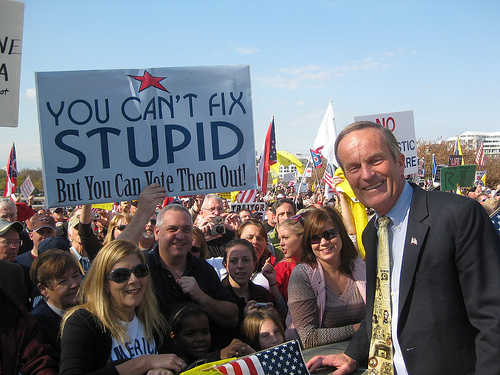
Rep. Akin and his fans.

Pervasive media bias against them has the added affect of making Republicans and conservatives both paranoid and less likely to perceive their own flaws. In this it is like racism: that black Americans know that elements of society refuse to treat them fairly makes it difficult for them to assess their own accountability when they fail. Given the opportunity to blame failure on ourselves or others, most of us are inclined to choose the latter: psychologists call it the fundamental attribution error. That tendency, however, undermines our ability to evaluate areas where we need to improve, and to improve them.

The news media’s leftward bias warps public opinion, tilts elections and distorts public policy. A few candid  journalists acknowledge this, like ABC’s Jake Tapper, who opined to Laura Ingraham yesterday that the media “helped tilt the scales” against Hillary and John McCain in 2008, saying that “Sometimes I saw with story selection, magazine covers, photos picked, [the] campaign narrative, that it wasn’t always the fairest coverage.” Weasel words for unethical media bias, true, but for a member in good standing of the liberal Beltway media like Tapper, an admirable confession. This is justly frustrating to conservatives, but they can’t let it drive them stupid, for this is the Catch 22 of all pervasive bias. If a group blames everything on bias, it begins to make the bias look justified.

Hypervocal, a snazzy blog that delves into such matters and much else, has an excellent analysis of a current example of this phenomenon, as conservatives complain that the news media is ignoring a juicy Minnesota scandal involving a gay Democrat while overplaying Rep. Todd Akin’s self-outing as an ignorant fool regarding rape, abortion, and female biology. This is such a regular refrain now any time an embarrassing event occurs involving a Republican that it is both predictable and laughable, and it is always unseemly. Continue reading

Comment of the Day: “How To Raise An Irresponsible and Dangerous Child”

“I know my precious angel crashed her car, but it’s her own fault: she left the keys in it!”

Michael, who is the reigning champ in the Comment of the Day Division, scores another with this comment, a rebuttal of ampersand’s plea that a mother’s efforts to deflect blame from her joy-riding teenager, now in a coma after causing a high speed police chase and an accident that closed down a major highway, shouldn’t be held against her. “The mother’s statement was stupid,” ampersand wrote, “but… if there’s any time when we should refrain from attacking people for saying stupid, regrettable things, it’s right after their 14 year old son has been in a terrible, tragic car accident. I don’t think it’s unreasonable to give this woman the benefit of the doubt, and suppose that how she acts on the worst day of her life might not be a representative sample of how she generally acts.”  I’m generally in favor of the benefit of the doubt, although I personally doubt whether any responsible parent would try to blame joy-riding on the owner of the car her son stole, or would try to minimize the offense by suggesting that “maybe he wanted to go farther than he felt like walking.”  I cannot imagine any tragedy that would have made my parents say something that absurd.  Still, I acknowledged that the context of the mother’s comments should be taken into consideration. Michael was tougher, and makes a powerful case that he should be. Here is his Comment of the Day on the post How To Raise An Irresponsible and Dangerous Child.

“I think ampersand is exactly wrong. So much that is wrong and wasteful is done because of this kind of sentiment. She should be confronted about this, because the alternative is to go along with it. She said it, it was published. It must be refuted. Not refuting it, publicly, leads to this being considered a valid opinion. Considering this a valid opinion means possibly arresting and convicting the owner’s boyfriend. It also means that it is OK to “borrow” someone’s car (however you have to) if you are tired of walking.

“Some examples of what happens when you go along with it because you don’t want to confront someone who has suffered the loss or injury of their child: Continue reading

How To Raise An Irresponsible and Dangerous Child

After a 14-year old Pennsylvania lad stole Jeep Grand Cherokee and led police on a high-speed chase that ended with him clipping another vehicle and causing a crash that closed the highway and left the boy in a coma, his mother told reporters that her son wasn’t the only one to blame for the accident.

“I’m not downplaying my son’s role in taking something that didn’t belong to him, but I am saying they actually left their keys in the car and the vehicle could have been taken by anybody,” she said. The mother, who has not been identified in press accounts because, I guess, her son is a minor and some people think that teenagers who steal cars, defy police and endanger lives should have their identities shielded (not me!), also found fault with the Jeep’s owners boyfriend, who followed the vehicle after the kid started driving it away: Continue reading

Unethical Quote of the Week (Trayvon Martin-George Zimmerman Ethics Train Wreck Division): George Zimmerman

“I feel like it was all God’s plan…I do wish there was something, anything I could have done that wouldn’t have put me in a position where I would have had to take a life.” 

—–George Zimmerman, shooter of Trayvon Martin, now facing charges of second degree murder, in an interview this week with Sean Hannity on Fox News

In the sage and concise words of frequent commenter and Ethics Alarms critic tgt, who brought this quote to my attention ( the idiocy of a murder defendant submitting to a televised interview was too much for me, and I could not bear to watch it):

“Whether it was murder or self defense, don’t pretend you were just a bystander in the process. You absolutely could have done other things. If you think you made the right choices, defend them. Don’t pretend they were out of your hands.”

And the ethics train wreck rolls on…

______________________________________________________

Pointer: tgt

Facts: Orlando Sentinel

Graphic: Without a Peer

Ethics Alarms attempts to give proper attribution and credit to all sources of facts, analysis and other assistance that go into its blog posts. If you are aware of one I missed, or believe your own work was used in any way without proper attribution, please contact me, Jack Marshall, at  jamproethics@verizon.net.


Comment of the Day: “Comment of the Day on ‘Young, Gullible, Lazy, Unimaginative and Unbelievable: I Wonder Why This Lawyer Has Trouble Finding A Job?'”

I couldn’t resist this one.

The thread on my post about an Occupy Wall Street protester who apparently was a law school grad and who held a hand-lettered sign blaming his failure to find work, not on the fact that he was standing around in a park holding a sign, but on his law school, has uncovered some unpleasant truths, such as…

  • Law schools are giving degrees to a lot of people who don’t know what to do with them
  • A lot of law school grads have not acquired some of the basic skills, like unbiased analysis, that their training was supposed to convey
  • A striking number of law school graduates identify with whiny unemployed 20-lear-olds holding signs
  • Too many people want to be lawyers for the money, rather than to serve a higher social function
  • Personal accountability is on the wane in America
  • People will believe the damnedest things if it will prevent them from accepting responsibility for their own plight, and
  • Confirmation bias is a frightening phenomenon.

Embodying many of these qualities was the recent post of someone with the apparently ethnic name of Iwantoremainanonymous-–Indian, perhaps?—who  had many observations typical of the thread that I unfortunately cannot permit to be posted, because he not only defied  the Ethics Alarms no anonymous comments rule, but, in his wealth of legal knowledge, disputes that I even have the right to make such rules.

Here is his jaw-dropping, incomplete Comment of the Day on “Comment of the Day on ‘Young, Gullible, Lazy, Unimaginative and Unbelievable: I Wonder Why This Lawyer Has Trouble Finding A Job?'”: Continue reading