Test: Which Teacher Do You Trust Least?

Your challenge: Rank from “Most Untrustworthy” to “Least Untrustworthy”  the following unethical teachers, all the subjects of news stories over the past 30 days:

The candidates:

A. Jack Conkling, a high school social studies teacher in Buhler, Kansas, who began a rant this on his Facebook page like this:

“All this talk in the news about gay marriage recently has finally driven me to write. Gay marriage is wrong because homosexuality is wrong. The Bible clearly states it is sin. Now I do not claim it to be a sin any worse than other sins. It ranks in God’s eyes the same as murder, lying, stealing, or cheating…”

Yes, he had students among his Facebook friends, who made sure everyone in the school was aware of Conkling’s views. Continue reading

More School Bullying…As In Schools Bullying Students

What the hell kept you?

From an ACLU complaint recently filed in the Northern District of Indiana:

“The plaintiffs in this case are all 14-year-old girls, proceeding by their initials, who were previously enrolled as eighth graders at Griffith Middle School, which is operated by Griffith Public Schools. In late January, they engaged in a lengthy conversation on http:// http://www.facebook.com-through the comments section of one of their personal pages after school from their personal computers. This conversation spanned numerous subjects, from the pain of cutting oneself while shaving to the girls’ friendship, before turning to a discussion of which of their classmates they would kill if they had the chance. At all times, the conversation was purely in jest and could not have been interpreted seriously, as is evidenced by the girls’ repeated use of “emoticons,” by their use of abbreviations indicative of humor, and by the nature and tone of the conversation. The girls were simply engaged in teenage banter.Nonetheless, on January 26, 2012, all three (3) girls were suspended from school for ten (10) days as a result of this conversation, and they were ultimately expelled for the remainder of their eighth grade year. This disciplinary action occurred because they had supposedly violated a provision of the student handbook prohibiting bullying, harassment, and intimidation, even though no statement in the conversation-nor the conversation as a whole–constituted a “true threat.” Additionally, the conversation did not cause any disruption to the educational environment or to school activities, nor was it foreseeable that it would.”

Glory be and Halleluiah! Continue reading

Unappreciated Ethics Hero: Facebook? Oh, Yes!

Unlike more primitive methods of mind control, Facebook is painless!

I think perhaps we have not been giving Facebook its due, and now, as the social networking monster is still reeling from its botched IPO, is a good time to right that wrong. We’ve been looking so hard at Facebook’s privacy settings, dadta collection, layouts and pointless games that we’ve missed the most important feature of it—magic. Like Wonder Woman’s golden lasso, but  a really, really big one, Facebook magically persuades people to not only tell the truth about the rotten things they are doing (like going dancing or golfing after persuading an employer to pay them disability because they are permanently unable to work), will do (like planning, in advance of the hearing the evidence, to vote guilty on a jury) or did (we’re getting to that), but to tell it to millions of people, potentially, so that they get punished.  Facebook’s power to compel confessions causes users to post videos or photographs of themselves in the process of doing incriminating things, so they can be then used as evidence in court. You have to admit, this is a wonderful thing. I don’t know how Mark Zuckerberg and his pals figured out how to do it, or what book of spells they stumbled across at Harvard, but they have performed a boon for humanity, and we ought to stop giving them grief.

Take the case of Michael Ruse, a charming Brit standing trial, accused of helping a friend beat up his father using a baseball bat. Micheal’s trial was going well for him, until Facebook took over his mind, such as it is, and flooded it with virtue. Suddenly, he was sending out a the message to his friends—and everyone else, for it was a public message—that he thought he would “get away with it.” An anonymous observer of the post—it could have been Wonder Woman, come to think of it, or at least Linda Carter— printed it his incriminating words and brought them to the court’s attention.

Under the advice of his barrister, Ruse changed his plea to guilty. The judge was not impressed, telling Ruse, “You pleaded guilty part way through the trial only really because you were stupid enough to put on Facebook what amounted to a full confession.” Well, yes, but as usual, he’s not giving Facebook credit for its uncanny ability to compel the truth. (Ruse’s lawyer replied to the judge, “He needs help with regards to thinking skills.” Perhaps. )

Ruse was  sentenced to 46 weeks in jail, another example of justice through Facebook magic. But apparently Zuckerberg’s magic lasso isn’t finished with him yet, for after sentencing Ruse got back on his Facebook account and insulted the judge.

Thank you, Facebook!

________________________________________

Pointer: Fark

Facts: Gawker

Graphic: Mind Control Blog

Ethics Alarms attempts to give proper attribution and credit to all sources of facts, analysis and other assistance that go into its blog posts. If you are aware of one I missed, or believe your own work was used in any way without proper attribution, please contact me, Jack Marshall, at  jamproethics@verizon.net.

The Schizo Principal’s Facebook Dilemma

Principal Losos, a.k.a Suzy Harriston. Don’t ever call  her “Sooz”.

In Clayton, Missouri, the high school principal has resigned after being outed as a fake student on Facebook. Posing as Clayton High student Suzy Harriston, Principal Louise Losos amassed over 300 student friends from her school, until a former student pierced her false identity and urged everyone to de-friend it. Poor, fictional Suzy vanished, and shortly afterward so did Louise, who was placed on a leave of absence. Now she has resigned.

Can anyone think of a good reason why Losos should not have lost her job? In addition to being creepy, her posing as a student was a lie, and hardly proper conduct for the head of a school, a role model, and an ethical exemplar. If she were investigating a murder, or a series of unexplained thefts, or a suspected Al Qaeda cell working out of the Science Club, she might have some ammunition on her side, but the only use she seems to have put Suzy to was building student support for a friend of hers, a physical education teacher, whose job was in jeopardy.

There was one note in the Yahoo! report that complicates the analysis: Continue reading

A Facebook Suicide and the Duty To Rescue

One takeaway from Claire Lin's death: it's a good idea to have Facebook friends with character.

In Taiwan, a distraught young woman sent streaming photos* of her suicide attempt as she conversed with nine Facebook friends. Some urged her to stop, but none tried to contact police or rescue professionals as she asphyxiated herself with burning charcoal fumes. Yes, her attempt was successful. You can read the disturbing story of Claire Lin’s Facebook suicide here.

Would this happen in America? I wouldn’t be surprised. Sociologists are already weighing in with opinions about the isolation of social media and how the internet makes reality seem less real. I doubt that any of that was especially important in this incident. There have been so many other examples of people left to die with potential rescuers aplenty that were documented on Ethics Alarms and elsewhere, from the Mount Everest climbers who walked past their dying companion, to the more recent case of the Apple store employees who listened to a women get beaten to death in Maryland, that teach us that too many people have the natural inclination not to take affirmative action to help another in distress, and that the instinctive rescuers are the exception, not the rule.

Our culture should teach and reinforce the shared societal duty to come to the assistance of others in peril, but in fact it teaches the opposite. Most of us are told to mind our own business, to think of “Number One”, and  make reverse Golden Rule calculations to rationalize inaction (“He wouldn’t have lifted a finger to help me!”) We are taught to fear lawsuits, to wait for professionals (even if they aren’t coming), and to be fearful of making a bad situation worse. And, of course, we are conditioned to let the other person take the risk, so we can have our cake (not get involved) and eat it too ( see the situation resolved without anyone being harmed). And if we wait just a bit too long for that other person to do the right thing, we can always blame him (or her), saying, “I thought someone else would do it!” Continue reading

Easy Call: Employers Asking For Facebook Passwords? It’s Unethical. So Let’s Stop It.

Ethics Alarms’ predecessor, The Ethics Scoreboard, had a feature known as “Easy Calls,” where I would render periodic ethics verdicts I thought should be obvious. Today’s talk radio and blogosphere sensation, the report that asking for a job applicant’s Facebook password is becoming a common practice of employers, is a classic easy call. And like a lot of those on the Scoreboard, an amazing number of people are getting this easy call wrong anyway.

For example, I heard lawyer-radio talk-show host Laura Ingraham today mock complaints about the practice, saying it was a legal request. Sure, it’s legal. It is still wrong, an indefensible incursion of personal privacy. “You are always free to look for a job somewhere else,” Ingraham says, as if that makes everything fine. Being free to reject an unfair and coercive job requirement doesn’t make it any less unethical. Law professor Orrin Kerr says that the Facebook demand is in the same league as demanding a job applicant’s house keys. Let’s see, what else could a prospective employer ask? Continue reading

Well THAT Didn’t Take Long: The Next Step in School Censorship of Student Speech

Huh. You know, I just didn't think it would come from the schools! Well, live and learn...

Ethics Alarms has been steadfast in its position from the very first reports of schools presuming to punish students for what they post online, in their own time, in their own homes. That position is, and will forever be, that this is a gross abuse of power that must not be tolerated, much less encouraged. Every time I have written about this, there have been defenders of the practice. This story, from Minnesota, should convince them of how wrong they are. Continue reading

Taking A Stand On Privacy, As Ethics Alarms Go Silent

"Oh, all right---as long as I get that job."

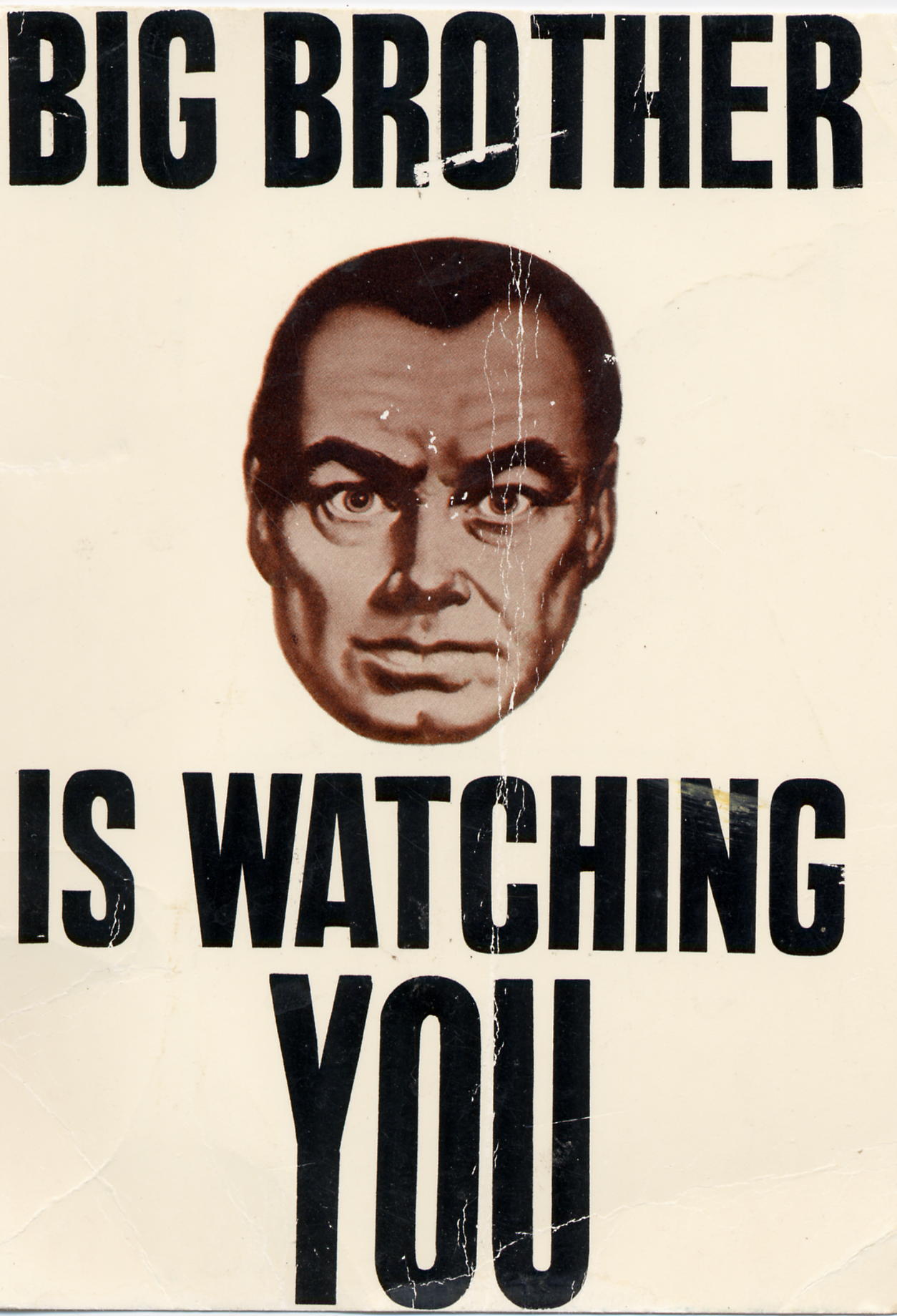
The cultural consensus on the boundaries of personal privacy are eroding more quickly than I imagined. There are a lot of reasons for this: the intrusions of technology, increased government intrusiveness as part of anti-terror measures, utilitarian calculations that conclude that privacy should be sacrificed for supposedly more worthy objectives, like preventing bullying, or discouraging sexism and anti-gay attitudes. Whatever the reasons, it is crucial that society puts the brakes on, hard, or George Orwell’s nightmare will arrive remarkably intact, just a few decades late.

A stunning report on the MSNBC blog Red Tape reveals that some state agencies are routinely requiring job applicants, as a condition of employment, to provide full access to their social networking accounts so their otherwise private communications can be monitored. Equally disturbing, college athletes at many colleges are being required to “friend” a coach or other university personnel, who can keep tabs on what the student is posting. From the University of North Carolina handbook: Continue reading

Facebook’s Weird Ethical Standards

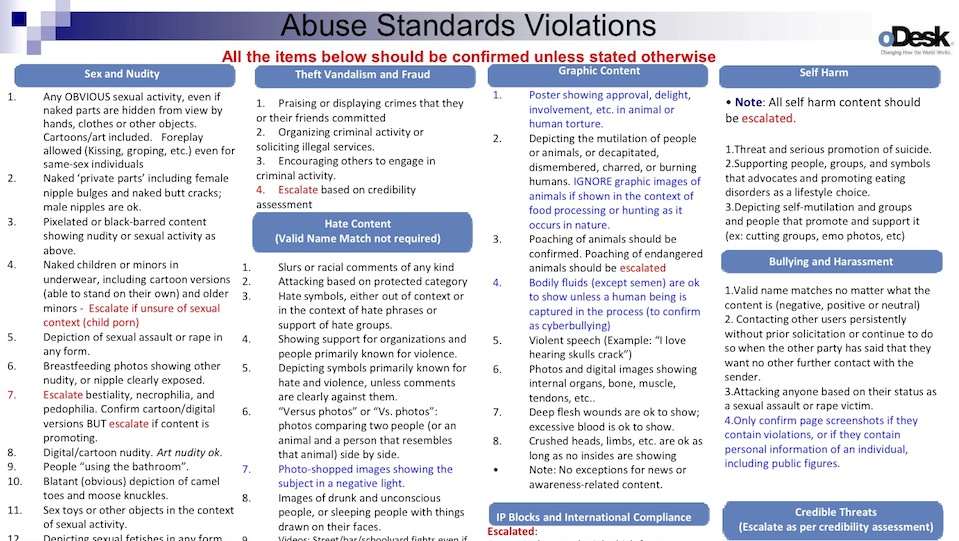
I know, they're too small to read. Never mind; they also don't make any sense

The idea of Gawker, a website that shares the ethical standards of the seamier denizens of “Rick’s” in “Casablanca,” doing a legitimate ethics expose gives me a brain cramp, but the gossip site has given a platform to a Facebook whistleblower, sort of.

I say “sort of,” because knowing Gawker, I wouldn’t be surprised to learn that he was paid to rat out his former employers-once-removed (he was hired by  Facebook’s outsourcing firm that handled his training—oDesk), making him ethically less of a whistleblower than a candidate for Gawker’s editorial board. The argument, I suppose, would be that a dollar an hour, which is what Gawker’s source says was his princely reward for doing Facebook’s dirty work, shouldn’t buy much loyalty and confidentiality, if any. Ethically, that’s false: you are obligated to abide by the terms of bad deals if you voluntarily agree to them. Practically speaking, it is true. A worker a company exploits is likely to harbor more animus than good will, and it isn’t the happy workers who blow whistles. Fine: neither Gawker’s source nor Gawker are ethically admirable. On to Facebook.

The whistleblower is Amine Derkaoui, a 21-year-old Moroccan who was recruited by an outsourcing firm to screen illicit Facebook content. This is what he was paid a dollar an hour for, which, when one considers the news reports flying around recently about how rich Mark Zuckerberg is, and after the company filed its record $100 billion IPO, seems unequivocally exploitive. His real exposé, however, involves what he was paid to do, which was to be Facebook’s censor. Derkaoui supplied Gawker with a bootleg copy of part of Facebook’s abuse standards, which lays out what the company believes is appropriate and what it believes should be banned from the web. Thus it is Facebook’s morality, revealing the ethical standards that the company embraces. Continue reading

A “Naked Teacher Principle” Spin-Off: “The Case of the Naked Football Coach”

If it's any consolation, Coach Withee, George Costanza sends his sympathies.

With the notable exception of the high school art teacher who moonlighted on the web as an artist that painted pictures using his butt and genitals while wearing a paper bag over his head, most victims of the “Naked Teacher Principle”(TNTP for short) have been females.  [You can read the initial exposition of the principle here. “To put it in the simplest possible terms, a responsible high school teacher has a duty to take reasonable care that her students do not see her in the nude. It’s not too much to ask.”] This time, however, the naked teacher was not only male but the football coach. And, as the merciless Principle demands, he’s out of a job. Continue reading