Ethics and “Casey At The Bat”

casey-at-the-bat-1888-granger

Today is the 125th anniversary of the publication of “Casey at the Bat,” arguably the most popular and famous of American poems, the creation of humorist Ernest L. Thayer in 1888.

The poem carries many  lessons relevant to ethics and life within its tale of the hometown hero who fails spectacularly just when heroics are most needed and anticipated, such as…

  • Don’t promise what you cannot be sure of delivering.
  • Good faith failure isn’t unethical, a sin or a crime, but it still carries with it the need for someone to accept responsibility for it.
  • The focus of disaster is always on the last individual who might have prevented it, but that is neither fair nor logical. The Mudville Nine lost the game, not Casey.
  • Expecting miracles, last-minute rescues, heroic intervention and infallible rescuers is foolish and irresponsible.
  • Respect your adversaries, for your own sake as well as theirs.
  • “Pride goeth before a fall.”

Today, however, I am struck by how neatly the poem reminds us that in baseball there is no spin, no rock to hide under and no Fifth Amendment to claim. When a player fails, or makes a mistake, or misbehaves, it is usually all out on the field, watched in person by thousands, seen on TV by millions, and recorded forever. There is usually no way to deny or hide responsibility, and indeed part of the professionalism of baseball is accepting that, facing the media and the public, and saying, “That was on me. I failed. I’ll do better next time.”

Most of the time, that’s all the crowd asks after failure. Honesty and accountability.

As long as Casey doesn’t keep striking out, that is.

Here’s the poem, recited by the now-forgotten Bob Hope sidekick Jerry Colonna, he of the rolling eyes:

________________________________________

Spark: Craig Calcaterra

Graphic: Fine Art America

Ethics Dunces: America’s Leaders…Or, If You Prefer, “Happy New Year! We’re Doomed!”

falling

UPDATE: 1/1/ 13  At the last possible moment —indeed, after the official deadline had past— a bi-partisan deal temporarily averting the worst effects of the fiscal cliff was achieved. The details of the compromise are here. But nothing I see in it would cause me to change any of the conclusions I reach below. It seems that the fiscal can was kicked down the road once again, for our craven leaders avoided doing their jobs:  dealing with the debt ceiling, reigning inexcessive government spending, and fixing a dysfunctional budget process. As the Washington Post stated on its front page today:

“The “fiscal cliff” was designed by Washington for Washington — it was intended to set up a scenario so severe that the president and Congress would, at last, have to take on the nation’s major tax and spending problems. Instead, lawmakers again found a way to sidestep many of the prickliest issues and in the process set up other, potentially more severe, showdowns in the new year.”

Additional taxes go into effect (supposedly an additional 600 billion over the next decade—a drop in the bucket), but no serious cuts in spending will be made, and the net effect is simply to delay considering responsible fiscal reforms until the next crisis. Our weak and feckless national leaders were minimally effective to the extent that they managed to avoid the worst possible result, looking as bad as possible in the process, waiting until the clock had run out. Do you find that encouraging, impressive and promising? I don’t.

It is disgusting.

_____________________________________________________________

The failure of America’s elected leaders to avert the so-called “fiscal cliff,” an artificial deadline that they set for themselves the last time they proved incapable of being fiscally and legislatively responsible, is frightening and dismaying proof of their utter incompetence, irresponsibility and cowardice.

While the worst condemnation ought to fall on the President, as he is in the highest office and thus bears the most responsibility when the government fails, the easiest way to spot partisan and biased individuals from now on will be to note those who claim that one party or one branch of government is more blameworthy than the other. I don’t want to hear it. All sides and interests had a duty to the nation, and they all failed us.

Recall that all of this begins and ends with the imperative of reducing the deficit in future years and beginning to pay  down the unsustainable debt. Neither party, nor President Obama, nor the Senate (which has not passed a budget in years), nor the Republican-controlled Congress, have been honest or realistic about the crucial and pressing need to reduce spending significantly (which requires reforming so-called entitlements, as well as other painful cuts) and to increase revenue through increased tax rates and reduced tax deductions. By their irresponsible and utterly stupid bungling of this escalating crisis, they have embarrassed the nation, weakened its defense, undermined its economy, risked the welfare of hard-working and vulnerable citizens, endangered the world and placed the future of the nation in peril.

It is unforgivable. Sharing the shame in this display of complete leadership incompetence are such culprits as the national media, which allowed both parties to avoid the topic of how sequestration would be averted through the entire election cycle; government watchdog groups, which made nary a peep as two years passed with the “cliff” looming, and  Congress wasted its time passing show-bills to thrill its most radical constituency, while the President campaigned and fiddled; and the unengaged, naive and polarized public, who have sent the message that there will be no consequences of a jointly-managed fiasco that threatens to crush generations to come…their children. A great job all ’round, Americans.

We enter 2013 with the permanent decline of the great American experiment evolving from a possibility to a probability, because, arguably for the first time in its history, the United States wasn’t lucky. This time, when the nation needed visionary, talented, courageous and bold leaders to address an epic crisis, there was nobody there but cowards, hacks, pygmies, narcissists, petty partisans and amateurs.

Happy New Year.


___________________________________

Graphic: According to Jewels

Thanking Dick Williams…Finally

The late Dick Williams, doing what great leaders do

If you are not a baseball fan, or under the age of thirty, you probably never heard of Hall of Fame manager Dick Williams, who died yesterday at the age of 84. I never met Williams myself, but I have been indebted to him for four decades. I never told him the immense difference he made in my life, just by doing his job.

In the winter of 1967, I was a devoted fan of my home town team, the Boston Red Sox, and had been since 1962.  Over that period I had listened to every single baseball game on my transistor radio when a game wasn’t on TV, which was most of the time, or when I wasn’t at the game, which was almost always the case. I was the only person I knew who followed the team, and for good reason: it was torture. The Red Sox were hopelessly mediocre on the way to awful, and hadn’t had a winning season in more than ten years.

It is a great character builder to follow the fortunes of a terrible baseball team. Almost every day, for six months, you are let down, and yet return to the scene of your despair the next, attempting to muster hope while steeling yourself against likely disappointment. You find yourself finding things to appreciate other than winning: the gallant veteran player who “plays the right way” (Eddie Bressoud, shortstop, 1962-1965); the exciting rookie who gives promise of a better future (Tony Conigliaro, right fielder—rest in peace, Tony); the unique talent who is worth watching for his own sake (Dick Radatz, relief pitcher, 1962-1966). These things help, but following a perennial losing team and caring about them is like being punched in the gut four or five days a week without knowing which day you’re getting it.

Since 1965, I had always reserved seats for the first day of the season and one of the last two home games, just in case those last games would be crucial to a (hahahaha!) Red Sox pennant drive. This was especially pathetic, since the team was getting worse. They had finished in a tie for 9th place in 1966, and as the 1967 season loomed, Vegas had them installed as 100-1 underdogs to win the American League pennant. In truth, the odds should have been longer. Nonetheless, I wrote the Red Sox and got my tickets, this time for the next to last day of the season.

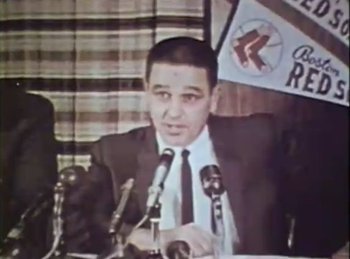
The team was full of rookies and near rookies, and appropriately had hired a minor league manager, Dick Williams, to be the new skipper. Williams was something else, however: he was a gifted leader. One day, in the middle of Spring Training, a Boston scribe asked the new manager what the prospects were for the upcoming season. Would the team escape the cellar? Would there be forward progress? Williams’ answer was instant front page news:

“We’ll win more than we lose.” Continue reading